For businesses seeking an ecommerce marketing agency in Melbourne, there's a good chance you're already feeling the gap between having a store and having a sales system. Your Shopify site might look clean. Your WooCommerce store might have solid products. You may even be running Google Ads or Meta campaigns already. But sales still swing too much, reporting feels fuzzy, and every increase in ad spend seems to expose a new bottleneck.
That situation is common. I see it with Melbourne retailers that have done a lot right, but built their growth in disconnected pieces. One freelancer handled the website. Another ran ads. Tracking was bolted on later. Email flows were half-finished. Product feeds were never cleaned up properly. Then the owner is left trying to work out why traffic is there but profit isn't.
A real digital marketing agency in Melbourne for ecommerce should be able to do more than list services. It should be able to diagnose friction across the full funnel, fix the technical layer, and tie acquisition back to margin. That's the difference between activity and actual growth.
Why Your Melbourne Ecommerce Store Needs More Than a Website
A Melbourne business owner launches a store after months of work. The branding is polished. Product photography looks sharp. The theme is premium. Friends say the site looks great. Then the harder part starts. Sales come in bursts, then go quiet. Paid traffic lands, bounces, and disappears. Returning customers don't come back often enough. Every marketing move feels heavier than it should.
I've had that conversation many times. Usually the issue isn't the product. It isn't even that the site is "bad". It's that a website on its own doesn't do enough. It has to work with ads, analytics, product data, checkout flow, and follow-up automation.
The real job is full-funnel performance
The Australian ecommerce market is already large enough that small efficiency gains matter. Industry data compiled for 2026 places Australian ecommerce revenue in the multi-billion-dollar range, with ongoing growth in online sales and mobile commerce. That changes the role of an ecommerce marketing agency in Melbourne. The job isn't just to get more clicks. It's to improve the whole path from impression to purchase to repeat order, as noted in Australian ecommerce revenue statistics.
That means looking at questions like these:
- Traffic quality: Are your campaigns attracting buyers or just visitors?
- Landing-page match: Does the page continue the promise of the ad?
- Checkout friction: Are customers hesitating because shipping, trust, or form fields get in the way?
- Retention: Do buyers hear from you again after the first sale?
A lot of stores fail in the handoff between these steps.
Good stores leak revenue in ordinary places
Most leakage isn't dramatic. It's boring. A slow mobile product page. Variants that are awkward to choose. Google Shopping titles that don't match the way people search. Meta traffic landing on a collection page with no clear buying angle. GA4 set up, but not set up well enough to trust.
A store doesn't need more complexity first. It needs fewer points of friction.
That's why a specialist marketing agency in Melbourne should think like an operator, not just a media buyer or designer. Nice visuals help. Strong campaigns help. But if they don't connect, you get the worst version of both. Expensive traffic and inconsistent sales.
The Bedrock of Sales Your High-Converting Website
A Melbourne brand can spend thousands driving qualified traffic, then lose the sale on a slow product page, confusing variant selector, or a checkout that asks for too much before trust is established. I see that pattern often. The ad account gets blamed, but the underlying problem sits on the site.
Before we increase spend, we check whether the store can convert the traffic it already has. A high-converting ecommerce site has a clear job. It has to load fast on mobile, explain the product without fluff, answer obvious objections, and make the next step easy to take. If any of that breaks, paid media has to work harder to recover the sale.
What we fix before we push spend
A lot of agencies rush into more campaigns, more audiences, and more creative variations. We usually get better returns by fixing the storefront first. On many Melbourne ecommerce accounts, the cheapest growth comes from improving conversion rate, tightening the product feed, and removing friction from mobile shopping before adding new acquisition layers. That aligns with the mobile-first buying behaviour discussed in Farsiight's Melbourne ecommerce perspective.
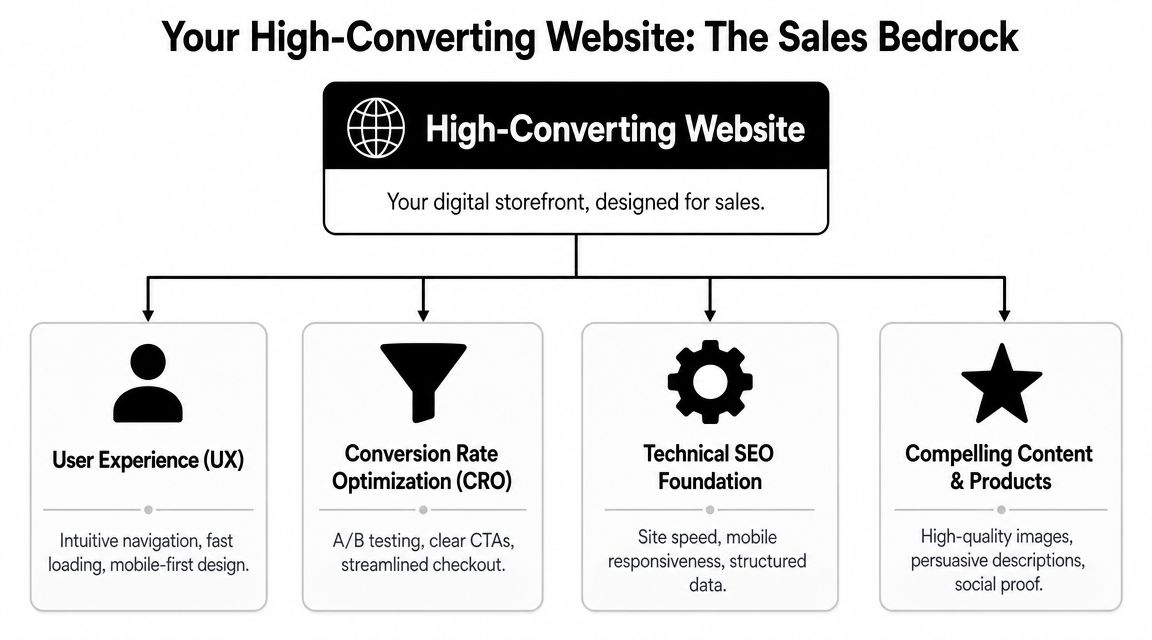
The work usually starts in four places:
| Area | What we look for | Why it matters |
|---|---|---|
| UX | Navigation, filtering, mobile layout, product page clarity | Shoppers need to find and compare products quickly |
| CRO | Add-to-cart flow, shipping visibility, trust cues, checkout steps | Small hesitation points reduce completed orders |
| Technical setup | Theme bloat, script conflicts, image handling, tracking reliability | Site speed and clean data affect both conversion and optimisation |
| Content | Product copy, imagery, FAQs, reviews, category structure | Better information reduces uncertainty and supports purchase decisions |
Shopify work that changes margin, not just appearance
Shopify is easy to launch and easy to overcomplicate. The difference shows up once a store needs logic that goes beyond a standard theme.
We regularly build custom functions around the store so the site fits the business model instead of forcing the business to fit the app stack. That can mean custom cart rules, bundle logic, subscription flows, product filtering, account features, or app integrations built with restraint. If a client needs something specific, we prefer a clean custom app or tightly scoped integration over stacking five apps that all inject scripts, clash with each other, and slow the storefront.
That trade-off matters. An app can save time this month and cost profit for the next year.
Plugin clutter usually creates the same set of problems:
- Slower mobile pages: extra scripts and embeds increase load time where conversion is already fragile
- Messy tracking: duplicate events and broken attribution make performance harder to judge
- Hard maintenance: small updates become risky because too many tools depend on each other
- Weaker buying flow: features get added without considering how a shopper moves to purchase
WordPress and WooCommerce need proper engineering
On WooCommerce builds, I look past the page builder straight away. A store can look polished on the front end and still be expensive to manage, brittle under load, and frustrating for the team using it every day.
Good development means clean theme structure, sensible plugin selection, stable templates, and an admin setup that content teams can use without breaking layouts. We often build custom Gutenberg blocks so staff can launch promo pages, buying guides, and category content without waiting on a developer for every update. That keeps the store flexible without turning the backend into a mess.
One practical rule applies here. If the team is afraid to edit the site, the build is wrong.
Stores selling products with delivery limits, age restrictions, or compliance requirements have another layer to solve. Performance work has to account for those operational constraints as well. WooCommerce performance for regulated products is a useful reference because it shows how fulfilment rules and benchmarking affect the customer experience long before dispatch.
The website should reduce the workload on your ads
A strong ecommerce site makes paid acquisition more efficient because the page finishes the job the ad started. Search traffic needs product pages that confirm intent quickly. Meta traffic often needs clearer merchandising, stronger trust cues, and sharper landing page structure. Returning visitors need a fast path back to the products they already considered.
That is why we spend so much time on page hierarchy, collection logic, variant handling, shipping communication, and mobile checkout flow. Generic service lists skip over that work. It is usually the work that improves profit. When the site is built properly, campaigns become easier to scale, reporting becomes more trustworthy, and growth stops depending on brute-force media spend alone.
Fuelling Growth with Precision Paid Advertising
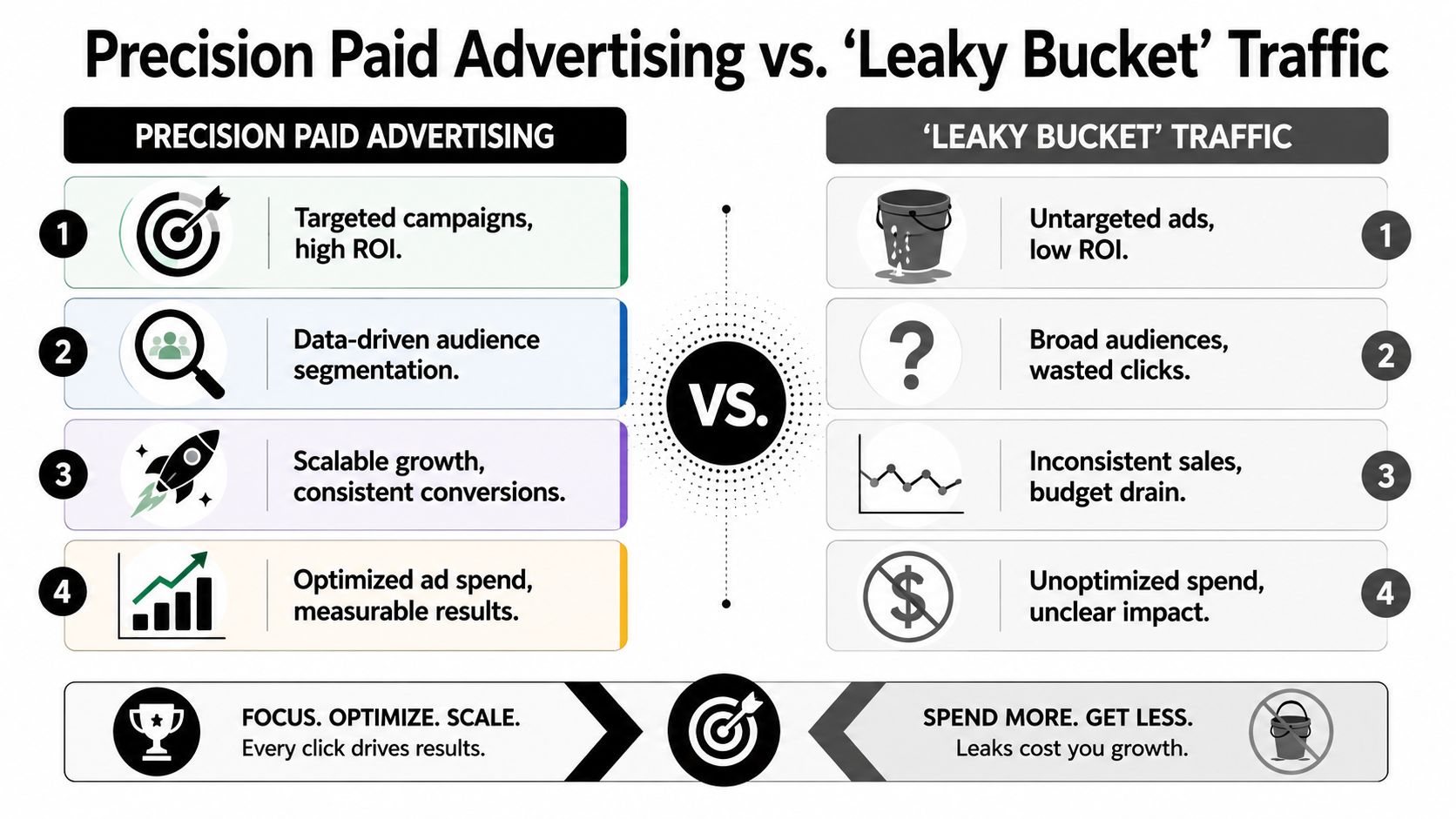
A Melbourne store can go from a strong week to a weak one fast. Sales dip, the first reaction is usually to blame the platform, raise budget, or switch campaign types. In practice, profitable paid media comes from tighter inputs. Better product data, cleaner tracking, sharper creative, and clearer budget decisions.
Google still carries a lot of buying intent in Australia, which is why search structure and Shopping feed quality deserve serious attention. Broad channel advice has its place, and these expert tips for Australian e-commerce are useful for brands expanding locally. But day to day profit is usually won in the account itself. Feed rules, search term control, margin-aware bidding, and landing page alignment do more for revenue than generic media plans.
Google Ads works best when the product data is clean
A lot of operators treat Google Ads like a bidding problem. I rarely see it that way at the start. It is usually a merchandising and data problem first.
If titles are vague, product types are inconsistent, images vary in quality, and landing pages bury the core selling point, the campaign starts on the back foot. No bidding strategy fixes that. We often improve performance by rewriting titles around real search intent, tightening product categorisation, excluding low-margin items, and sending traffic to pages built to close the click.
For ecommerce brands, I usually assess Google in four layers:
Shopping and feed quality
Here, intent gets matched to product data. Weak feeds produce weak traffic.Search campaigns
These matter when query control is important, especially for branded terms, competitor terms, or high-intent category searches.Performance Max
It can work well in mature accounts with solid assets and reliable tracking. In messy accounts, it often hides problems instead of solving them.Remarketing and audience overlays
Useful for products with longer consideration cycles, repeat visits, or higher average order values.
The PMAX versus standard Shopping debate gets too much airtime. If the catalogue is disorganised, tracking is unreliable, and the offer is unclear, both campaign types will struggle. One just hides the reason faster.
Common Google Ads mistakes we keep seeing
The same issues come up again and again:
- Campaigns launched before feed work: products go live with thin titles and poor categorisation, then spend becomes erratic.
- Over-broad search themes: queries drift because match types, negatives, and segmentation are too loose.
- Weak page relevance: the ad promises one thing, the landing page shows another.
- Budget spread too thin: too many campaign types, no clear priority.
- Tracking gaps: platform revenue and actual store revenue do not line up closely enough to make confident decisions.
The fix is usually plain work. Better titles. Better feed mapping. Cleaner exclusions. Stronger category structure. Better landing page continuity.
The video below gives extra context on how we think about paid traffic and campaign setup in practice.
Meta ads still matter, but the setup has changed
Meta remains a strong channel for demand creation, especially for products that need demonstration, social proof, or repeated exposure before purchase. But the account has to be set up properly. Too many brands are still making decisions off patchy attribution, weak event quality, and random creative rotation.
Our approach is more operational than promotional. We set up event tracking properly, often through Google Tag Manager and Meta Conversions API, so the platform gets cleaner signals. Then we test creative against a clear brief. Hook, offer, format, audience stage, and landing page all need to line up. If one part is off, spend gets wasted and the team blames the wrong variable.
A paid social partner should be able to explain why each campaign exists, what customer stage it targets, and what action the creative is trying to drive. If they cannot explain that clearly, the account is probably carrying dead weight.
Creative testing beats random ad churn
Many stores stall at this point. They increase budget before they improve the message.
I prefer a simple testing rhythm:
| Test area | Example question |
|---|---|
| Hook | Does the ad lead with problem, product, or outcome? |
| Format | Does static, UGC-style, or short video fit the product better? |
| Offer framing | Is the customer responding to urgency, value, or trust? |
| Audience fit | Does the message suit cold traffic or returning visitors? |
If a campaign only performs when nothing changes, it is not stable enough to scale.
We also apply the same discipline across other ad accounts we manage, including service campaigns such as Google Ads for plumbers and Facebook ads for electricians. The channel changes. The principle does not. Tracking quality, landing-page relevance, margin awareness, and message clarity carry more weight than platform tricks.
That is the difference between generic campaign management and profit-focused paid media. We are not just buying clicks. We are shaping the inputs that let a Melbourne ecommerce brand grow without guessing where the profit went.
Our Proven Six-Step Process from Strategy to Scale
The Melbourne agency market is crowded. That's not a criticism. It's just true. Directories and listings show a lot of firms offering PPC, SEO, CRO, web development, and reporting. Businesses now judge agencies more on process, execution, and measurable milestones than generic promises, which is reflected in Melbourne ecommerce agency listings on Clutch.
That pressure is healthy. It forces agencies to show how they work, not just what they sell.
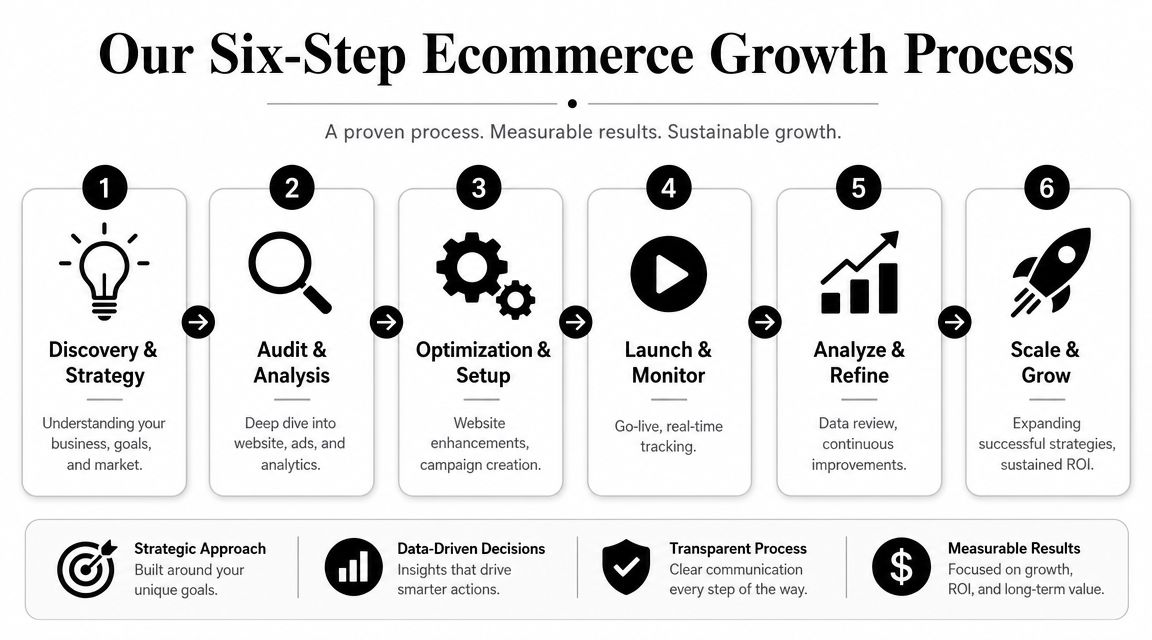
Step one and two start with diagnosis, not channel bias
We don't start by saying you need more Google Ads or more Meta budget. We start by asking what the business is trying to solve.
Discovery
We look at products, average order dynamics, repeat purchase patterns, customer intent, and current channel mix.Strategy
Then we map where growth is likely to come from. Sometimes that's feed optimisation. Sometimes landing pages. Sometimes retention. Sometimes paid media.
A lot of Australian ecommerce advice focuses on market entry and channel opportunity. For operators expanding or tightening their setup, these expert tips for Australian e-commerce are useful because they bring in practical thinking around expansion and fulfilment rather than just ad tactics.
Step three and four remove friction before launch
Next comes the technical and operational setup.
- Onboarding: Access, account structure, analytics review, feed checks, platform permissions
- Build and setup: Tracking fixes, campaign architecture, landing-page changes, product feed updates
- Launch: Controlled release, not a blind switch-on
Poor agency work often reveals itself in key areas. If onboarding is messy, reporting gets messy. If tags are inconsistent, decision-making gets noisy. If no one owns the feed, Shopping performance drifts.
A repeatable process protects the client from improvisation disguised as expertise.
Step five and six are where mature growth actually happens
Once campaigns and site changes are live, the actual work starts.
Optimisation
This is not the same as "checking the account". Proper optimisation means reviewing search terms, feed attributes, creative fatigue, landing-page engagement, checkout friction, and attribution quality together. Looking at one layer in isolation is how agencies miss the cause and only treat the symptom.
Scaling
Scaling isn't spending more because a week looked good. It means identifying what remains efficient when conditions change. Can the same category support more spend? Does the creative need refreshing first? Is there margin room across all products or only part of the catalogue? Are repeat purchases strong enough to support higher acquisition costs?
Those are the questions that stop growth from becoming reckless.
For brands wanting a structured partner rather than disconnected freelancers, our ecommerce marketing agency work is built around that kind of staged execution.
Beyond Vanity Metrics The Outcomes We Deliver
A lot of agencies talk about ROAS as if it's the final scoreboard. It isn't. ROAS is useful, but it can hide uncomfortable truths. You can have healthy-looking ad performance while margins get squeezed by discounts, shipping costs, returns, and weak customer retention.
That matters even more in a market this active. Australians spent about $63.8 billion online in the year to March 2025, and the stronger question for brands isn't just how to grow revenue, but how to protect profit while they grow, as discussed in this overview of ecommerce marketing in Melbourne.
What we track when we care about the business, not the dashboard
When I review an ecommerce account, I don't want to know only what the platform says. I want to know what the business keeps.
That shifts reporting towards metrics like:
| Metric | Why it matters |
|---|---|
| LTV | Helps judge whether acquisition costs are sustainable over time |
| CAC | Shows what it really costs to win a customer |
| Contribution by product or category | Prevents scale on products that look strong but carry weak margin |
| Repeat purchase behaviour | Tells you whether growth is being built or rented |
This is also where incrementality matters. Not every sale reported by an ad platform was created by that platform. Some were already on the way. Good reporting accepts that. It doesn't inflate itself to look smart.
Phone leads still matter for some ecommerce-adjacent businesses
Not every business closes everything through checkout. Some stores have high-consideration products, custom orders, wholesale enquiries, or service layers attached to ecommerce. In those cases, call handling becomes part of marketing performance.
We set up custom tracking numbers through Twilio for businesses that rely on calls, then route those calls into a 24-hour answering flow that can capture leads and book appointments into a calendar or Calendly. That matters for tradies, salons, clinics, and other operators who lose revenue when no one picks up.
The practical advantages are straightforward:
- Always available: The system doesn't stop because staff are busy
- Lead capture: Enquiries get recorded instead of disappearing
- Booking support: Appointments can be pushed straight into the calendar flow
- Better attribution: Paid campaigns can be judged on actual call outcomes, not just clicks
For businesses exploring creator-led acquisition as part of the broader mix, this guide to influencer agency pricing and ROI is a useful contrast because it shows how return can be framed very differently depending on channel and fee model.
The point of reporting isn't to make marketing look busy. It's to help the owner make better decisions.
Real outcomes are operational
The stores that perform best usually don't rely on one miracle tactic. They win because several ordinary things are done properly at the same time. Product data is maintained. Paid traffic lands on strong pages. Tracking is clean enough to trust. Customer service doesn't drop leads. The site is easy to update. The team knows which products deserve budget and which ones don't.
That's the kind of work that compounds.
Getting Started With Us and Your Free Ads Month
A Melbourne store owner comes to us after six months of flat sales. Traffic is up. Ad spend is up. Revenue has barely moved. The usual problem is not effort. It is that the site, tracking, feed setup, and campaigns were built in pieces, so nobody can see which part is holding back profit.
We start by diagnosing that properly.
That means reviewing the store build, the analytics setup, the product feed, the campaign structure, and the path from first click to completed order. I want to know where margin is being lost, where reporting is misleading, and whether more ad spend would help or make an existing problem even more expensive.
What working together usually looks like
Businesses come to us with different bottlenecks. Some need a cleaner WooCommerce build, faster page templates, or Gutenberg blocks the internal team can use. Others need web design in Melbourne with stronger merchandising, sharper UX, and landing pages built to support paid traffic. Some already have a solid site and only need paid media management with better controls around spend and attribution.
The engagement should match the constraint.
A typical starting point looks like this:
Audit the current setup
We examine the website, product catalogue, feed health, paid channels, analytics, and checkout path.Set priorities
We rank the work by commercial impact. Sometimes that means fixing merchant centre issues before touching campaigns. Sometimes it means rebuilding product pages before raising spend.Implement the right fixes
This can include development work, conversion tracking, campaign rebuilds, landing page changes, or feed improvements.Launch with control
Once the store and tracking are in better shape, we scale with clearer benchmarks and fewer false positives.
Common questions we get
How much should I budget for Google Ads
There is no standard number that fits every ecommerce brand. Budget depends on search demand, average order value, gross margin, repeat purchase behaviour, and how quickly the account can gather enough data to make decisions. A small budget can still work if the offer is strong and the account is tightly focused. A larger budget gets wasted fast if it is spread across too many products, audiences, and campaign types too early.
How much does it cost to start Google Ads
You pay Google for the clicks. Management is separate. In practice, the bigger cost is often running ads before the store is ready for paid traffic. If tracking is wrong, the feed is messy, or the product pages do not convert, you are buying traffic without learning much from it.
Do you only work with Melbourne businesses
No. We are based in Melbourne, and we also work with businesses in Sydney, Brisbane, Newcastle, Perth, Adelaide, Darwin, and Hobart. If you have a project in mind, you can contact us.
Do you handle Shopify and WordPress development too
Yes. We do the build work as well as the traffic work. That includes custom Gutenberg components, WooCommerce improvements, Shopify theme changes, app integrations, and API-level development when a store needs more than surface-level edits. For ecommerce brands, that matters. The campaign strategy improves when the same team can fix the technical issues affecting conversion rate, tracking accuracy, and average order value.
The offer is simple
If your business has a paid ads budget of at least 3k a month, we will manage your first month of paid ads at no management fee.
I like this structure because it gives both sides a fair way to assess fit. You get to see how we audit, how we build campaigns, how we report on profit, and how we communicate once real data starts coming in. We get to see whether the account has enough room to improve and whether your team is ready to act on the priorities we identify.
If your store needs a proper ecommerce growth system instead of another patchwork fix, this is the cleanest place to start.
If you're considering Alpha Omega Digital, apply through the contact page if your business has a paid ads budget of at least 3k a month. We'll review the opportunity and, if it's a fit, you'll get your first month of paid ads management free.
[email protected]
Read more insights from our team on web design, paid ads, and growth strategy.