You're probably in the same spot a lot of Sydney eCommerce owners reach after a few months of uneven sales. You know Google Ads can work. You've seen competitors show up for the exact searches you want. But once you start looking for a Google Ads agency in Sydney, every site sounds the same. More leads. Better ROI. Data-driven. Transparent. Premier. Proven.
From our side in Melbourne, we see this constantly. A business comes to us after speaking with three or four agencies, and they still can't tell who has a process and who just has a polished pitch deck. That confusion is fair. The Sydney market is crowded, and the difference between a capable operator and a campaign button-pusher often only becomes obvious after money has already been wasted.
For eCommerce brands, that mistake hurts twice. You lose ad spend, and you lose momentum. The fix is to hire more methodically. A strong agency partner should be able to explain how they think, how they measure, how they handle tracking, and how they make decisions when the data is messy. That matters far more than a homepage full of logos.
Finding a True Partner in a Crowded Sydney Market
Sydney business owners usually start with the same question. Who can run this account properly without chewing through budget while they “learn”? That's the right question, especially in a city where competition for intent-heavy searches can get expensive fast.
The market is mature enough that there are real specialists in it. In Sydney, typical starting ad spend is often around $2,000–$3,000 per month, while more ambitious eCommerce accounts often move into $5,000–$10,000 per month, according to Click Click Media's Google Ads agency page. The same page notes that Google Premier Partner status places an agency in the top 3% of Australian agencies, which is useful context when you're comparing credentials.
What a real partner sounds like
A genuine partner doesn't jump straight to campaign types and bid strategies. They start with the commercial reality of your store.
They ask questions like:
- Product economics: What are your margins, repeat purchase patterns, and top-selling categories?
- Fulfilment constraints: Are there products you can't scale aggressively because stock moves slowly or freight costs are messy?
- Conversion friction: Is the problem traffic quality, or is the site leaking revenue after the click?
- Customer intent: Are people searching for your brand, your product type, or a problem your product solves?
An average agency talks about traffic. A strong one talks about profitable traffic.
Practical rule: If an agency can't explain how your ad account connects to margin, stock, and conversion rate, they're managing media, not growth.
Why Sydney experience matters
I'm not saying you must hire an agency physically based in Sydney. We work with clients there from Melbourne all the time. But your partner does need to understand Sydney buying patterns, suburb targeting, and how local competition changes search behaviour.
For some brands, postcode-level intent matters. For others, Sydney is just one major market inside a broader national account. The point is simple. Your agency should know when to localise campaigns and when not to over-segment them.
A proper Google Ads agency in Sydney, or a Melbourne team with real Sydney experience, should be able to show they understand both. That's the difference between buying clicks and building an account that can scale cleanly.
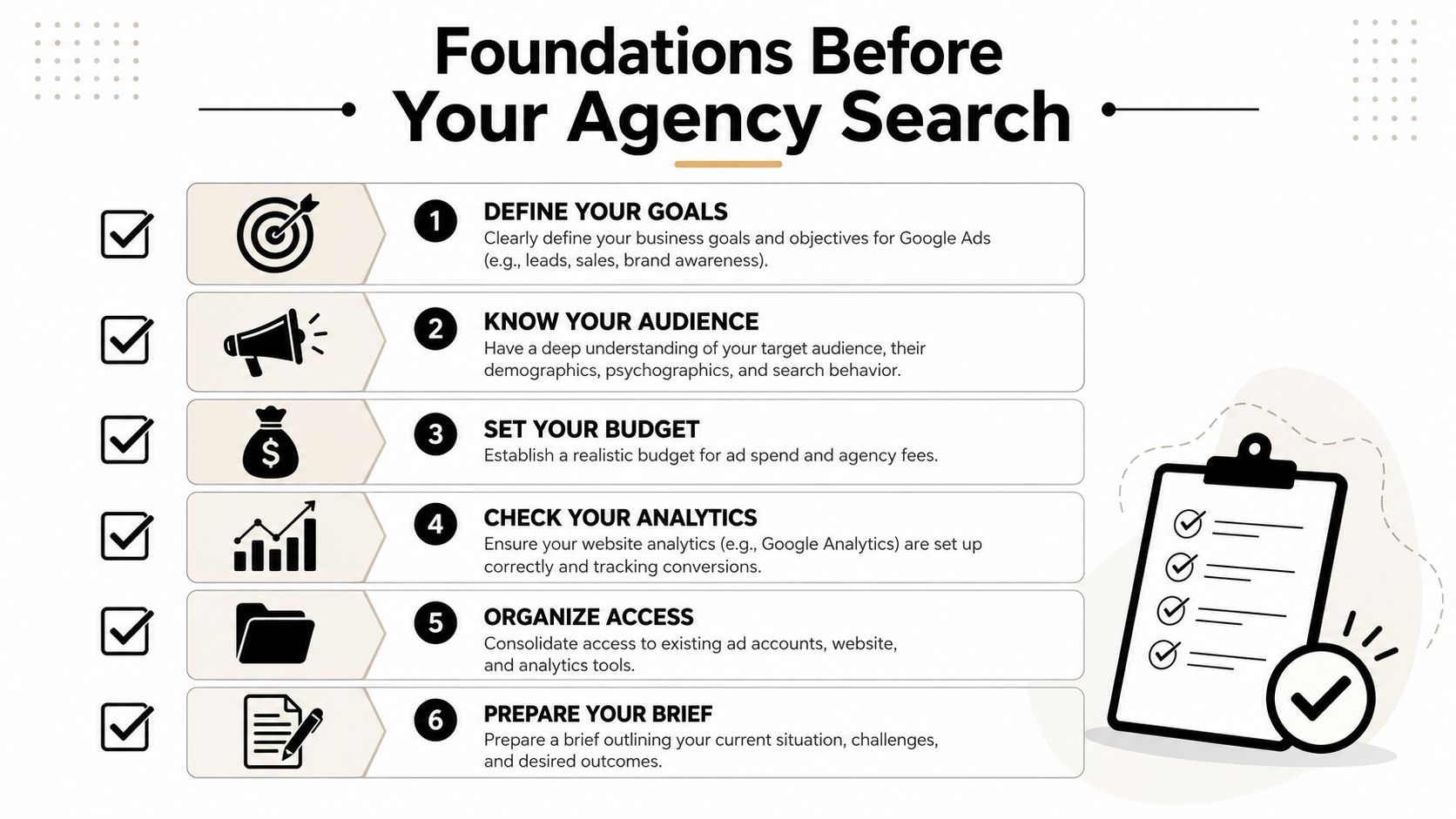
Setting Your Foundations Before You Start the Search
A Sydney store can spend months blaming Google Ads for poor growth when the problem sits closer to home. I've seen accounts with decent search demand, solid click-through rates, and enough budget to learn, yet sales still stall because the site converts poorly, tracking is unreliable, or the team has no agreement on what a profitable order looks like.
That is usually the point where an agency relationship goes sideways. The business hires for scale, but the account inherits unresolved commercial problems.
A good agency should call this out early. If they do not, you risk paying management fees to diagnose issues you could have fixed before the first campaign rebuild.
As noted by Sydney Digital Marketing's Google Ads agency page, agency support tends to make financial sense when the business is already set up to turn better traffic management into measurable lift. For a Sydney SMB planning for 2026, that standard is getting higher, not lower. Privacy changes, weaker attribution, and more AI-driven campaign automation mean your foundations need to be clear before you hand over spend.
Start with the business goal, not the platform
“Help us with Google Ads” is too vague to brief a serious agency properly.
For an eCommerce brand, the goal usually falls into one of a few buckets. Acquire more new customers at an acceptable first-order loss. Improve efficiency on demand that already exists. Push specific categories that have margin room, stock depth, or strategic value. Those goals produce very different account decisions, especially once Performance Max, feed quality, and remarketing audiences enter the picture.
I usually ask owners to get clear on four points before they start talking to agencies:
| Question | Why it matters |
|---|---|
| Which products deserve budget first? | Budget should follow margin, stock depth, and conversion potential |
| What does success look like? | Revenue can look healthy while contribution margin gets worse |
| What is the actual constraint? | Sometimes traffic is fine and the site is the bottleneck |
| What can the business operationally support? | Promotions, fulfilment capacity, and merchandising all affect campaign choices |
That last point gets missed a lot. If your team cannot keep hero SKUs in stock, approve promos quickly, or update landing pages during a sale period, even a capable agency will hit avoidable limits.
Your store has to convert
This is one of the least glamorous parts of hiring well, but it matters more than another agency pitch deck.
If mobile UX is clunky, product pages leave key questions unanswered, or checkout breaks trust, paid traffic becomes expensive market research. You learn that people were interested enough to click, then you pay to watch them drop out. We have had clients improve results more by fixing PDP structure, shipping clarity, and page speed than by changing bidding strategy.
The platform matters too. Shopify stores usually run into issues around theme speed, app overload, weak collection logic, and generic templates that do not support conversion. WordPress and WooCommerce builds often struggle with plugin conflicts, unstable checkout behaviour, and tracking gaps after site changes.
If that work is still outstanding, deal with it before the agency search gets serious, or run it in parallel. That might mean a Shopify development team in Melbourne or a WordPress developer.
A poor landing experience can make a good media buyer look average.
Get your measurement house in order
This matters even more now because Google's automation uses your data to make decisions. If conversion tracking is patchy, duplicated, delayed, or based on soft goals, AI-driven campaigns will optimise toward the wrong outcome faster than a manual account ever could.
Before you shortlist agencies, confirm that:
- Primary conversions are defined clearly: Purchases, qualified leads, or another outcome tied to revenue
- GA4, Google Ads, GTM, and Merchant Center are accessible: Agencies should not spend the first month chasing logins
- Feed quality is under control: Product titles, categories, pricing, availability, and imagery affect Shopping performance
- Consent and privacy settings are understood: Your team should know how tracking is affected by cookie consent, enhanced conversions, and platform limitations
- Reporting expectations are agreed internally: Decide whether success is judged by MER, ROAS, CAC, contribution margin, lead quality, or a blend
A lot of agency underperformance is really reporting confusion. The founder watches top-line revenue. Finance watches margin. The agency reports platform ROAS. Everyone thinks they are talking about the same thing, and they are not.
Prep work that saves pain later
The strongest agency relationships usually start with a business that has done some homework. Not polished homework. Honest homework.
Write down what has already been tested, where seasonality changes demand, which products are politically important inside the business, and who can approve changes without a two-week delay. If your internal team cannot sign off on budgets, feed fixes, creatives, or landing page edits quickly, campaign progress slows down fast.
I also suggest being honest about whether hiring an agency is financially sensible right now. If monthly spend is low, margins are tight, and conversion issues are unresolved, a consultant, a short audit, or temporary in-house management may be the better call. Agency fees pay off when the account has enough room for strategic changes to produce commercial gain, not just cleaner reporting.
That answer is not always what owners want to hear, but it is usually the right one.
How to Vet an Agency Portfolio and Past Results
Agency portfolios can be useful, but only if you read them like an operator instead of a shopper. Logos don't tell you much. Even headline numbers can mislead if they aren't tied to a clear commercial story.
What you want is proof of thinking. Not just proof that campaigns existed.
Look for the chain of reasoning
A credible case study should answer four questions:
- What was wrong before the agency got involved?
- What did they change first?
- How did they measure whether that change worked?
- What trade-offs did they have to manage?
If a case study skips straight from “client had challenges” to “great results”, I'd be cautious. Good account management is rarely that tidy. Strong operators can explain friction, not just outcomes.
One Sydney agency states that in the previous year it helped clients generate nearly $45 million in eCommerce revenue and almost 800,000 leads from just over 5 million ad clicks, and that it has managed over $10 million in annual spend since starting in 2016, according to Search Rescue's Google Ads page. That matters less as bragging rights and more as a benchmark for the kind of tracked outcome orientation serious agencies present.
Read past the revenue headline
Big revenue numbers can hide a lot. I'd rather see an agency explain:
| What to check | Why it matters |
|---|---|
| Tracking method | If attribution is messy, the result may be overstated |
| Channel mix | Search, Shopping, and Performance Max behave differently |
| Client type | eCommerce strategy for a fashion store won't map neatly to a niche parts retailer |
| Landing page role | Good agencies often improve the destination, not just the ads |
A useful portfolio also shows platform familiarity. For eCommerce, I pay attention when an agency understands Shopify feeds, product data quality, collection architecture, and how landing page structure affects paid search performance. If they work comfortably with custom builds as well, that's even better.
Questions a weak portfolio usually can't answer
When I'm reviewing agencies, these are the gaps that stand out:
- No mention of margin or profitability
- No explanation of tracking setup
- No detail on why campaign structure changed
- No evidence they've handled catalogue complexity
- No sign of collaboration with dev or design teams
That last one matters more than people think. Paid search performance often improves when the ad team can coordinate with developers. That could mean custom landing pages, cleaner templates, feed fixes, or stronger event tracking. If an agency also understands builds like web design in Melbourne or custom store development, that can make execution much smoother.
The best case studies don't read like trophies. They read like operating notes from a team that knows why performance moved.
A strong portfolio should leave you with a clear impression of how the agency thinks under pressure. If all you learn is that they've worked with known brands, keep digging.
Auditing Their Strategic Approach in the Age of AI
Many agency evaluations fall apart. The sales team says they use AI. The strategist mentions automation. The account manager talks about Performance Max. None of that tells you whether they know how to steer a modern account.
The main issue in Australia now isn't whether an agency uses automation. Everyone does. The issue is whether they know how to make automation useful when attribution is weaker and platform data is less clean than it used to be.
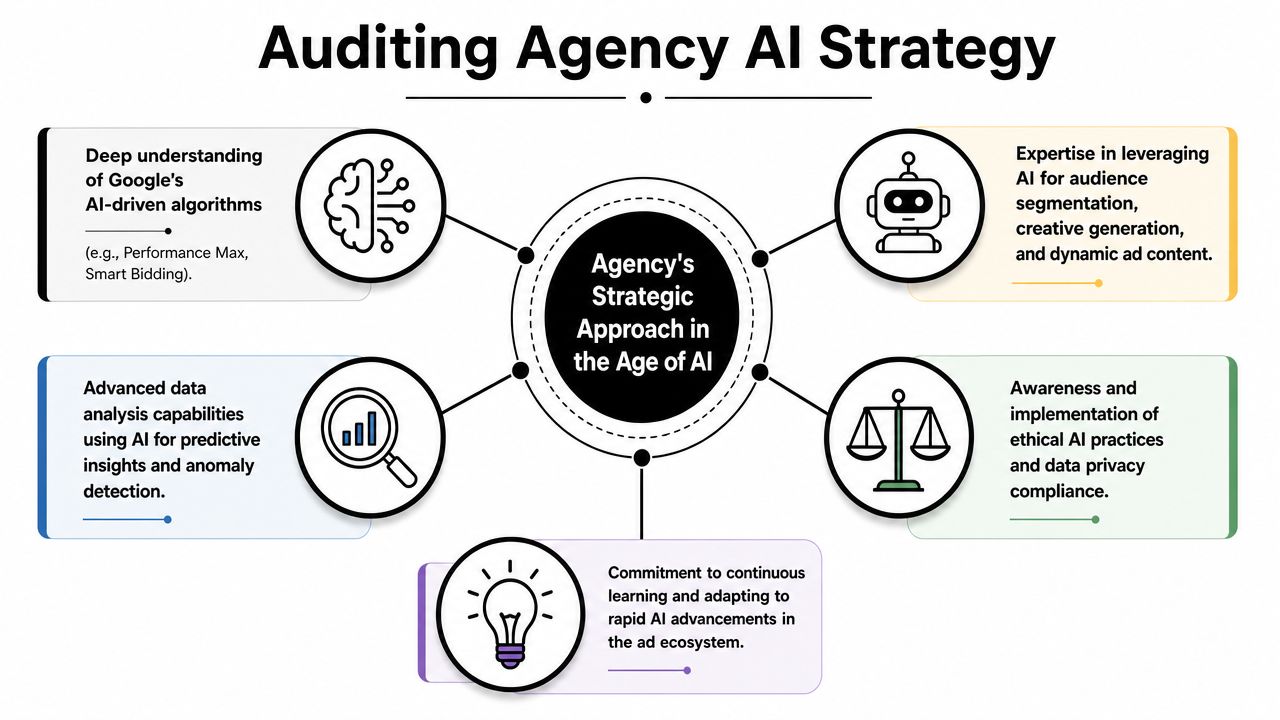
The current challenge for Australian advertisers is adapting to AI and privacy changes. An agency's value now sits heavily in how it handles weaker attribution signals, stronger first-party data needs, value-based bidding, conversion value rules, and CRM integration, as outlined by Defiant Digital's Google Ads agency page.
What competent answers sound like
When you ask an agency about AI-driven Google Ads, the conversation should move quickly into data quality.
A capable team should be able to discuss:
- First-party data collection: How customer data from your store, CRM, or backend supports campaign decisions
- Conversion quality: Whether all conversions are equal, and how lead quality or order value changes bidding logic
- Value rules: How they handle different product values, customer types, or business priorities
- Offline feedback loops: Whether post-click outcomes can be fed back into the platform when relevant
If their answer is “Google's automation handles that”, they haven't gone deep enough.
AI is only as good as the inputs
We've seen this repeatedly. Businesses launch Performance Max or automated bidding on shaky tracking, poor product feeds, and vague conversion goals. Then they assume the algorithm will sort it out. It won't. It optimises toward what it can see.
That's why creative, audience signals, and conversion inputs all matter. If you want a broader look at how teams are using AI-driven creative and targeting, that resource is worth reading because it frames AI as a system of inputs and decisions, not magic.
Here's a simple way to test an agency's maturity:
| Question | Strong answer | Weak answer |
|---|---|---|
| How do you use AI tools? | Tied to data, creative testing, and feedback loops | “We use smart campaigns” |
| How do you judge lead quality or sale quality? | Uses business data beyond the click | Only reports top-platform conversions |
| How do you adapt to privacy change? | Talks about first-party data and validation | Talks vaguely about machine learning |
| How do you control automation? | Explains guardrails, exclusions, and review cadence | “We let Google optimise” |
This short video is a useful prompt for the kind of strategic conversation you should be having with an agency, not the shallow version.
The agency should still have a point of view
AI hasn't removed the need for strategy. It has increased it.
The better agencies still make deliberate calls on budget splits, feed quality, asset grouping, search term control, landing page alignment, and when to separate campaigns instead of blending everything into one automated bucket. They also know when your store isn't ready for a more automated setup.
If the platform is learning from weak inputs, it gets confident in the wrong things.
For me, this is the screening test for a Google Ads agency in Sydney. Not whether they say “AI” often. Whether they can explain, in plain English, how they keep automation accountable to your business.
The Critical Questions to Ask on a Discovery Call
A discovery call should feel a bit like an interview and a bit like an account audit. You're not there to be impressed by jargon. You're there to figure out whether this team can make sound decisions with your money.
The best calls are specific. If you stay broad, most agencies will sound competent. Once you ask operational questions, the gaps show up quickly.
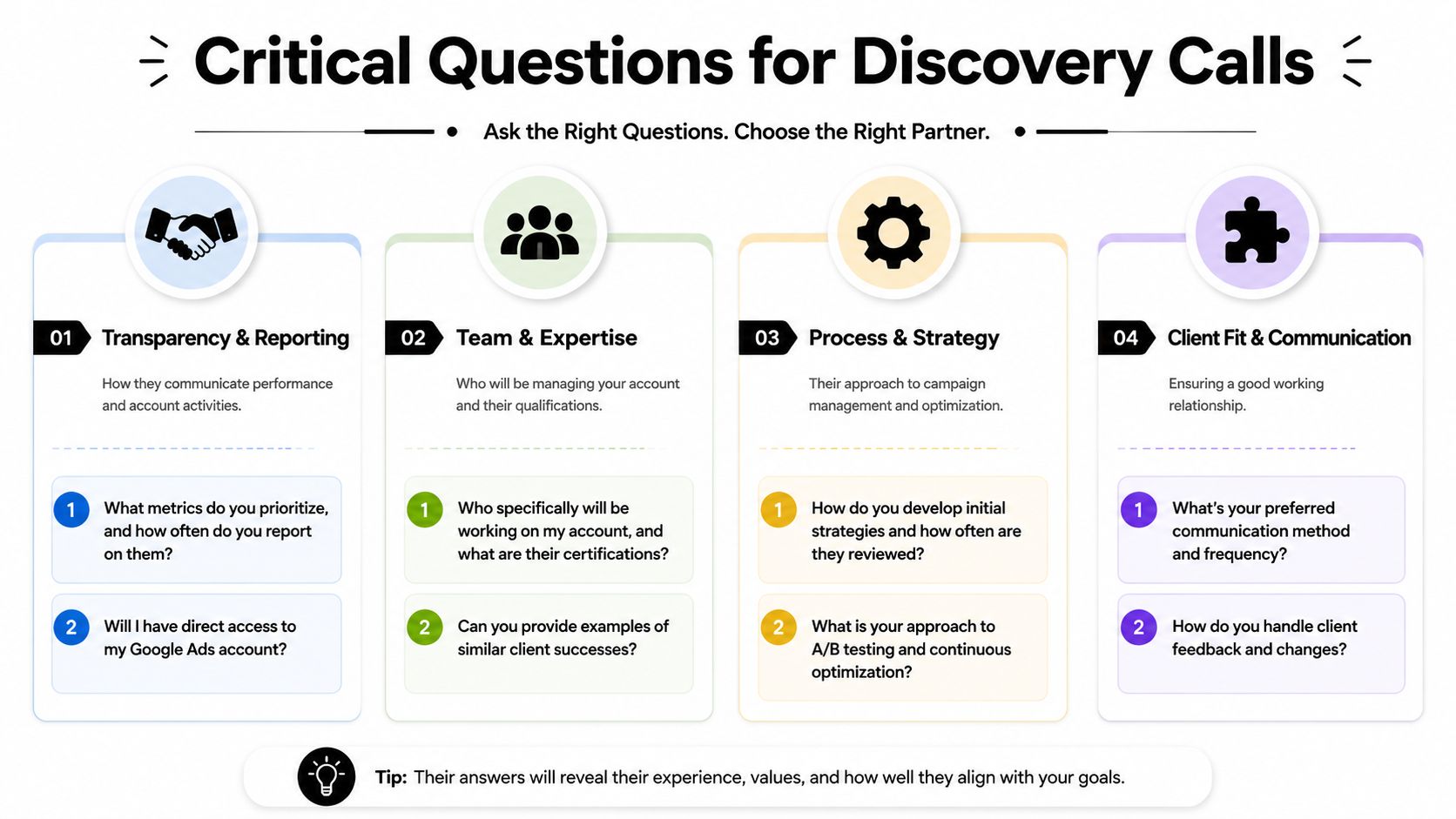
Ask them to walk the first phase
Don't ask, “How do you manage accounts?” Ask something harder.
Try this instead:
- First 90 days: What would you do first if you inherited our account tomorrow?
- Prioritisation: What would you look at before changing budget or launching new campaigns?
- Risk control: What signs would tell you not to scale yet?
- Store readiness: What issues on our website would concern you before launch?
A good team will answer in sequence. Audit. Tracking check. Feed review. Search query review. Product economics. Landing page check. Budget allocation. Testing roadmap. They won't just jump to “we'll optimise”.
Ask detailed tracking questions
This is the section I care about most, because weak tracking poisons every decision after it. Australian guidance on Google Ads measurement stresses the need to define a primary conversion goal and track CTR, CPC, conversion rate, CPA, and ROAS in Google Ads while validating post-click behaviour in Google Analytics. It also warns that missing conversion setup undermines optimisation and makes comparisons unreliable, according to Cliq MC's guide to Google Ads measurement and performance.
So ask questions that force specifics:
- What conversion actions would you insist on before launch?
- How do you validate purchase tracking, form tracking, and phone call tracking?
- What is your GTM and GA4 setup process?
- How do you separate traffic issues from landing page issues?
For service businesses, call handling matters even more. We've set up custom Twilio numbers for clients who needed cleaner attribution and better lead capture workflows. In the right setup, that can support round-the-clock call answering, appointment booking into internal calendars or Calendly, and better coverage for businesses that lose enquiries when staff are tied up. It's especially practical for operators like tradies, salons, clinics, and other appointment-led businesses where missed calls often mean missed revenue.
If that's your world, a specialist in Google Ads for plumbers or similar local lead generation can be worth considering because the tracking and call workflow needs differ from standard eCommerce.
Weak tracking makes bad agencies look good and good agencies look bad.
Ask who actually does the work
Many discovery calls are run by the strongest communicator at the agency, not the person who'll manage your account.
Ask plainly:
| Question | Why you need it |
|---|---|
| Who is my day-to-day contact? | You need to know who owns the work |
| Who builds and optimises campaigns? | Strategy and execution aren't always done by the same person |
| How often do we meet? | Cadence affects momentum |
| What happens if performance drops? | You want a response process, not vague reassurance |
Ask about cross-channel thinking
Even if Google Ads is the priority, you want to know whether they can think beyond one channel. A strong team might mention how paid search interacts with creative testing, landing page updates, or paid social retargeting.
That doesn't mean you need a giant full-service setup. It means you want a partner who understands the ecosystem. Depending on your mix, that may include support from a Facebook and Meta Ads agency or a best Facebook Ads agency if your product needs stronger demand capture across platforms.
Ask about fees without dancing around it
Be direct. Ask what the management fee covers, what falls outside scope, and whether landing page work, feed management, reporting setup, or creative production are included.
If the pricing is vague on the call, it usually stays vague later. Clean commercial terms are part of a healthy agency relationship.
Structuring a Trial Period for a Win-Win Start
I like trial periods because they reduce the chance of a bad long-term fit. Not free work. Not a token audit. A proper initial engagement with clear scope, shared access, and realistic goals.
For most eCommerce accounts, a structured first phase works better than a long lock-in. It gives the agency enough room to do the setup properly while giving the business a fair way to judge competence.
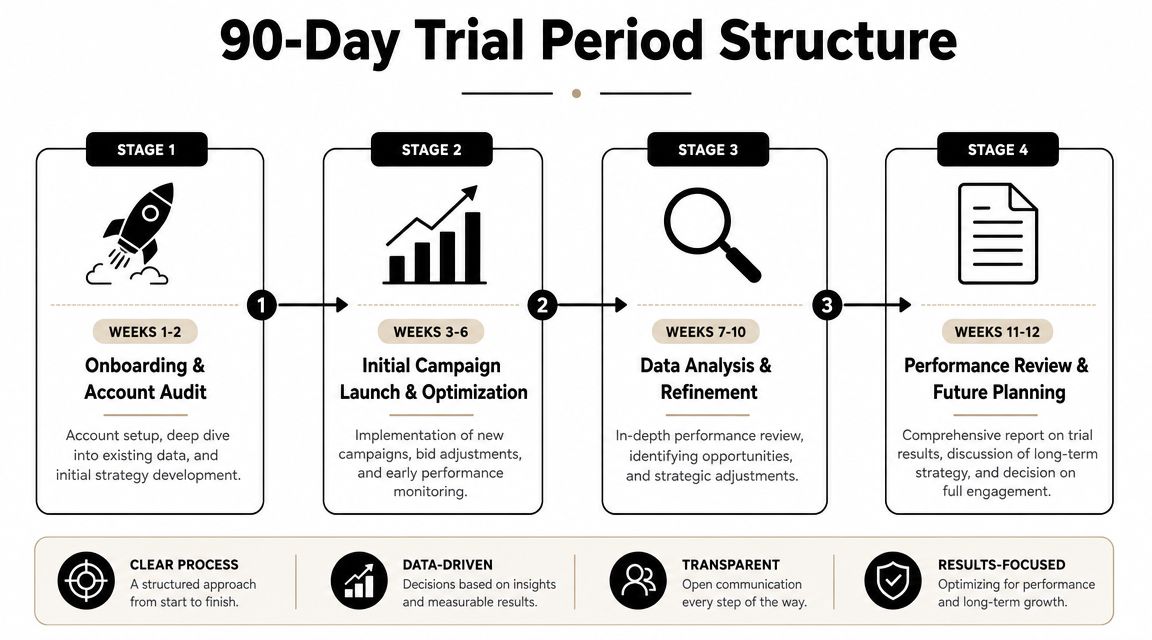
What should happen early
The first stage should be operational and diagnostic, not performative.
I'd expect work such as:
- Account audit: Existing campaigns, search terms, feed quality, conversion actions, and audience signals
- Commercial alignment: Product priorities, margins, offers, and seasonality
- Tracking validation: Purchases, forms, calls, analytics, and tag setup
- Launch plan: Clear reasoning for what gets rebuilt, paused, retained, or expanded
If an agency starts making sweeping performance promises before this is done, I'd be careful.
What success looks like in a short trial
Early success usually isn't about hero numbers. It's about whether the account is getting more trustworthy.
A healthy trial period often shows up as:
| Stage | What to judge |
|---|---|
| Early setup | Is the structure logical and are priorities clear? |
| Initial launch | Is spend pacing sensibly and is communication proactive? |
| Optimisation phase | Are changes tied to data rather than guesswork? |
| Review point | Can the agency explain what it learned and what happens next? |
This is also where the agency's communication style becomes obvious. Good teams document decisions. They explain what changed and why. They don't hide behind dashboards.
What I'd avoid
There are a few patterns that usually lead to disappointment:
- Long contracts before any working relationship exists
- No shared definition of success
- No access to the ad account
- No agreed reporting cadence
- Aggressive scaling before tracking is trusted
A decent agency won't be threatened by a structured trial. In fact, it should make their work easier. Expectations are clearer, the review point is cleaner, and both sides know what they're evaluating.
If you're comparing partners, this stage often reveals more than the pitch ever could.
Your Next Steps to Accelerating Growth with Google Ads
A Sydney eCommerce brand can burn through months of budget with the wrong agency and still be left arguing about attribution, feed issues, and whether the campaigns were ever set up properly. The better outcome starts before the contract is signed. Pick a partner that can explain how Google Ads will contribute to profit, not just traffic, and how they plan to handle AI-led campaign automation and weaker tracking signals heading into 2026.
From my side of the fence in Melbourne, the strongest agency relationships usually begin with a clear commercial case. If monthly spend is too low to support testing, creative iterations, feed improvements, and proper analysis, hiring an agency often does not make financial sense yet. In those cases, it is usually smarter to fix product pages, conversion tracking, or merchandising first, then bring in specialist help once the account has room to perform.
Good agencies also know where their remit should stop. A paid media team can improve targeting, query control, feed quality, bidding inputs, and reporting. It cannot rescue a weak offer, slow site, or broken checkout on ad management alone. For eCommerce businesses, that distinction matters because the true cost is not just wasted spend. It is wasted time.
I'd also look closely at whether the agency is ready for the version of Google Ads we have now. Smart Bidding, Performance Max, consent mode, server-side tracking options, first-party data use, and privacy-related signal loss all affect results. A serious Sydney partner should be able to tell you what they can control, what they cannot, and how they make decisions when platform reporting gets less clean.
If broader implementation support matters, Alpha Omega Digital is one example of an agency that combines paid advertising with WordPress and Shopify development. That setup can be useful when account growth depends on fixing both campaign inputs and on-site conversion issues, rather than treating media buying as a standalone service.
The next step is simple. Decide whether your business is ready for agency support, based on budget, margins, tracking quality, and operational capacity. Then choose the team that speaks plainly, shows its working, and is comfortable being judged on decision quality as much as short-term performance.
If you're a business with a paid ads budget of at least 3k a month, I'd love to offer you a low risk deal, get a month of paid ads management FREE. Apply now through the contact page. A CTA for Alpha Omega Digital.
[email protected]
Read more insights from our team on web design, paid ads, and growth strategy.