If you're looking for a Google Ads agency in Melbourne, you're probably already tired of vague promises. You may have run campaigns yourself, hired a freelancer, or worked with a digital marketing agency Melbourne businesses recommended, only to end up with clicks that didn't turn into sales, calls, or booked jobs.
That frustration is common. Google Ads can work exceptionally well for eCommerce brands and service businesses, but only when the account structure, tracking, landing pages, and follow-up process are all aligned. In Melbourne, that's even more important because competition is tight, search intent changes by suburb and service type, and wasted spend adds up fast.
The hard truth is that most campaigns don't fail because Google Ads is broken. They fail because the setup is loose, the tracking is incomplete, or the agency reports on activity instead of business outcomes.
Why Running Google Ads in Melbourne Feels So Hard
A lot of Melbourne business owners start the same way. They open a Google Ads account, add a few keywords, write a couple of ads, set a budget, and expect enquiries to come through within days. Sometimes they do get traffic. What they don't get is qualified demand.
That's where the disappointment kicks in. You're paying for clicks, the dashboard looks busy, but the phone isn't ringing or the Shopify orders aren't moving in a way that justifies the spend.

Melbourne is competitive in a way that punishes weak setups
Melbourne isn't forgiving when your campaign structure is broad or your messaging is generic. If you're an online store, you're competing for commercial intent against established brands with cleaner feeds, stronger offers, and better remarketing. If you're a service business, you're often bidding against businesses with tighter location targeting, better reviews, and faster follow-up.
Search also matters more than many owners realise. In Australia, search advertising accounted for about 57% of all digital advertising spend in 2024, making it the largest digital channel by share according to Clutch's Melbourne Google Ads agency market overview. That matters because Google Ads isn't some side experiment. For many Melbourne businesses, it's the core channel for capturing demand that already exists.
If someone is searching with strong intent, paid search is often where that sale or lead gets won.
Practical rule: If buyers already know what they want, weak Google Ads management usually costs more than not advertising at all.
DIY usually breaks at the tracking layer
Most self-managed accounts aren't destroyed by one major mistake. They're worn down by lots of small ones.
I see the same issues repeatedly:
- Loose keyword targeting that matches irrelevant searches
- No negative keyword discipline so budget leaks into low-intent traffic
- Poor landing page alignment where the ad promise and page content don't match
- Basic conversion tracking only which records form fills but not lead quality
- No phone attribution so calls get treated as invisible revenue
- Delayed follow-up where leads arrive but no one responds quickly enough
For eCommerce, it often shows up as decent traffic and poor revenue. For service businesses, it shows up as form spam, missed calls, and staff saying "the leads were bad" when the actual issue was a broken qualification process.
A local market needs a local operating rhythm
Running Google Ads in Melbourne also means dealing with local behaviour that national templates miss. Search terms shift by suburb, urgency changes by service category, and ad scheduling often needs to reflect when your team is available to answer calls or process orders.
That's why the best Google Ads work isn't just account management. It's operational thinking. The agency or in-house lead needs to understand how enquiries move from click to sale, how your site is built, how your CRM or Shopify store records conversions, and where sales are getting lost.
That same practical mindset is what people should expect from a serious marketing agency Melbourne businesses rely on, not just from a paid ads specialist. The ad account is only one part of the system.
What a Melbourne Google Ads Agency Actually Does
A good Google Ads agency doesn't just "run ads". It builds and manages the full system that turns search intent into enquiries, sales, and usable data. That's why the gap between average management and strong management is usually bigger than most businesses expect.
The visible part is easy to notice. Keywords, ads, budgets. The harder part is everything underneath that keeps the account efficient.
The account work people see
At the surface level, agency work includes research, build, testing, and optimisation.
For Melbourne advertisers, a technically sound starting point is to use exact and phrase match on high-intent queries, then expand only after query quality is proven. Responsive Search Ads allow up to 15 headlines and 4 descriptions, and that setup should be paired with weekly search term reviews and call tracking, as noted in this Melbourne Google Ads guide from Million Hits.
That sounds simple, but it has real consequences. If you're too broad too early, Google will happily spend your budget on local searches that look related but don't buy.
A competent agency usually handles work like this:
- Keyword mapping: Grouping buyer-intent terms by product type, service intent, urgency, and location.
- Campaign structure: Separating brand, non-brand, shopping, remarketing, and service categories so budgets don't blur together.
- Ad copy testing: Building multiple angles around trust, urgency, pricing style, product range, turnaround time, or local relevance.
- Negative keyword management: Excluding junk traffic before it drains spend.
- Bid and device adjustments: Watching how mobile, desktop, and local intent behave differently.
- Search term review: Cutting irrelevant queries and finding strong new ones.
The backend work most businesses never see
Here, good agencies earn their keep.
The backend includes Google Tag Manager, Google Analytics, event setup, attribution logic, call tracking, form tracking, and often handoffs into a CRM or Shopify. If that stack isn't clean, reporting becomes fiction.
For eCommerce brands, we care about purchase tracking, cart events, product feed health, checkout behaviour, and whether returning customers are being mixed in with new customer acquisition. For lead generation, we care about form quality, call quality, booked appointments, and whether leads become revenue.
A proper digital marketing agency Melbourne businesses trust should also understand the site underneath the ads. If you're on Shopify, campaign performance can be limited by theme issues, landing page speed, weak product pages, or poor collection logic. If you're on WordPress, form setup, template bloat, plugin conflicts, and sloppy Gutenberg builds can subtly wreck conversion rates.
That overlap is why businesses often need broader technical support, not just ad management. If you're rebuilding a lead generation site or cleaning up a service landing page, experienced WordPress developers in Melbourne can make the conversion path easier for paid traffic. If you're scaling an online store, strong Shopify developers in Melbourne can remove friction that no bid strategy can fix.
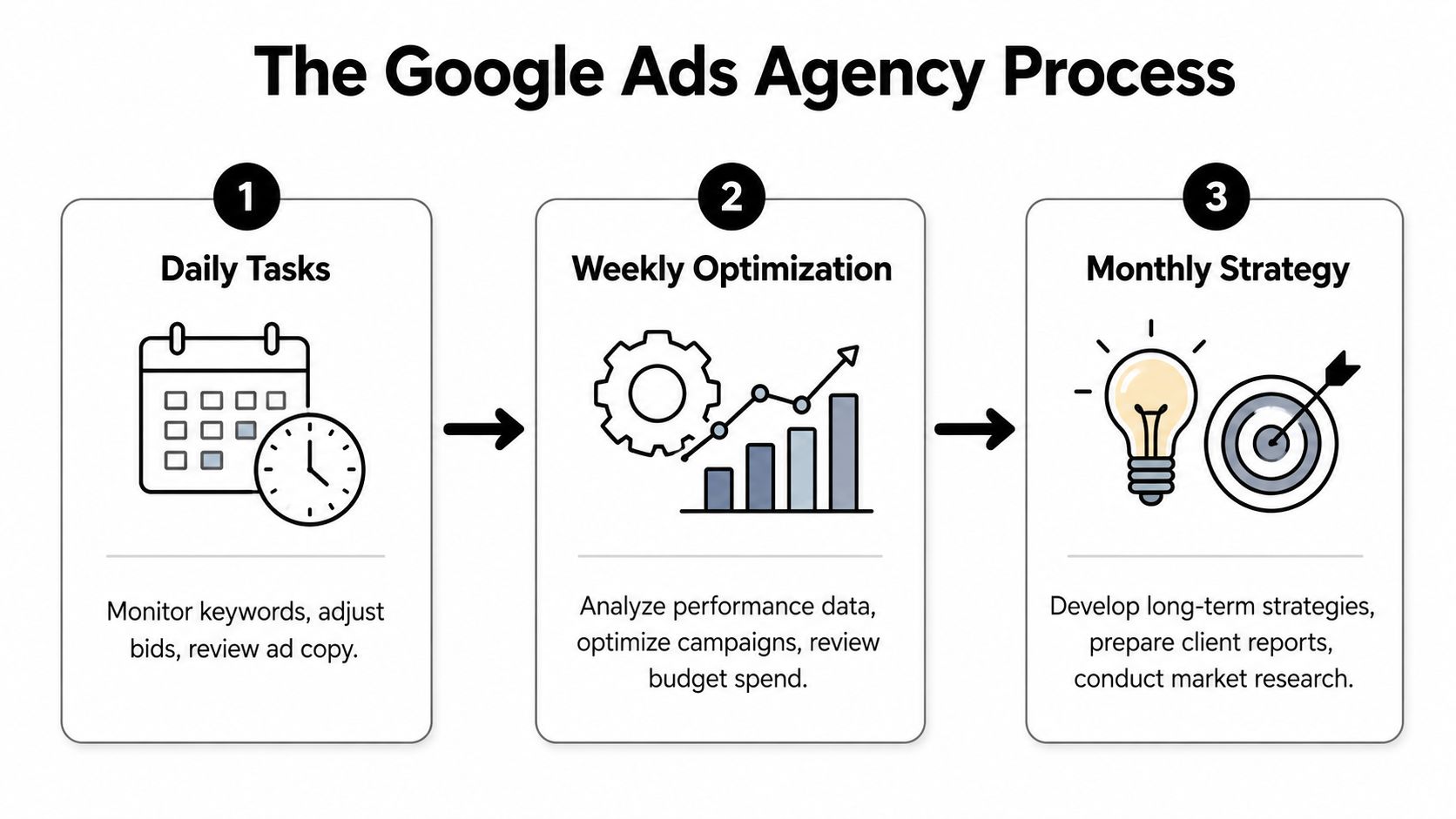
Daily, weekly, and monthly agency work are different jobs
A lot of business owners expect one kind of work. In reality, there are three.
| Timeframe | What matters most | Typical focus |
|---|---|---|
| Daily | Prevent waste | Budget pacing, search query review, bid issues, disapprovals |
| Weekly | Improve efficiency | Ad tests, keyword refinement, negative lists, landing page checks |
| Monthly | Improve direction | Offer analysis, conversion quality review, attribution cleanup, scaling decisions |
The difference matters because plenty of agencies are active without being useful. They make changes, send reports, and talk about platform updates while ignoring whether the account is attracting profitable customers.
If you want a broader framework for turning ad traffic into enquiries, these actionable lead generation strategies are useful because they push the conversation past clicks and into follow-up, qualification, and conversion process.
Good Google Ads management is half media buying and half quality control.
The Undeniable Edge of a Local Melbourne Partner
You can hire an agency from anywhere. Plenty of businesses do. But when you're running Google Ads for a Melbourne business, local context still matters more than people think.
I've seen national and overseas teams build campaigns that are technically clean and still miss the mark because they don't understand how people search locally, how suburbs shape buyer behaviour, or how Melbourne businesses operate day to day.
Suburb nuance changes intent
A person searching from Fitzroy doesn't always behave like someone searching from Brighton, Dandenong, Richmond, or Toorak. The products they prioritise, the urgency they bring, and the expectations they have around trust, pricing, and convenience can all shift.
That doesn't mean every campaign needs hyper-granular suburb splits. Sometimes that creates more noise than value. But a local partner knows when suburb-level targeting helps and when it just fragments data.
That local knowledge also improves ad copy. Small wording choices around service areas, delivery expectations, appointment availability, and local trust cues often matter more than flashy headlines.
The timezone and access advantage is real
This sounds basic, but it matters. If your campaigns need attention, you want fast communication with people who are awake, available, and close enough to understand what's happening in your market.
With a local team, you can:
- Jump on quick calls when budgets need shifting or landing pages break
- Review search quality faster because the agency recognises Melbourne-specific query patterns
- Meet face to face for offer discussions, product planning, or creative reviews
- Coordinate web and ads work together without long delays across time zones
That last point gets overlooked. Paid media and website performance are connected. If you're running ads into a weak site, the result won't improve just because the targeting is tighter. That's why many businesses benefit from a partner that understands both paid acquisition and site performance. For example, strong web design in Melbourne helps create landing pages that work with your campaigns instead of undermining them.
Local paid search and local SEO should support each other
Melbourne businesses often split these functions between different suppliers. One team handles Google Ads. Another handles local SEO. Sometimes nobody owns the Google Business Profile properly.
That separation creates inconsistency. Your paid ads may promise one thing while your organic listings, reviews, or location signals tell a slightly different story.
A local partner tends to spot that faster. They understand that local SEO, Google Business Profile optimisation, and paid search should reinforce the same commercial message. That's especially important for multi-suburb service businesses and stores with local fulfilment or pickup expectations.
The best local campaigns don't just target Melbourne. They feel like they belong in Melbourne.
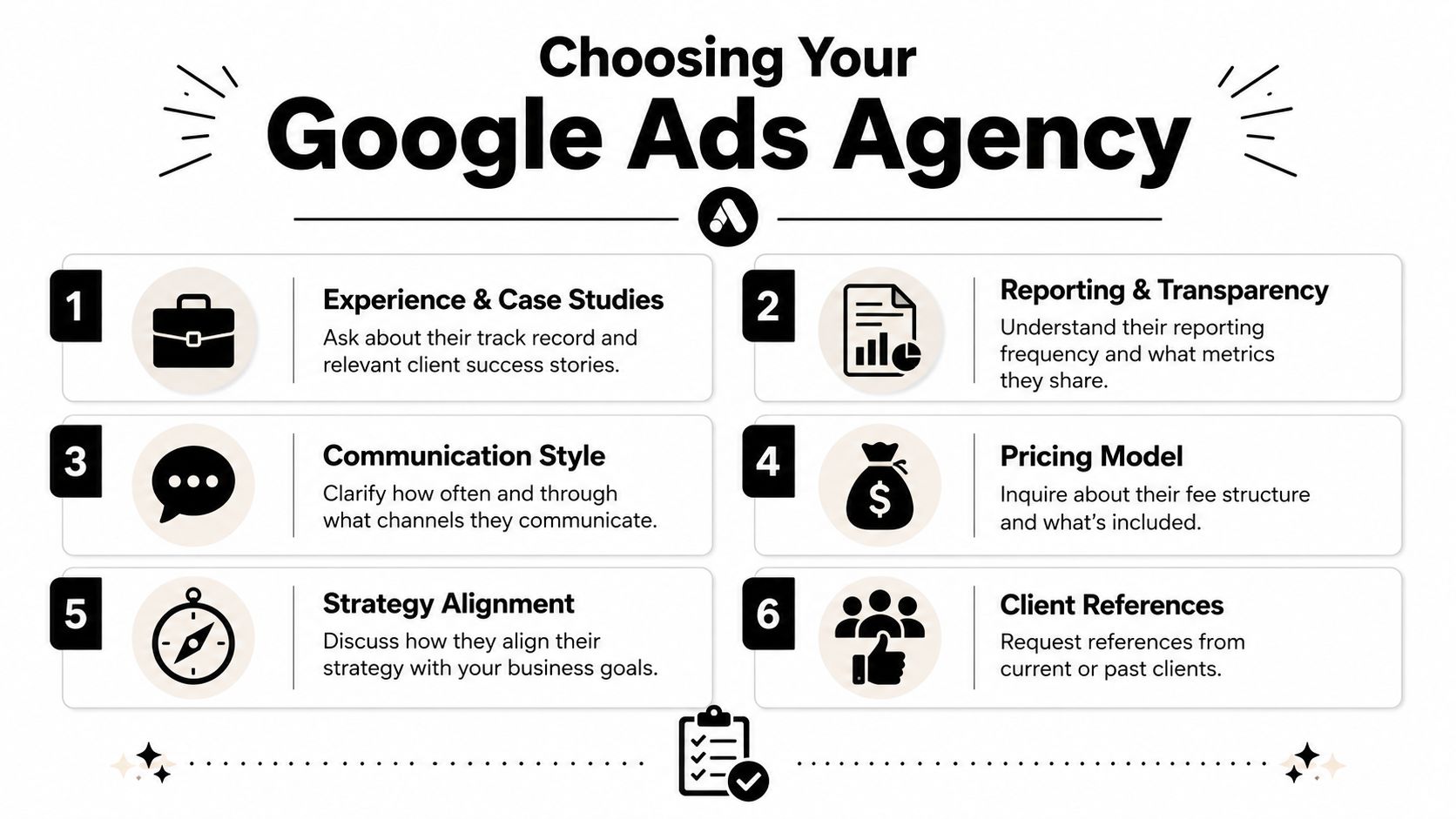
How to Choose the Right Agency for Your Business
Most agencies sound good in a sales call. The hard part is figuring out whether they're capable of managing your account in a way that fits your business model.
That matters even more if you're eCommerce-focused. A service business can sometimes survive mediocre tracking for longer than an online store can. In eCommerce, a weak product feed, poor attribution, or lazy campaign segmentation gets exposed quickly.
Specialist depth is rarer than it looks
One useful signal is platform credibility. According to Due North's overview of Google Ads agencies in Melbourne, fewer than 3% of agencies in Australia achieve Google Premier Partner status. That doesn't guarantee a fit for your business, but it does tell you something important. Top-tier Google Ads capability is limited.
That scarcity is why I generally tell businesses not to hire based on polished branding alone. Plenty of agencies can sell Google Ads. Fewer can build reliable conversion tracking, separate branded from non-branded demand, understand feed-driven shopping performance, and report back in a way that ties to actual profit.
Questions worth asking in the first meeting
I wouldn't start with "How many clients do you have?" or "How cheap are you?" I'd ask questions that expose how they think.
Try these:
- How do you structure accounts for eCommerce versus lead generation?
- What do you treat as a real conversion, and what do you ignore?
- How do you handle branded traffic, search terms, and negative keywords?
- What happens when form leads look high but sales quality is poor?
- Who handles tracking setup in GTM and Google Analytics?
- If we're on Shopify or WordPress, can you work with the site team directly?
- How do you report performance beyond platform metrics?
A solid agency should answer clearly. If they hide behind jargon, that usually means the work is shallow.
For a second opinion on the evaluation process, this guide on choosing a Google Ads marketing partner is worth a read because it frames the relationship as an operational partnership, not just a vendor agreement.
Red flags that usually show up early
Bad agencies often reveal themselves quickly if you know what to listen for.
| Red flag | Why it matters |
|---|---|
| They promise guaranteed rankings | Google Ads isn't SEO, and guarantees usually ignore lead quality or profit. |
| They focus on clicks first | Click volume without qualified intent is a distraction. |
| They don't mention tracking setup | If attribution isn't discussed, reporting will be weak. |
| They avoid account access questions | Transparency problems usually get worse after onboarding. |
| They don't ask about margins or sales process | They may optimise for lead volume, not business outcomes. |
Here's a useful video if you're comparing providers and want a quick sense check before you sign anything:
Technical fit matters as much as media skill
If you're an online store, I'd also check whether the agency understands the platform you're selling on. That's not optional. Shopify brands need someone who can work around theme limitations, app conflicts, feed logic, and checkout tracking. WordPress sites need someone comfortable with form logic, custom templates, plugin risk, and page speed issues.
That doesn't mean your ad agency has to build your whole site. But they should know what a good site partner looks like.
Examples of useful adjacent capability include:
- WordPress development for landing page builds and custom blocks in Gutenberg
- Shopify development for collection pages, product templates, and custom app logic
- Meta Conversion API setup when you want cleaner event matching alongside paid social
- GTM and analytics implementation so ad decisions aren't based on broken signals
The best agency relationship usually feels less like outsourcing and more like having a sharp operator in your corner.
Measuring Success Beyond Clicks and Impressions
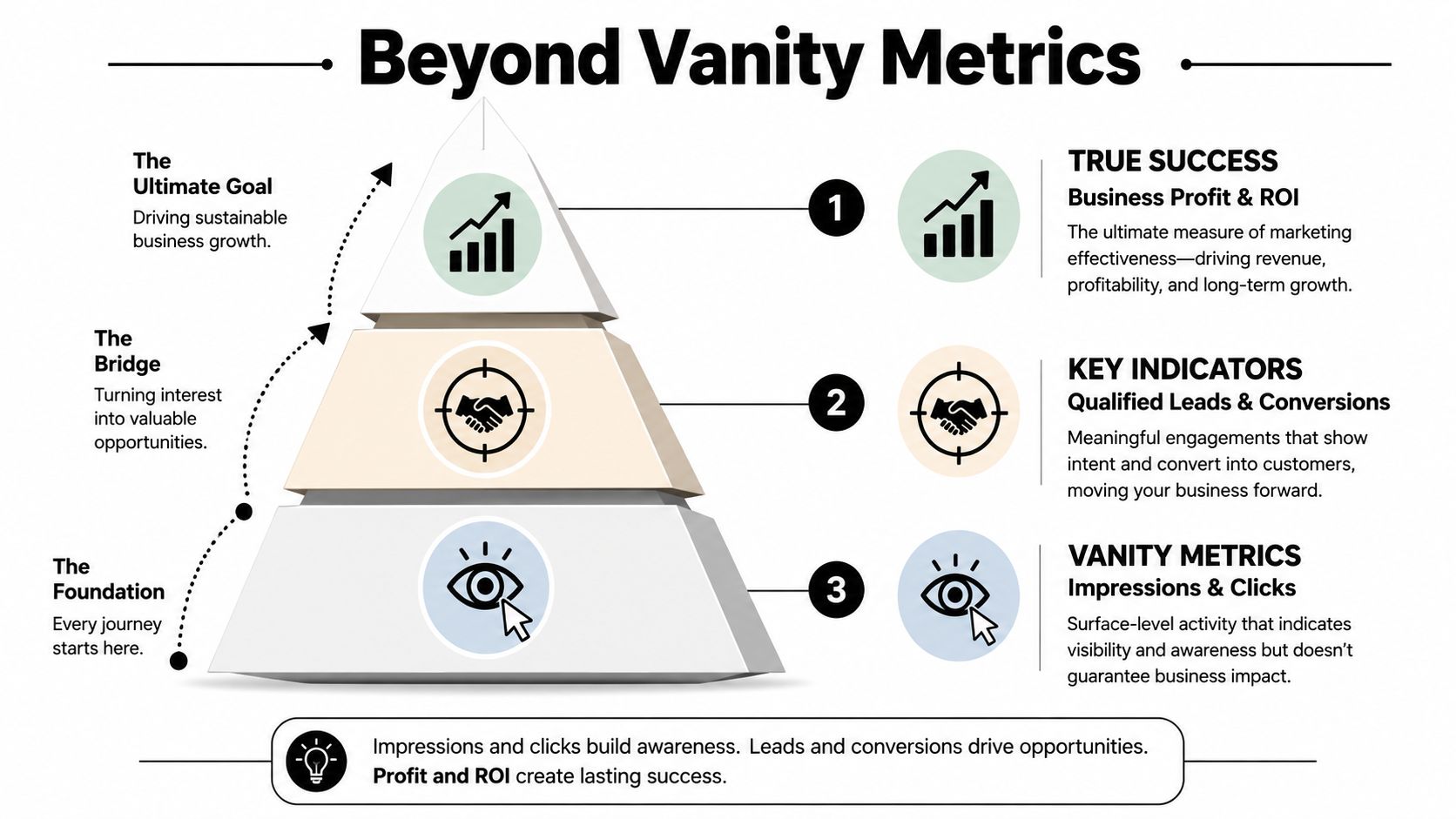
Clicks matter. Impressions matter. But neither tells you whether your Google Ads account is making the business more profitable.
That's the line many Melbourne businesses miss when they hire a Google Ads agency Melbourne firms recommend. The reporting can look polished while the business still feels unimpressed. That's because activity isn't the same as commercial progress.
Vanity conversions create false confidence
Form submissions can be misleading. So can add-to-carts, page views, and generic lead counts. Some of those signals are useful directional indicators, but they aren't the finish line.
A key challenge for Melbourne SMBs is separating vanity conversions from revenue-producing ones. As Farsiight's Melbourne Google Ads page notes, privacy changes are reducing visibility, which makes the quality of tracking and attribution from Google Ads into a CRM or Shopify backend increasingly decisive for profitability.
That point matters a lot in practice.
A service business might get plenty of enquiries but discover later that many were outside the service area, low-intent, or uncontactable. An eCommerce store might see conversion events in-platform while the actual order mix shows low-margin products, repeat customers, or discount-driven purchases that don't leave enough profit behind.
What to watch: If the report says the campaign is working but the owner doesn't feel it in cash flow, attribution is usually incomplete or the conversion definition is too soft.
What good measurement looks like
For eCommerce, success usually comes down to whether you can connect Google Ads to actual sales behaviour inside Shopify. That includes understanding what products sold, what traffic was branded versus non-branded, and whether the campaign brought in profitable customers rather than just discounted transactions.
For lead generation, the standard is different. The right measurement framework often includes:
- Qualified phone calls rather than just total calls
- Booked jobs or appointments rather than raw form submissions
- Lead source visibility inside the CRM
- Sales feedback on lead quality, not just lead count
- Offline conversion imports where possible, so Google learns from real outcomes
If you're working on the conversion side of an online store, this guide on mastering e-commerce conversions is a useful complement because it focuses on the post-click journey, where a lot of ad efficiency gets lost.
Why call tracking changes the conversation
For service businesses, phone calls are often the most valuable conversion. They're also the most poorly tracked.
A standard setup might count clicks on a phone number or record that a call happened. That's not enough if you want to judge lead quality. The stronger approach is to assign a custom number, track the source, route the call properly, and connect that activity back to campaign performance.
We've found this especially important for tradies, clinics, salons, dentists, restaurants, and other appointment-based businesses. If a lead calls after hours and nobody answers, the campaign may have done its job but the business still loses the sale.
That's why I like call systems built around Twilio, paired with automated answering and booking logic. A well-designed setup can answer calls around the clock, handle basic screening, and book directly into a calendar or Calendly flow when appropriate. It doesn't get tired, it doesn't call in sick, and it doesn't leave paid leads sitting in voicemail overnight.
For some businesses, that backend improvement matters as much as the ad optimisation itself.
Our 6-Step Process for Growing Melbourne Businesses
The best client relationships are the ones where everyone knows what's happening, why it's happening, and what happens next. A six-step process keeps that clear and stops Google Ads management from turning into random monthly activity.
1. Discovery
The first conversation shouldn't start in Google Ads. It should start in the business.
We look at the offer, margins, product mix, service area, seasonality, sales process, and how leads or orders are handled after the click. For eCommerce, that usually means digging into Shopify structure, collections, best sellers, and conversion friction. For service businesses, it means understanding booking flow, response time, and what a qualified lead looks like.
2. Strategy
Once the commercial picture is clear, strategy becomes much easier. At this stage, campaign types, account structure, landing page requirements, and tracking priorities get mapped out.
Sometimes the answer is Search first. Sometimes Shopping carries more weight. Sometimes Performance Max is useful, and sometimes it's better to control search intent more tightly before expanding.
Start with the traffic most likely to buy. Scale only after the tracking tells the truth.
3. Onboarding
This is the part many agencies rush, and it causes problems later. Proper onboarding includes account access, GTM and analytics checks, conversion setup, feed review where relevant, call tracking planning, and alignment with the website or dev team.
If the site needs work, that gets flagged early. That might involve landing page changes, Shopify theme edits, form improvements, speed fixes, or better checkout tracking.
4. Launch
Launch isn't just flipping campaigns live. It's controlled release.
Budgets are watched closely. Search terms are reviewed early. Ad copy gets tested against intent. Device behaviour, location signals, and conversion paths are checked before too much spend accumulates.
5. Optimisation
Significant gains commonly originate from this point. We refine what the campaign has already taught us.
That includes query filtering, negative keyword expansion, ad asset testing, feed improvements, landing page adjustments, and tighter alignment between reported conversions and real outcomes. If leads are weak, the answer isn't always more volume. Often it's better filtering.
6. Scaling
Scaling only makes sense when the campaign is producing outcomes you want more of.
For eCommerce, that may mean pushing into additional product groups, better Shopping coverage, or stronger retargeting support through Meta. For service businesses, it may mean expanding geo coverage carefully, extending hours with better call handling, or adding new service-specific campaigns.
This framework works because it keeps the focus on business quality, not platform busyness. That's just as relevant for a national eCommerce brand as it is for a Melbourne tradie trying to book more of the right jobs.
Your Low-Risk Offer to Get Started
If you've made it this far, you already know the difference between basic ad management and the kind of Google Ads work that supports growth. It isn't just about keywords. It isn't just about dashboards. It's about commercial intent, clean tracking, local understanding, and a process that doesn't fall apart after launch.
That's also why consistency matters so much. Good campaigns are built through regular refinement, honest reporting, and fast decisions when something isn't working. The businesses that get the most out of paid search usually aren't the ones chasing hacks. They're the ones treating Google Ads like a core acquisition channel and managing it properly.
If you're looking for a digital marketing agency Melbourne businesses can rely on for practical execution, the standard should be simple. You should know what is being tracked, why campaigns are structured the way they are, how success is judged, and what happens when lead quality slips.
For businesses with a paid ads budget of at least 3k a month, there's a low-risk way to test that relationship. Get a month of paid ads management free and judge the work on clarity, execution, and results rather than sales talk.
There are no long-term contract promises hiding behind the offer. It's a straightforward chance to see what disciplined account management looks like when it's tied to actual business outcomes.
If you're ready to work with Alpha Omega Digital, a Melbourne-based team helping businesses across Melbourne, Sydney, Brisbane, Newcastle, Perth, Adelaide, Darwin and Hobart, and you have a paid ads budget of at least 3k a month, you can get your first month of paid ads management free. If you've got a project in mind and want help with Google Ads, Shopify, WordPress, tracking, or conversion-focused web work, apply through the contact page.
[email protected]
Read more insights from our team on web design, paid ads, and growth strategy.