You're probably here because your Facebook ads feel busy but not reliable.
The pattern is usually the same. Sales come through in bursts, one ad set looks promising for a few days, then results flatten, costs climb, and Ads Manager starts feeling like a cockpit with half the instruments missing. You've boosted posts, tried interest targeting, maybe run a retargeting campaign, and still can't clearly answer the only question that matters: is this making me money, or am I just buying traffic and hope?
I work with Melbourne businesses that hit that point all the time, especially ecommerce brands on Shopify and service businesses that need booked jobs rather than empty leads. The problem usually isn't effort. It's that Meta has become a serious performance channel, and serious performance channels punish guesswork. Once your spend becomes meaningful, the gap between “ads are running” and “ads are working” gets expensive fast.
The Moment You Realise DIY Facebook Ads Aren't Enough
A lot of business owners don't start by looking for a Facebook Ads agency. They start by trying to keep control.
That makes sense. In the early stage, DIY feels responsible. You know your product better than anyone. You know your customers. You can write your own offers and shoot content on your phone. For a while, that's often enough to get some traction.
Then the cracks show.
A Melbourne store owner I spoke with recently described it well. They had a decent Shopify site, solid products, and enough margin to advertise. Some weeks Meta looked promising. Other weeks the exact same budget produced nothing useful. They kept changing audiences, swapping creatives, tweaking copy, and checking results every few hours. Nothing felt stable. The main frustration wasn't poor performance alone. It was not knowing why performance changed.
What starts breaking first
The first issue is usually measurement.
If your tracking is thin, every decision becomes a guess. Was the problem the ad? The audience? The landing page? The checkout? If you can't separate those, you can't improve them. You just keep replacing pieces and hoping one sticks.
The second issue is creative fatigue. A founder often has one or two angles that worked early. They push them too long. Meta keeps spending, but the audience response fades.
The third issue is structure. Boosted posts, mixed objectives, loose retargeting, and patchy exclusions can make an account look active while giving you almost no strategic clarity.
Practical rule: If you can't explain where a sale dropped off between click, landing page, add to cart, and purchase, you don't have a scaling problem yet. You have a visibility problem.
That's the turning point. Not when ads fail completely, but when you realise the platform has become technical enough that your time is better spent running the business than trying to become a part-time media buyer, analyst, copywriter, designer, and tracking specialist.
The smarter next step
Hiring help isn't waving the white flag. It's specialising.
A good partner steps in to build the things DIY usually lacks. Proper campaign structure. Creative testing discipline. cleaner tracking. Better reporting. Honest calls about what's broken. If you're comparing options, a dedicated Facebook Meta Ads agency should be able to show how it turns ad spend into a repeatable system, not just more activity inside the account.
That matters even more for ecommerce. Product feeds, offers, landing page friction, checkout behaviour, and remarketing windows all affect performance. The ad is only one part of the machine.
When business owners finally reach this point, the relief is usually immediate. Not because results transform overnight, but because the guessing stops.
Is It Time to Hire? Key Signs You're Ready for an Agency
Some businesses hire too early. Others wait far too long.
The right time usually arrives when your ads have become important enough that inefficiency hurts. Once you're spending real money, the cost of weak execution is no longer theoretical. It shows up in margin, stock planning, lead quality, and cash flow.

The benchmark gap matters
A useful reality check is platform benchmark data. Across Facebook campaigns, Sprout Social reported an average click-through rate of 2.59% and an average conversion rate of 9.21% for Facebook campaigns in its benchmark roundup, which gives you a practical baseline for judging whether your account is underperforming or under-optimised (Sprout Social benchmark data).
If your campaigns sit well below that and you can't explain why, that gap often represents lost revenue rather than bad luck.
That doesn't mean every account should hit those figures. Industry, offer, price point, landing page quality, and sales cycle all matter. But it does mean many businesses are not dealing with an ad platform problem. They're dealing with an execution problem.
Signs you're ready now
Here are the patterns I look for when a business has outgrown DIY:
- You're spending enough for mistakes to sting. Once monthly spend becomes meaningful to the business, wasted clicks and weak campaigns stop being small experiments.
- Your results are unstable. One week looks good, the next falls apart, and no one can identify the cause with confidence.
- You don't trust the reporting. Ads Manager says one thing, Shopify or your CRM says another, and the numbers don't line up in a way you can act on.
- You've hit a creative wall. The same hooks, offers, and visuals keep circulating because there's no testing system.
- You're making channel decisions emotionally. You turn campaigns off too early, duplicate winners too aggressively, or chase short-term spikes instead of building a process.
A healthy account doesn't rely on one lucky ad. It relies on a repeatable testing rhythm.
Agency versus in-house
Sometimes the actual question isn't “should I hire an agency?” but “should I build this in-house or outsource it?”
If you're weighing that up, this breakdown of which marketing approach is right for businesses is worth reading because it frames the trade-off properly. In-house gives proximity and speed. Agency support gives specialist depth across strategy, creative, tracking, and optimisation.
For most SMEs, the decision comes down to maximizing potential. If you don't yet have the budget or workload to justify a full internal team, an agency often gives you broader expertise faster.
When waiting costs more than hiring
I've seen businesses delay agency support because they wanted to “learn a bit more first.” Fair enough. But there's a point where more learning inside a live ad account becomes expensive tuition.
A Facebook Ads agency starts making commercial sense when you need better decisions, not just more hands. If poor targeting, weak creative, or a clunky landing page keeps wasting spend, a good operator can often recover more value than their fee by tightening the basics alone.
That's usually the moment to move.
What a Great Facebook Ads Agency Actually Does All Day
You log into Ads Manager, see spend going out, a few sales or leads coming in, and assume the job is mostly launching ads and tweaking budgets.
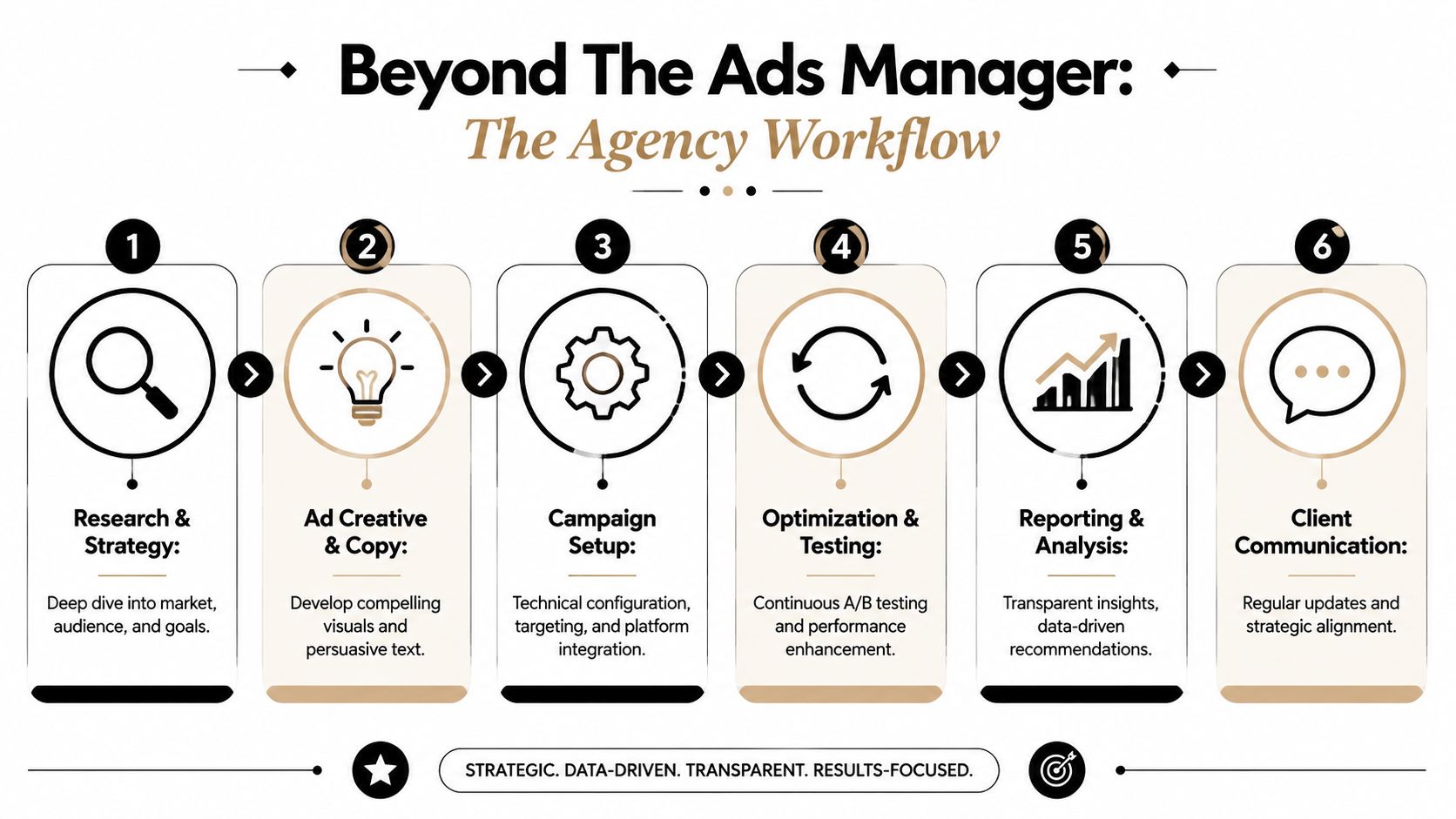
Actual work sits underneath. A good Facebook Ads agency builds the system that helps you buy traffic with more confidence, measure what happened, and make better decisions next week than you made this week.
Strategy before spend
Good campaign management starts with diagnosis, not media buying.
For an ecommerce brand, we look at product margin, average order value, repeat purchase behaviour, shipping offer, landing page quality, and where customers drop off. For a service business, we look at the offer, lead form friction, sales follow-up speed, and whether booked jobs can be tied back to campaigns. If those pieces are weak, more spend just makes the problem more expensive.
This matters even more in Australia because attribution is messy. Privacy changes, patchy browser tracking, and long consideration cycles mean the platform view is often incomplete. A serious agency plans around that from day one instead of promising perfect visibility it cannot deliver.
The measurement stack comes first
This is the part I check first when I audit an account.
If tracking is loose, every optimisation decision gets weaker. You start judging campaigns on click-through rate, cost per click, or a Meta-reported lead number that includes low-intent enquiries your sales team would never call back. That is how businesses mistake activity for performance.
A proper setup usually includes:
- Meta Pixel and Conversions API: to reduce browser-side data loss
- Google Tag Manager and clean event setup: so actions fire consistently and can be tested
- CRM feedback loops: so qualified leads, sales, and revenue can flow back into reporting
- Platform integrations: especially where offline sales, phone calls, or lead stages matter
For lead generation, the benchmark is simple. We want to know which campaigns produced qualified enquiries, not just form fills. For ecommerce, we want purchase data we can trust enough to scale with.
The broader point in Metadata's agency guide is sound. Decisions should be tied to conversion quality, not surface-level engagement.
If you run Shopify or WordPress, some of this work happens outside Ads Manager. If you need one team that handles both the ad side and the implementation side, Alpha Omega Digital's ecommerce marketing agency covers that mix of performance work, tracking setup, and site support.
Creative testing drives a large share of the gains
Accounts rarely improve because someone found a magic audience. They improve because the message gets sharper.
The best agencies test offers, hooks, proof, format, and angle in a structured cycle. One round might compare a price-led message against a results-led message. Another might test founder video against UGC-style content, or a short product demo against a static testimonial. The goal is to learn why people buy, not just find one ad that spikes for a week.
For businesses producing content in-house, even simple engagement posts can surface useful language. strategic Facebook poll ideas can reveal objections, preferences, and buying triggers you can later turn into stronger ad concepts.
What works: regular creative testing tied to offer, funnel stage, and landing page intent.
What fails: relying on one winner until frequency climbs, results flatten, and no replacement is ready.
A useful behind-the-scenes look at campaign thinking is below.
The day-to-day is less glamorous than people think
A well-run account involves repetitive, disciplined work. That is usually a good sign.
| Focus area | What the agency does |
|---|---|
| Account hygiene | Naming conventions, exclusions, budget checks, event verification |
| Testing | Reviewing creative, audiences, placements, and landing page performance |
| Analysis | Checking for signal loss, drop-off points, and wasted spend |
| Communication | Explaining what changed, why it changed, and what to watch next |
Good operators stay measured because they know one strong day does not prove much, and one bad day rarely justifies a panic edit. They look for patterns, compare platform data with your backend numbers, and protect spend while the evidence builds.
That is the job. Not chasing vanity metrics. Building a machine that gives you more qualified leads or more revenue, with tracking solid enough to hold up in the Australian market.
Vetting a Top Marketing Agency in Melbourne
A polished proposal can hide a weak operator.
I've seen Melbourne businesses sign with an agency that talks well, shows pretty dashboards, and still cannot explain why sales dropped after an iOS update, why lead quality fell once a broad campaign scaled, or why Meta reports 40 conversions while the CRM shows 12 real opportunities. That gap matters more than the pitch deck. In Australia, privacy changes and patchy attribution have made agency selection harder. The agency you hire needs to handle uncertainty without hiding behind vanity metrics.

Why local knowledge helps
Local knowledge is practical, not cosmetic.
A Melbourne-based strategist usually has better context for how buyers behave across suburbs, how quickly expectations shift around shipping or response times, and how seasonal periods affect different categories. EOFY means something different for a B2B service firm than it does for a skincare brand. A tradie covering the south-east has a different targeting problem from an ecommerce store shipping nationally. Those details shape budget splits, creative angles, and how tightly campaigns should be geo-controlled.
Creative judgment also changes locally. Copy that sounds punchy in a US account can feel exaggerated to an Australian buyer. Offers need the right tone. So do testimonials, landing pages, and calls to action.
What to look for in the first meeting
I pay close attention to what the agency asks before it talks strategy.
Strong agencies ask about margins, sales cycle length, repeat purchase rate, booking capacity, tracking setup, and where attribution usually breaks. They want to know whether your CRM is clean, whether Shopify or WordPress creates any limitations, and whether your team can follow up leads quickly enough to turn media spend into revenue.
That line of questioning tells you how they think. A team focused on business outcomes will examine the whole path from click to sale, not just the ad account.
A digital marketing agency Melbourne businesses can trust should understand the assets around the ads:
- landing pages
- product page UX
- WordPress or Shopify limitations
- CRM workflows
- reporting accuracy
- cross-channel overlap with Google Ads and email
I rarely separate paid media from the website because the buyer does not separate them. If the page loads slowly, the offer is unclear, or the form sends junk into the CRM, campaign performance suffers. If your site needs work, support from an experienced WordPress developer in Melbourne can directly affect conversion rate. The same applies if your funnel depends on both search intent and paid social remarketing through a Google Ads agency.
The best agency conversations focus on your commercial model, your tracking gaps, and what counts as a real win in the backend.
Red flags that deserve a hard no
Some problems show up early if you know what to listen for.
- Guaranteed outcomes: Serious operators do not promise exact revenue or lead targets from cold traffic.
- Platform-only reporting: If they report clicks, CTR, and ROAS without discussing CRM data, call quality, or actual sales, they are missing the point.
- No clear view on attribution: Agencies should explain how they handle Meta data versus GA4, CRM records, and offline conversions, especially with privacy restrictions affecting visibility.
- No ownership clarity: Your ad account, pixel, product feed, and tracking assets should be addressed before you sign.
- No questions about fulfilment or sales process: Media can create demand. It cannot fix a weak quote process or a slow sales team.
- Too much focus on vanity metrics: Reach, likes, and cheap traffic do not pay wages.
A simple shortlist test
Ask each agency how they would diagnose a campaign that looks healthy inside Meta but is not producing enough revenue.
The weaker team usually jumps to audiences and budget. The better team starts with reconciliation. They compare Meta-reported conversions with your CRM or ecommerce backend, check event quality, review landing page behaviour, look for creative fatigue, and ask whether the offer or follow-up process changed. That is the kind of thinking you want in the Australian market, where tracking is rarely perfect and decisions need to hold up against messy real-world data.
That difference tells you a lot.
Critical Questions to Ask Before You Sign a Contract
Most discovery calls are wasted on soft questions.
“Can you help us grow?” won't tell you much. Every agency says yes. The better approach is to ask questions that force the team to reveal how they think, what they measure, and what they do when results get messy.
Start with lead quality, not volume
For Australian businesses, especially service businesses, one of the most important questions is how the agency handles lead quality versus lead volume. Meta has huge reach here, so generating form fills isn't the hard part. The hard part is making sure those leads turn into profitable customers. That's why the stronger agencies build CRM feedback loops instead of stopping at front-end lead numbers, as discussed in this lead quality angle on Meta advertising.
Ask it plainly:
- How do you tell the difference between a cheap lead and a good lead?
- How will you get feedback from our CRM, booking system, or sales team back into the campaign?
- What happens if lead volume rises but revenue doesn't?
If they struggle with those questions, that's useful information.
Ask how they test, not just what they'll launch
A lot of agencies can build campaigns. Fewer can explain their testing method clearly.
Try questions like these:
- How do you structure creative testing in the first month?
- What variables do you isolate first, audience, offer, or creative?
- How do you decide when an ad is tired and needs replacing?
- What do you do if click-through looks decent but purchases stay weak?
You're looking for a thoughtful answer, not a script. Good operators talk about hypothesis, comparison, and decision-making. Weak ones talk in generalities.
If an agency can't explain how it learns, it probably isn't learning much inside your account.
Push into tracking and attribution
A lot of sales calls get uncomfortable, which is exactly why you should ask.
Use questions like:
- How do you set up measurement before scaling?
- Do you work with server-side tracking or Conversions API where needed?
- How do you validate what Meta reports against Shopify, GA4, or our CRM?
- How do you report on qualified outcomes, not just platform-attributed conversions?
These questions matter because attribution is less clean than it used to be. A decent agency won't pretend otherwise. It will explain how it reduces blind spots and how it handles uncertainty.
Ask who actually runs the account
This one gets overlooked all the time.
You may speak to a strategist or founder on the call, then get handed to a junior once the contract is signed. There's nothing wrong with junior support if the system is sound, but you should know the structure before you commit.
A few useful prompts:
- Who builds the campaigns?
- Who reviews performance each week?
- Who writes the ads and briefs the creative?
- How often will we speak to the person making strategic decisions?
The goal of the call
You're not trying to trap anyone. You're trying to see whether the agency thinks like a business partner or a media seller.
A real partner will answer with nuance. They'll admit trade-offs. They'll talk about where Meta works well, where it needs support from the website or CRM, and what they need from you to succeed.
That's the conversation worth having.
Decoding Agency Pricing, Contracts, and Success Metrics
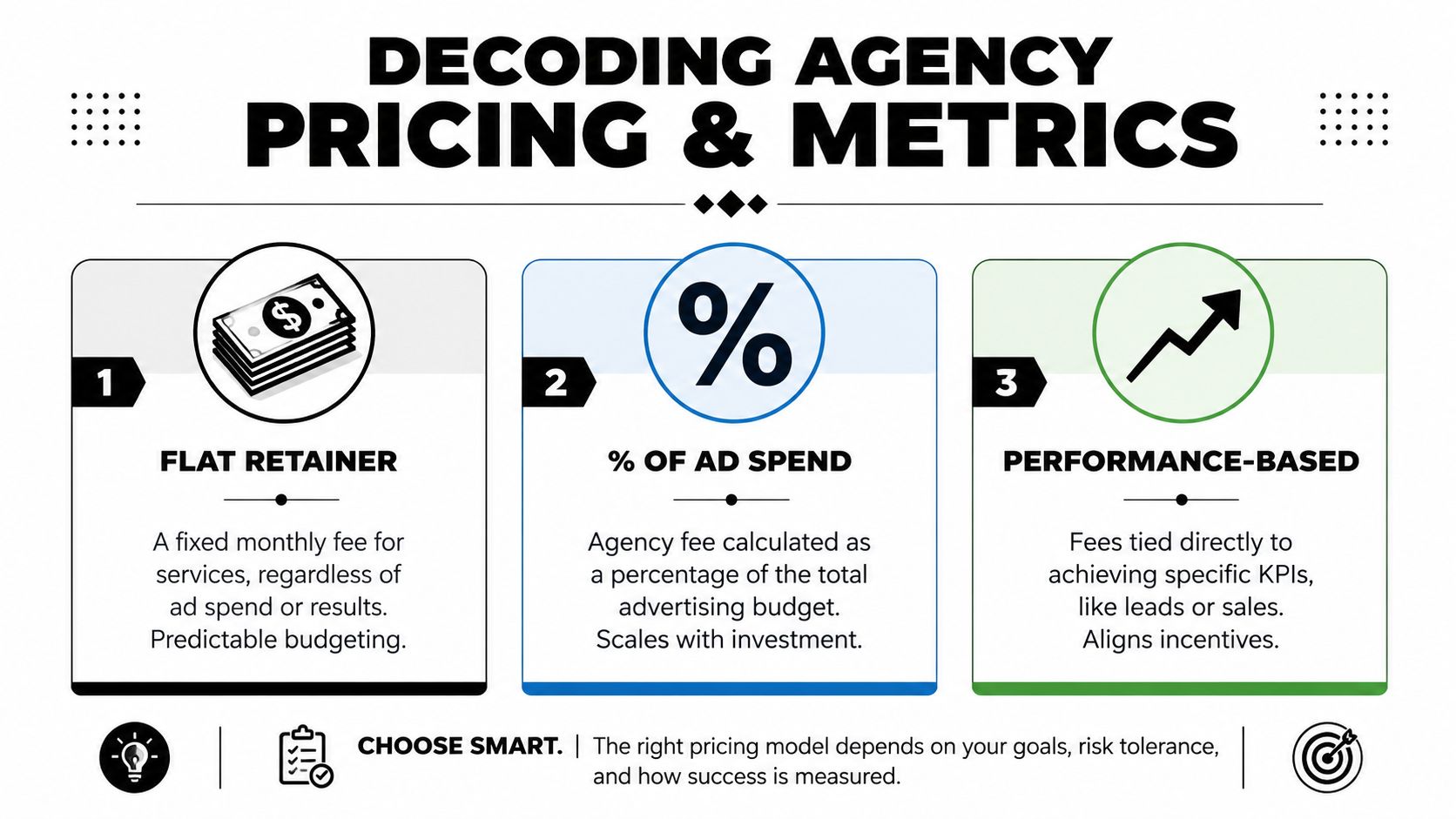
Pricing confuses a lot of business owners because agencies package the same service in very different ways.
That doesn't automatically make one model better than another. What matters is whether the pricing encourages good decisions, whether the contract is fair, and whether success is measured with the right KPIs.
The common pricing models
Here's the quick version.
| Model | How it works | Watch-out |
|---|---|---|
| Flat retainer | Fixed monthly fee for management | Scope needs to be clear |
| Percentage of ad spend | Fee scales with budget | Can incentivise higher spend over efficiency |
| Performance-based | Fee linked to agreed outcomes | Tracking and attribution must be solid |
I don't dislike any of these by default. I care more about fit.
A flat retainer works well when the workload is stable and the agency is doing meaningful strategic work. A percentage-of-spend model can make sense when the account is growing and there's a clear service structure behind it. Performance-based sounds attractive, but it can become messy if no one agrees on what counts as a genuine result.
What success should look like
Good agencies don't anchor the relationship around vanity metrics.
Industry guidance on Facebook advertising performance emphasises ROAS and customer acquisition cost as measures of success, with improvement coming from testing and budget optimisation rather than just spending more. In one documented example, applying Campaign Budget Optimisation alongside creative testing led to a 74% increase in conversions and a 43% decrease in cost per conversion, which is a strong reminder that account structure and testing discipline matter as much as budget size (campaign optimisation example).
For ecommerce, the useful metrics usually include:
- ROAS
- CAC
- conversion rate
- average order behaviour by campaign type
For service businesses, I care more about:
- cost per qualified lead
- booked appointments
- call quality
- sales outcome after the lead enters the pipeline
Contracts should reduce risk, not trap you
Read the agreement closely.
The basics I'd expect to see handled clearly are:
- Account ownership: your ad account should remain yours
- Asset access: pixel, catalogue, pages, and tracking tools should be transparent
- Notice periods: reasonable exit terms matter
- Scope: creative, reporting, tracking, landing pages, and call support should be defined
- Reporting cadence: monthly is common, but clarity matters more than frequency
If a contract is hard to understand, that's often a preview of the working relationship.
Commercial check: If an agency wants credit for sales, it should also be willing to discuss how sales are verified.
Proving results beyond form fills
For trades and call-heavy service businesses, leads don't always arrive through neat online forms. A lot of value comes through phone calls.
In those cases, I like using call tracking properly. Sometimes that means setting up a custom number through Twilio so calls can be attributed more cleanly, routed properly, and tied back to campaign activity. For businesses like plumbers, electricians, dentists, clinics, restaurants, hairdressers, and beauty operators, that matters because missed calls are missed revenue.
A solid setup can support practical workflows such as:
- 24-hour call answering coverage
- calendar or Calendly booking
- lead routing to the right staff member
- better visibility into which campaigns generated actual enquiries
That's the difference between “the ads got clicks” and “the ads drove jobs.”
Ready to Partner for Growth? Here's Your Next Step
You usually know the moment. Sales are uneven, Meta reports look healthier than the bank account, and nobody can give you a straight answer on which campaigns are producing real revenue or qualified leads.
At that point, hiring a Facebook Ads agency becomes a business decision about control and clarity. The right agency helps you set up tracking you can trust, test offers and creative with discipline, and read performance through the lens that matters most: revenue quality. That matters even more in Australia, where privacy changes and patchy attribution can make platform numbers look cleaner than reality.
If you're still comparing options, it helps to read a few viewpoints on how agencies approach optimisation. This piece on Meta Ads agency optimisation tips is useful because it focuses on spend efficiency and ongoing improvement work, not just launching campaigns.
For Melbourne businesses, local context still counts. A digital marketing agency Melbourne brands can rely on should understand Australian buying behaviour, know how to work across Shopify or WordPress, and speak plainly about lead quality, margin, and sales verification. I've found that matters just as much for ecommerce brands as it does for service businesses that rely on calls, bookings, and fast follow-up from the front desk or sales team.
Keep your standards high.
Ask who is running the account. Ask how results are verified when attribution is incomplete. Ask what happens when creative performance drops off, or when leads increase but close rates fall. Good agencies answer those questions directly because they've had to solve those problems before.
If you've reached the point where DIY is costing more than it's saving, that's usually the signal to get help.
If your business is spending at least $3,000 a month on paid ads, I'm happy to offer a low-risk starting point. Get your first month of paid ads management free. Apply through the contact page. Alpha Omega Digital is a Melbourne-based marketing agency that also works with clients in Sydney, Brisbane, Newcastle, Perth, Adelaide, Darwin and Hobart.
[email protected]
Read more insights from our team on web design, paid ads, and growth strategy.