You're probably here because one of three things has happened.
You ran Meta ads yourself and got a stream of clicks with no clear profit. You hired a freelancer or agency, got monthly reports full of jargon, and still couldn't tell what was working. Or you're about to hire a Facebook Ads agency in Sydney and you don't want to burn another few months finding out the hard way who knows what they're doing.
I've seen this from both sides. Good agency relationships can become a real growth lever for an eCommerce brand. Bad ones drain budget slowly, hide behind vanity metrics, and leave the owner carrying all the risk. The problem isn't that Sydney lacks options. The problem is that most agency sales processes make weak operators look polished.
That's why the hiring process matters more than is commonly understood. If you know what to look for, what to ask, and what not to get distracted by, you can avoid most of the expensive mistakes before a campaign even launches.
Your Starting Point for Finding the Right Sydney Agency
Sydney businesses don't have a reach problem. They have a decision problem.
The audience on Facebook is large enough to support serious local and state-based targeting. One Sydney-focused industry source cites more than 15 million active users in Australia and notes suburb-level targeting as a practical advantage, while another agency reference says 5.3 million+ NSW residents use Facebook daily through this Sydney Facebook ads market overview. That matters because a Facebook Ads agency in Sydney should be able to build campaigns around actual buying zones, delivery areas, store catchments, or suburb clusters rather than broad, lazy targeting.
Most business owners start in the wrong place. They search, open five agency websites, skim some logos and testimonials, and book calls. That feels productive, but it usually leads to comparing the wrong things.
Start with fit, not flair
A polished proposal doesn't tell you much. A real operator usually gets into your margins, your offer, your customer journey, your stock position, and your tracking setup quickly.
If I'm speaking with an eCommerce brand, I want to know things like:
- What are you selling: A low-ticket impulse product needs a very different campaign structure from a high-consideration bundle.
- What happens after the click: If the product page is weak, the agency can buy traffic all day and still fail.
- What platform are you on: Shopify, WooCommerce, and custom builds all create different tracking and development considerations.
- What does success mean to you: Some brands need first-purchase efficiency. Others can tolerate a higher acquisition cost because repeat purchase economics are strong.
A general list of agencies can still help if you use it correctly. For example, if you want to compare how specialised firms position paid social across niches, this roundup of best paid social agencies for SaaS businesses is useful as a benchmark for how focused agencies explain strategy, process, and vertical expertise. Even if you're in eCommerce, the exercise is valuable because it trains you to spot specificity versus fluff.
Practical rule: Don't hire the agency with the nicest pitch. Hire the one that diagnoses your business most accurately.
What a serious search looks like
I'd narrow your shortlist with three filters before you ever book a call.
| Filter | What to look for | What to avoid |
|---|---|---|
| Vertical relevance | Clear eCommerce experience and understanding of product feeds, offers, landing pages, and repeat purchase behaviour | Agencies that mainly serve local lead gen businesses but say they can “also do eCommerce” |
| Operational depth | Evidence they can handle creative, tracking, and optimisation together | Shops that only buy media and outsource the rest |
| Commercial honesty | Clear talk about trade-offs, testing, and uncertainty | Agencies that jump straight to promises |
The right Facebook Ads agency in Sydney should feel less like a vendor and more like a commercially minded operator. They should help you avoid bad bets, not just launch campaigns faster.
First Step Do This Internal Work Before You Search
A lot of bad agency hires start the same way. The owner is under pressure, sales are flat, and the brief sounds vague because nobody has stopped to define what success needs to look like. Then the agency fills in the blanks, sells confidence, and six weeks later both sides are frustrated for different reasons.
Do the internal work first.
If you don't know your margins, your acceptable customer acquisition cost, your stock constraints, or how much room you have for testing, you force the agency to make commercial decisions with half the picture. I've seen this create expensive confusion. The account can look busy while the business gets very little from it.
Know your real objective
“More sales” is not a working objective. It gives an agency too much room to interpret the job.
Pick one primary outcome and make it specific to the stage your business is in:
- Acquire new customers at a cost the business can sustain
- Push a proven hero product harder
- Lift total paid social revenue without destroying margin
- Drive more first purchases, then let email and retention do the rest
- Support a launch, promotion, or seasonal window with a clear target
The order matters. Start with business math, then translate that into ad account goals. For eCommerce brands, that usually means contribution margin, average order value, repeat purchase behaviour, and refund rate before anyone talks about campaign structure.
Build a one-page operating brief
Good agencies ask better questions when the client gives them something real to work with. A one-page brief is enough if it covers the right things:
- Best-selling products and strongest categories
- Average order value
- Current traffic sources
- New versus returning customer mix
- Offers or promotions that have converted before
- Seasonal peaks, stock issues, and fulfilment limits
- Tracking setup and reporting gaps
- Platform constraints on Shopify, WooCommerce, or a custom build
This is also where businesses often discover that the bottleneck is not media buying. It might be product pages, site speed, poor tracking, or a weak post-click journey. If you sell online, broader channel and platform context matters. That is why comparing agencies that understand digital marketing for Shopify can be useful. You want a partner who can see where Meta fits in the full buying path, not one who treats the ad account like an isolated machine.
Set a budget based on learning, not hope
This part gets mishandled all the time.
Owners set a budget based on what feels comfortable. Agencies accept it because they want the deal. Then nobody can tell whether performance problems come from weak creative, a poor offer, bad landing pages, tracking errors, or simple lack of volume.
A better approach is straightforward:
- Start with what you can afford to pay for a customer
- Estimate how many conversions you need before you trust a pattern
- Check whether your monthly budget can realistically generate that volume
- Leave room for creative testing and production, not just spend in Meta
Small budgets are not automatically wrong. They do change the type of work an agency can do. Sometimes the right decision is to run a tighter test around one product, one offer, and one audience angle instead of pretending a low-spend account can support broad scaling decisions.
Define what sits outside the agency remit
This saves arguments later.
If your site is slow, your reviews are thin, your checkout is clunky, or your analytics are messy, paid social will expose those problems very quickly. The agency can flag them. They cannot always fix them unless that work is part of the engagement.
I tell clients to separate three things before they start agency conversations. What the agency will own, what your internal team will own, and what needs outside technical support. In some cases that means media buying only. In others, the account will struggle until someone fixes technical foundations such as WordPress development or Shopify development.
One honest page of internal context will do more for your agency search than ten sales calls. Strong agencies respect clarity. Weak ones prefer ambiguity because it gives them more room to overpromise.
Evaluating an Agency's Core Capabilities
A polished deck can hide a weak operating model.
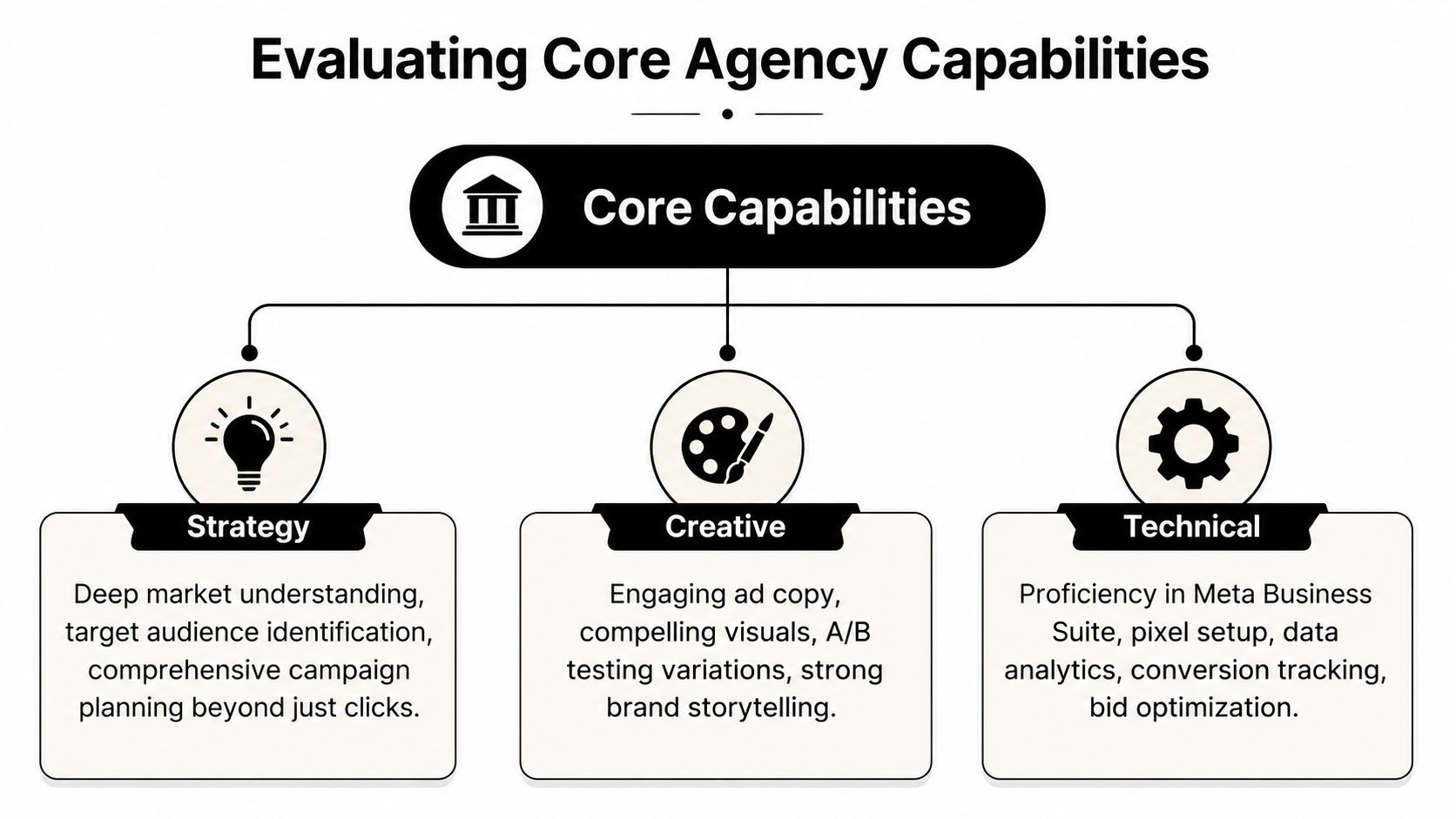
I've seen Sydney agencies win pitches with case studies, slick creative, and confident reporting language, then struggle once the account needs hard decisions. The crucial question is whether they can diagnose commercial problems, produce enough creative variation to learn fast, and measure performance well enough to know what works.
Strategy that starts before the ad account
Good strategy starts with the business, not the campaign structure.
For eCommerce brands, that means the agency should be able to talk through product demand, margin pressure, repeat purchase behaviour, offer strength, landing page intent, and whether paid social is supposed to acquire new customers profitably or feed the top of the funnel. If they jump straight to audience targeting and budget splits, they are skipping the part that determines whether the account has room to scale.
I also want to know whether they can see beyond Meta. Brands selling on Shopify rarely grow through one channel in isolation. Email, site conversion rate, merchandising, and post-click experience all shape paid social performance. That broader view is why references on digital marketing for Shopify can help when you compare agencies. You are looking for a partner that understands how Facebook ads fit into the full buying journey.
Case studies matter here, but only if you read them properly. If an agency shows a great ROAS result, ask what the offer was, how strong the brand already was, what the average order value looked like, and whether retention carried the economics. A result that came from a warm audience, a discounted offer, or a seasonal spike may tell you very little about what they can do for your business.
Creative systems, not isolated ad concepts
Here, strong agencies separate themselves quickly.
Any agency can show you a few attractive ads. The better test is whether they have a repeatable process for producing, reviewing, and replacing creative before performance drops. Meta rewards speed of learning. Agencies that rely on one winning concept for too long usually end up defending decline instead of preventing it.
What I listen for is operational detail. How do they brief creatives? How many angles do they usually test in the first month? What happens if click-through rate is acceptable but conversion quality is poor? How do they respond when frequency rises and results soften?
A capable creative process usually covers:
- Hook testing: Different first frames, opening claims, product use moments, or problem statements
- Offer testing: Standard pricing, bundles, bonuses, urgency, social proof, or objection handling
- Format testing: Static images, short-form video, UGC-style footage, carousels, founder-led creative, testimonials
- Iteration rules: Clear decisions on what gets cut, refreshed, expanded, or reworked after the first round of data
I care less about whether they call themselves a creative agency and more about whether they can produce enough structured variation to find a message that sells.
Technical measurement that survives signal loss
A lot of agencies sound competent until the conversation reaches tracking.
Privacy restrictions, attribution gaps, and browser-level data loss have changed the standard. Agencies need to explain how they configure Meta Pixel, Conversions API, event prioritisation, first-party data capture, and reporting logic when platform numbers do not match your CRM or Shopify data. If they cannot explain that clearly, they are buying media without a reliable feedback loop.
The trade-off is real. Some agencies are strong media buyers but weak on implementation. Others know the technical side but cannot turn that into better decisions in the account. You want both, or at least an agency that knows where its limits are and coordinates with specialists instead of bluffing through setup issues.
For eCommerce brands, this often overlaps with development work. Theme edits, checkout changes, custom events, app conflicts, and feed issues can all distort performance data or break conversion tracking. One option in that broader stack is Alpha Omega Digital, which works across websites and paid advertising, but the important point is simpler than that. Make sure your agency can either handle the technical work properly or manage the right people without delays, confusion, or finger-pointing.
Sharp Questions to Ask a Potential Agency
You get on a sales call expecting clarity. Twenty minutes later, you have a polished deck, a few big claims, and no real sense of how the agency will behave once your money is in the account.
That is the trap.
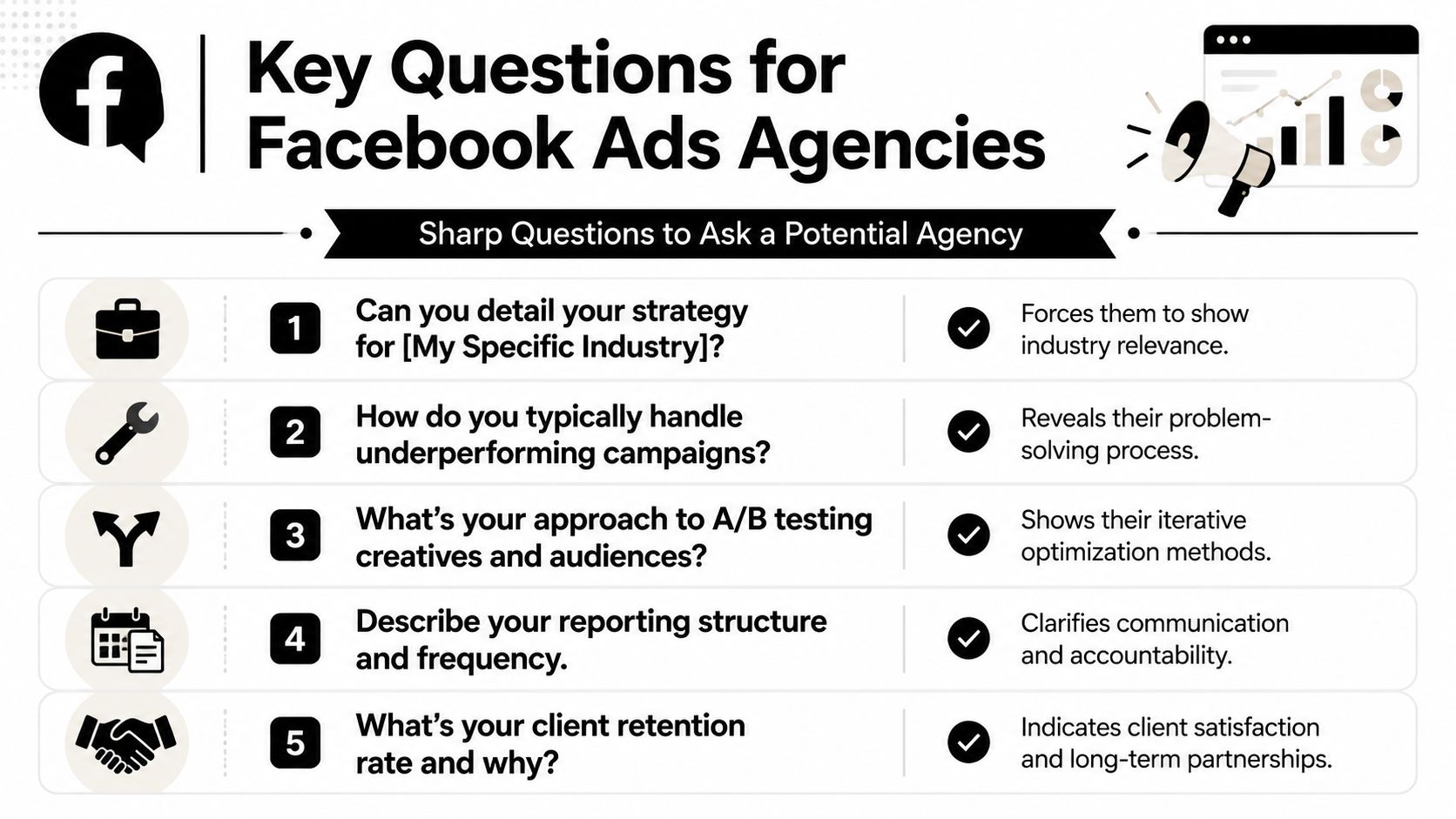
The right questions are not the standard checklist pulled from generic marketing blogs. The useful ones expose judgment, accountability, and how the agency handles pressure when results are uneven. I have sat on both sides of these calls, and the biggest hiring mistakes usually come from accepting fluent answers instead of pressing for operational detail.
Questions that reveal how they actually think
Here are the questions I would ask, and what a strong answer sounds like.
Walk me through an account or campaign that underperformed. What happened, what did you change, and what was the result?
Good agencies can talk about misses without getting defensive. I want to hear their diagnosis, the order of changes they made, and what they learned. If every failure is blamed on the client, the economy, or Meta, expect the same pattern when your account hits a rough patch.What do you test first in a new account, and why in that order?
This question gets past surface-level talk fast. A serious team has a framework. They may start with offer, creative angle, landing page friction, or audience structure, but they should be able to explain why those come first for your business model. "It depends" is fine as a starting point. It is not fine as the whole answer.How does creative testing work week to week? Who requests assets, reviews performance, and decides what gets replaced?
Plenty of agencies say they test creatives. Fewer can explain the cadence, decision rules, and bottlenecks. Ask how many variations they usually need before they find traction, what signals tell them an ad is tired, and whether your team or theirs owns production. Asking these questions reveals whether the agency has a working system or just a nice opinion about testing.How do you build audiences over time once the easy wins are gone?
I want specifics here. They should be able to explain how they use customer data, exclusions, retargeting windows, broad targeting, lookalikes where relevant, and how audience strategy changes as conversion data builds. Vague language usually means shallow account work.How do you decide where budget moves each week?
Budget allocation tells you a lot about the maturity of the operator. Ask what signals matter most, how quickly they act on them, and what they do when one campaign is efficient but capped and another is spending hard with weak returns. One useful reference on that process is this guide to Meta optimisation workflows. The point is not the platform jargon. The point is whether the agency manages the account actively or leaves spend drifting.
What strong answers sound like
Strong answers are usually plain and a little unglamorous.
You will hear specifics about review frequency, testing priorities, decision-making, and ownership. You will also hear limits. Good operators know what they can control, what sits with the client, and where results can stall because of stock issues, weak offers, slow pages, or poor follow-up from sales teams.
Weak agencies often hide behind polished language. They talk about scale, AI, omnichannel growth, and optimisation, but they stay vague on who does the work and how decisions get made inside the account.
Ask for process, accountability, and examples. Promises are cheap. Operating discipline is not.
One more question owners rarely ask
Ask who will run the account after you sign, and how senior that person is.
This question changes the tone of the meeting because it gets to the true relationship, not the pitch. In a lot of agencies, the sharpest person is in sales. Once the contract is signed, the work shifts to a junior account manager following a template.
If you are speaking with a proper ecommerce marketing agency, get clear on the handover, meeting cadence, escalation path, and who has authority to make changes without waiting three days for approval. That is the stuff clients usually discover too late.
Decoding Pricing Retainers and Expected KPIs
A pricing proposal tells you a lot about how an agency thinks.
I have seen two Sydney agencies charge almost the same monthly fee and deliver completely different levels of work. One was running fresh tests every week, fixing tracking issues, pushing for better offers, and explaining trade-offs clearly. The other was basically renting access to Ads Manager and calling it strategy.
That is why the pricing model matters less than the operating model behind it. You are not buying a fee structure. You are buying attention, judgment, and follow-through.
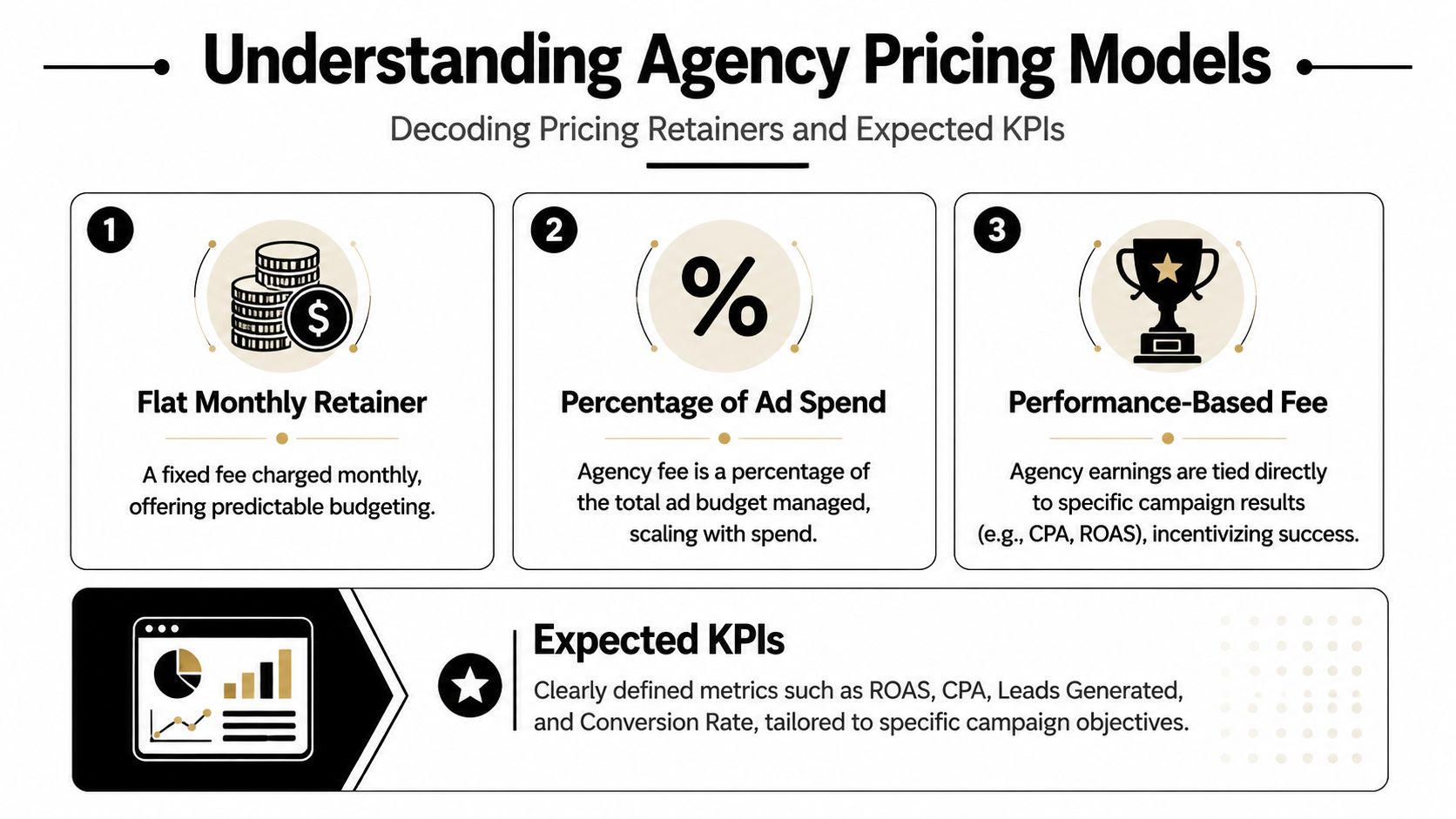
The three pricing models you'll see most
| Model | How it works | Where it can go wrong |
|---|---|---|
| Flat retainer | Fixed monthly management fee | Sounds simple, but weak scopes let agencies do the bare minimum |
| Percentage of ad spend | Fee increases as spend increases | The incentive can drift toward bigger budgets instead of better returns |
| Performance model | Fee depends on agreed results | Attribution arguments start fast if tracking, margin, or lead quality is unclear |
For a lot of small to mid-sized brands, a flat retainer is the cleanest option. It gives you a predictable cost and makes it easier to compare agencies. It only works if the scope is written properly.
Percentage-of-spend pricing is not automatically bad. It can make sense when an account needs heavy buying support across multiple campaigns, markets, and creative angles. But if an agency gets paid more every time spend goes up, you need a clear view of what would justify that increase.
Performance deals sound attractive in a sales call. In practice, they often get messy because Facebook rarely deserves all the credit for a sale, and agencies love counting wins that the business would have earned anyway through brand demand, email, or repeat customers.
What should be included in the fee
Owners often get caught on the quiet details.
A proposal can say “full management” and still leave out the work that improves performance. If creative testing is extra, tracking fixes are extra, landing page feedback is extra, and reporting is thin, the retainer may only cover campaign maintenance.
Ask what the monthly fee includes in plain terms:
- Creative scope: Are they producing ads, briefing your team, editing existing assets, or only trafficking what you send?
- Tracking support: Will they help with Pixel, Conversions API, GTM, event setup, and troubleshooting when attribution goes sideways?
- Reporting cadence: Do you get weekly commentary, monthly reviews, a live dashboard, or a PDF that says very little?
- Communication: Who answers questions, how fast, and through what channel?
- Platform support: Will they handle catalogue problems, feed issues, landing page feedback, and coordination with your developer or ecommerce team?
I always tell owners to look for the sentence that says what happens when something breaks. That is usually where the actual scope shows up.
KPIs that deserve your attention
A lot of agencies choose KPIs that are easy to defend, not KPIs that help you judge whether the account is commercially healthy.
Good KPI setting starts with the economics of your business. A brand with strong repeat purchase behaviour can afford a different acquisition cost from a business that makes its profit on the first order. A lead generation company with a disciplined sales team can tolerate softer front-end metrics than one with poor follow-up. Context matters.
For ecommerce, I separate KPIs into two groups.
Operational indicators
- CPM
- click-through rate and outbound click quality
- landing page view rate
- add to cart trend
- checkout initiation trend
Commercial indicators
- cost per acquisition
- new customer acquisition efficiency
- average order value and margin quality
- repeat purchase contribution
- blended performance against target
Operational metrics help explain performance. Commercial metrics tell you whether the work is worth funding.
If an agency leads every review with reach, impressions, and traffic growth, push harder. Those numbers can be useful diagnostic signals, but they do not answer the question that matters to an owner. Is paid social producing profitable demand, or is it just spending cleanly?
Contract terms matter more than owners expect
The contract usually gets attention last. It should get attention early.
I am wary of long lock-in periods at the start of a relationship, especially when the agency has not yet proved its process, communication, or commercial judgment. A short initial term with a clear review point is usually fair to both sides.
The agreement should spell out deliverables, asset ownership, access levels, reporting expectations, approval workflows, and exit terms. If those details are vague, problems get expensive fast. Pricing only makes sense once those conditions are clear.
Red Flags to Watch for When Hiring
Some agencies tell on themselves early. Others hide the problems until after onboarding.
The obvious red flags matter, but the subtle ones matter more because they often predict the actual day-to-day experience once the excitement of the sale disappears.

The warning signs I take seriously
- Guaranteed outcomes: No one credible can guarantee platform performance. There are too many variables outside the agency's control.
- No account ownership clarity: If they won't confirm that you'll have access to your own ad account, business manager assets, and data, walk away.
- Vanity metric obsession: Reach, impressions, and clicks have context. On their own, they don't tell you if the campaigns are commercially sound.
- Vague reporting language: If every answer sounds polished but non-specific, expect the reporting to be the same.
- Template strategy for every client: A skincare brand, a furniture brand, and a supplements brand shouldn't all get the same playbook.
The red flag most owners miss
Be careful with agencies that only talk about media buying and never mention conversion rate optimisation, merchandising, or post-click experience.
That usually means they want to control only the easiest part of the outcome. Then, if performance stalls, they can always point to the site, the offer, or the product pages without having raised those issues clearly at the start.
A good agency makes the risks visible before you sign. A bad one discovers them after your first invoice is paid.
Listen for how they handle uncertainty
This sounds soft, but it's one of the best filters.
A mature operator can say, “We don't know yet, but here's how we'd find out.” That's a strong answer. It means they understand testing, variance, and diagnosis.
A weak operator tends to overstate certainty. They claim they already know what will work, despite not having touched your data, your creatives, or your customers. That confidence can sound reassuring. It usually isn't.
If the sales process feels like theatre, the service often will too.
Ready to Grow Your Business
Hiring a Facebook Ads agency in Sydney isn't about buying campaign management. It's about choosing how much clarity, discipline, and accountability you want around your growth spend.
The businesses that get the most from paid social usually do a few things well before they sign anything. They know their numbers. They ask sharper questions than average. They care about tracking, creative process, and commercial fit more than pitch decks and logo slides. And they understand that the right agency relationship should improve decision-making, not just ad delivery.
That matters even more for eCommerce brands. Paid social performance doesn't sit in a vacuum. It touches the site experience, the offer, the product page, the checkout, the feed setup, the data layer, and the way the business measures success. A good partner sees that whole picture. A weak one stays inside Ads Manager and hopes the rest sorts itself out.
If you're comparing options, stay practical. Ask who will run the account. Ask how they test. Ask how they handle signal loss. Ask what happens when results are flat for a month. Ask what's included in the fee. Those answers will tell you far more than a case study ever will.
If you want a partner that works across paid ads, Shopify, WordPress, tracking, and conversion-focused web work, a marketing agency Melbourne businesses often look at for that broader mix is the team behind web design and growth services in Melbourne. The same applies if you've been searching for a digital marketing agency Melbourne brands can use while also servicing Sydney and other Australian cities. Fit still matters more than geography.
If you're a business with a paid ads budget of at least 3k a month, Alpha Omega Digital offers a low-risk deal: get a month of paid ads management FREE. They're based in Melbourne and work with clients across Sydney, Brisbane, Newcastle, Perth, Adelaide, Darwin and Hobart. If you've got a project in mind, apply through the contact page.
[email protected]
Read more insights from our team on web design, paid ads, and growth strategy.