If you're in Brisbane and you've tried Facebook Ads before, you probably know the pattern. You boost a post, get a burst of likes, maybe a message or two, then nothing that feels tied to real revenue. The platform looks busy, the dashboard looks promising, but the business outcome feels vague.
I run a digital marketing agency Melbourne businesses use for web builds, tracking, Google Ads, and paid social, and I see the same problem across Brisbane accounts all the time. Most underperforming campaigns aren't failing because Facebook stopped working. They're failing because the setup is shallow. Weak tracking. One creative concept. No landing page thinking. No audience structure. No plan for what happens after the click.
For Brisbane brands, especially ecommerce stores and service businesses with serious growth goals, Facebook still has a clear role. But it isn't a set-and-forget channel anymore. It needs creative testing, proper measurement, and a full-funnel mindset. That's where a real Facebook Ads agency in Brisbane should earn its keep.
Growing Your Brisbane Business Beyond Hope Marketing
A lot of Brisbane businesses come to us after wasting money in the most common way possible. They didn't make a reckless decision. They did what sounded reasonable. They ran a few boosted posts, targeted broad suburbs, used whatever image was already on hand, and hoped the algorithm would sort it out.
It rarely does.
I've spoken with owners who knew their buyers were on Facebook and Instagram, but couldn't work out why attention wasn't turning into sales. That's the gap between being visible and being commercially effective. Visibility on its own doesn't pay wages.
What hope marketing looks like in practice
Hope marketing usually has a few signs:
- Boosted post logic: The ad starts as a social post, not a campaign built for a business outcome.
- No conversion path: The click goes to a generic homepage instead of a product page, collection page, or focused landing page.
- One audience only: Everyone gets the same message, whether they've never heard of you or already visited your site.
- No feedback loop: Nobody can confidently say which ad drove the sale, enquiry, or phone call.
When we audit these accounts, the problem usually isn't effort. It's structure. Brisbane businesses are often doing enough activity to feel busy, but not enough of the right activity to create predictable revenue.
Practical rule: If you can't explain why a campaign is built a certain way, you're probably paying Meta to collect expensive lessons.
What experienced management changes
A proper campaign build starts before Ads Manager. We look at the offer, the margin, the customer journey, the product pages, and the tracking. For ecommerce, that might mean reviewing a Shopify theme, checking product feed quality, and tightening the post-click experience. For service businesses, it often means rebuilding the landing page around one clear action.
This is also where the difference between a tactical freelancer and a broader marketing agency Melbourne operators trust becomes obvious. Paid social performance is tied to site speed, UX, event tracking, CRM handoff, and creative production. If those pieces are weak, the media buying won't save you.
A Brisbane business doesn't need more vague promises about reach. It needs a system that can answer simple commercial questions. Which audience is buying. Which creative is producing quality traffic. Which landing page turns that traffic into money.
Are Facebook Ads Still Worth It in Brisbane
A Brisbane business owner launches Meta ads on Monday, sees clicks by Wednesday, and by Friday starts asking the question that matters. Are these people going to buy, book, or call, or are we just paying for traffic that feels busy?
That is the right question in 2026.
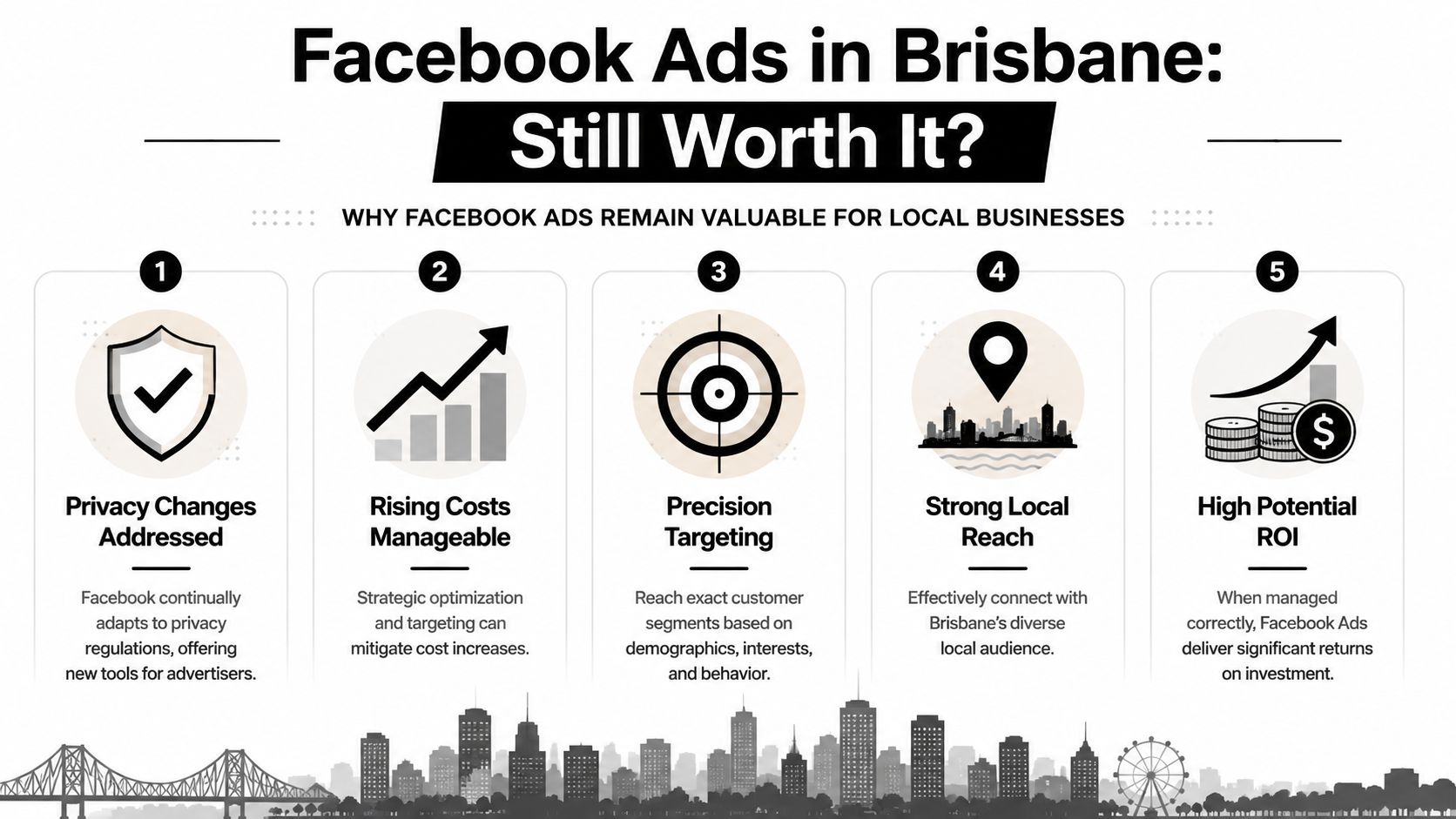
Yes, Facebook Ads are still worth it in Brisbane. They are worth it for businesses that use Meta for what it does well: getting in front of the right people before they are ready to search, building familiarity over time, and bringing warm prospects back through remarketing. They are a poor fit for anyone expecting cold traffic to behave like high-intent Google traffic on day one.
Why Meta still earns a place in the mix
I see the same mistake in audits across Brisbane. Businesses judge Facebook Ads by the wrong standard. They want direct response results from cold audiences without doing the work on offer positioning, creative rotation, landing page clarity, or follow-up.
Meta still has huge reach and strong buying power as an ad platform. According to KlientBoost's Facebook ad statistics roundup, advertisers continue to spend heavily on Facebook because the platform can buy attention at scale. That does not guarantee profit. It means the opportunity is still there for businesses that can turn attention into action.
That trade-off matters more now because the platform is less forgiving than it was a few years ago.
Creative fatigue hits faster. iOS privacy changes have reduced visibility in standard browser tracking. Broad targeting can work, but only when the account has strong signals and the creative speaks clearly to the buyer. Media buying alone is no longer enough. Brisbane advertisers need a full-funnel setup that covers message, offer, page experience, tracking, and remarketing.
Facebook versus Google for Brisbane businesses
I explain it to clients this way.
| Channel | Best use | Where it struggles |
|---|---|---|
| Google Ads | Capturing existing demand | Reaching people before they start searching |
| Facebook Ads | Creating demand, remarketing, product discovery | Converting cold traffic when the offer or creative is weak |
For a Brisbane ecommerce brand, the strongest setup is often both. Google captures the person searching for the product today. Facebook introduces the brand earlier, helps the product stay visible during comparison, and brings cart visitors back after they get distracted.
For service businesses, the split is similar. Google is usually stronger for urgent intent. Facebook is often better for building demand around considered purchases such as cosmetic treatments, property services, education offers, or higher-ticket local services where trust needs time.
What changed, and why some businesses think Facebook stopped working
The platform did not stop working. Cheap, lazy execution stopped working.
If an account is burning through creative, sending traffic to a weak page, and relying on last-click reporting, performance usually slides fast. I have seen Brisbane brands blame targeting when the problem was that the same ad had been shown too many times, the offer was unclear, or the site gave people no reason to act.
That is the 2026 reality. Meta still works best as part of a system.
Use it to create demand. Use it to build retargeting pools. Use it to support email, SMS, Google, and direct traffic. Judge it on contribution across the funnel, not just on whether a cold prospect buys instantly after one impression.
What Brisbane advertisers should expect instead
Brisbane businesses should expect testing, iteration, and some wasted spend early if the account has weak data. They should also expect Meta to become more profitable once the funnel is structured properly and the creative is refreshed often enough to keep response rates healthy.
The businesses getting good results are not treating Facebook like a vending machine. They are treating it like a channel that rewards better inputs.
Facebook Ads are still worth it in Brisbane for businesses that understand their role. Meta creates demand, supports remarketing, and helps move buyers from awareness to action. It disappoints businesses looking for easy wins from cold traffic without the rest of the funnel in place.
The Unskippable Tech for Accurate Ad Measurement
If an agency is still relying on browser-only tracking and calling that enough, they're behind. That's not a small technical preference. It's a reporting and optimisation problem.
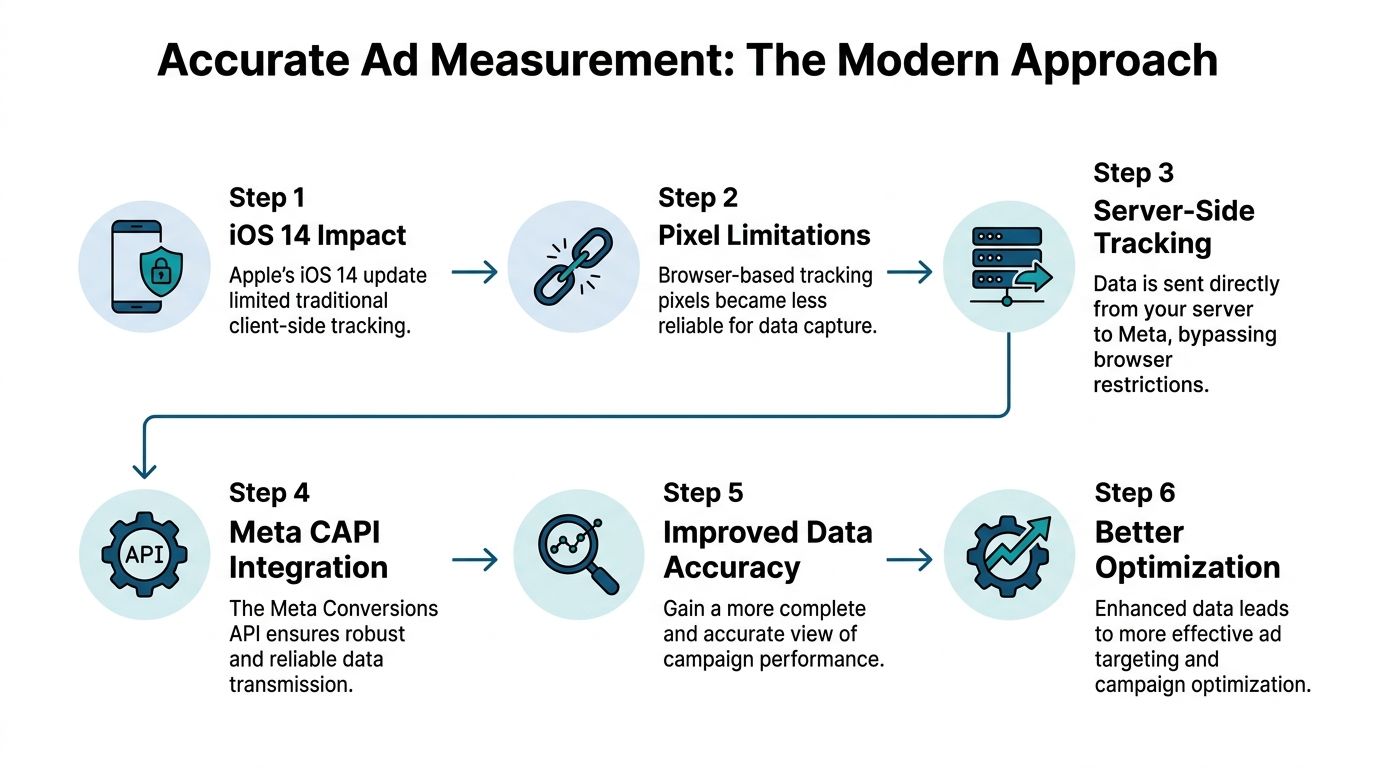
Since privacy changes hit browser tracking harder, the old setup of installing the Meta Pixel and moving on has become unreliable. For Shopify and WordPress stores, that means your account can miss purchases, undercount leads, and send weaker signals back into Meta's optimisation system.
Why CAPI matters now
The fix is Meta Conversions API, usually paired with server-side tracking. Instead of depending only on the browser to fire events, the website server also sends conversion data back to Meta. That improves event reliability and gives the platform a better signal to optimise against.
The verified Australian benchmark here is strong. Agencies in Australia that implement Meta's Conversion API report a 28% increase in attributed conversion data, which directly addresses data loss from iOS privacy settings. That same benchmark links CAPI implementation to a 35% reduction in CPA and 40% faster campaign scaling.
Those aren't abstract gains. In practical terms, that means the ad account has a better shot at identifying which purchases, leads, or higher-value actions should influence delivery.
What we check before campaigns scale
When we set up tracking for ecommerce, the job isn't just "install app, tick box, done". We check the whole event chain.
- Event quality: Purchase, add-to-cart, initiate checkout, and lead events need to fire consistently.
- Deduplication: Browser and server events must work together so Meta doesn't count the same action twice.
- Platform fit: Shopify, WordPress, and custom builds each have different implementation risks.
- Post-click logic: If the thank-you page, form flow, or checkout is messy, better tracking won't fix the underlying leak.
Development and ads often overlap. A team handling both often moves faster because they can fix the source of the issue instead of reporting on it. If you're comparing providers, a service like Shopify developers in Melbourne is relevant because accurate tracking usually depends on theme changes, checkout logic, app conflicts, and clean event implementation.
Better attribution doesn't just make reports look nicer. It changes how Meta allocates spend.
What Brisbane businesses should ask an agency
Before hiring a Facebook Ads agency in Brisbane, I'd ask these three questions:
- How are you handling CAPI and server-side tracking on my platform?
- How do you validate event quality after setup?
- If reporting drops, who fixes the technical issue?
If the answers are vague, that usually means the agency is still operating on an outdated media-buyer-only model. That was easier years ago. It isn't enough now.
Our Six-Step Framework for Predictable ROI
Most bad ad accounts don't fail from one huge mistake. They fail from lots of small, avoidable ones. No clear offer. Loose audience setup. Weak creative rotation. Budget moved on gut feel. Reporting that arrives too late to be useful.
We use a six-step framework because it keeps those problems from creeping in.
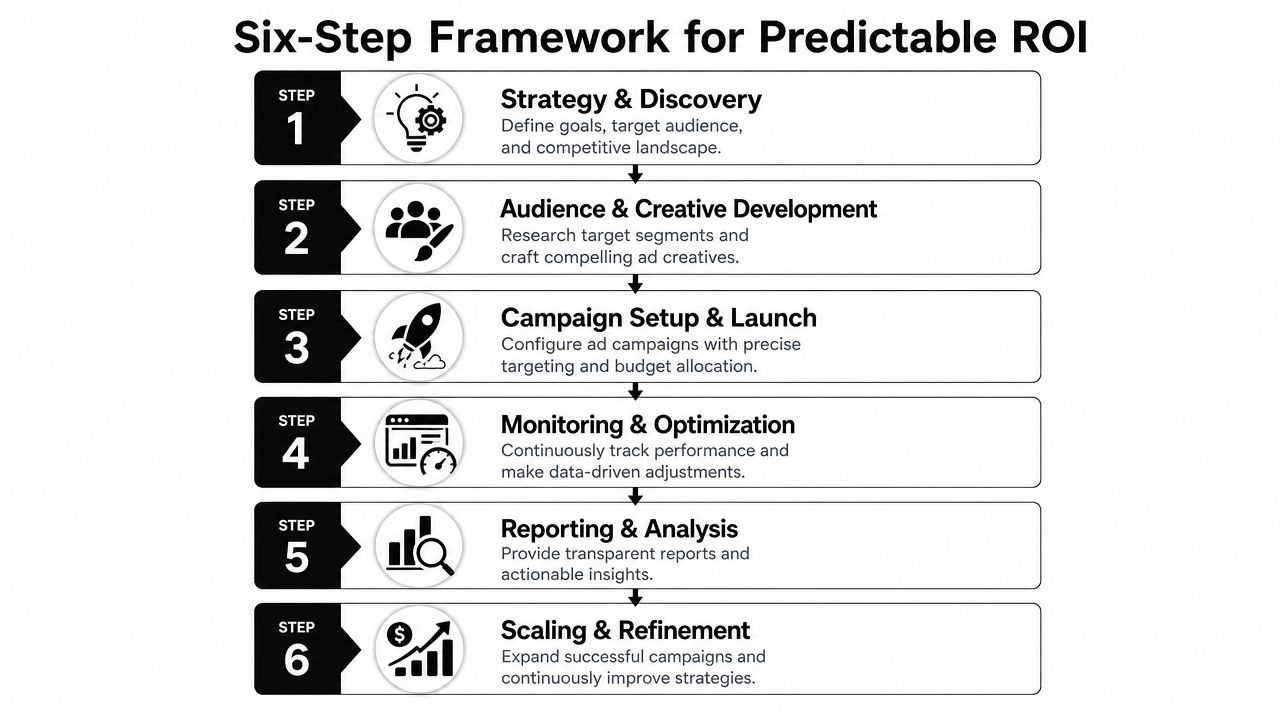
The framework we use on live accounts
| Step | What happens | Why it matters |
|---|---|---|
| Strategy and discovery | We define the offer, margin realities, audience segments, and sales path | Without this, campaigns optimise for noise |
| Audience and creative development | We map cold, warm, and retargeting paths and build assets for each | One message won't work for every stage |
| Campaign setup and launch | We structure campaigns for learning, not ego metrics | A clean build makes optimisation easier |
| Monitoring and optimisation | We review spend flow, audience quality, and on-site behaviour | Fast corrections protect budget |
| Reporting and analysis | We focus on decisions, not dashboard theatre | Reports should guide actions |
| Scaling and refinement | We increase budget only where economics hold | Scaling a weak campaign just magnifies waste |
What real optimisation looks like
The best Australian agencies don't leave creative running until it obviously dies. Verified AU data shows top-performing agencies use rule-based scheduling to pause underperforming creatives within 48 hours and increase budgets on high-traffic days. That level of management is associated with a 30% increase in ROAS during peak periods and an 18% reduction in wasted ad spend.
That matters because account management isn't just watching numbers. It's making operational decisions quickly enough to matter.
Some practical examples:
- Weekend budget pressure: If a product consistently converts better on stronger shopping days, spend should reflect that pattern.
- Creative decay: Once a concept starts losing efficiency, replacing it early is cheaper than defending it.
- Funnel imbalance: If top-of-funnel spend rises but warm traffic isn't converting, the issue may be your product page or offer, not your targeting.
What this means for Brisbane ecommerce brands
Brisbane ecommerce businesses often hit a plateau because they launch with enthusiasm, then stop iterating. The first winner carries the account for a while, then results soften, and nobody can tell whether the issue is fatigue, targeting overlap, or poor landing page alignment.
A repeatable framework gives you a way to diagnose that properly. It also makes cross-channel coordination easier if you're running Meta with Google Shopping, branded search, or email automation.
Winning the Ad Game with Better Creative
Most accounts that stall don't have a targeting problem first. They have a creative problem first.
You can target the right suburb, the right age bracket, the right interest cluster, and still lose because the ad doesn't earn attention. People aren't opening Facebook to admire your media buying. They're there to scroll quickly and ignore most things.

Why creative testing is now operational, not optional
One of the strongest Australian observations in this space is that the risk isn't just poor media buying. It's underinvestment in creative testing and first-party data capture. As noted by BFJ Digital's Meta shopping ads article, many local advertisers still rely on static "boosted post" thinking, and that approach struggles as competition for attention increases.
I agree with that completely. The accounts that survive longer don't usually have one miracle ad. They have a system for generating and replacing winners.
The testing process that actually helps
We treat creative like a production pipeline, not a one-off design task. That means testing different variables on purpose.
- Hook angle: Problem-led, outcome-led, testimonial-led, founder-led.
- Format: Static image, short video, UGC-style cut, carousel, product demo.
- Offer framing: Discount, bundle, urgency, value-add, social proof.
- Landing match: The ad promise has to continue on the page, not disappear after the click.
Some ads need polish. Some win because they feel native and direct. We've seen plain iPhone footage outperform cleaner studio edits, and we've seen the reverse too. That's why broad opinions about what "works on Meta" aren't enough. You need a process.
If you only have one ad concept in market, you're not testing. You're hoping.
What weak creative usually looks like
Weak creative tends to show up in predictable ways:
| Weak creative | Stronger creative approach |
|---|---|
| Generic lifestyle image | Visual tied directly to product use or buyer problem |
| Headline that says little | Opening line with a clear benefit or tension |
| Same ad for all audiences | Different assets for cold traffic and retargeting |
| Click-focused promise | Post-click message that continues the same story |
For ecommerce clients, this is one area where a combined build-and-growth setup helps. A team that's comfortable with product feeds, Shopify design, custom landing pages, and creative testing can move faster than a siloed setup where everyone waits on someone else.
If you're already working with an ecommerce marketing agency, this is the standard I'd hold them to. Not whether they can launch ads. Whether they can produce, test, retire, and replace creative without turning every change into a month-long project.
Real-World Results We Deliver
Results matter, but this is also where a lot of agencies get loose with the truth. They throw around screenshots, cherry-pick date ranges, or make every client sound like an overnight success.
That isn't useful.
What strong ecommerce work looks like
For ecommerce, I care about four things more than a flashy dashboard screenshot:
- Tracking integrity
- Offer-market fit
- Creative throughput
- Margin-aware scaling
Verified Australian benchmark data gives a realistic anchor here. In the AU market, top-tier Facebook Ads agencies in Brisbane achieve a median ROAS of 4.2x for ecommerce clients when they use Meta's CAPI alongside server-side tracking. That's the kind of benchmark that matters because it's tied to a specific technical standard, not a vague success story.
When an ecommerce account starts improving, it's usually because several pieces finally line up. Product pages get cleaned up. Conversion tracking starts reporting properly. The creative stops looking like brand collateral and starts looking like direct response. Retargeting gets segmented properly.
What good lead generation looks like
For service businesses, the commercial picture is slightly different. A lead gen account lives or dies on lead quality, speed to contact, and whether the follow-up process is tight enough to turn enquiries into booked work.
We've seen Facebook perform well when the campaign is paired with a proper response setup. That includes custom call tracking, cleaner landing pages, and CRM or calendar integration so leads don't sit untouched.
A practical example is using a custom Twilio number tied to campaign attribution. That setup helps businesses understand which ads are driving calls, and it also supports workflow improvements. Features like after-hours answering, appointment booking into a calendar or Calendly, and consistent call handling are useful for tradies, hairdressers, beauty therapists, dentists, restaurants, and medical clinics because missed calls often mean lost revenue.
I won't pretend every Brisbane account should use the exact same stack. Some need lead forms. Some need landing pages. Some need phone-first campaigns. The point is that a Facebook Ads agency in Brisbane should be able to connect ad delivery to what happens after the click or call. Otherwise the reporting only tells half the story.
Understanding Your Investment in Growth
A lot of business owners ask the cost question too late. They ask after they've already been burned by cheap management, weak creative, or a campaign that never had enough budget to learn in the first place.
There is a minimum level of spend below which serious testing gets difficult.
What realistic starting budgets look like
Local Brisbane agencies often recommend a starting ad spend of $1,000 per month, while noting that ad spend can start from $5 per day, and that an in-house marketing manager can cost $80k+ plus super annually, according to BAMBRICK's Facebook Ads Brisbane page. I think that's a useful framing because it separates "possible" from "commercially sensible".
Yes, you can run ads on tiny budgets. That doesn't mean you'll gather enough data to make sharp decisions.
Where the money actually goes
A proper Facebook ads budget isn't just buying impressions. It's funding a learning system.
- Media spend: The budget Meta uses to find and test audiences.
- Creative production: New angles, new formats, refreshed assets.
- Tracking and technical support: CAPI, event fixes, and platform cleanup.
- Management and analysis: Ongoing decisions, reporting, and performance control.
That last part is where businesses often compare the wrong things. They compare an agency fee to pushing the buttons themselves, instead of comparing it to the cost of wasting spend while learning slowly.
In-house versus outsourced
| Option | Likely strength | Likely risk |
|---|---|---|
| Do it yourself | Cheap at first | Slow learning, weak setup, expensive mistakes |
| Hire in-house | More internal control | Salary overhead and narrower skill coverage |
| Use an agency | Access to strategy, creative, tracking, and media buying | Only worth it if the process is disciplined |
If your site also needs conversion work, development support matters. That might mean product page changes, theme edits, or form improvements from a WordPress developer before increasing ad spend. There's no point paying for more clicks if the page they're landing on is making the sale harder than it should be.
Ready to Grow Your Brisbane Business
A Brisbane business comes to us after three months of "running Facebook." Leads are inconsistent. Sales staff say the leads are weak. Reporting inside Meta looks fine, but revenue in the bank says otherwise. By that point, the problem usually is not one thing. It is a mix of tired creative, patchy tracking after privacy changes, weak follow-up, and no clear plan from first click to closed sale.
That is the lens I'd use to judge any Facebook ads agency in Brisbane in 2026. The agency needs to do more than buy media. It needs to run the system around the ads.
What to look for before you sign
I keep the shortlist tight.
Can they explain how your funnel works
A good agency should be able to map the path from ad to landing page to lead to sale, then show where drop-off is happening. If they only talk about reach, clicks, and CPMs, they are describing activity, not growth.Can they set up measurement properly
iOS changes and weaker browser-level tracking changed how Facebook accounts need to be configured. Ask how they handle CAPI, event quality, CRM attribution, and duplicate conversions. If the answer is vague, expect vague optimisation too.Do they have a process for creative fatigue
Brisbane accounts that spend consistently burn through good ads faster than many owners expect. An agency should already have a rhythm for testing new hooks, offers, formats, and audience-aware messaging before results slide.Can they work beyond Ads Manager
Strong performance usually depends on a wider operating stack. GTM, GA4, CRM syncing, landing page edits, feed management, and first-party data collection all matter. If you want a broader view of the tools agencies often use behind the scenes, Gainsty's social media agency guide is a useful reference.
Questions Brisbane businesses usually ask me
How long until Facebook Ads start producing results
You can get early signals fast. Reliable performance takes longer.
We usually look for proof in stages. First, are the right people clicking? Then, are they converting on site or through forms? Then, are those leads turning into qualified opportunities or sales? Businesses get into trouble when they scale off the first stage and ignore the rest.
Are Facebook Ads still worth it for Brisbane service businesses
Yes, if the business can turn attention into booked work.
I've seen perfectly good campaigns fail because nobody called leads back quickly, forms asked the wrong questions, or the sales process had no structure. Facebook can create demand and feed your pipeline. It cannot fix missed calls, slow quoting, or weak sales conversations.
Should I choose Facebook instead of Google
Usually, the answer is both, but for different jobs.
Google captures demand that already exists. Facebook helps create demand, stay in front of buyers who are comparing options, and bring back people who visited but did not act. The right split depends on your category, your margins, and how long people take to decide.
Can one agency handle ads, tracking, and website changes
Some can, and that matters more than it used to.
One option in Australia is Alpha Omega Digital, which works across paid media, web development, and conversion-focused site improvements. That overlap is useful when campaign performance depends on fixing event tracking, improving page speed, changing form structure, or updating a landing page offer without waiting on three separate suppliers.
I would care less about whether the agency has a Brisbane postcode and more about whether it can take responsibility for the full funnel. Media buying on its own is not enough now.
If you're a business with a paid ads budget of at least $3,000 a month, I'd love to offer you a low risk deal. Get a month of paid ads management FREE. Apply through the contact page at Alpha Omega Digital. Alpha Omega Digital is a marketing agency based in Melbourne that also works with businesses in Brisbane, Sydney, Newcastle, Perth, Adelaide, Darwin and Hobart.
[email protected]
Read more insights from our team on web design, paid ads, and growth strategy.