Growth covers a lot of problems for a while. Orders keep coming in, your catalogue expands, your team adds another app, another spreadsheet, another workaround, and the site still limps along. Then one week you hit the point where the platform that helped you launch starts slowing the business down.
That's the moment most owners start searching for a Shopify Plus agency. Not because they want a shinier theme, but because they need a stronger operating system for the next stage of growth.
I've seen this most often with Australian eCommerce brands that began on WooCommerce or a standard Shopify setup, then ran into friction around inventory logic, marketing attribution, checkout customisation, GST handling, third-party systems, and content workflows. It's also why brands looking for a marketing agency Melbourne or digital marketing agency Melbourne increasingly want one partner who understands both build and growth, not just one side of the equation.
When Your Growing Store Starts Feeling Small
It usually starts on a Monday morning. Paid traffic is live, orders are coming through, and nobody is panicking. Then the cracks show up all at once. Marketing cannot trust the numbers in GA4. Ops is chasing stock issues across two systems. Customer service is dealing with preventable order errors. The founder wants a new landing page up today, but it still needs a developer.
I have seen this pattern with growing Melbourne and Australian brands again and again. The store still works, so the problem gets dismissed as a few annoying admin issues. In practice, those issues point to the same thing. The platform is starting to restrict how the business runs.
The ceiling shows up in operations first
Many owners assume they need a visual refresh. In most cases, the bigger problem sits underneath the theme.
On WooCommerce, the warning signs are familiar. Too many plugins. Custom code that only one past developer understands. Update anxiety every time a checkout, shipping, or product add-on plugin changes. On standard Shopify, the pressure tends to build in different places: workflow control, app sprawl, checkout flexibility, B2B requirements, reporting gaps, and the limits of a setup built for a smaller operation.
The practical test is simple.
If the team is spending more time working around platform limits than improving conversion, retention, stock flow, and campaign execution, the store has outgrown its current setup.
That does not always mean an immediate rebuild. For a lot of Australian businesses, the smarter move is staged. We might keep content in WordPress for a period, protect high-value SEO pages, and shift commerce onto Shopify Plus first. We might clean up feeds, tracking, and catalogue structure before touching design. That approach is common here because local brands often have years of SEO content, messy middleware, and internal processes built around what started as a lighter system.
What that ceiling feels like day to day
The pain is rarely dramatic. It is repetitive.
| Symptom | What it usually means |
|---|---|
| The site needs constant plugin fixes | The build is unstable and expensive to maintain |
| Reporting does not line up across channels | Tracking, attribution, or feed setup needs to be rebuilt |
| Merchandising changes take too long | The CMS, theme structure, or approval flow is slowing the team |
| Paid traffic converts inconsistently | Speed, UX, and data quality are hurting performance |
| Every campaign launch feels manual | The platform is not supporting the marketing workflow |
This is the point where founders start asking better questions. Not "Do we need a new theme?" but "Why does every change require a workaround?" and "Why are smart people spending their week fixing process issues instead of growing revenue?"
Melbourne brands usually need one partner who can see the whole stack
That gap matters more as the business grows. A developer can build templates and ship tickets. A strong partner looks at how the storefront, tracking, product structure, search, feeds, CRM, fulfilment, and paid media affect each other.
For the brands we work with, the stack usually includes:
- Store speed and front-end performance so paid traffic from Google and Meta has a fair chance to convert
- Tracking accuracy across GTM, GA4, Meta Conversion API, and channel events
- Platform fit across WordPress, Shopify, and any migration path between them
- Merchandising control so internal teams can launch collection pages, campaign pages, and promotional content without dev bottlenecks
- Acquisition alignment across Google Shopping, PMAX, Meta ads, Instagram Shop, and catalogue feeds
WordPress still has a place. It can be the right call for content-heavy businesses with a strong editorial engine. But once order volume grows, systems get more connected, and the cost of admin friction starts hitting margin, Shopify Plus becomes a serious operational decision.
That is usually when the store starts feeling small. Not because revenue is up. Because the platform can no longer keep up with how the business needs to sell.
What a Shopify Plus Agency Actually Does
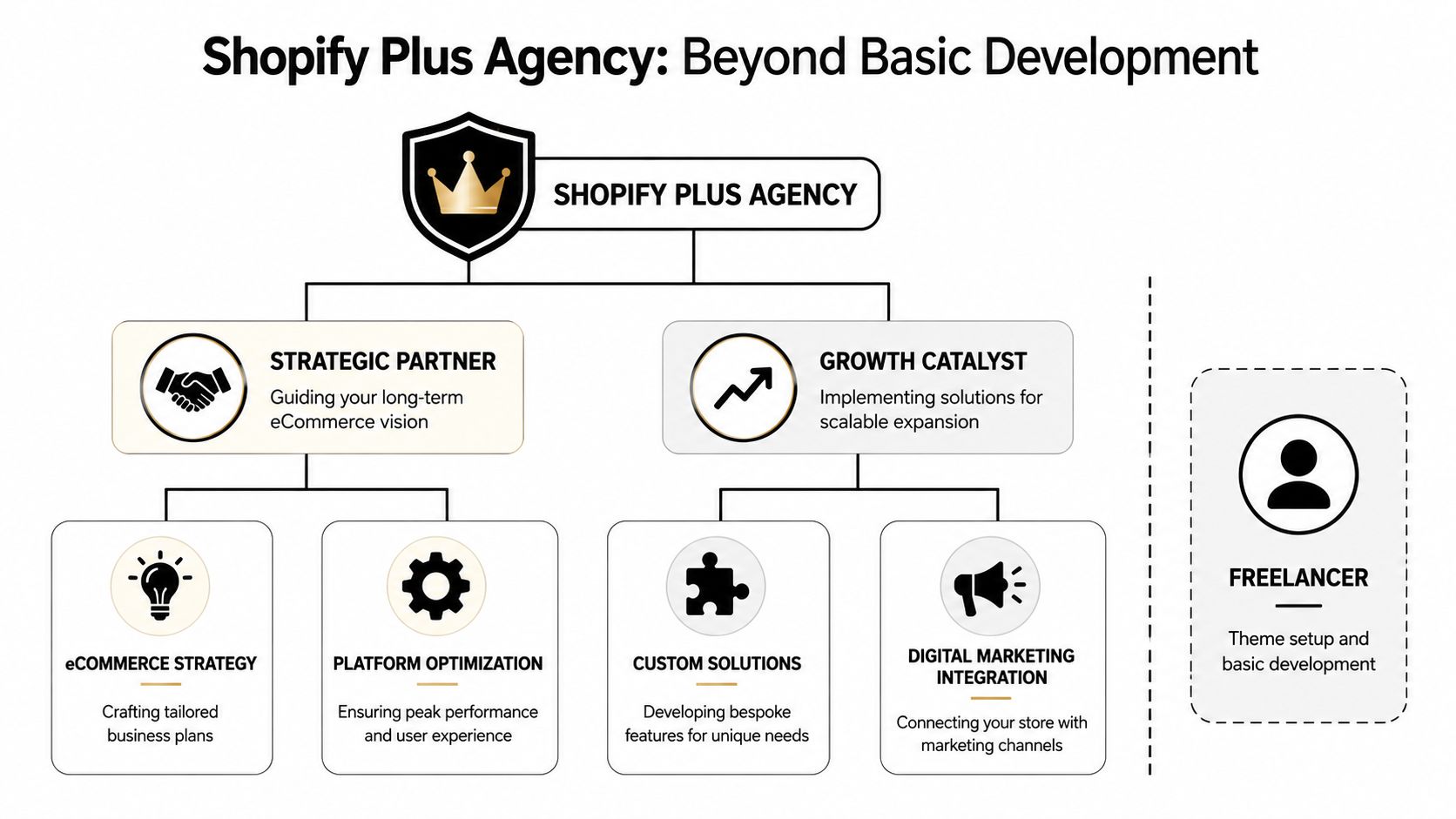
A good Shopify Plus agency doesn't just build pages. It designs the system around how the business sells, fulfils, reports, and scales.
That distinction matters. A freelancer might be perfect for a quick theme edit or a small Shopify design task. But enterprise eCommerce work usually needs strategy, UX, development, data, integration, and post-launch optimisation working together.
Think of it like building a flagship retail store
If you were opening a physical flagship store, you wouldn't hire one person to paint the walls and expect them to handle layout, fit-out, foot traffic, POS, security, staffing, and growth planning.
That's the difference here too.
A proper Shopify Plus partner usually plays three roles at once:
- Strategic advisor who maps what the business needs now and what it will need once traffic, markets, and product lines expand
- Technical architect who handles Shopify development, integrations, data structure, performance, and custom app logic
- Growth operator who connects the store to paid media, analytics, CRM, retention, and conversion testing
This matters for businesses searching terms like shopify development partners, shopify developer, shopify developers, and shopify developer api. Those searches sound technical, but the buying intent behind them is commercial. The business wants a store that performs, not just one that exists.
The work goes well beyond theme setup
In practice, a Shopify Plus agency often gets involved in areas like:
- Shopify design and UX including collection structure, product page layout, mobile conversion flow, and landing page templates
- Shopify API work for ERP, CRM, 3PL, subscriptions, loyalty tools, and custom business logic
- Tracking and analytics including setting up Google Tag Manager containers, GA4 event structures, and Meta Conversion API installation
- Paid media enablement including Google Shopping feeds, PMAX vs Google Shopping account structure, campaign priority in Google Ads, and channel attribution
- Content operations where WordPress still plays a role through WordPress development, WordPress design, and building custom blocks in Gutenberg
The strongest Plus builds don't feel “custom” for the sake of it. They feel easy to run because the complexity sits under the surface.
A lot of businesses also underestimate how closely build quality affects media performance. If your collection filtering is clunky, your product pages are slow, and your event tracking is unreliable, a Facebook ads agency or a Google Ads specialist can only do so much.
What works and what usually doesn't
Here's the plain version.
What works
- A clear scope tied to business problems
- Clean analytics before scaling spend
- Thoughtful app selection instead of app overload
- Custom features only where they solve a genuine need
- A launch plan that includes post-launch iteration
What doesn't
- Treating Shopify Plus like a cosmetic redesign
- Rebuilding old platform bad habits on a new platform
- Letting the dev team work without input from marketing, ops, and customer service
- Installing GTM, GA4, Meta events, and feeds as an afterthought
- Choosing the cheapest quote on a complex migration
This is also why businesses looking for a seo agency Melbourne, Google My Business help, local SEO, or a digital marketing agency Melbourne often end up needing technical help too. Organic growth, paid traffic, product feeds, content, and conversion all touch the website. In eCommerce, they're not separate departments. They're one commercial engine.
The Migration and Implementation Roadmap
Friday afternoon is when weak migrations get exposed. Orders are still coming in, the warehouse is chasing stock questions, paid traffic is live, and someone asks whether customer tags, GST settings, and shipping rules will survive the switch. For growing Australian brands, that anxiety is justified. A platform move can fix years of operational drag, or it can create a fresh set of problems if the handover is rushed.
The projects that go well start with commercial logic, not design files. We map how the business sells, fulfils, reports, and supports customers across Australia before anyone touches a theme. That matters even more in Melbourne and the wider AU market, where multi-location stock, GST, local carriers, and marketplace fulfilment often sit in the same stack. Teams doing understanding Shopify and Amazon fulfillment usually find this out quickly.
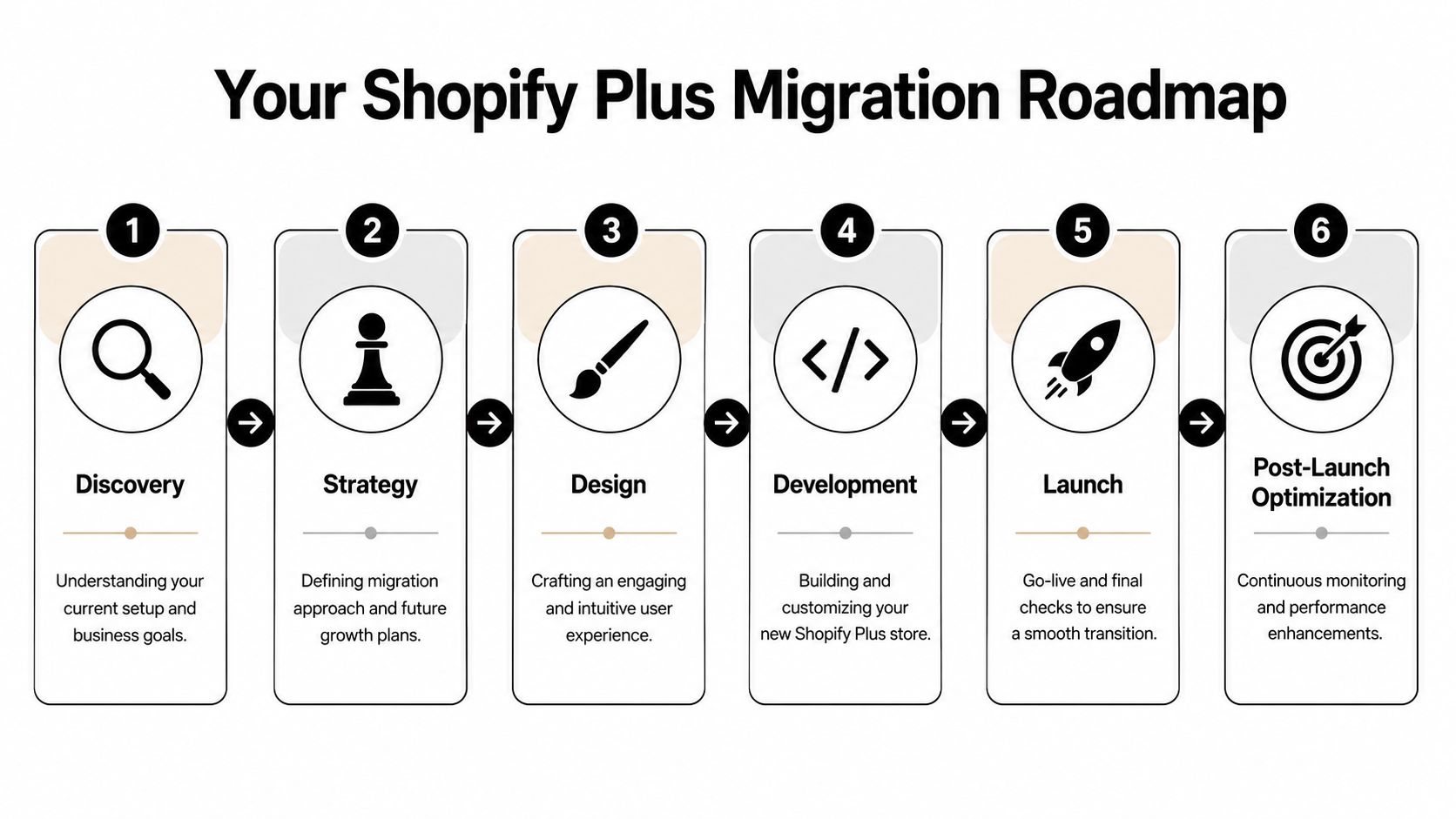
The six steps that keep projects under control
Discovery
We start by auditing the current platform, catalogue, customer data, apps, plugins, feeds, reporting, and tracking setup. On WooCommerce jobs, I also look for the hidden logic owners forget is there. Custom checkout fields, product add-ons, shipping workarounds, discount rules, and hard-coded content templates usually show up here.Strategy
The migration model gets decided at this stage. Full replatform, hybrid transition, phased rollout, or headless. The right choice depends on operational complexity, content requirements, team capability, and integration risk. Hype should not drive architecture.Design
Good Shopify Plus design supports how people buy. Navigation, collection filtering, mobile product pages, upsell placement, bundle logic, and account flows all affect revenue. We design around merchandising and conversion, not just brand presentation.Development
Implementation work occurs during this phase. It encompasses theme development, Shopify API integrations, Shopify CLI workflows, data migration scripts, app configuration, and custom feature rebuilds. If the store connects to an ERP, 3PL, CRM, POS, or subscription platform, this phase needs disciplined testing.
A useful primer if your team wants a visual walk-through is this video:
Launch
A good launch feels uneventful. Orders process correctly, taxes apply as expected, shipping methods display properly, confirmation emails send, product feeds sync, and GA4 plus ad platforms record events cleanly. Staff know what to do on day one because they have already run through the process.Post-launch optimisation
Launch day is the start of the next phase, not the finish line. Real user behaviour exposes what needs work. Search results, collection sorting, landing pages, bundles, email capture, and audience rules usually improve over the first few weeks once traffic hits the new build.
WordPress to Shopify Plus needs a careful handover
Many Australian migrations often get messy. Commerce often lives in WooCommerce, content lives across WordPress templates and plugins, and business rules are scattered through old extensions that nobody wants to touch before launch. We handle that by separating what must migrate now, what can be rebuilt better inside Shopify, and what should stay in WordPress temporarily.
The practical work usually includes:
- Phased data sync for customers, orders, products, and inventory changes while the new store is being built
- Plugin replacement mapping so each WooCommerce function is matched to a Shopify app, native feature, or custom code approach
- GST and shipping setup checks so tax, zones, and local delivery rules are correct from day one
- Tracking continuity across Google Ads, Meta, GA4, merchant feeds, and remarketing audiences
- CMS decisions about which content should move, which content should be consolidated, and whether WordPress remains part of the stack for a period
A migration fails when the new site launches with the old business problems still built into it.
Cost needs straight answers too. In Australia, heavily customised Shopify Plus migrations with deep integrations or headless components can move well beyond a standard theme build. One published guide on the cost to hire Shopify developers in Australia notes a range of AUD $40,000 to $150,000 or more for larger projects involving advanced requirements (Abbacus Technologies). In practice, the final number comes down to complexity, integration depth, and how much legacy logic needs to be rebuilt properly.
Cheap quotes on complex replatforming jobs usually create expensive problems later. The scope is underestimated, testing gets compressed, or business rules are left until the final week and billed as variations.
What affects price more than anything else
| Cost driver | Why it matters |
|---|---|
| Integrations | ERP, CRM, 3PL, POS, and custom APIs add setup, testing, and failure points |
| Migration model | Hybrid and phased rollouts require more planning than a clean rebuild |
| Design depth | Custom UX, content modules, and merchandising rules take more time than adapting a base theme |
| Catalogue and content structure | Large product ranges, variant complexity, and layered CMS requirements increase migration effort |
| Internal decision speed | Slow approvals stall development and create rework |
One final point from experience. Brands that plan for handover early get better long-term value from Shopify Plus. Documentation, staff training, and clear ownership of merchandising, campaigns, and reporting save a lot of frustration once the new site is live.
Core Services to Supercharge Your Growth
Growth on Shopify Plus rarely comes from one big feature. It comes from fixing the points where revenue gets lost every day. In Melbourne and across Australia, that usually means three areas: operational bottlenecks, weak tracking, and channel execution that has outgrown the current setup.

Development that solves business bottlenecks
The best development work removes friction for the team running the store.
That can mean connecting Shopify Plus to an ERP, 3PL, POS, subscription platform, or a custom quoting tool. It can mean building private app logic or lightweight admin utilities when off-the-shelf apps create workarounds, duplicate data, or monthly app bloat. It can also mean cleaning up metafields, collection rules, and theme components so merchandising, content, and campaign teams can launch changes without waiting on a developer every time.
We see this often with Australian retailers moving off patched-together WooCommerce or older custom platforms. The site might still be taking orders, but the team is relying on manual exports, stock corrections, spreadsheet-based promo logic, and too many apps trying to do jobs they were never designed for. Shopify Plus gives you a cleaner operating model, but only if the implementation is shaped around how the business works.
For content-heavy brands, WordPress can still have a role. In practice, the split works best when commerce stays in Shopify and richer editorial content, buying guides, and SEO resources stay in WordPress. That approach suits brands with serious content operations, but it adds governance, syncing decisions, and another layer of technical ownership. The trade-off needs to be deliberate.
Tracking and attribution that paid media can trust
Poor measurement wastes more budget than weak ads.
If events are duplicated, missing, or firing at the wrong stage, Meta will optimise against bad signals. If feed attributes are incomplete, Google Shopping performance drops. If UTMs, GTM, GA4, and platform-side conversions are misaligned, the marketing team ends up arguing over numbers instead of improving the account.
A solid setup usually includes:
- Google Tag Manager configured around a clear event plan
- GA4 mapped properly for product view, add to cart, checkout, and purchase events
- Meta Conversions API configured with deduplication and match quality checks
- Catalogue and feed setup for Google, Facebook, and Instagram
- Testing across devices, payment methods, and post-purchase flows
That last part matters. We regularly find stores where tracking looks fine on a desktop test order, then breaks on Shop Pay, subscription products, bundled offers, or AU-specific shipping flows.
Retention deserves the same level of care. Swanky Agency notes that many Shopify Plus brands use automation to improve ROAS and repeat purchase performance, particularly when flows are tied closely to fulfilment and lifecycle messaging (Swanky Agency). That lines up with what we see locally. Email and SMS flows work better when they reflect Australian delivery expectations, stock timing, and support realities, not a generic US playbook copied into Klaviyo.
Paid media that matches the store architecture
Store structure and paid media affect each other every week.
A poor product feed will limit Google Ads no matter how good the media buyer is. Weak landing pages make creative testing less useful on Meta. Cluttered collections, inconsistent product titles, and missing metafields reduce what you can do across campaigns, reporting, and remarketing.
A few examples from real projects:
- Google Shopping campaigns perform better when product titles, images, GTINs, and custom labels are cleaned up first
- Performance Max versus standard Shopping depends on data quality, margin control, reporting needs, and how much product segmentation the brand requires
- Meta creative testing works best when landing pages, offer logic, and product availability are stable
- Budget planning should be based on margin, average order value, conversion rate, and stock position, not generic platform benchmarks
Often, agency scope becomes blurred. A paid media team can buy traffic. A Shopify Plus partner should also be fixing the store conditions that determine whether that traffic converts.
One field lesson. Consistency beats novelty. Brands usually get better returns from disciplined feed work, stronger product pages, cleaner tracking, and steady creative iteration than from chasing a new tactic every fortnight.
Fulfilment choices shape growth as well. If you are selling through multiple channels, it helps to spend time understanding Shopify and Amazon fulfillment before you split inventory or promise fast delivery across marketplaces. We have seen channel expansion create support pressure, margin erosion, and stock sync issues long before it creates real profit.
The wider eCommerce stack often expands with growth
As a store matures, the platform stops being the whole story. The stack around it gets broader and more specialised.
| Growth area | Typical implementation |
|---|---|
| Content and SEO | Category content, technical fixes, local search visibility, buying guides |
| Acquisition | Google Ads, Meta ads, shopping feeds, remarketing |
| On-site conversion | Theme speed, landing pages, merchandising logic, reusable sections |
| Automation | Email, SMS, post-purchase flows, win-back logic |
| Call handling for hybrid businesses | Twilio number setup, calendar booking, after-hours lead capture |
The last category matters for more Australian businesses than people assume. We have worked with operators who sell online but still close high-value sales by phone, or run a hybrid model with bookings, consults, and service enquiries. In those cases, a Twilio number connected to a virtual answering workflow can capture missed calls, qualify leads, and book appointments into a calendar or Calendly. That protects ad spend and lifts conversion from channels that would otherwise send customers into voicemail.
The common thread is alignment. Platform decisions, tracking, creative, fulfilment, and operations need to support each other. That is what turns Shopify Plus from an expensive rebuild into a stronger growth system.
How to Choose Your Melbourne Shopify Plus Partner
A lot of Melbourne brands start this process after a bad quarter. The site is under strain, paid traffic is expensive, the warehouse team is frustrated, and someone in the business says, "We need Shopify Plus." Fair enough. The harder question is who should lead the move.
The wrong partner usually does not fail in the pitch. They fail in discovery, in trade-off decisions, and in the first six weeks after launch when real operational issues show up. We have stepped into projects where the build looked polished, but key flows for GST handling, local shipping rules, ERP sync, or B2B pricing logic were still shaky. That is where cost blows out.
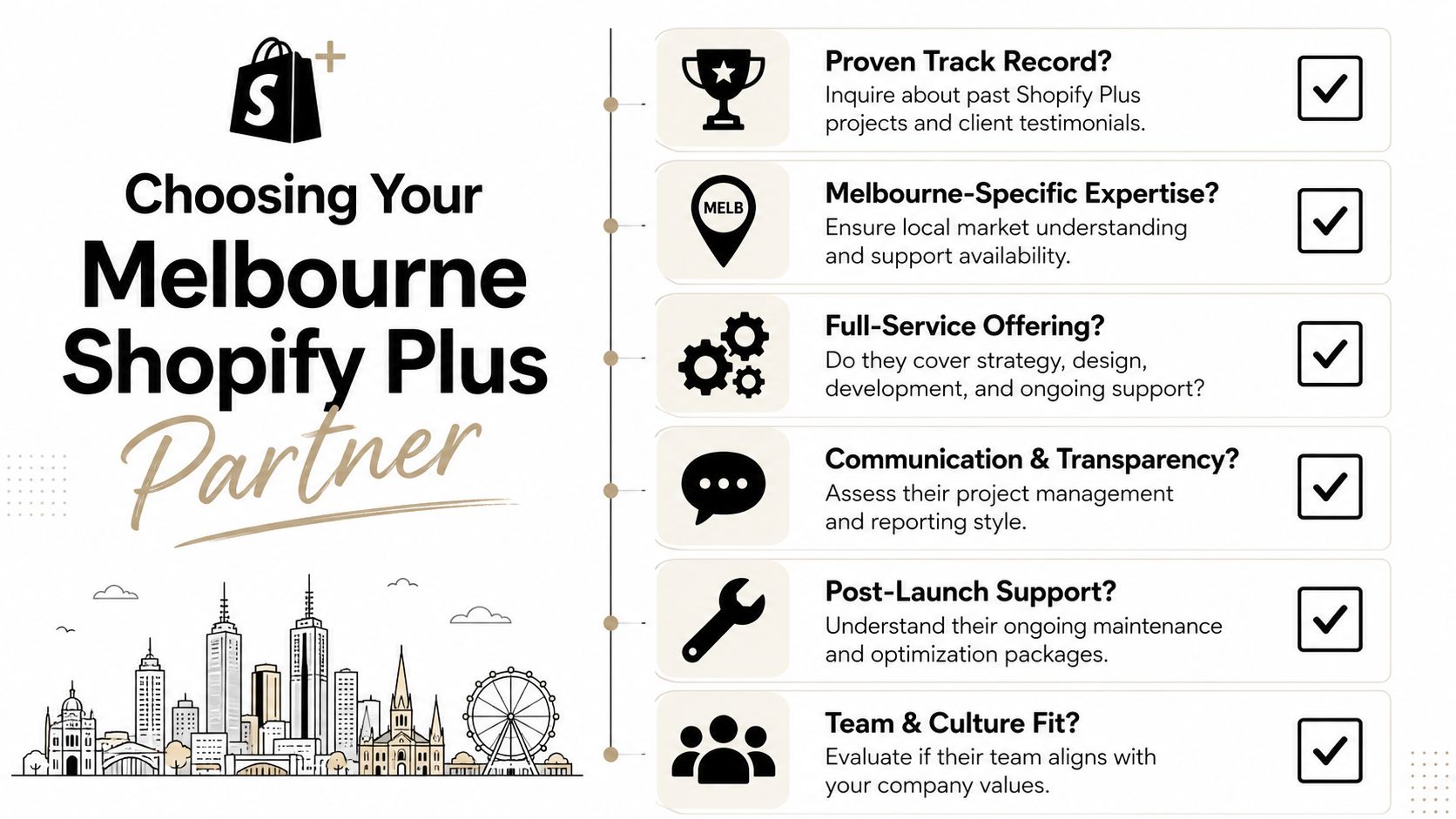
The questions worth asking before you sign
Good partners answer direct questions with direct answers. If the response stays high-level, treat that as a warning.
Ask these:
What kind of Shopify Plus work do you do every month
Look for specifics. Migrations from WooCommerce or Magento, custom app work, ERP or 3PL integrations, Shopify Functions, Checkout Extensibility, and post-launch optimisation all tell you more than a generic "end-to-end Shopify" claim.Who actually runs the project
Founders often sell the work. The day-to-day reality sits with a project manager, solution architect, lead developer, and support team. Ask who is in the room during scoping, who signs off technical decisions, and who picks up urgent issues during launch week.How do you handle scope pressure
Every serious build hits edge cases. The useful answer is not "we manage it tightly." It is a process. What gets documented, what triggers a change request, what gets pushed to phase two, and what gets escalated because it affects trading.How do you prepare the store for marketing and reporting
A build partner does not need to run your ads, but they do need to set the site up so your team or agency can work properly. Ask about GTM, GA4, product feeds, Meta Conversion API, consent mode, event mapping, and QA before launch.What should stay outside Shopify for now
This question separates commercial thinking from rebuild thinking. In Australia, the right answer is often hybrid for a period. Legacy content, complex quoting tools, or some service workflows may stay put until the new commerce stack settles.
Price matters. Fit matters more.
Cheap builds rarely stay cheap. They either miss important work in scoping or push the underlying complexity into change requests and patchwork fixes.
For context, the average hourly rate for a Shopify developer in Melbourne is between $80 and $218 AUD, with top-rated, experienced developers typically charging between $90 and $200 per hour, according to Melbourne Shopify developer pricing data on Airtasker.
That range is only a reference point. A stronger test is whether the proposal reflects your business model. A fashion brand with frequent launches, bundles, and returns pressure needs a different solution from a wholesaler with account-specific pricing and a field sales team.
Here is the pattern I trust more than any pitch deck:
| Agency signal | What it usually means |
|---|---|
| They ask about margin, fulfilment, returns, and internal workflows early | They are scoping a commerce system, not just a website |
| They can explain what stays standard and what needs custom work | They know how to control cost and complexity |
| They involve technical and strategy people before the quote lands | Fewer surprises once delivery starts |
| They lead with visuals and a low estimate | Important operational work may be missing |
A Melbourne partner does not need polished theatre. They need pattern recognition from real AU projects.
Red flags I would take seriously
The first red flag is shallow discovery. If the agency can quote quickly without reviewing apps, integrations, data structure, and operational dependencies, they are guessing.
The second is app-first problem solving. Apps are useful. A store stacked with overlapping apps for subscriptions, bundles, search, discounts, shipping, and reporting often becomes harder to maintain, slower to troubleshoot, and more expensive month to month.
The third is no interest in commercial metrics. A partner who never asks about AOV, return rate, blended CAC, repeat purchase behaviour, or fulfilment cost is treating the job as design and development only. That is not enough for a Plus build.
I also pay attention to what happens after launch. Some teams are strong builders and weak operators. If support, CRO, analytics, SEO, retention, and paid media handoff all sit outside their capability, your internal team ends up stitching together the result.
That matters for Melbourne businesses choosing across categories like seo agency Melbourne, Google Ads agency, Facebook Meta ads agency, web design Melbourne, or ecommerce marketing agency. The store is one part of the growth system. The better partner understands how the platform, data, operations, and acquisition channels need to work together once the site is live.
From WordPress to Enterprise Success A Real-World Example
A Melbourne retailer hits the same wall in a familiar way. The WooCommerce site still takes orders, but every campaign needs workarounds, product updates depend on plugin behaviour nobody fully trusts, and reporting breaks at the exact moment the business needs cleaner numbers.
We see this a lot with Australian brands that grew in stages. WordPress and WooCommerce were a sensible starting point. Then the catalogue expanded, paid media spend increased, wholesale or multi-market requirements appeared, and the store architecture started creating drag across the business.
One recent pattern stands out. The problem is rarely one dramatic failure. It is the build-up of smaller issues. Customer data sits across plugins and spreadsheets. Merchandising changes take too long. Blog content performs well in search, but commerce pages are hard to scale. The team spends more time protecting the current setup than improving it.
Why a hybrid migration often works better
An overnight replatform is not always the best call.
For content-heavy brands, we often move the trading engine to Shopify Plus first, then keep selected WordPress assets live for a defined period. That usually means product catalogue, checkout, promotions, and operational workflows shift first, while legacy blog content, resource hubs, or SEO pages stay in place until redirects, templates, and content governance are ready.
That structure reduces risk. The business keeps selling. The marketing team keeps publishing. Operations get time to test fulfilment rules, tax settings, and customer flows before every moving part is consolidated into one stack.
It also reflects how a lot of Australian businesses operate. Clutch's Australia Shopify developer market page notes strong Shopify adoption among businesses while many companies still maintain older web stacks, including WordPress, during growth or transition phases, and it gives useful context on agency pricing in this category. https://clutch.co/au/developers/shopify
What the work usually involves
On real projects, the migration plan is less about “moving a website” and more about rebuilding the commercial system properly.
- Data migration for customers, orders, products, gift cards, and subscription history where needed
- Feature review to decide which WooCommerce plugin behaviour should be rebuilt, replaced, or removed
- Content triage so high-value SEO assets are preserved without dragging old site problems into the new build
- Integration setup across ERP, 3PL, email, search, reviews, and reporting tools
- AU market checks for GST, shipping logic, payment methods, and post-purchase expectations
The trade-off is straightforward. A hybrid model can protect revenue and rankings during transition, but it also adds temporary complexity. Two systems need clear ownership, clean tracking rules, and a plan for final consolidation. Without that discipline, “temporary” turns into a long-term mess.
What changed after launch
The strongest outcomes were operational, not cosmetic.
The team could launch campaign pages without waiting on patch fixes. Product and collection updates became routine instead of risky. Tracking improved because the stack was simpler. Customer service had better order visibility. Warehouse errors dropped because the store logic finally matched the fulfilment process.
That is the part founders usually feel first. Less friction. Fewer manual checks. More confidence in what the platform is doing day to day.
For brands weighing channel strategy at the same time, the platform decision also affects customer ownership and margin control. The Shopify vs Amazon guide is useful if the business is deciding how much of future growth should sit on owned infrastructure versus marketplace demand.
WordPress and Shopify do not need to compete with each other in every case. For some Melbourne and wider AU brands, WordPress remains the better home for editorial content during a transition. Shopify Plus becomes the better home for commerce, operations, and growth. The win comes from choosing the role of each system deliberately, then retiring legacy complexity on a clear timeline.
Ready to Build Your Forever Platform
The right Shopify Plus move doesn't feel like buying a new website. It feels like removing friction from the business.
If your current store is slowing campaigns down, creating operational mess, or making every change harder than it should be, the core issue usually isn't design alone. It's that the platform no longer matches the stage your business is in. That's when a strong Shopify Plus agency becomes valuable. Not as a vendor, but as the team that helps align build, systems, analytics, and growth.
For Australian eCommerce brands, that matters even more. Melbourne businesses often need local market nuance, GST awareness, practical migration planning, and a partner that understands how store architecture affects Google Ads, Meta ads, shopping feeds, local SEO, and retention. That's also why many buyers searching for a digital marketing agency Melbourne, marketing agency Melbourne, shopify development partners, wordpress development Melbourne, or shopify developer api are really searching for the same thing. A team that can connect the technical decisions to commercial outcomes.
If you're still weighing channels and ownership models, this broader Shopify vs Amazon guide is useful context before you lock in your long-term platform strategy. It helps frame the trade-off between owning the customer relationship and relying on marketplace demand.
A few final points are worth keeping front of mind:
Choose for the next stage, not the last one
The platform should support where you're going, not just where you started.Don't separate build from growth
Shopify development, Shopify design, tracking, feeds, and paid acquisition are tied together.Respect migration complexity
WordPress to Shopify Plus can be done well, but only when the process is disciplined.Back Australian relevance when building links and authority
For eCommerce brands doing backlink exchange or partnership outreach, Australian websites are usually the better priority than generic international placements.
If you run an eCommerce business and want practical support across WordPress development, Shopify development, Google ads, Facebook ads, local SEO, or conversion tracking, the goal isn't to chase every tactic. It's to build a store and marketing engine that can keep compounding.
If you're looking for a partner that combines high-converting web builds with performance marketing, Alpha Omega Digital is based in Melbourne and works with businesses across Sydney, Brisbane, Newcastle, Perth, Adelaide, Darwin and Hobart. If you're a business with a paid ads budget of at least 3k a month, I'd love to offer you a low risk deal, get a month of paid ads management FREE. Apply through the contact page. If you also need specialist help, explore their WordPress developer services, Google Ads for plumbers, best Facebook ads agency, Facebook ads for electricians, Shopify developers Melbourne, ecommerce marketing agency, Google Ads agency, Facebook Meta ads agency, WordPress developers Melbourne, and web design Melbourne.
[email protected]
Read more insights from our team on web design, paid ads, and growth strategy.