If you're reading this, there's a fair chance your store isn't failing. It's just stuck.
You've got products people want. Orders come through often enough to prove demand. The site looks decent on the surface. But growth has slowed, small technical issues keep piling up, and every week turns into a scramble between fulfilment, customer support, theme tweaks, ad experiments, reporting, and the jobs you wanted to spend your time on.
I've seen that point a lot with ecommerce brands in Melbourne. The owner usually starts by looking for a Shopify agency, but what they really need is clarity. Not every store needs a rebuild. Not every brand needs more traffic. Sometimes the issue is weak tracking. Sometimes it's a clunky mobile experience. Sometimes the store is fine and the paid media is the bottleneck. Sometimes the opposite is true.
That difference matters because hiring the wrong partner is expensive, not just in fees, but in lost time, bad data, patchy launches, and months of momentum you don't get back. This is the inside view on how I'd assess a Shopify partner if I were hiring one for my own store in Australia.
When Your Shopify Store Hits a Growth Ceiling
A lot of ecommerce businesses hit the same wall in roughly the same way. Sales aren't dead, but they stop climbing. Your ad account starts feeling unpredictable. The theme that looked simple at launch now feels limiting. You want better landing pages, better product page layouts, cleaner bundles, stronger tracking, and a proper plan for Google Ads and Meta. Instead, you're spending your Tuesday night trying to work out why a collection page is loading strangely on mobile.

I've worked with store owners who were wearing four hats badly because they had no choice. Founder. Marketer. Developer. Customer service lead. That setup can work when you're validating a product. It usually breaks once the business needs consistent execution across design, Shopify development, paid media, analytics, and retention.
The warning signs are usually operational first
The first signs aren't always obvious in your revenue graph. They show up in the day-to-day friction:
- Theme work takes too long because every edit feels risky.
- Product launches drag out because nobody owns design, copy, merchandising, and setup end to end.
- Paid ads underperform because the landing experience and tracking aren't trustworthy.
- Reporting creates arguments because Shopify, GA4, and ad platforms all tell a slightly different story.
- Simple requests pile up like adding custom sections, improving filters, refining cart behaviour, or fixing collection templates.
That friction is the growth ceiling. Not the platform itself.
Practical rule: If you're making decisions based on guesswork because your store setup, tracking, and marketing are disconnected, you've outgrown the DIY stage.
Why the right partner changes the trajectory
A good Shopify agency earns its keep, not by selling a prettier theme, but by removing bottlenecks.
A capable partner should be able to look at the entire system. Storefront UX. Shopify design. Shopify API use cases. Paid traffic. Product feed quality. GTM and Google Analytics setup. Meta Conversions API. Offer positioning. Local SEO if you're blending ecommerce with a showroom or service component. If you're moving off WordPress, they should also understand migration risk and know when a dedicated WordPress developer needs to be involved to preserve structure, content, and SEO value.
Here's what I've learned the hard way. Businesses usually wait too long to hire specialists because they frame the decision as overhead. The better frame is an advantage. A good partner frees the founder to focus on inventory, margins, offers, suppliers, and customer experience instead of debugging apps and second-guessing campaign settings.
What works and what doesn't
A few patterns show up repeatedly.
| Situation | What usually works | What usually fails |
|---|---|---|
| Store looks fine but sales are flat | Auditing user journey, offers, tracking, and traffic quality | Rebuilding the whole site without diagnosing the bottleneck |
| Ads are running but results feel murky | Fixing data flow with GTM, GA4, and Meta CAPI | Scaling spend before attribution is clean |
| Founder is stretched thin | Bringing in a team with clear ownership across channels | Hiring separate freelancers with no shared strategy |
| Store has outgrown theme defaults | Custom Shopify development and better merchandising logic | Installing more apps to patch structural issues |
The businesses that break through usually stop asking, “Can I keep doing this myself?” and start asking, “What should I keep owning, and what should a specialist own?”
First Define Your Mission Before You Search
Before you search for a digital marketing agency Melbourne or a Shopify partner, get specific about the actual problem. This step saves a huge amount of money.
Most bad agency engagements start with a vague brief. The owner says they want “a better website” or “more sales”, the agency fills the blank with whatever it sells, and both sides spend the next few months realising they were solving different problems.
Start with the business problem, not the platform
I've found that the cleanest briefs answer four questions.
- Is this a build, rebuild, or optimisation job?
- Is the main issue traffic, conversion, tracking, or operations?
- Do you need design, development, marketing, or all three?
- What has to stay intact during the project?
That last question matters a lot. If you're migrating from WordPress, preserving rankings, redirects, category structure, blog content, and collection intent isn't optional. If your store already gets traction from Google, a careless rebuild can create more damage than improvement. That's when broader WordPress development, WordPress design, and migration experience matter just as much as Shopify skill.
A practical self-audit before agency calls
Use this checklist before you book any discovery sessions.
Storefront problem
Are visitors struggling to browse, compare, trust, or complete checkout? Look closely at mobile navigation, product page clarity, collections, filters, cart behaviour, and page speed.Marketing problem
Are you getting traffic that doesn't buy, or not getting enough qualified traffic at all? This affects whether you need a Facebook ads agency, help with Google Ads, a beginners guide to Google Shopping ads, support with Google shopping ads for dropshipping, or a broader acquisition plan.Tracking problem
Do you trust your numbers? If not, sort that first. That means setting up Google Tag Manager containers, configuring GTM and Google Analytics, and handling Conversions API installation for Meta or setting up Meta Conversion API properly.Development problem
Do you need custom functionality? That might include Shopify API work, building custom Shopify apps using Shopify CLI, custom sections, subscription logic, bundles, landing pages, or advanced merchandising. On the WordPress side, it could mean building custom blocks in Gutenberg or fixing a theme stack that's become hard to manage.
A lot of agencies skip this discipline. One of the biggest local pitfalls is poor planning before launch. The need for thorough user flow analysis and technical performance assessment before going live is highlighted in this Shopify success rate guide, which also notes that up to 95% of Shopify stores fail within the first few years and that a proper build starts with a Needs Analysis and Project Planning workshop.
If an agency wants to quote before it understands your catalogue, traffic sources, operational constraints, and customer journey, it's guessing.
Match the brief to the partner
Not every business needs a full-service team from day one. Some need a developer first. Others need paid media and measurement. Others need a redesign because their site is undermining perfectly decent ad traffic.
A simple way to sort it:
| Your main need | The kind of partner to prioritise |
|---|---|
| Replatforming from WordPress | Shopify team with migration and SEO preservation experience |
| Theme limitations and custom features | Strong Shopify developer or Shopify development partner |
| Weak conversion rate | CRO-led Shopify team with design and analytics depth |
| Scaling acquisition | Paid media team strong in Meta, Google Shopping, PMAX, and landing page feedback loops |
| Dirty attribution | Team fluent in GTM, GA4, Meta CAPI, and event mapping |
Clarity here protects you from buying a full rebuild when what you really needed was cleaner tracking and a better media strategy.
The Anatomy of a High-Performing Shopify Agency
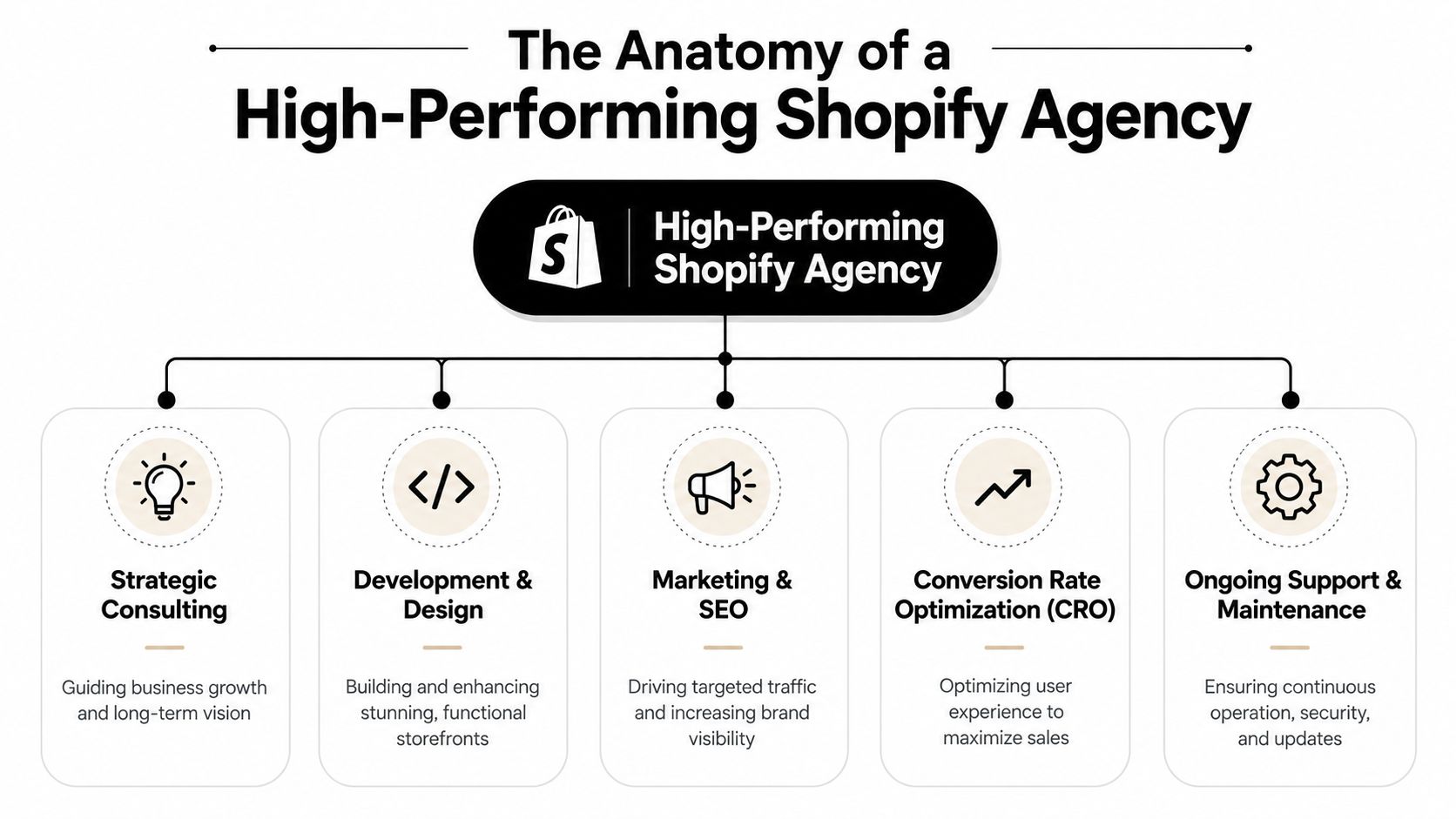
The agencies that consistently help ecommerce brands grow tend to be multidisciplinary. They don't treat Shopify design, Shopify development, paid acquisition, and analytics as separate silos. They treat them as parts of the same commercial engine.
Strong agencies do more than theme setup
A store can look polished and still underperform badly. Good agencies know that a nice homepage doesn't fix weak product detail pages, poor variant logic, confusing shipping information, broken analytics, or an ad account optimising against bad events.
The core capabilities I look for are these:
Strategy and commercial thinking
They should understand offer structure, merchandising, landing page intent, new customer acquisition, and what changes actually affect revenue.Shopify design and frontend execution
Good Shopify design isn't decoration. It's navigation logic, product page hierarchy, collection usability, trust cues, mobile-first behaviour, and clean section architecture.Real Shopify development skill
This includes theme customisation, app integration, API work, and, when needed, building custom Shopify apps using Shopify CLI. If you need a capable Shopify development team in Melbourne, the test isn't whether they can install apps. It's whether they can explain when not to.Paid media and channel fluency
A quality partner should be able to talk through Google Ads for service based businesses, Google Ads for contact form submissions, PMax vs Google Shopping ads, campaign priority in Google Ads, and how they run a Meta ads creative testing process without hiding behind jargon.Measurement and data plumbing
They should know how to implement GTM and Google Analytics, event tracking, enhanced conversions, and Conversions API installation for Meta so reporting is useful, not decorative.
Real CRO has a traffic threshold
Plenty of agencies oversell. They mention CRO in a proposal, then make tiny visual edits on stores that don't have enough traffic for meaningful testing.
The benchmark I use is simple. Meaningful testing requires at least 10,000+ monthly sessions, with 30,000+ as the ideal threshold, according to this Shopify CRO methodology reference. The same source warns that agencies working below that baseline often chase vanity metrics that don't connect to revenue, especially when they apply US-style testing habits to lower-volume Melbourne stores.
That doesn't mean lower-traffic stores can't improve. They can. It means the method changes.
What good CRO looks like on lower-volume stores
For smaller stores, I prefer a blend of:
- heuristic analysis
- session review
- funnel review
- speed and UX fixes
- stronger merchandising
- better offer communication
- cleaner event tracking
- landing page refinement tied to campaign intent
That's still optimisation. It's just not pretending you've got enough volume for endless A/B testing.
A serious CRO partner will tell you when not to run a test.
Technical range matters more than a big service menu
I pay attention to what an agency can explain in detail. Can they discuss Shopify API limitations and opportunities? Can they speak comfortably about Instagram Shop and Facebook Shop setup? Can they map product feeds for Google Shopping? Can they connect merchandising logic to campaign structure? Can they build around platform constraints instead of blaming them later?
The same applies to content-led stores and hybrid ecommerce businesses. If your brand needs editorial content, guides, or landing pages outside Shopify, broader web capability matters. That might include a WordPress development partner in Melbourne for supporting sites, content hubs, or migration planning, especially when WordPress developers, a WordPress web developer, or a WordPress website developer need to work alongside Shopify specialists.
One example in Melbourne is Alpha Omega Digital's ecommerce and web development work, which sits across Shopify builds, WordPress development, paid media, and conversion-focused improvements. That's useful when a brand doesn't want separate vendors arguing over who owns the result.
Decoding Shopify Agency Pricing in Australia
Pricing in Australia gets messy because proposals often bundle strategy, design, development, app setup, tracking, migration, support, and marketing into one broad number without showing what you're buying.
That's where businesses get caught. The issue usually isn't that an agency charges too much in absolute terms. It's that the scope, level of expertise, and post-launch obligations are unclear.
Why Melbourne businesses overpay
The local market has a real transparency problem. According to the 2025 Australian ECommerce Industry Report, 57% of Melbourne SMBs overpay for Shopify development by 30–45% due to unclear pricing structures, and 71% couldn't identify which agency tier matched their growth stage. Those figures matter because they explain why so many proposals feel hard to compare. If one agency is pricing like a top-tier retained consultancy and another is pricing like a boutique delivery team, but both use similar language, buyers struggle to judge value.
What usually sits behind the quote
A proposal can look expensive for good reasons or bad ones. I want to know which.
| Pricing model | Usually suits | Watch-outs |
|---|---|---|
| Fixed project fee | New builds, migrations, redesigns | Scope creep, vague revision limits, weak post-launch support |
| Monthly retainer | Ongoing ads, CRO, support, reporting | Fuzzy deliverables, no roadmap, too much “general support” language |
| Hourly work | Small dev tasks, troubleshooting, ad hoc changes | Hard to forecast costs, incentives can misalign |
The phrase "Shopify agency pricing" is too broad to be useful on its own. A store migration, a custom app brief, a lightweight redesign, and a paid media retainer are different jobs.
The trade-offs between tiers
At one end, you have premium agency models with big teams, heavier process, and broader overhead. At the other, you have boutique operators who can be nimble, senior, and commercially sharp, but may have less bench depth. Neither is automatically better.
Ask yourself:
Do you need complexity handled?
Multi-market stores, custom integrations, advanced feeds, subscriptions, B2B logic, and deep analytics often justify a heavier team.Do you need speed and access?
Smaller firms can sometimes move faster and keep communication tighter because fewer layers sit between strategy and execution.Do you need migration protection?
If you're moving from WordPress, WooCommerce, or another CMS, preserving SEO, content architecture, redirects, and product data quality should be priced explicitly.
Cheap proposals often become expensive after launch because the missing work shows up later as fixes, rework, and lost performance.
Read proposals like an operator
When I review a quote, I look for the line items that agencies often blur together:
- Discovery and planning
- UX and design
- Theme development
- App configuration
- GTM, GA4, and Meta CAPI
- Product feed work
- SEO migration handling
- QA and launch checks
- Training and handover
- Post-launch optimisation
If those pieces aren't visible, ask for them. A clean proposal should tell you what happens before launch, what happens after launch, and who is responsible when a platform, app, or tracking issue appears.
How to Interview an Agency and Spot Red Flags
Agency sales calls are easy to like. Good decks. Good language. Nice mockups. The problem is that polished agencies can still be weak operators.
I care less about how they pitch and more about how they think under pressure. The right interview questions expose that quickly.
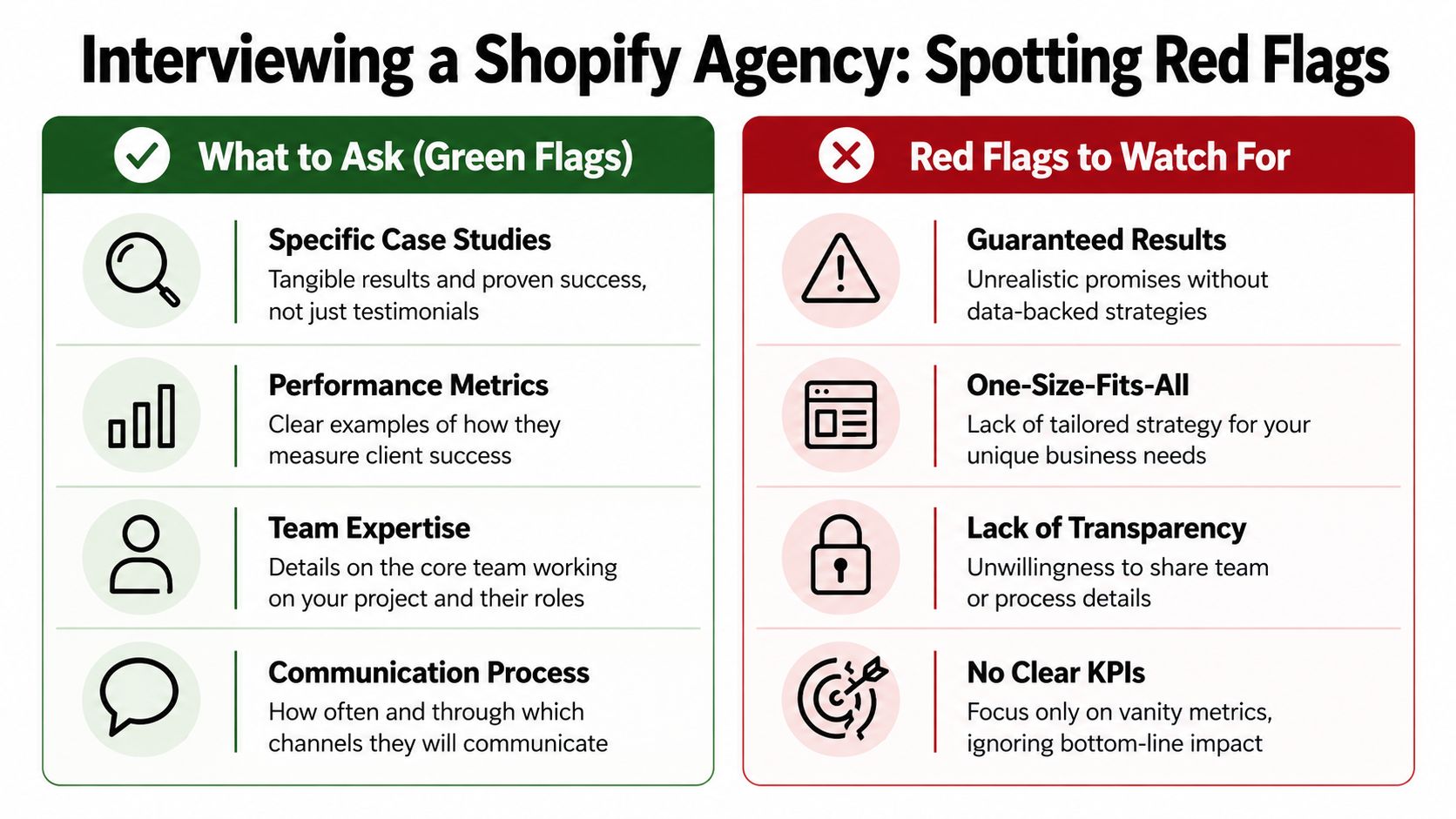
Ask for process, but ask for proof
These questions usually tell me a lot:
Show me a sample monthly report.
I want to see how they report on store performance, paid media, creative testing, and next actions.What happens in the first month after launch?
Weak agencies go vague here. Strong ones talk about QA, tracking validation, user feedback, merchandising changes, and prioritised fixes.How do you decide whether a store needs CRO, more traffic, or a rebuild?
This reveals whether they diagnose or sell.Who will work on my account?
I want names, roles, and what each person owns.Tell me about a project that became difficult. What changed?
Good operators answer this directly. Poor ones dodge or pretend every job runs smoothly.How do you handle GTM, GA4, and Meta CAPI setup?
If the answer sounds improvised, expect attribution issues later.What does your Meta ads creative testing process look like?
A real answer mentions hypotheses, creative angles, volume of testing, learning cadence, and when they kill ideas without quitting too early.
Post-launch support is where many agencies fall apart
This is the gap most buyers miss. They interview the build team and forget to interview the support model.
That mistake is expensive. A 2024 Australian Government survey found that 42% of ecommerce businesses ended their agency partnership within 18 months, and 68% of those cited no clear CRO roadmap as the main reason. That tells you the issue isn't usually launch day. It's what happens after launch when the agency has already moved on.
So ask these directly:
- How often do you review store performance after launch?
- What triggers a CRO recommendation from your team?
- What metrics do you consider actionable versus vanity?
- How often will we meet, and who comes to those meetings?
- What gets checked after app installs, theme edits, and campaign launches?
If “ongoing support” isn't attached to a cadence, a roadmap, and clear decision-making criteria, it's just a phrase.
Red flags I wouldn't ignore
Some red flags are obvious. Some are subtle.
| Red flag | Why it matters |
|---|---|
| Guaranteed rankings or guaranteed ROAS promises | Experienced teams know too many variables sit outside their control |
| Generic recommendations before access or audit | They haven't diagnosed the actual problem |
| No clear owner for analytics and tracking | You'll end up debating numbers instead of improving them |
| Heavy focus on clicks, reach, and likes | Vanity metrics can hide weak commercial outcomes |
| No interest in your margins or repeat purchase behaviour | They may optimise for surface metrics, not business quality |
| Vague support language | Post-launch issues will become your problem |
I also get wary when an agency claims to do everything but can't go deep on anything. If they say they run Google Ads, ask about what budget to spend on Google Ads, why Google Shopping ads not spending budget happens, or how they think about campaign priority in Google Ads. If they say they handle Meta, ask how they measure success on Facebook ads and why brands shouldn't quit too early when testing creative and offers. Detail reveals competence.
One more thing to test
Ask how they collaborate with businesses that also need SEO, local visibility, or hybrid service and ecommerce support. A capable marketing agency Melbourne should be able to connect local SEO, Google My Business, a wider SEO agency Melbourne remit, and paid acquisition without turning each channel into a separate universe.
That matters if your business sells online and also relies on local trust signals.
The Onboarding Journey What to Expect After Signing
A solid onboarding process feels calm. Not chaotic. You shouldn't be chasing the agency for timelines, wondering who is doing what, or discovering halfway through that basic assets were never requested.
When we onboard ecommerce clients, the first priority is alignment. That's especially important on Shopify because the platform is now firmly embedded in the local market. As of 2025, Shopify is the most popular ecommerce platform in Australia, powering 29% of local stores, and merchants have generated over $1.6 trillion in sales since inception. Those numbers show why a good setup matters. The platform is strong, but strong platforms still need expert implementation.
What a healthy onboarding flow looks like
I prefer a practical sequence.
Discovery and goals
The business context requires proper unpacking. Product mix, margins, fulfilment realities, customer segments, ad history, repeat purchase behaviour, catalogue complexity, and internal bottlenecks all need to be on the table.
If the business also has content, lead generation, or support assets on WordPress, that gets mapped early too. The mapping process allows WordPress development Melbourne, WordPress development company work, and Shopify planning to overlap.
Technical access and audit
Once the relationship is formalised, the team should gather access cleanly and audit the current stack. Shopify admin. Meta. Google Ads. Merchant Center. GTM. GA4. Email tools. Feed tools. Reviews. Search console. Call tracking if relevant.
This is also where the ugly things usually show up. Duplicate tags. Wrong events. Broken pixels. Apps affecting load or layout. Product feed errors. Theme edits that nobody documented.
Roadmap and prioritisation
I like to split work into immediate fixes, near-term growth items, and later enhancements. That helps avoid one common mistake, which is treating every request as equally urgent.
Typical early priorities might include:
- Fixing event tracking so ad platforms can optimise properly
- Refining collection and product templates for clearer buying paths
- Cleaning up Google Merchant Center inputs
- Improving mobile UX where most friction appears first
- Setting a reporting cadence so everyone knows what success looks like
Custom solutions during onboarding
Not every ecommerce business needs the same stack. Some need straightforward theme work. Others need more operational support tied to marketing and lead handling.
For service-led brands and hybrid businesses, we've also set up custom Twilio-powered numbers that handle 24-hour call answering, never get sick or tired, and can book appointments directly into your calendar or Calendly. That kind of setup can save a surprising amount of lost business for tradies, hairdressers, beauty therapists, dentists, restaurants, and doctors who miss calls after hours or during busy periods.
The point isn't the tool itself. It's that onboarding should uncover where revenue leaks are happening outside the storefront too.
Good onboarding doesn't just collect passwords. It identifies where money is being lost.
Communication should feel structured
You should know:
- who your day-to-day contact is
- when updates happen
- what gets approved by you
- how changes are prioritised
- what gets tested before launch or deployment
If those basics are unclear during onboarding, they usually stay unclear later.
Measuring Real Success The KPIs That Drive Your Business
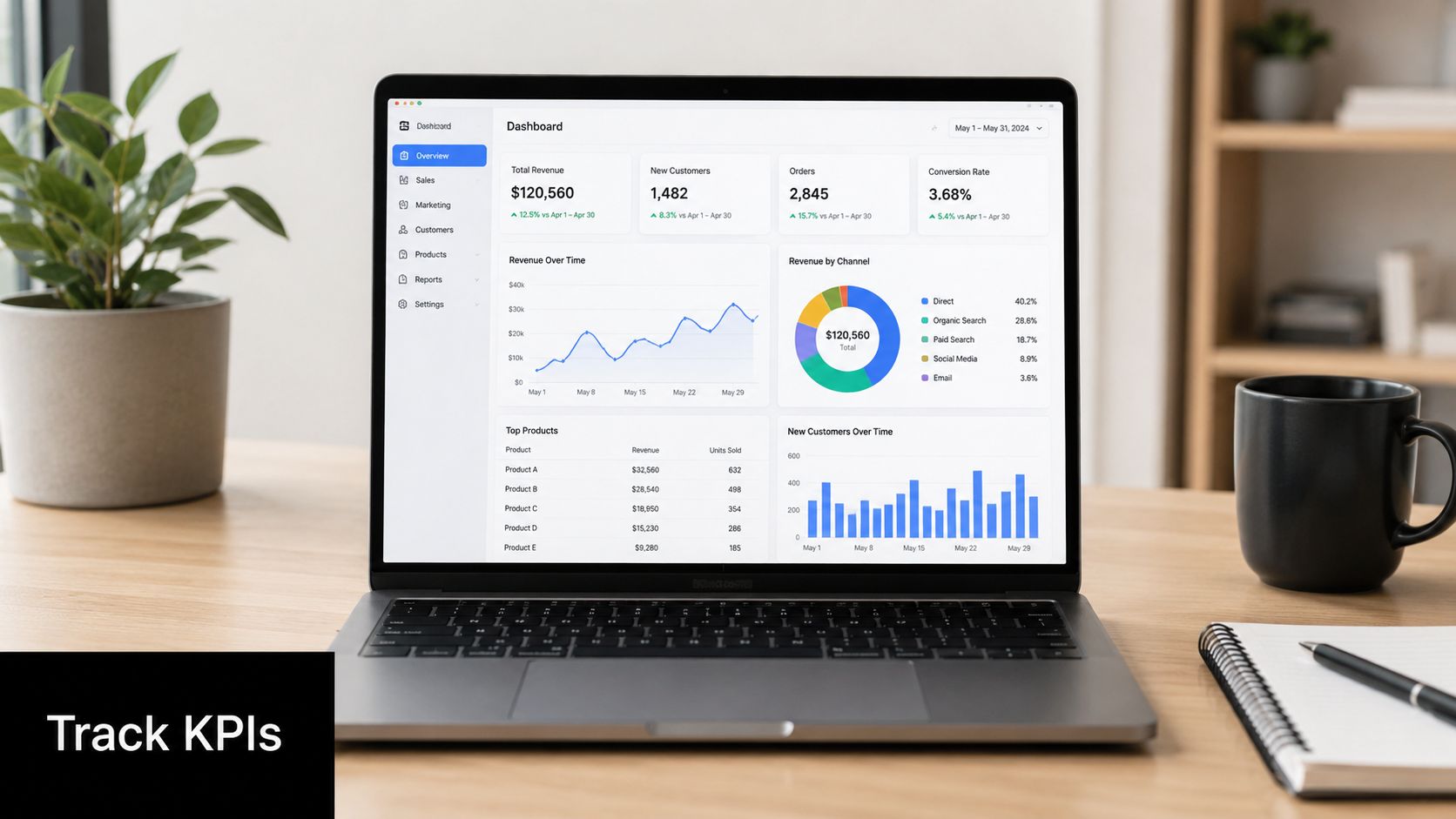
Traffic can go up while profit goes backwards. Ad spend can rise while customer quality drops. A redesigned store can look sharper and still create more friction on mobile. That's why I push clients to focus on commercial KPIs, not dashboard theatre.
The upside of getting this right is huge. Shopify reported $8.88 billion in total revenue in 2024, up 26% year over year, and Shopify merchants generated $14.6 billion during the 2025 BFCM weekend. That scale shows what the platform can support when campaign execution and store performance are tightly managed.
The metrics that actually matter
For ecommerce, these are the numbers I care about first.
| Area | KPI | Why it matters |
|---|---|---|
| Store performance | Conversion rate | Tells you how efficiently traffic turns into orders |
| Basket quality | Average order value | Helps you understand merchandising and offer strength |
| Acquisition | Cost per acquisition | Shows what it costs to win a customer |
| Paid media | Return on ad spend | Useful for channel efficiency when interpreted alongside margin |
| Customer quality | Lifetime value | Stops you from overvaluing cheap but weak customers |
| Experience | Site speed and checkout friction | Affects both conversion and campaign efficiency |
Channel-specific measurement matters too
A few examples.
Meta and Facebook ads
If you're working with a Facebook and Meta ads agency, don't stop at reach and click-through rate. Look at purchase quality, landing page match, new customer behaviour, creative fatigue, and whether Meta's signal is trustworthy after Conversations API installation for Meta and event mapping. If the business is asking how to measure success Facebook ads, the answer isn't one metric. It's a combination of cost to acquire, post-click behaviour, and revenue quality.
Google Ads and Shopping
For Google, the conversation changes by business model. A product-heavy catalogue might need a serious look at feed quality, query intent, campaign priority in Google Ads, and the trade-offs in PMAX vs Google Shopping ads. Service-led brands using ecommerce as a lead support tool may care more about enquiry quality, assisted conversions, and how Google Ads for contact form submissions is tracked.
This also affects budgeting. The cost to start Google Ads or the budget to spend on Google Ads depends on category competition, margin room, conversion rate, and tracking maturity. Any agency that gives a universal answer is shortcutting the strategy.
Good reporting changes decisions
The reporting system should help you make decisions quickly. It should tell you:
- which products or categories deserve more traffic
- where users are dropping off
- whether creative testing is improving performance
- whether your landing pages match traffic intent
- when to scale, pause, or rebuild parts of the funnel
Metrics should lead to action. If a report looks polished but doesn't change what gets done next, it isn't doing its job.
Ready to Grow Your Store Without the Guesswork?
Hiring a Shopify agency isn't really about outsourcing tasks. It's about deciding that your store deserves a proper operating system for growth.
The businesses that get the most from a partner are usually clear on three things. What problem they're solving, what success looks like, and what kind of support they'll need after launch. That's where a lot of generic agency advice falls short in Australia. It talks about services. It rarely talks about fit, pricing clarity, support cadence, or how to evaluate whether a partner can really help an ecommerce brand grow.
If you want a useful external reference for measuring online store performance, that guide is worth reading alongside your own reporting setup. It helps sharpen the conversation around the numbers that matter once the site is live and campaigns are running.
For businesses comparing options, I'd also keep one principle front and centre. A good digital marketing agency Melbourne or marketing agency Melbourne should be able to connect store build quality, paid media execution, analytics, SEO fundamentals, and post-launch optimisation into one coherent strategy. If they can't do that, you'll spend more time coordinating suppliers than growing the business.
Alpha Omega Digital is a marketing agency based in Melbourne, Australia but also services clients from Sydney, Brisbane, Newcastle, Perth, Adelaide, Darwin and Hobart. If your business needs help across Shopify development, Shopify design, Google Ads, Meta ads, local SEO, Google My Business, PPC for tradies, Facebook shop, Instagram shop, or custom web work like web design in Melbourne, the key is choosing a team that can tie the moving parts together instead of treating each one as a separate project.
If you've got a project in mind and want a straight answer on what to fix first, start the conversation before the next plateau turns into six months of drift.
If you're a business with a paid ads budget of at least 3k a month, I'd love to offer you a low risk deal. Get a month of paid ads management FREE. Apply now through the contact page for Alpha Omega Digital.
Alpha Omega Digital
Read more insights from our team on web design, paid ads, and growth strategy.