If you're reading this, there's a fair chance your Shopify store is doing enough to prove the product works, but not enough to feel stable. Sales come in, then flatten. You install another app to fix one gap, and it creates two more. Your theme looks fine from a distance, but it doesn't feel like a serious growth asset when paid traffic hits it.
That's usually the point where business owners start looking for a Shopify web design agency, not because they want a prettier site, but because they're tired of guessing. In Melbourne, I see this with ecommerce brands that started lean, moved fast, and got traction. Then the store became the bottleneck.
A proper partner doesn't just redesign pages. They fix how the store sells, tracks, loads, integrates, and scales. If you're also comparing broader options like a marketing agency Melbourne businesses can rely on, or a digital marketing agency Melbourne brands can use for both build and growth, that's the core decision. Do you want a supplier, or do you want a team that understands revenue mechanics?
When Your Shopify Store Hits a Growth Ceiling
A lot of stores hit the same wall in roughly the same way. The founder starts with a standard theme, adds products, writes decent copy, runs a few ads, and gets enough sales to validate the offer. That setup works for a while because speed matters more than polish early on.
Then the cracks show.
Your product pages don't answer buyer objections cleanly. Your bundles feel bolted on. Your apps overlap. Your theme edits get messy. Mobile feels cramped. Reporting is unreliable because no one set up tracking properly from day one. You're busy, so you keep patching instead of rebuilding.
The plateau usually isn't traffic
Most owners assume they need more traffic. Sometimes they do. Often they need a store that deserves more traffic first.
I've seen businesses spend heavily on Google Ads and Meta, only to discover the actual issue was the site experience. Paid traffic exposed weak page structure, slow render, clunky variant selection, poor merchandising, and thin trust cues. More visitors only made those problems more expensive.
A growth ceiling often means your store has outgrown the decisions that helped you launch it.
This is why a specialised Shopify web design agency matters. You're not hiring someone to make things “look better”. You're bringing in people who can diagnose why conversion has stalled and rebuild the sales path around what customers need to see.
Why this matters more now
Shopify isn't a small ecosystem anymore. In 2025, Shopify merchants generated $1.6 trillion in total global sales since the platform's inception according to Shopify platform sales statistics. That scale changes the standard. Melbourne brands aren't only competing with local stores. They're competing with increasingly polished ecommerce experiences across categories.
A ceiling can show up in different ways:
- Design fatigue. Your store looks like a theme with your logo on it.
- Operational friction. Apps don't sync well with inventory, subscriptions, bundles, or reviews.
- Poor merchandising. Bestsellers aren't surfaced well, collections are weak, and PDPs don't carry enough persuasion.
- Tracking gaps. You can't tell what channel, campaign, or product path is driving profit.
- Mobile underperformance. Traffic lands, scrolls, and drops off before intent becomes action.
That's usually when we tell clients to stop asking, “What app do I add?” and start asking, “What should the store do better?”
A strategic rebuild can be the difference between staying stuck at a decent level and building an asset that supports the next stage of growth.
What a Shopify Web Design Agency Actually Does
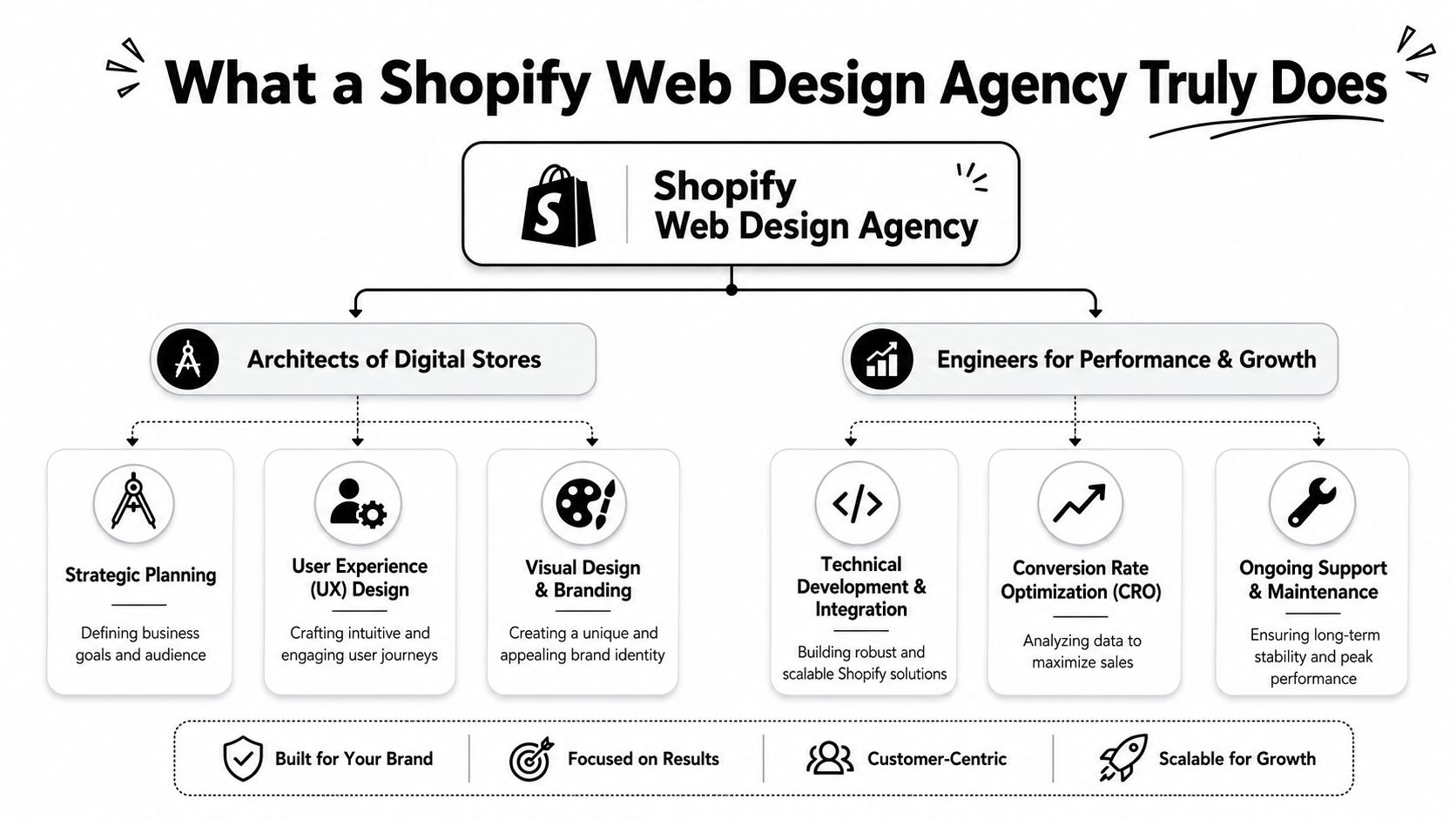
A real Shopify web design agency sits somewhere between a retail architect, systems engineer, and conversion consultant. That sounds lofty, but the work is practical. We shape how people move through the store, how the technology supports that journey, and how data gets captured so decisions stop being guesswork.
Design is about buying behaviour
Good Shopify design isn't decoration. It's layout, hierarchy, clarity, and momentum.
On a homepage, that means deciding what appears first and why. On a collection page, it means helping buyers narrow choice without feeling lost. On a product page, it means presenting enough information to remove hesitation without burying the add-to-cart action.
The strongest stores usually get a few things right:
- Clear page hierarchy so buyers know where to look next
- Strong mobile layouts because product discovery often starts on a phone
- Brand consistency across typography, product imagery, colour, and microcopy
- Fewer distractions near the point of decision
Development is where the money leaks get fixed
This is the part most business owners underestimate. Shopify development is the engine room.
That can include theme customisation, Shopify API work, custom section development, app integration cleanup, and performance tuning. If a store needs features that off-the-shelf apps handle poorly, we may build around the Shopify API or create internal tools through building custom Shopify apps using Shopify CLI. That's where a basic theme setup turns into an actual sales platform.
For content-heavy brands, we also work across WordPress. Some businesses need Shopify for commerce and WordPress for richer publishing or landing page flexibility. That's where experience in WordPress Developer work, WordPress development, WordPress design, and building custom blocks in Gutenberg becomes useful. The build has to support marketing, not just checkout.
Tracking and analytics should be built in early
One of the first things we clean up on inherited builds is data. If GTM and Google Analytics are sloppy, everything downstream suffers.
That usually means reviewing:
| Area | What we look for |
|---|---|
| GTM and Google Analytics | Clean event structure, purchase tracking, form events, add-to-cart and checkout actions |
| Meta Conversion API | Reliable server-side signal setup and deduplication |
| Google Tag Manager containers | Naming logic, trigger hygiene, and event consistency |
| Attribution quality | Whether campaign reporting reflects what the store is actually doing |
A store can look sharp and still be blind. That's a bad combination when ads are involved.
Why a Professional Agency Outperforms DIY Every Time
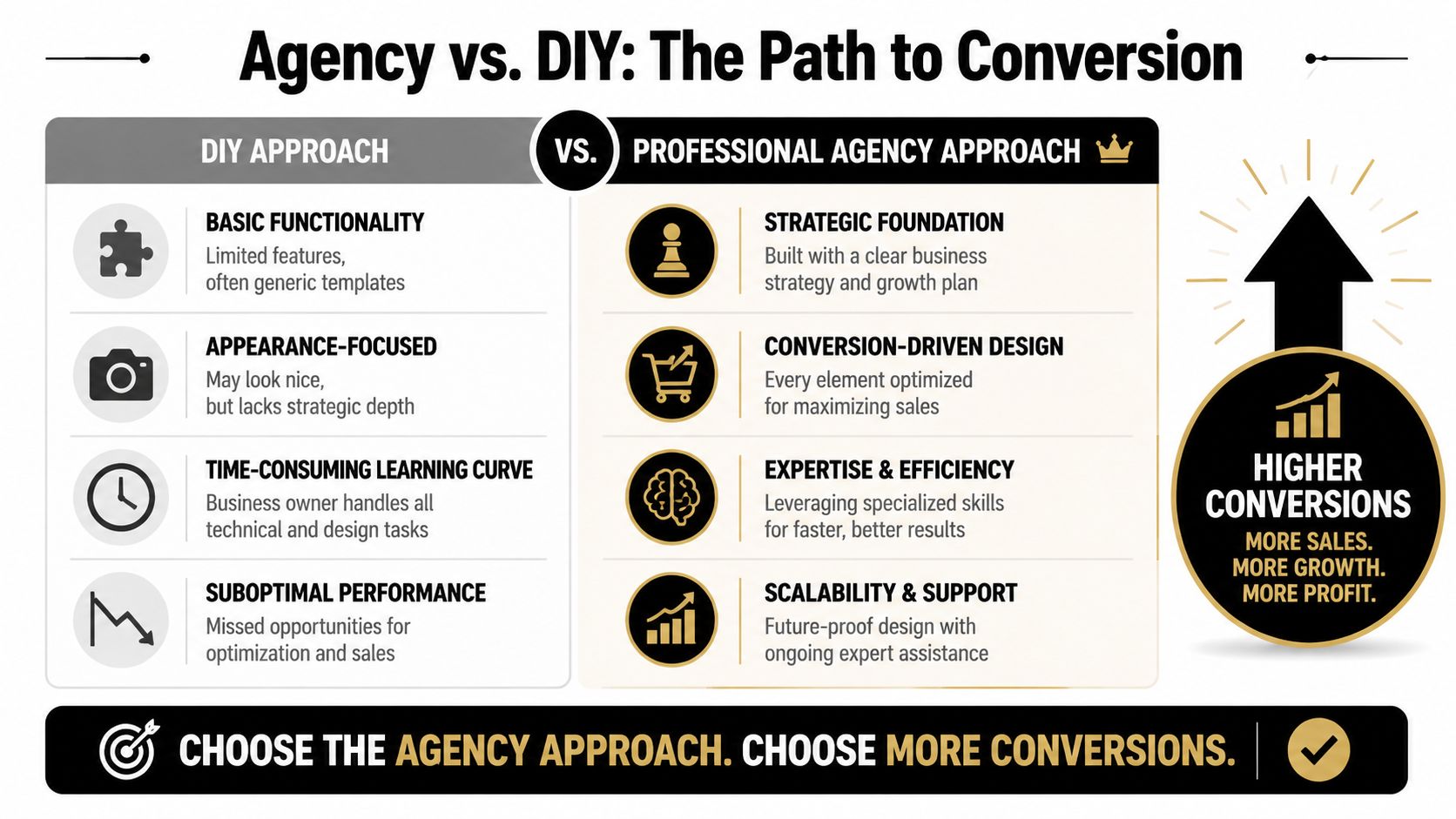
DIY gets a store live. It rarely gets a store optimised. That's the difference.
The owner doing it themselves usually makes reasonable decisions with limited time. A freelancer may improve the visuals. A professional agency should improve the economics. That means stronger conversion logic, better technical execution, and fewer hidden losses between first click and completed order.
Local buying behaviour matters
One reason generic builds underperform in Australia is they miss what local shoppers need to feel comfortable buying.
A critical CRO priority for an AU-focused Shopify build is the trust gap. Australian shoppers require 2.1 more trust signals on product pages than US counterparts, and 64% of Melbourne consumers will abandon a cart if shipping costs aren't shown upfront. That's why we often place shipping clarity, payment confidence, returns reassurance, and delivery expectations directly on the PDP instead of hiding them deeper in the site.
A polished generalist site can still lose money. It may look modern but fail to answer the objections a buyer has at the moment of decision.
Practical rule: if a shopper has to hunt for shipping cost, returns, or payment reassurance, the product page is doing less selling than it should.
Conversion-first work beats appearance-first work
A lot of DIY stores are assembled around surface choices. Fonts. colours. banner layouts. app add-ons. Agencies that know ecommerce start with flow instead.
We look at:
- How products are discovered
- What objections appear before checkout
- Where friction enters on mobile
- How variant selection, bundles, and upsells affect decision speed
- Whether ads and landing pages match buyer intent
This is also why many brands move from a general build provider to a specialist team after the first plateau. The conversation changes from “Can you make this section nicer?” to “Why are we losing buyers here?”
If you're reviewing partners, compare a broad visual portfolio with actual ecommerce execution. A page from a Web Design Melbourne studio can look great, but a specialist in Shopify Developers Melbourne work should also be able to explain theme structure, app conflicts, performance bottlenecks, and checkout influence.
Platform perspective helps
Because we also work across WordPress development Melbourne, WordPress website developer projects, and broader ecommerce stacks, the contrast is clear. Shopify tends to win when the business needs operational simplicity, cleaner product management, and a checkout flow designed for selling. WordPress can be powerful, especially with WooCommerce, but it usually demands more discipline in plugin control, maintenance, and performance management.
The issue isn't whether DIY is possible. It is. The issue is whether the business owner should still be acting as designer, developer, analyst, and QA tester once revenue is serious.
Our Six-Step Process From Concept to Conversion
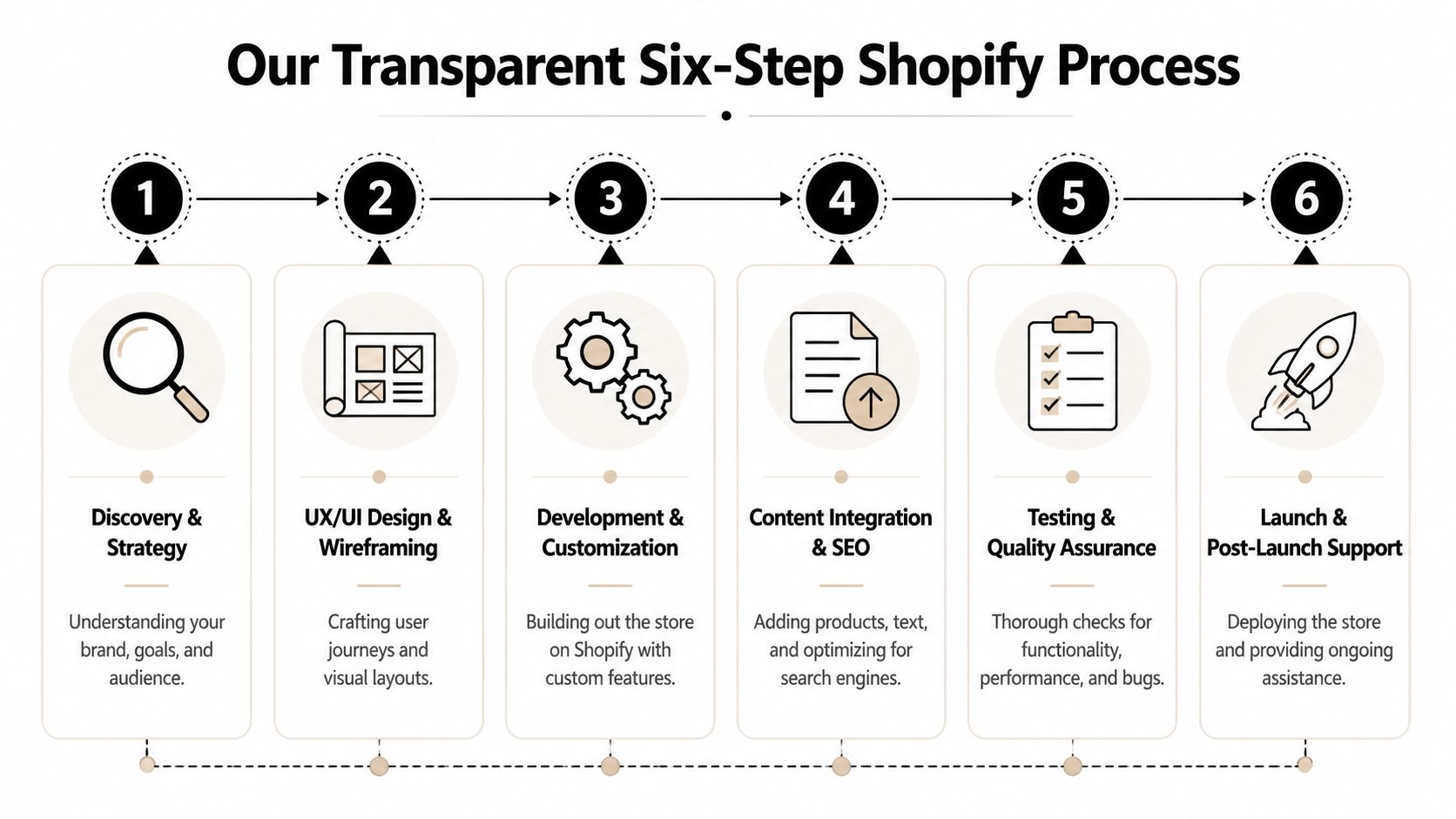
Most store owners don't need mystery. They need a process that shows what's happening, what decisions matter, and what gets delivered at each stage. A structured workflow protects the client from rework, scope drift, and half-built ideas.
Step one to three
We start with commercial context before design.
Discovery and strategy
We review the catalogue, audience, margin profile, current theme, traffic mix, and operational needs. During this process, we find out whether the core problem is merchandising, performance, trust, content structure, or tracking.UX and UI design
Wireframes come before decoration. We map collection behaviour, PDP logic, cart flow, mobile interactions, and content hierarchy. The goal isn't novelty. It's making the store easier to buy from.Development and customisation
At this stage, the approved thinking becomes a working Shopify build. Depending on the project, that may include Shopify development, custom sections, API work, third-party integration cleanup, and selective custom app work.
Step four to six
The second half is where many weaker providers rush. We don't.
| Step | What happens |
|---|---|
| Content and SEO setup | Products, collections, metadata, redirects, structured layouts, and foundational content are loaded properly |
| Testing and QA | Devices, browsers, forms, checkout steps, cart behaviour, app conflicts, and event tracking are checked |
| Launch and post-launch support | We monitor behaviour, fix launch issues quickly, and move into optimisation rather than disappearing |
A store should never launch with “we'll sort that later” hanging over key functions.
Performance isn't optional
A strong build has to respect how people browse. In Australia, that means mobile performance carries enormous weight. Google's data shows that pages failing to hit a Largest Contentful Paint under 2.5 seconds see a 32% drop in conversion rates for Australian eCommerce sites, where 78% of traffic is mobile.
That's why our developers spend time on the unglamorous work. Reducing unnecessary scripts. Tightening theme code. Managing third-party app weight. Reviewing image delivery. Cleaning up layout shifts. Checking what happens above the fold on slower connections.
Slow stores don't just feel worse. They force paid traffic to work harder for the same outcome.
This process mindset also carries across our WordPress development company work. Whether it's a Shopify store or a content-heavy site built by a WordPress web developer, the principle is the same. Build for business use, not just launch day screenshots.
Driving Growth with Performance Marketing
A store launch is only the start. If the build team and the paid media team think separately, growth usually gets expensive. The best results come when website structure, tracking, creative, and campaign settings are planned together.
For ecommerce brands, I look at performance marketing as an extension of site architecture. Your landing pages affect ad efficiency. Your event tracking affects optimisation. Your product feed quality affects shopping campaigns. Your PDP clarity affects whether paid clicks have a chance to convert.
Google Ads needs structure, not guesswork
A lot of clients ask some version of the same question. How much does it cost to start Google Ads, and should we run Shopping or PMAX?
For Australian ecommerce, the average minimum budget for a profitable Google Shopping campaign is AU$1,200/month, and Performance Max campaigns often deliver 32% higher ROAS than traditional Shopping ads according to Google Shopping budget and PMAX performance guidance. That doesn't mean PMAX is always the right first move, but it does mean budget and campaign type have to match the stage of the business.
Here's how I frame it for clients:
Beginners guide to Google Shopping ads
Start with clean product data, accurate pricing, strong titles, and clear feed categories. Campaign setup won't save a weak feed.PMAX vs Google Shopping ads
PMAX can open up more reach and automation. Standard Shopping gives tighter manual control. The right choice depends on account maturity and data quality.Campaign priority in Google Ads
Priority matters when multiple Shopping campaigns overlap by intent, margin, or product segment. Without a plan, spend drifts.Google Shopping ads not spending budget
This often points to feed issues, weak targeting logic, tracking problems, or low auction competitiveness rather than a platform glitch.
For service offers alongside ecommerce, we use different logic again. Google Ads for service based businesses, Google Ads for contact form submissions, and PPC for tradies rely far more on lead quality, landing page fit, and call handling than on product feed strategy. That's why pages like Google Ads for Plumbers exist separately from retail campaign setups.
Meta performance depends on signal quality and patience
Meta can scale fast, but only when the account has the right data and the client doesn't panic in the testing phase.
That means setting up Conversions API installation for Meta, aligning browser and server events properly, and using setting up Google Tag Manager containers in a way that doesn't create duplicate or broken signals. We also connect Instagram Shop and Facebook Shop when the catalogue and offer suit that path.
Creative matters just as much as tracking. A disciplined Meta ads creative testing process beats random ad launching every time. Hooks, formats, offer framing, UGC style, PDP alignment, and landing page continuity all matter.
If you're looking at partner options, a broader Google Ads agency or best Facebook ads agency conversation should include technical setup, not just media buying language. That's especially true for ecommerce.
Realistic Investments and Expected Returns
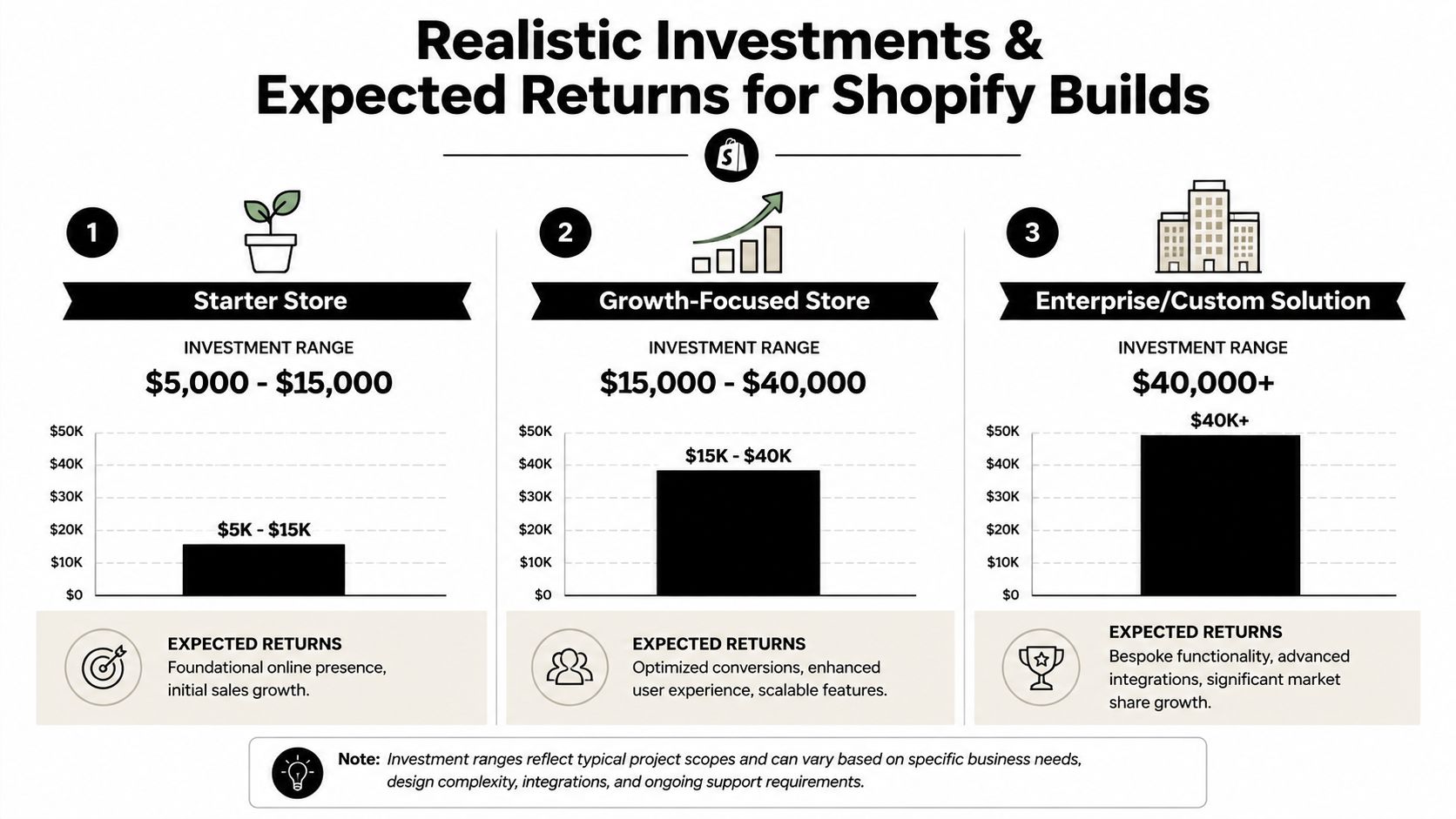
Most business owners don't need inflated promises. They need a realistic view of where the money goes and what kind of return logic makes sense. A Shopify project should be treated like a commercial investment, not a graphic design expense.
What proper Shopify work tends to cost
The market range is broad because project scope varies wildly. A simple store with light customisation is not the same thing as a multi-system ecommerce build with advanced custom functionality.
Verified industry figures put the average Shopify agency investment between $15,000 and $150,000+ depending on complexity, with basic custom builds at $15,000 to $35,000, enterprise implementations at $75,000 to $150,000+, project timelines of 6 to 16 weeks, and ongoing maintenance between $500 and $5,000+ monthly according to Shopify agency pricing and project scope data.
That range sounds wide because it is. The central question is what you need the store to do.
Where the money usually goes
A serious ecommerce build often includes some mix of the following:
- Custom Shopify design rather than stock theme reshuffling
- Shopify API work for systems that need better data flow
- Building custom Shopify apps using Shopify CLI when off-the-shelf apps create more friction than value
- Tracking implementation across GTM, GA, and paid channel events
- Content structure and SEO groundwork
- Post-launch optimisation, not just launch support
For some brands, the better decision isn't a heavy custom Shopify build at all. It may be a leaner Shopify setup combined with stronger paid media, email, or local SEO. That's the trade-off many agencies gloss over.
A more useful way to think about return
I don't use invented case studies, and I'm wary of agencies that do. What I can say from real project work is that the right investment level depends on margin, repeat purchase behaviour, product complexity, and traffic quality.
A brand doing steady revenue with a weak theme and poor tracking often gets more value from fixing fundamentals than from chasing flashy custom features. A business with operational complexity may need deeper backend work because manual workarounds are costing time every week.
A cheap build is expensive when it blocks growth, breaks tracking, or needs replacing in a year.
This is also where a hybrid partner can help. If the business needs ecommerce plus content, landing pages, or authority-building assets, support from a WordPress Developers Melbourne team or an Ecommerce Marketing Agency can be more practical than splitting strategy across multiple suppliers.
Your Checklist for Hiring the Right Agency
Hiring the wrong agency doesn't just waste budget. It slows the business down for months. The right questions save a lot of pain early.
I'd look well beyond visual portfolio work. Pretty homepage mockups don't tell you how an agency handles data, performance, integrations, or conversion pressure once traffic starts coming in.
Questions that reveal real capability
When you speak to any Shopify web design agency, ask things like:
How do you handle Shopify API work?
If they avoid technical detail, they may only be theme customisers.What's your process for GTM and GA setup?
“We install analytics” is not enough. Ask how they define events and validate purchase tracking.How do you approach Meta Conversion API?
A paid social team should be able to explain signal quality in plain English.What happens after launch?
If support is vague, expect handover issues.How do you evaluate success?
Good answers mention conversion behaviour, tracking integrity, speed, merchandising, and channel alignment. Weak answers focus only on appearance.
What to inspect in the portfolio
A useful portfolio review looks more like an audit than a mood board review.
| What to review | Why it matters |
|---|---|
| Product pages | This is where most ecommerce revenue is won or lost |
| Mobile layout quality | A desktop-perfect store can still fail on phones |
| Collection filtering and navigation | Weak discovery kills product depth |
| App and integration logic | Frankenstein stacks create hidden friction |
| Tracking maturity | Without clean data, ad scaling becomes guesswork |
I also recommend reading outside your shortlist. If you want a solid external perspective on vetting marketing agencies for growth, that article is useful because it focuses on fit and commercial thinking rather than agency theatre.
Red flags I'd take seriously
Some warning signs show up quickly:
- They promise rankings, ROAS, or conversion lifts without context
- They can't explain technical decisions in business terms
- They avoid discussing post-launch support
- They pitch every client the same stack
- They separate design from marketing too aggressively
For paid social specifically, reviewing how a team handles audience testing, creative fatigue, and event tracking is worth the effort. If you want to compare what a specialist should cover, the Facebook Meta Ads Agency page is one example of the kind of service detail you should expect any provider to explain clearly.
Shopify Agency FAQs
A lot of high-intent questions come up late in the decision process. These are the ones I hear most from ecommerce owners who are comparing agencies, freelancers, and in-house options.
What's the difference between a Shopify designer and a Shopify developer
A Shopify designer focuses on layout, brand presentation, user flow, and page structure. A Shopify developer handles theme code, custom functionality, integrations, app logic, and technical performance.
On stronger projects, both roles work together. The same applies across WordPress. A WordPress website developer or WordPress development company can build flexible infrastructure, but if no one is thinking about buyer behaviour, the final site may still underperform.
How long does a Shopify project usually take
Timelines depend on complexity, approvals, content readiness, and the number of systems involved. Projects move faster when product data is clean, decision-makers are available, and the scope is clear.
The biggest delays usually come from content bottlenecks, app sprawl, or trying to redesign business logic halfway through development.
What ongoing support should I expect after launch
Support usually covers bug fixes, theme updates, conversion tweaks, merchandising adjustments, tracking checks, and app maintenance. If the agency disappears after launch, you'll likely end up paying someone else to understand their work.
That's especially relevant if your store also relies on local SEO, Google My Business, Google Ads, Facebook ads agency support, or email and automation. The channels need continuity.
How do you measure success with Facebook ads
You don't measure Meta success by CTR alone or by whether one ad looked exciting in the first few days. You measure it through signal quality, cost against margin, purchase behaviour, creative durability, and how well the landing page converts the traffic it receives.
There's another trap worth calling out. Melbourne Meta ads agencies find that 68% of e-commerce campaigns fail because clients quit testing too early, and campaigns that complete the 7-day learning phase and continue creative testing achieve 41% higher conversion rates according to Meta creative testing and learning phase data. That's why mastering Facebook ads often comes down to process discipline. Facebook ads, don't quit too early is not motivational fluff. It's operational advice.
Can call tracking and AI answering help ecommerce or service hybrids
Yes, especially for businesses that sell online but still close revenue through calls, bookings, or quote requests.
We often set up a custom number through Twilio for businesses that need better call handling. The setup can support 24 hour call answering, doesn't get sick or tired, and can book appointments into your calendar or Calendly. For businesses like tradies, hairdressers, beauty therapists, dentists, restaurants, and doctors, that reduces missed-call leakage and helps with PPC attribution. Tools like CallRail and Go High Level also come up regularly when teams want clearer call tracking for inbound campaigns.
If you're comparing social providers more broadly, even outside ads management, it's useful to review criteria people use when they choose the best Instagram growth service. The specifics differ, but the evaluation mindset is similar. Look for process, transparency, and fit.
Do you handle Shopify and WordPress together
Yes, and sometimes that's the right move. Some brands need Shopify for the store and WordPress for richer publishing, landing pages, or SEO content architecture. That can include WordPress design, WordPress developer Melbourne work, WordPress developer Sydney support, Shopify development partners work, and shopify developer api implementation depending on the stack.
Alpha Omega Digital is one Melbourne option for businesses that want both web build and paid media under one roof, including Shopify, WordPress, Google Ads, Meta ads, and ecommerce tracking setup.
If you're a business with a paid ads budget of at least 3k a month, I'd love to offer you a low risk deal. Get a month of paid ads management FREE. Apply now through the contact page. Alpha Omega Digital is a marketing agency based in Melbourne, Australia but also services clients from Sydney, Brisbane, Newcastle, Perth, Adelaide, Darwin and Hobart. Have a project in mind? Contact us.
Alpha Omega Digital
Read more insights from our team on web design, paid ads, and growth strategy.