If you're looking for a Facebook Ads agency in Sydney, there's a good chance you're already tired of half-working campaigns. Maybe you've boosted a few posts, seen traffic come in, and then watched sales stay flat. Maybe your ads manager account looks busy, but your Shopify store doesn't.
I see this a lot with ecommerce brands that come to us after trying to handle Meta in-house. The ads weren't always terrible. The problem was usually everything around them. Weak campaign structure, no real testing process, poor tracking, and a site that couldn't convert the traffic it was getting.
That gap matters because Facebook still gives Sydney businesses real reach. In Australia, Facebook has over 17 million active users, and 5.3 million New South Wales residents engage with Facebook daily, which makes suburb-level targeting in places like Parramatta and Bondi Junction highly practical for local campaigns according to Craze for Marketing's overview of Facebook ads in Australia. The opportunity is there. The issue is execution.
I run campaigns with that in mind. Good Meta performance doesn't come from a magic audience or one lucky creative. It comes from joining together ad strategy, creative testing, clean tracking, and a website that removes friction. That's true whether you're looking for a Facebook Ads agency in Sydney or a digital marketing agency Melbourne businesses can use across paid ads, Shopify development, WordPress development, SEO, and analytics.
Beyond the Boost Button Why Sydney Businesses Hire an Agency
The Boost Post button is attractive because it's fast. Facebook asks for a budget, a broad audience, and you're live in minutes. For an ecommerce owner who's juggling stock, customer service, shipping delays, and content, that convenience feels useful.
The problem is that boosted posts usually start from the platform's priorities, not your business model. A promoted post might get attention, but attention alone doesn't tell you whether the campaign is feeding profitable traffic into your store, helping repeat purchases, or building a retargeting pool you can use later.
What boosted posts usually miss
When I review underperforming accounts, the same issues come up:
- No campaign architecture: Everything runs in one blob. Prospecting, retargeting, catalogue activity, and offers are mixed together.
- Weak conversion signals: The account often optimises for clicks or engagement instead of the action that matters to the store.
- No creative plan: One image, one message, one audience. When it gets stale, performance drops and nobody knows why.
- Landing page mismatch: The ad promises one thing, and the product page delivers another.
A real Facebook Ads agency in Sydney doesn't just launch ads. It builds the full path from impression to purchase.
Most wasted ad spend isn't caused by Meta being "too expensive". It's caused by businesses paying for traffic before they've built a system that can convert it.
Why local businesses still need strategic support
Sydney ecommerce brands have a strong local advantage when they use Meta properly. The platform gives enough scale to run broad campaigns, but it also lets you narrow down by geography, product category, and buying stage. If you're selling with a local delivery angle, store pickup, or city-specific offer, that matters.
A strategic agency can also work across locations. We're based in Melbourne, and that doesn't stop us from managing Sydney accounts effectively. In practice, what matters is whether the team understands Australian ecommerce, suburb-level targeting, feed quality, conversion tracking, and creative fatigue. That's the work that moves the account.
The difference between activity and progress
A lot of businesses hire an agency because they're done with random acts of marketing. They don't need more dashboards. They need a clear answer to questions like these:
| Question | Weak approach | Professional approach |
|---|---|---|
| What are we optimising for? | Likes, clicks, reach | Purchases, lead quality, profitable actions |
| Why did performance drop? | Guessing | Testing and data review |
| What should we change first? | New audience every week | Structured creative, offer, and landing page analysis |
That same thinking carries into adjacent channels too. A marketing agency Melbourne ecommerce brands trust shouldn't only know Meta. It should understand Google Ads, Google Shopping, PMAX vs standard Shopping, local SEO, GTM, Google Analytics, and development work on Shopify and WordPress because those systems affect paid performance directly.
What a Professional Facebook Ads Agency Actually Does
Audiences often only see the final layer. They see the ad in the feed and assume the work is writing a caption and pressing publish. The actual work starts much earlier.
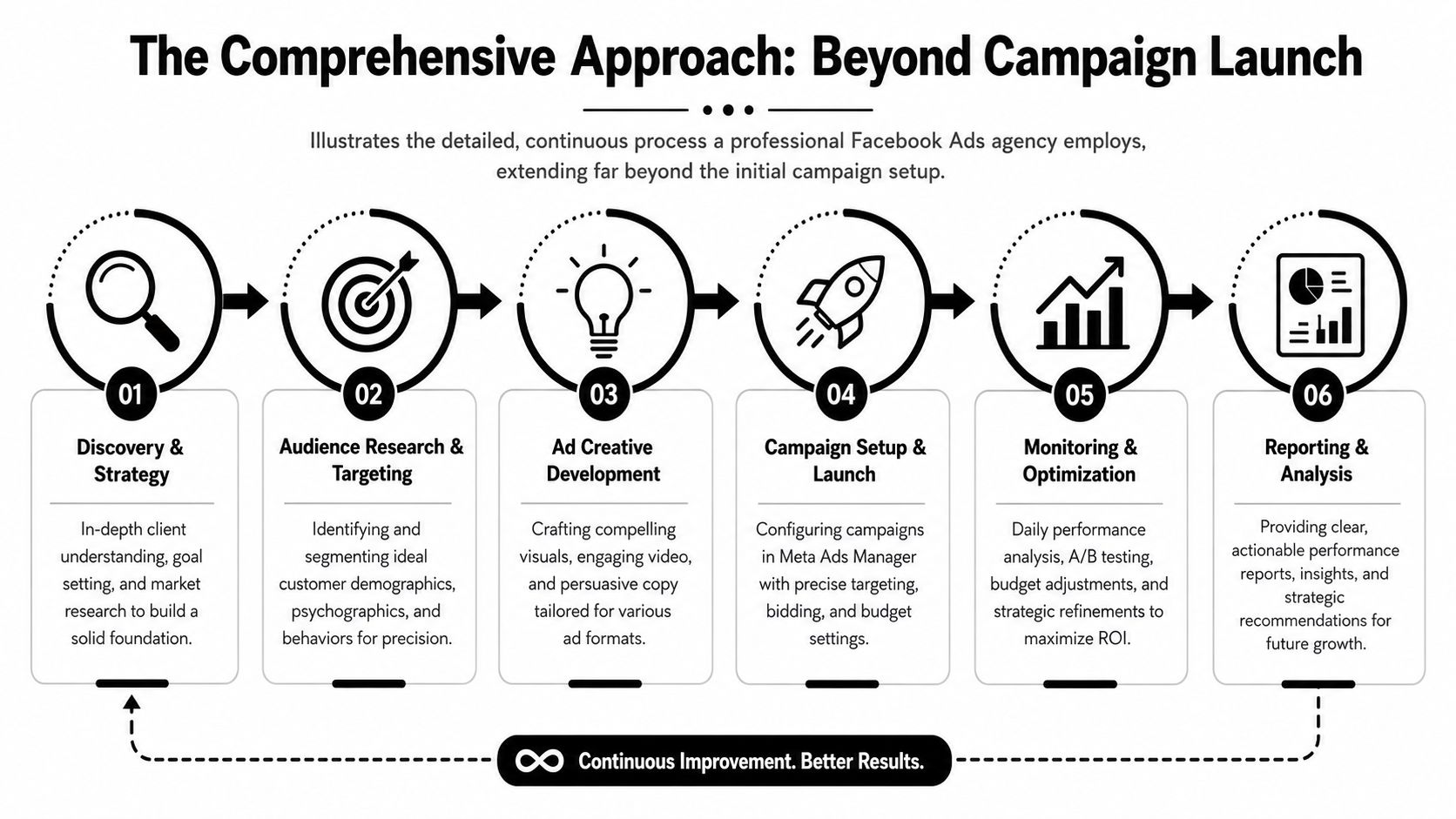
It starts with diagnosis, not ad creation
Before I touch creatives or budgets, I want answers to basic commercial questions. What products carry margin? What products drive first purchase but not repeat purchase? Which collections deserve budget and which ones only look good on Instagram?
That work changes campaign structure. A store with hero products needs a different setup from a broad-catalogue store. A new brand needs different messaging from one with returning customers and a warm email list.
Research and targeting are only one layer
Audience research still matters, but it isn't the whole strategy. I look at product intent, price point, customer objections, content hooks, and where friction appears on site. A buyer doesn't convert because we guessed the right age bracket. They convert because the ad angle, offer, page experience, and trust signals all line up.
Here are the moving parts we usually manage:
- Offer positioning: Is the campaign selling the product, the problem solved, the social proof, or the use case?
- Campaign architecture: Separate cold acquisition from retargeting so the signals stay clean.
- Creative mix: Static, video, UGC-style, founder-led, product-led, and collection-led variants.
- Measurement setup: Pixel events, CAPI, and event prioritisation need to reflect commercial goals.
- Landing page alignment: Product page, collection page, advertorial, or custom landing page.
The creative testing problem most SMEs face
Smaller businesses get stuck at this stage. They know they should test more creative, but they don't have a full content team. So they run one message until it burns out.
Meta's own data says 74% of small Australian businesses run only one ad angle, which leads to 45% faster performance decay, while multi-angle testing is associated with up to a 3.2x ROAS uplift according to this Meta-focused discussion on Australian creative testing trends. That's why I don't rely on one "winner" ad. I build a low-cost testing process around several angles.
For ecommerce, that often means testing:
- Problem-aware creative: What frustration does the product remove?
- Outcome-focused creative: What does life look like after the product is used?
- Proof-based creative: Reviews, demonstrations, comparisons, and objections answered.
- Offer-led creative: Bundles, shipping triggers, seasonal hooks, or entry product offers.
- Founder or brand story creative: Useful when the category is crowded and trust matters.
Practical rule: If you only have budget for a few ads, vary the angle before you vary the design. Different messages usually teach you more than small visual tweaks.
If you're also comparing paid social channels for ecommerce, this guide for TikTok Shop operators is worth a read because it frames where Facebook and TikTok differ in buying intent, creative style, and store readiness.
Day-to-day management is mostly about decisions
A professional agency doesn't "set and forget". We cut weak ads, protect spend on strong products, adjust retargeting windows, review landing pages, and decide whether performance issues come from creative, tracking, audience quality, or the product itself.
That same practical mindset applies across channels. It matters when you're mastering Facebook ads, building a beginner's guide to Google Shopping ads internally for your team, troubleshooting Google Shopping ads not spending budget, or deciding whether PMAX vs Google Shopping is the better fit for a specific SKU set.
The Unseen Foundation Why Your Website Is Key to Ad Success
I don't separate paid ads from web development because buyers don't experience them as separate things. They click the ad and judge the business through the landing page. If the page is slow, confusing, or thin on trust, the media buy takes the blame for a website problem.
That's why I often tell ecommerce owners that ad performance starts before the campaign launches. It starts with product pages, collection structure, mobile UX, theme speed, and checkout friction.
Shopify and WordPress both affect ROAS
On Shopify, the usual issues are bloated themes, weak product templates, poor upsell logic, and apps stacked on top of each other until the store slows down. On WordPress and WooCommerce, I often see plugin conflicts, messy template logic, and hard-to-manage page builders that make testing painful.
If you're sending Meta traffic to either platform, I care about:
- Mobile-first layout: Most paid social traffic arrives on mobile, so the first screen has to carry the page.
- Product page clarity: Price, variants, delivery info, reviews, and add-to-cart need to be obvious.
- Trust elements: Returns, shipping, payment methods, FAQs, and social proof reduce hesitation.
- Speed and stability: Lag kills momentum. So do popups that interrupt the purchase journey.
Custom development often beats patchwork fixes
A lot of stores try to solve conversion issues with another app. Sometimes that's fine. Often it creates more moving parts, more code, and more things to break. For serious growth, custom work usually holds up better.
That can mean using a customized theme section, cleaner cart behaviour, or a custom block that supports merchandising without bloating the page. On WordPress, it might mean building custom blocks in Gutenberg instead of forcing every layout into a generic page builder. On Shopify, it could involve Shopify API work, Shopify design, or building custom Shopify apps using Shopify CLI when off-the-shelf apps don't fit the workflow.
For businesses looking at implementation support, our Shopify developers in Melbourne, WordPress developer services, and WordPress developers Melbourne pages outline the kinds of build and optimisation work involved.
Development and paid ads should talk to each other
Many agencies often split the job badly. The media team blames the site. The dev team blames the ads. Nobody owns the customer journey.
I prefer to look at the whole path:
| Stage | What the ad team controls | What the site must deliver |
|---|---|---|
| Click | Message, targeting, intent match | Relevant landing page |
| Product view | Expectation set in ad | Clear product details and proof |
| Cart | Offer framing | Low-friction cart and checkout |
| Purchase | Retargeting and remarketing logic | Functional checkout, trust, speed |
That applies whether you're running Facebook ads agency work, Google ads for service based businesses, Google ads for contact form submissions, or scaling an ecommerce store through Shopping. Better websites don't just "look nicer". They make your paid acquisition more efficient.
I've seen the same principle hold across WordPress development, WordPress design, Shopify development, Shopify design, and even Instagram Shop and Facebook Shop integrations. When the store experience is coherent, the ad account gets better data and better conversion behaviour.
Mastering the Technicals CAPI GTM and Accurate Tracking
Tracking is where a lot of accounts fall apart. The campaigns might look fine in Ads Manager, but if the underlying signals are messy, Meta optimises on bad information. Then businesses make budget decisions off numbers they shouldn't trust.
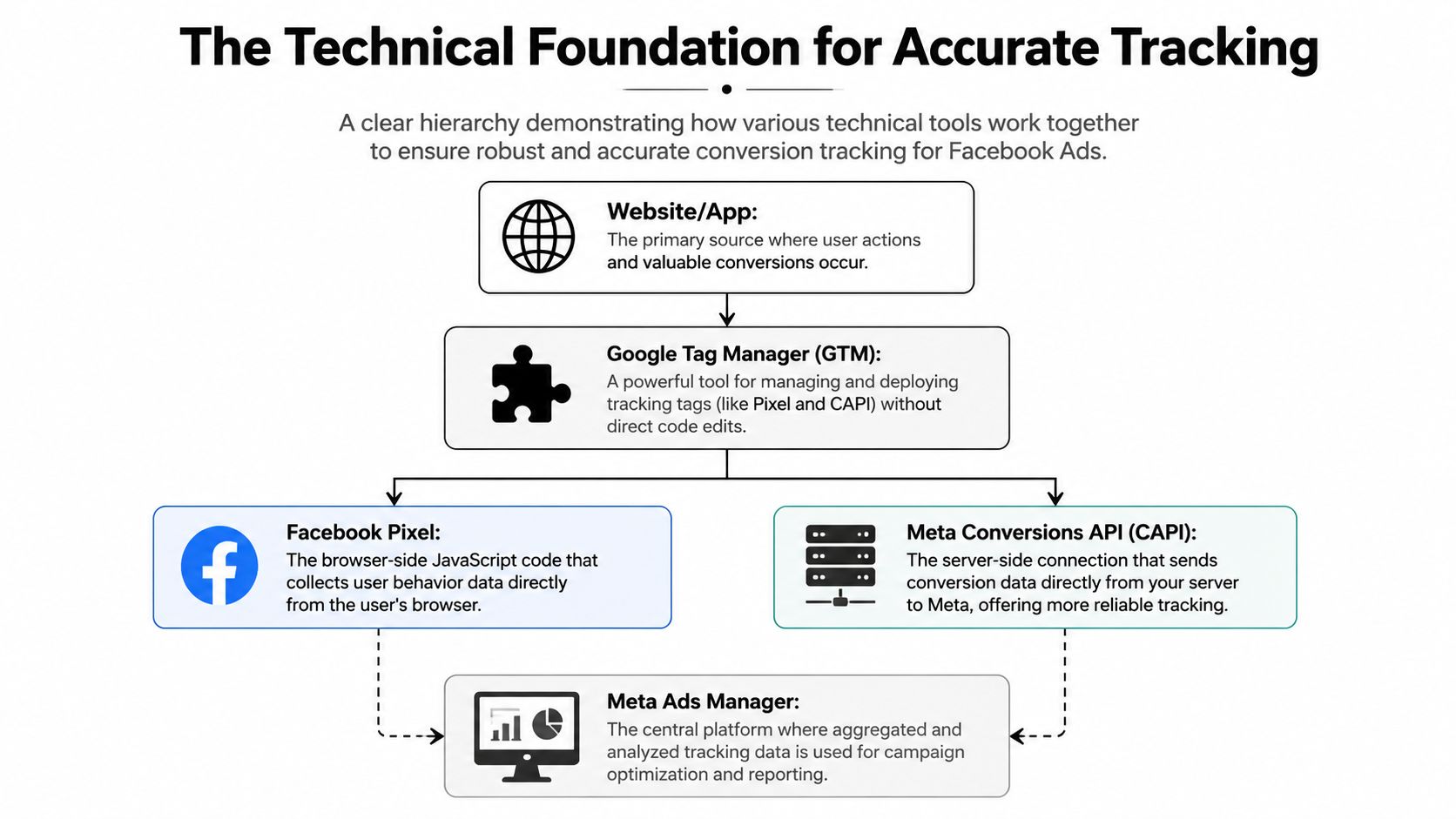
I explain this to clients with a simple analogy. Browser-only tracking is like trying to find your way with a smudged windscreen. You can still drive, but you won't make sharp decisions confidently. Meta Conversions API sharpens the picture by sending server-side data, and Google Tag Manager helps organise how those signals are deployed and maintained.
What each piece actually does
The Meta Pixel captures browser-side activity. It's useful, but it can miss events because of browser restrictions, consent settings, or blocked scripts.
Meta CAPI sends event data from the server side. That doesn't replace the Pixel. It complements it. In a good setup, the browser and server work together so event matching is stronger and reporting is more reliable.
Google Tag Manager is the control layer. It gives us one place to manage tags, triggers, and event logic without editing theme files every time a business wants to change tracking.
A clean setup usually follows this order
- Map the key events: View content, add to cart, initiate checkout, purchase, and any useful custom actions.
- Check platform alignment: Shopify, WooCommerce, or a custom build can all handle tracking differently.
- Install through GTM where appropriate: This keeps changes manageable and easier to test.
- Connect CAPI carefully: Match identifiers properly and avoid duplicate firing.
- Validate events: Test with real pathways, not assumptions.
If you're deep in product analytics or app-side event work, some of the same implementation discipline shows up in technical reads like these developer tips for Posthog iOS widgets. Different stack, similar principle. Data is only useful when the implementation is clean.
This walkthrough gives a visual explanation of the setup path:
Why this matters for ecommerce decisions
Bad tracking doesn't just hurt reporting. It hurts optimisation. If Meta can't consistently understand which clicks turn into real purchases, it has a harder time finding more buyers.
That affects how you judge everything else:
- Creative winners may be false winners
- Retargeting pools may be incomplete
- ROAS can look weaker or stronger than reality
- Budget scaling decisions become riskier
Good media buying starts with believable data. If purchase tracking is shaky, every "optimisation" after that is less reliable.
For businesses wanting implementation help, Meta Ads management and setup support can sit alongside setting up Google Tag Manager containers, Google Analytics, and Conversions API installation for Meta so reporting and bidding don't rely on guesswork.
How to Evaluate and Choose the Right Sydney Agency
Most agency sales calls sound similar. Everyone says they focus on ROI. Everyone says they're data-driven. That doesn't help much when you're trying to decide who should manage your budget.
I think the better approach is to ask questions that expose how the agency works when things get difficult. Good agencies answer clearly. Weak agencies stay vague.
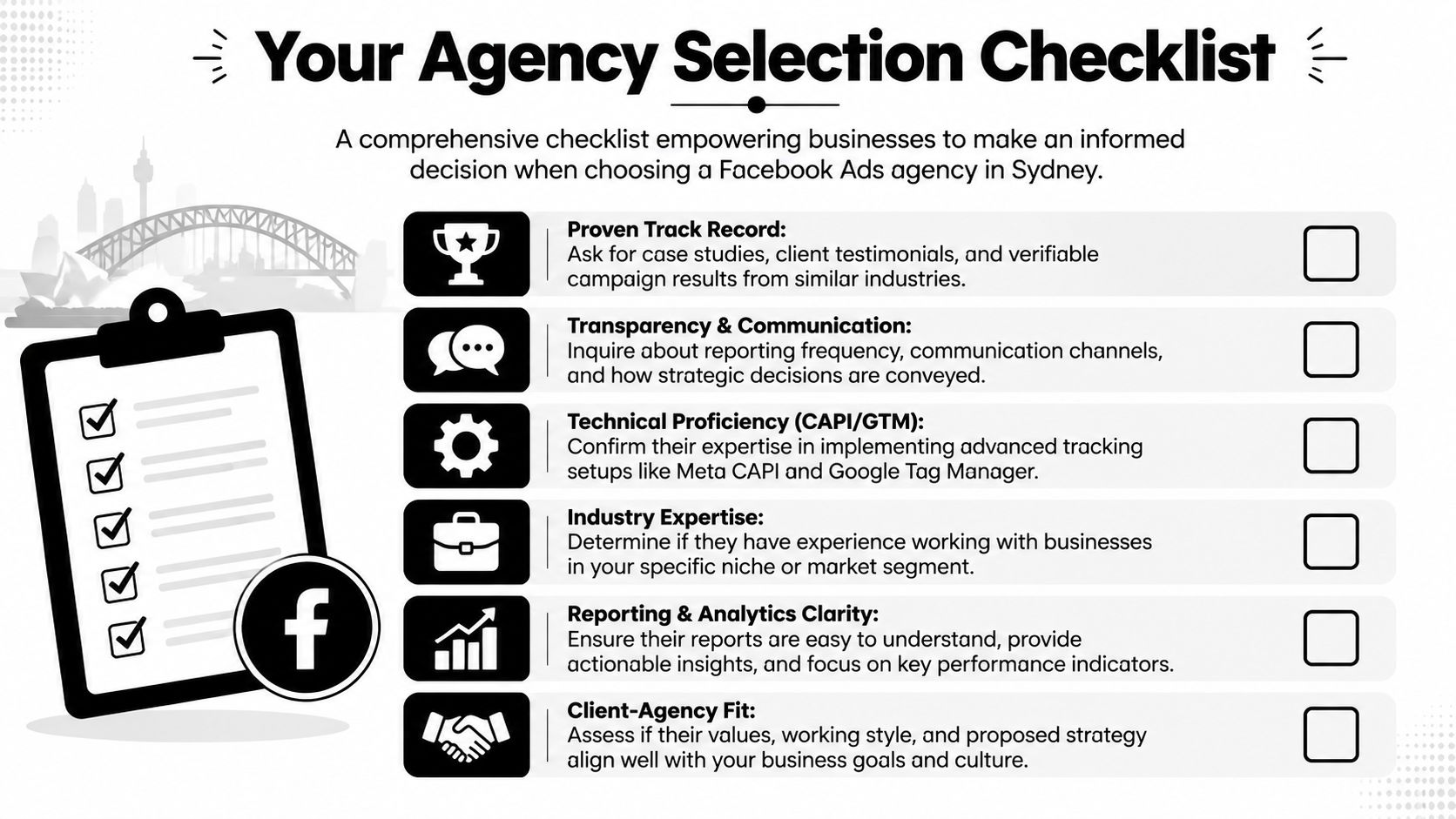
Ask about process, not promises
A useful discovery call should tell you how they research products, how they test creative, how they handle attribution, and what they do when campaigns stall.
I'd ask questions like:
- How do you structure prospecting vs retargeting?
- What does your creative testing process look like if we don't have an in-house content team?
- How do you install and validate CAPI and GTM?
- Who reviews the landing pages and product pages?
- What happens in the first month besides launching ads?
If the answers stay at the level of "we optimise weekly" or "we use AI and testing", keep digging.
Compliance matters more than many agencies admit
This is one of the biggest blind spots in the market. In regulated sectors, creative can get accounts restricted or ads rejected if it crosses policy lines. According to Medical Marketing Group's Meta ads page, 68% of Australian SMEs in regulated sectors report ad bans due to non-compliant creative, and 92% of Sydney Facebook Ads agency landing pages lack dedicated compliance-creative case studies. Even if you're in ecommerce rather than healthcare or finance, that stat tells you something important. Many agencies don't think thoroughly about policy risk until there's already a problem.
So ask directly:
| Vetting question | Why it matters |
|---|---|
| How do you handle policy-sensitive copy and imagery? | Prevents ad rejection and account issues |
| Have you managed restricted or review-prone categories? | Shows practical compliance experience |
| Can you explain your approval process for creative? | Reveals whether they work carefully or just publish fast |
Reporting should connect to commercial outcomes
I don't care how pretty the report looks if it doesn't help a business decide what to do next. Strong reporting ties spend to actions, highlights creative learnings, and points to operational blockers like low stock, shipping friction, or weak checkout conversion.
You should also ask how the agency handles channels beyond Meta. A business that understands Google Ads, Local SEO, Google My Business, and even SEO agency Melbourne style search work can often give stronger strategic advice because paid social isn't treated in isolation.
Call tracking is a real differentiator for service-heavy campaigns
Not every campaign ends with an online checkout. Some enquiries come through calls, especially in trades and booking-led businesses. We sometimes set up a custom number through Twilio so calls can be routed, logged, and handled more intelligently. The useful part isn't the novelty. It's the operational impact.
That kind of setup can support features like:
- 24 hour call answering: enquiries don't wait for business hours
- Consistent availability: the system never gets sick or tired
- Calendar booking: appointments can be booked into your calendar or Calendly
- Reduced lost leads: useful for tradies, hairdressers, beauty therapists, dentists, restaurants and doctors
For businesses that rely heavily on booked enquiries, practical resources like our Google Ads for plumbers and Facebook ads for electricians pages show how lead flow and call handling fit into paid acquisition.
If an agency can't explain how it handles creative risk, tracking accuracy, and lead quality, it probably won't manage scale well either.
Unpacking the Costs Agency Fees and Expected ROI
Agency pricing confuses people because the labels vary, but the models are fairly standard. You'll usually see a fixed retainer, a percentage of ad spend, a hybrid structure, or a performance-tied arrangement.
None of those is automatically right or wrong. The useful question is whether the model fits the amount of work required and keeps the incentives sensible.
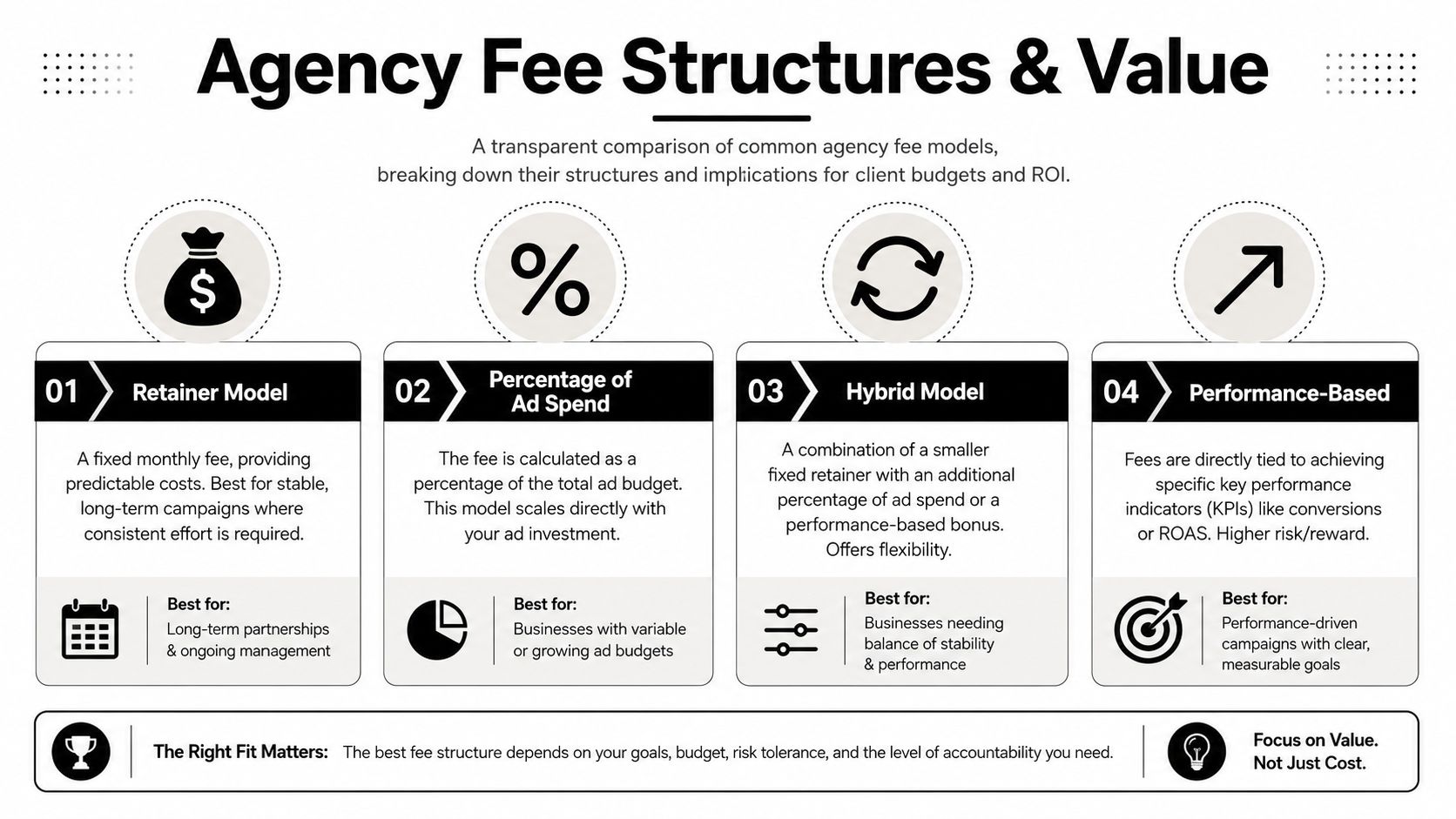
Common fee models in plain English
| Model | How it works | Trade-off |
|---|---|---|
| Retainer | Fixed monthly management fee | Predictable, but scope needs to be clear |
| Percentage of ad spend | Fee scales with budget | Simple, but not always aligned with efficiency |
| Hybrid | Base fee plus spend-linked component | More flexible, can suit scaling brands |
| Performance-based | Fee tied to agreed outcomes | Attractive in theory, but definitions matter |
I usually tell ecommerce owners not to obsess over the management fee in isolation. A cheaper agency that mishandles tracking, creative, and landing pages can cost far more than a higher-fee team that protects profitable spend.
ROAS is the metric that keeps the conversation honest
In the Australian market, a healthy benchmark is at least 4:1 ROAS, meaning $4.00 in revenue for every $1.00 spent on ads, according to Kamber's guide to key Facebook ads metrics. For ecommerce, that's the benchmark I care about most when the campaign objective is purchases.
That doesn't mean every campaign hits it immediately. New accounts need testing. Product launches can be messy. Seasonal periods behave differently. But using ROAS as the commercial reference point keeps everyone focused on profit, not vanity metrics.
Budget conversations should be practical
A lot of business owners ask how much to spend on Google Ads or social ads as if there's a universal number. There isn't. Spend should reflect margin, conversion rate, average order value, and the amount of learning the account still needs.
If you want a broader small-business perspective, this piece on how much to spend on social ads is useful because it frames budget as a planning decision rather than a random guess.
For ecommerce, I look at budget in context with:
- Product economics: some SKUs can carry paid acquisition better than others
- Site readiness: scaling spend into a weak store is expensive learning
- Creative capacity: more spend requires more testing and fresher assets
- Channel mix: Meta, Google Shopping, branded search, and email should complement each other
This same logic also helps when clients ask about how much does it cost to start Google Ads, what budget to spend on Google Ads, campaign priority in Google Ads, Google Shopping ads for dropshipping, or PPC for tradies. Cost only makes sense when tied to expected commercial return.
Our Free Ad Management Offer and How We Work
A Sydney business usually comes to us after a frustrating month. Meta is spending. Clicks are coming through. Sales are uneven, reporting does not line up with Shopify or WordPress, and nobody can say with confidence whether the problem sits in the offer, the creative, the site, or the tracking.
That is the point where we start.
We do not begin by pushing more budget into the account. We begin by checking whether the account can support clear decisions. I want to see how purchases are being attributed, whether CAPI is passing clean events, whether GTM is set up properly, and what happens on the landing page after the click. If those pieces are weak, ad management alone will not fix the result.
What working with us actually looks like
The first conversation is commercial, not cosmetic. We ask about margin, repeat purchase behaviour, stock reliability, lead quality, sales cycle, and what a good customer is worth over time. That shapes how aggressively we can test and what kind of CPA or ROAS target makes sense.
From there, we work through a practical sequence:
- Audit and diagnosis: review the ad account, tracking setup, product or service priorities, and post-click experience
- Access and setup: confirm platform access, pixel and CAPI health, feed quality, domain verification, and event mapping
- Build: structure campaigns, define testing angles, prepare audiences, and align creative with the landing page
- Launch: go live carefully, validate events, compare platform reporting with backend results, and catch setup issues early
- Improve: pause waste, push proven angles, request site changes where needed, and keep testing hooks, formats, and offers
- Report: explain what changed, what we learned, and what we are doing next
That process matters because smaller businesses do not have budget for random experimentation. We try to get useful answers fast. Sometimes that means proving a product angle works. Sometimes it means finding out the website is slowing down the whole account.
We work on the systems around the ads as well
This is one of the biggest differences between basic ad management and work that improves performance.
If a landing page is too slow on mobile, we will say it. If the Shopify theme is breaking product page trust, we will flag it. If a WordPress form sends poor-quality leads because the page does not filter intent well, we will address that too. Paid traffic magnifies whatever is already true about the site. Good pages convert more of the same traffic. Weak pages make every click more expensive.
That is why our work often includes support around Shopify builds, WordPress updates, feed fixes, GTM configuration, event troubleshooting, and conversion-focused page changes. Alpha Omega Digital handles ecommerce marketing support across those areas, including paid social, Google Ads, Shopify work, WordPress development, and conversion-focused design.
The free management offer
For businesses spending at least $3,000 a month on paid ads, we offer one month of ad management free.
The reason is simple. Good agency relationships are easier to judge inside the work than inside a sales pitch. You get to see how we audit, how we communicate, how we handle tracking issues, how we approach creative testing, and whether our recommendations make commercial sense for your business.
We are based in Melbourne and work with clients across Sydney and other Australian cities. The fit is strongest when a business wants one team that can connect Meta ads, analytics, website changes, and creative testing instead of treating each part as somebody else's problem.
The best engagements usually start with a clear view of what is happening in the account, what is blocking scale, and what needs to be fixed first.
Frequently Asked Questions About Facebook Ads
How long should I give Facebook ads before judging them
Long enough to gather meaningful signals, but not so long that you keep funding obvious problems. I don't like quitting too early, but I also don't believe in blind patience. Early data helps you spot tracking issues, weak hooks, or poor landing page alignment quickly. Strong judgement comes from reading the right signals, not waiting passively.
Do ecommerce brands need Google Ads as well
Often, yes. Meta is strong for discovery, retargeting, and creative-led selling. Google captures demand when people are already searching. For many stores, the combination works better than either platform alone, especially when branded search, Google Shopping, and retargeting all support each other. If you need support there too, our Google Ads agency page covers that side of the mix.
What if my Facebook ads get clicks but not sales
That's usually a signal mismatch. The ad may be attracting low-intent users, or the site may be losing them after the click. I check product page clarity, mobile speed, offer strength, and whether the creative set the right expectation. Clicks without sales aren't a Meta-only problem.
Do I need a big content team to make Meta work
No, but you do need a repeatable testing process. Many smaller businesses get stuck because they think "creative testing" means constant expensive shoots. In practice, a lean process using customer objections, founder insights, product demos, reviews, and angle variations can go a long way.
Should I use Shopify or WordPress for ecommerce
Both can work. Shopify is usually cleaner for dedicated ecommerce operations, while WordPress can make sense when content and custom structure are central to the business. The right choice depends on operational needs, not ideology. What matters most is whether the platform supports speed, tracking, merchandising, and conversion-focused design.
Can Meta ads work for service businesses too
Yes, especially when the offer is clear and follow-up is strong. That's where call tracking, contact form tracking, CRM handoff, and booked-calendar workflows start to matter. The same principles apply. Good targeting, strong messaging, clean attribution, and consistent lead handling.
What's more important, creative or targeting
For most ecommerce campaigns now, creative does more of the heavy lifting than people expect. Targeting still matters, but if the message is weak, broad or precise audiences won't save it. The best accounts pair strong angles with clean structure and reliable event data.
What else should I have in place besides Meta ads
At minimum, I want a reliable store, clear analytics, good product pages, and email flows that catch some of the demand you're paying to create. Beyond that, the best setups usually include some mix of local SEO, Google My Business if relevant, Google shopping ads for dropshipping where appropriate, and consistent technical housekeeping across tagging and feeds.
How do I measure success properly
For ecommerce, revenue quality and ROAS matter most. But I also look at supporting signals such as product-level performance, landing page behaviour, creative fatigue, and how efficiently the account turns cold traffic into warm audiences. Good measurement is layered. It doesn't rely on one number alone.
If you're looking for a practical partner rather than another sales pitch, Alpha Omega Digital is a Melbourne-based agency working with businesses across Sydney, Brisbane, Newcastle, Perth, Adelaide, Darwin and Hobart. If your business has a paid ads budget of at least 3k a month, I'd love to offer you a low risk deal. Get a month of paid ads management FREE. Apply now through the contact page.
[email protected]
Read more insights from our team on web design, paid ads, and growth strategy.