If you’re looking for a Facebook Ads agency in Melbourne, there’s a good chance you’re already feeling the tension. Sales matter, margins matter, and every week that goes by with weak tracking or random campaign changes costs real money. I see this a lot with eCommerce owners on Shopify and WordPress who have tried boosting posts, hired a freelancer, or run ads themselves for a while and still can’t answer the one question that matters most. Is this profitable?
That question sits at the centre of every serious engagement I take on as a Melbourne-based operator. A proper digital marketing agency Melbourne businesses can trust doesn’t just launch ads and send a report. We need to understand your product, your checkout flow, your tracking setup, your offer, your creative, and what happens after the click. If any of that is shaky, ad spend gets wasted fast.
For eCommerce brands, the backend work is often the difference between panic and progress. I’ve seen stores with decent products and solid gross margins struggle because events were firing twice in Google Tag Manager, Meta events were incomplete, or the Conversions API was never set up properly. The ads get blamed first. The site and data layer are often the actual problem.
My Journey from Ad Spend Panic to Profitable Partnership
I remember working with a Melbourne store owner who had that familiar look. Good products. Clean Shopify site. Strong belief in the brand. But every time Ads Manager dipped, the whole business mood dipped with it.
They’d tried doing everything themselves. A few lookalike audiences, some retargeting, a handful of product images, and scattered campaign structures copied from YouTube. Some weeks looked promising. Then results fell apart and nobody knew why.
What panic usually looks like
In practice, ad spend panic tends to show up in a few predictable ways:
- Campaign hopping because the owner changes direction every few days
- Creative fatigue ignored until click-through drops and spend keeps burning
- Tracking confusion where purchases in Shopify don’t line up with Meta reporting
- Weak landing pages that make decent traffic look like bad traffic
- No margin context so the business celebrates sales that don’t support cash flow
That wasn’t a bad business owner. It was a business owner trying to make platform decisions without enough clean data.
Most businesses don’t need more ad hacks. They need a stable setup and fewer bad decisions made under pressure.
What changed
Once we stripped things back, the work became clearer. We looked at the site first, then event tracking, then feed quality, then creative, then campaign structure. Not the other way around.
That shift matters. A real marketing agency Melbourne brands can lean on has to act like an operator, not just a media buyer. For Shopify and WordPress stores, that often means being part advertiser, part analyst, part developer. If your WordPress design is clunky, if your product pages are slow, or if your Shopify theme makes mobile shopping harder than it should be, ads won’t rescue that.
I’ve had the same conversation with businesses needing help across WordPress development, WordPress design, Shopify development, and Shopify design. They come in asking for better Facebook ads. What they often need first is a better path from click to conversion.
What a Top Facebook Ads Agency Actually Does
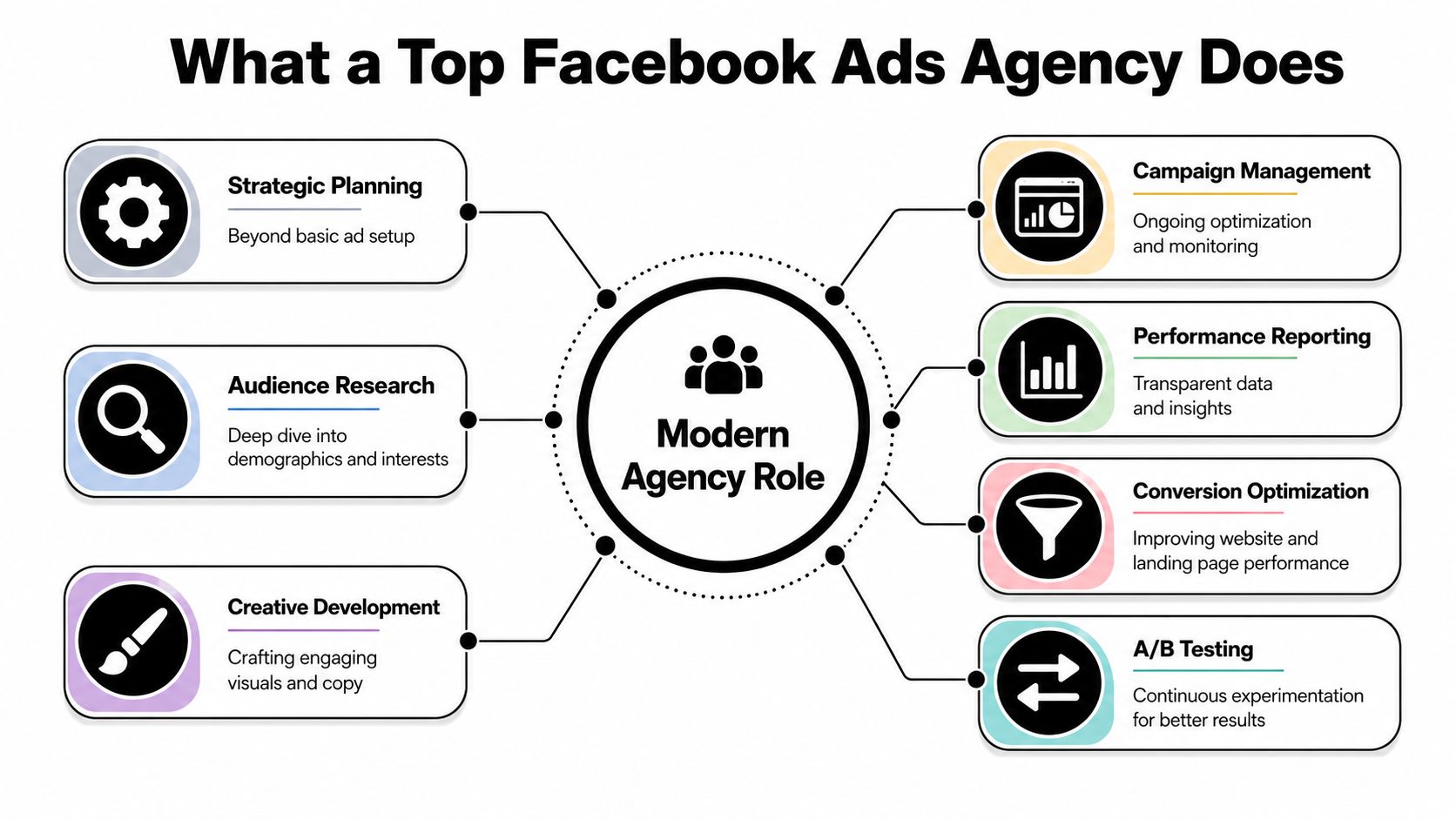
A Facebook Ads agency is often thought to just build audiences, writes copy, and launches campaigns. That’s a tiny slice of the job. The serious work usually starts before the first ad goes live.
The technical layer comes first
For eCommerce, I want to know whether the data can be trusted. That means checking:
- Google Tag Manager setup so core events aren’t duplicated or missing
- Google Analytics configuration so traffic quality can be read properly
- Meta Pixel health to confirm browser-side tracking is sensible
- Conversions API installation so server-side events support attribution
- Shopify or WordPress event mapping so add-to-cart, checkout, and purchase actions align with reality
For Shopify stores in Australia, Meta Conversion API installation can improve data accuracy by up to 30% compared to standard browser-based tracking, according to Sharp Instincts’ write-up on Shopify and Meta tracking. That’s why I treat CAPI setup as foundational, not optional.
I’ve seen this especially with stores relying on app-heavy builds, custom checkouts, or patched-together themes. If event quality is weak, optimisation gets distorted. Meta learns from bad signals and spends accordingly.
Creative testing isn’t random
Once tracking is reliable, then we can test properly. Most failed campaigns don’t fail because the platform is broken. They fail because the team never built a testing process.
A proper Facebook ads agency Melbourne stores hire should have a defined creative workflow. Ours usually revolves around message angles, offer framing, hooks, product proof, and format variation. Static images, short-form video, UGC-style assets, founder-led content, carousels. Each has a role.
Practical rule: If an agency can’t explain how it tests creative, it probably isn’t testing. It’s rotating guesses.
The feed itself keeps changing, which is why I pay close attention to platform behaviour and content presentation. If you want a useful non-promotional read on how feed shifts can affect visibility and engagement patterns, the latest Facebook news feed update is worth scanning.
Development work is part of ad performance
Generalist agencies usually fall short because good ad management often depends on web capability.
For example:
| Area | Why it matters |
|---|---|
| WordPress development | Product pages, landing pages, and theme performance affect conversion quality |
| Building custom blocks in Gutenberg | Lets you create reusable high-converting sections without bloated page builders |
| Shopify development | Theme tweaks, app conflicts, and product page UX directly affect ROAS |
| Shopify API work | Useful when the store needs custom integrations or richer operational flows |
| GTM and Google Analytics | Clean attribution helps you diagnose what worked and what didn’t |
I’ve worked on campaigns where fixing the store delivered more value than changing the audience. That might mean refining mobile PDP layouts, tightening checkout intent, building custom Shopify features, or cleaning up WordPress templates. If your agency can’t talk comfortably about the backend, it’s only seeing half the problem.
Why Your Melbourne eCommerce Business Needs a Specialist
A broad agency can run ads. A specialist eCommerce agency understands the entire revenue path. That’s the difference.
Clicks don’t pay the bills
For Australian campaigns, a positive Return on Ad Spend benchmark is at least 4:1, meaning $4.00 in revenue for every $1.00 spent, based on Kamber’s guide to key Facebook Ads metrics. That’s the benchmark I want in mind when I assess whether a campaign is healthy enough to scale.
A non-specialist often stops at platform metrics. Reach looks fine. Clicks look fine. Maybe cost per click looks acceptable. None of that guarantees the store is making money.
An eCommerce specialist will look deeper at:
- Product-market fit in ad messaging
- Landing page continuity from ad to PDP
- Offer strength and margin pressure
- Upsell and bundle opportunities
- Checkout friction on mobile
- Retargeting windows based on actual buyer behaviour
Those are not side issues. They are the work.
Shopify and WordPress stores need operational thinking
I work with a lot of Shopify brands, but the same applies to WooCommerce and broader WordPress builds. If the product feed is messy, if GTM is unreliable, or if the theme breaks basic trust signals, your campaign performance gets capped no matter how good the media buying is.
This is why I care about adjacent skills as much as campaign settings. A store may need help with:
- Shopify development crash course fixes for a founder who’s inherited a messy build
- Building custom Shopify apps using Shopify CLI when standard apps create friction
- Shopify developer API tasks to connect operational systems cleanly
- WordPress website developer support for custom product landing pages
- Custom shop and collection page UX that helps paid traffic convert faster
A specialist can connect those dots. A generic agency often can’t.
Specialist focus also changes channel decisions
Some stores shouldn’t lean on Meta alone. I’ve had campaigns where Google Shopping ads for dropshipping, branded search, or PMAX vs Google Shopping ads decisions mattered just as much as Facebook and Instagram. A specialist knows when Meta is the acquisition engine, when it should support demand capture, and when product feed work needs attention first.
That also applies to Instagram Shop and Facebook Shop setups. They can help support discovery and trust, but they’re not a replacement for a strong site experience. If your catalogue sync is poor or your imagery is weak, those surfaces won’t do much for you.
I’ve found that businesses hiring a digital marketing agency Melbourne specialist usually improve faster because fewer people are arguing over vanity metrics. The conversation stays tied to revenue, tracking quality, and conversion reality.
Local Melbourne Market Insights for Facebook Ads
Melbourne has range. That’s what makes local campaign strategy interesting and difficult at the same time. Audience behaviour isn’t uniform across the city, and that matters when you’re shaping offers, creative, and targeting.
Local scale and national reach can work together
Australia has over 17 million monthly active Facebook users, representing about 85% of the population, according to Impressive’s overview of Facebook advertising in Australia. For a Melbourne business, that creates two very different but equally useful opportunities. You can go narrow and local, or you can use Melbourne as the base and scale nationally with precision.
The mistake I see is starting too broad with no local foothold. A lot of brands do better when they first build response from the segments they already understand. That might be inner-city trend buyers, suburban family purchasers, niche hobby communities, or local repeat customers already familiar with the category.
Why local knowledge still matters
A Melbourne-based operator usually has a better instinct for how to angle campaigns around real buying behaviour. Not because Melbourne is magically different, but because local nuance shapes demand.
That can influence:
- Creative references tied to local lifestyle and buying context
- Offer timing around local retail peaks and community rhythms
- Audience framing based on suburb clusters or known behavioural overlap
- Local SEO and Google Business Profile support for brands with physical stores or showrooms
I also look at how paid and organic support each other. If a business has a storefront, weak Google My Business signals, poor local landing pages, or inconsistent brand presentation, paid social has to do more of the trust-building work on its own. That’s inefficient.
A local campaign doesn’t need to stay local forever. It just needs to start where the message is most likely to land.
The Melbourne competition problem
Melbourne advertisers also compete in a crowded market. You’re not just bidding against brands in your exact niche. You’re fighting for attention against every polished retailer, every offer-heavy product ad, and every business with a stronger creative pipeline than you.
That means local advantage doesn’t come from geography alone. It comes from better alignment between:
| Factor | What actually helps |
|---|---|
| Audience targeting | Starting with segments that already show stronger buyer intent |
| Creative | Ads that feel relevant rather than generic catalogue spam |
| Site experience | Fast product pages, clean trust signals, mobile-ready checkout |
| Brand search support | Good local SEO and a consistent branded presence |
A seo agency melbourne mindset can complement paid social. Even if Facebook and Instagram drive the first click, many buyers come back later through branded search, map listings, or direct traffic. If those surfaces are weak, attribution gets murky and conversion rates slip.
A Realistic Look at Agency Pricing and Ad Spend ROI
Most business owners don’t mind paying for ads. They mind paying for confusion. If an agency cannot show where the budget is going, why results are changing, and what they are doing about it, trust disappears fast.
I have seen this with Melbourne eCommerce brands on both Shopify and WordPress. The account looks active, spend is going out every day, and the reports are full of platform metrics. Then you check the backend and find broken event mapping, duplicate purchases in GTM, or a half-finished Meta CAPI setup that is starving the algorithm of clean data. Strategy gets blamed for problems that started in the tracking.
What the benchmark numbers actually tell you
Globally, the average cost per action for Facebook ads is $18.68, and the average CPM is $7.19, based on KlientBoost’s Facebook ads statistics roundup. Those figures are reference points, not promises.
I use benchmarks to test whether the commercial model makes sense before anyone starts obsessing over ad tweaks. If a store cannot absorb acquisition costs in that range, the problem may sit with pricing, margin, average order value, repeat purchase rate, checkout friction, or the offer itself.
A few principles matter more than the headline numbers:
- CPA is a margin question first
- CPM measures the cost of attention
- Higher CPM can still produce strong profit
- Cheap traffic often underperforms after the click
That last point gets missed all the time. A weak product page, slow mobile load time, clunky cart, or poor trust signals can make an ad account look worse than it is.
What businesses usually pay for
There are two separate costs. One is media spend paid to Meta. The other is the agency’s work to plan, build, test, track, and fix what sits around the campaigns.
The second part is where a lot of owners under-budget. Good agencies do far more than launch ads and swap creatives every few weeks. On eCommerce accounts, the core work often starts in the backend because poor attribution poisons decision-making. If purchase events are missing or inflated, reported ROAS becomes meaningless.
For Shopify and WordPress stores, agency work often includes:
- Google Tag Manager setup and event configuration
- Meta Conversions API installation and testing
- GA4 and GTM troubleshooting
- Creative testing frameworks and ad iteration
- Landing page and checkout feedback
- Feed and catalogue cleanup
- Support across Meta and Google when channel overlap affects attribution
That technical layer is why some brands also bring in teams that can handle related store work, such as Shopify developers in Melbourne. If the store cannot convert, more traffic just makes the waste easier to measure.
How I judge ROI in the real world
ROAS matters, but raw ROAS can hide a lot. I care more about contribution margin, new customer economics, and whether the account is learning from clean signals.
For example, a campaign showing a lower platform ROAS can still be the better bet if it is acquiring first-time customers who come back and buy again. The opposite is also true. I have seen retargeting campaigns report strong numbers while prospecting is doing all the heavy lifting and getting no credit because attribution is messy.
This is why setup quality matters so much. Meta CAPI, GTM, feed accuracy, and clean purchase event tracking are not side tasks. They shape what the platform can optimise toward, what the agency can trust in reporting, and whether scaling decisions are grounded in reality.
Where Google Ads fits into the mix
Store owners often ask whether Meta or Google should get the bigger share of spend. The answer depends on whether the brand needs to create demand, capture existing demand, or do both at the same time.
In practice, I usually look at the split this way:
- Google Shopping captures existing product intent
- Meta creates demand and supports retargeting
- PMAX and standard Shopping serve different control and feed-quality needs
- Budget allocation should follow margin, search demand, and tracking reliability
For Australian eCommerce businesses, Google Shopping campaigns often average AU$1,200 to AU$3,500 in monthly spend to achieve measurable ROAS, and underdelivery can happen because of product eligibility issues or bid thresholds, as noted in Swanky’s article on Shopify agency work in Australia.
That matters because underspending is not always a demand problem. Sometimes the account is misconfigured, the feed is weak, or conversion tracking is giving Google poor feedback.
A short explainer helps here if you’re comparing paid channels and setup quality:
What about service businesses and call tracking
My main focus is eCommerce, but the pricing conversation changes again for lead generation accounts. In service businesses, lead quality and response speed usually matter more than the lowest possible cost per lead.
We’ve set up custom numbers through Twilio for businesses that wanted tighter call handling and clearer attribution. That helps when missed calls are costing real revenue after hours. For tradies, clinics, salons, and restaurants, better call routing can improve ROI faster than another round of audience testing.
I also use platforms such as CallRail and Go High Level when teams need clearer attribution for PPC call campaigns.
Your Hiring Checklist Questions to Ask Any Agency
A polished pitch means nothing if the agency can’t think clearly once the account is live. When I’m on the client side of the table, I don’t want slogans. I want process, accountability, and technical competence.
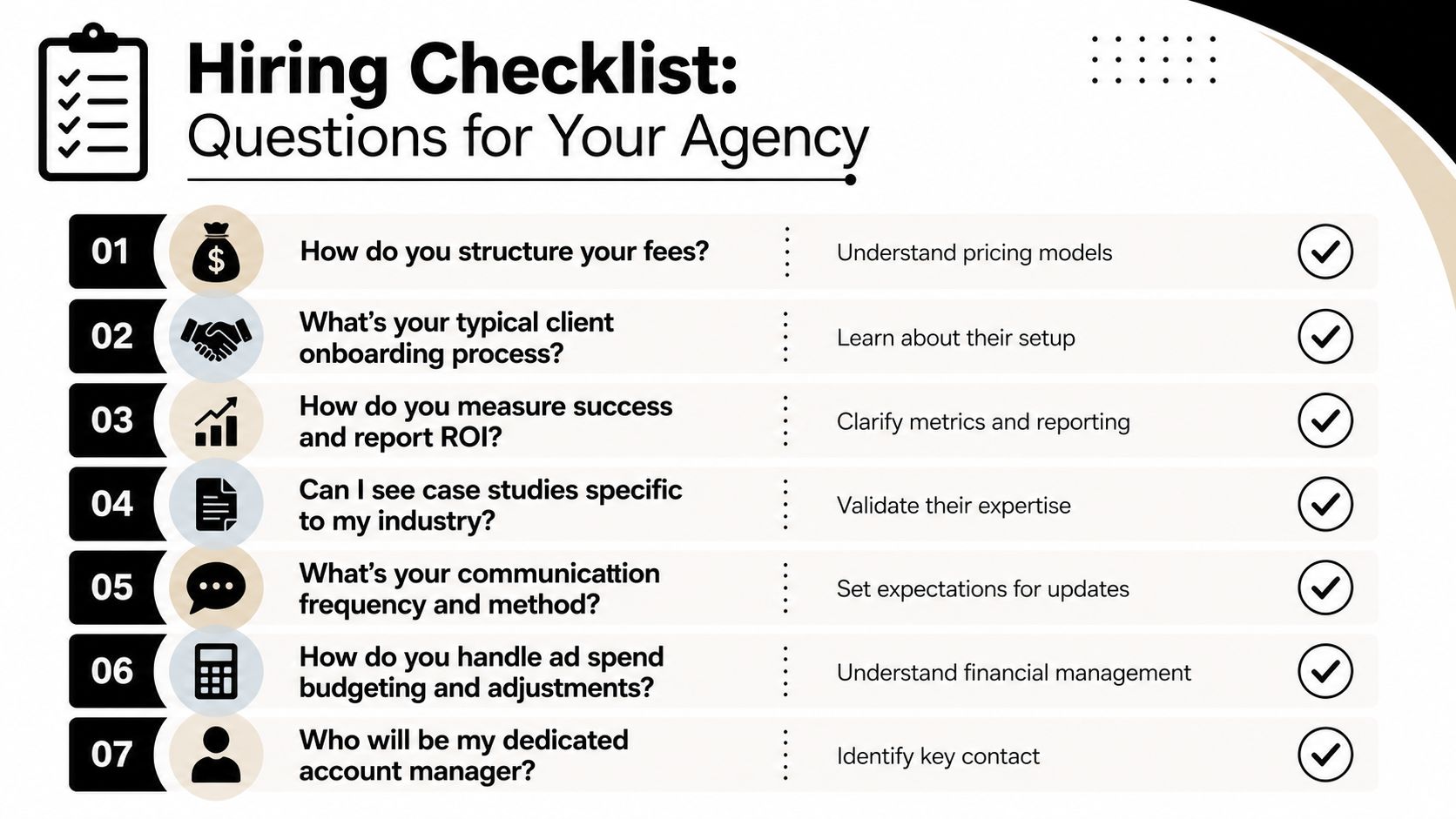
Questions that reveal whether they actually know what they’re doing
Ask these plainly and listen for direct answers:
- How do you handle tracking setup? If they can’t explain GTM, pixel events, attribution issues, and Meta CAPI in simple terms, that’s a warning.
- What does your creative testing process look like? You want to hear about structured testing, not “we make fresh ads when performance drops.”
- How do you report on success? Good agencies talk about business metrics first, platform metrics second.
- Who is doing the work day to day? Sales staff often disappear after the contract is signed.
- What changes do you recommend on Shopify or WordPress before scaling? This tells you whether they understand post-click conversion.
Red flags I wouldn’t ignore
Not every bad agency is dishonest. Some are just shallow. That still costs you money.
| Red flag | Why it matters |
|---|---|
| They talk mostly about reach and likes | Vanity metrics won’t tell you if the business is profitable |
| They avoid technical questions | Weak tracking leads to weak decisions |
| They promise fast wins without context | Serious accounts need testing, iteration, and clean data |
| They don’t ask about margins | They can’t judge success properly without commercial context |
| They treat Shopify and WordPress as irrelevant | Site issues often drive campaign failure |
If an agency asks more about your ad budget than your gross margin, I’d keep looking.
Ask about broader capability too
A strong marketing agency Melbourne businesses hire for Meta should be able to speak intelligently about nearby systems and channels, even if you don’t use all of them straight away.
That includes things like:
- Beginners guide to Google Shopping ads level education for founders who are new to paid search
- How much does it cost to start Google Ads in a way that relates to your category
- Google Shopping ads not spending budget diagnosis
- Google ads for plumbers or adjacent service-specific account structures
- WordPress web developer support if landing pages need customisation
- Shopify development partners capability if the store stack needs work
You don’t need one agency to do everything. You do need one that understands how the pieces connect.
Measuring What Matters How to Read Reports and Avoid Pitfalls
The average report is too busy. It throws charts at the client and hopes volume looks like sophistication. I prefer fewer numbers, cleaner questions, and sharper decisions.
The report should answer three things
When I review a Meta account with a client, I care most about:
- How much did we spend?
- How much revenue did the campaign influence?
- What return did that spend produce?
Everything else is support material. Useful, yes. Primary, no.
Clicks, CPC, CTR, thumb stop rate, landing page views, outbound CTR, add-to-cart volume. Those are diagnostic metrics. They help explain why a result happened. They are not the business result itself.
Why GTM clarity changes the conversation
A lot of reporting problems are really tracking problems. If your Google Tag Manager container is messy or your Google Analytics setup isn’t aligned with your store events, you end up arguing over phantom issues.
Common examples include:
- Duplicate purchase events that inflate apparent success
- Broken add-to-cart triggers that make the funnel look weaker than it is
- Checkout event gaps that hide where people are dropping off
- Mismatched UTM conventions that muddy channel comparisons
When GTM is clean, it becomes easier to connect Meta behaviour with site behaviour. Then you can tell whether the problem sits in the audience, the ad, the landing page, the product, or the checkout flow.
Good reporting doesn’t impress you. It helps you decide what to fix next.
Don’t quit too early
One of the worst habits in paid media is pulling the plug before the account has enough signal. I get why owners do it. They want certainty quickly and platforms don’t always give it.
But mastering Facebook ads requires patience with the testing cycle. Month one often exposes problems. Creative misses. Weak offers. Data gaps. Tracking inconsistencies. Audience assumptions that don’t hold up. That’s still progress if the team reads it properly.
Consistency matters in every channel I manage. The same lesson applies whether we’re talking Meta, local SEO, product feed work, or Google ads for contact form submissions. Marketing your business isn’t one clever launch. It’s repeated, measured improvement.
A good agency should help you stay disciplined without pretending every campaign deserves infinite time. Some offers need changing. Some stores need development work. Some products won’t scale well on paid social. Honest analysis beats blind persistence.
Ready to Grow Your Business with an Expert Partner
A lot of business owners assume the choice is between doing Facebook ads in-house or handing everything to an agency and hoping for the best. I don’t think that’s the right framing.
The choice is whether you’re willing to build a reliable growth system. That means clean tracking, sensible creative testing, a site that can convert traffic, and enough consistency to make optimisation possible. Without those pieces, changing agencies won’t fix much. Neither will changing platforms every month.
For eCommerce brands on Shopify and WordPress, the technical groundwork is more critical than commonly acknowledged. That’s why I keep coming back to the same point. A competent digital marketing agency Melbourne businesses hire for paid social should understand the backend as well as the ad account. It should be able to talk through GTM, Google Analytics, Shopify API implications, WordPress build constraints, feed quality, Meta event health, and what occurs at checkout.
I also think founders give up too quickly on channels that haven’t been set up properly in the first place. Facebook ads, don’t quit too early isn’t motivational fluff. It’s operational advice. If the first round of reporting reveals bad event tracking, weak product pages, or creative that doesn’t match the market, the answer isn’t always to stop spending. Often the answer is to fix the system that spend is flowing into.
If you’re comparing providers, look for a partner that can think across paid media, store development, and analytics without turning everything into jargon. That applies whether you need WordPress developers Melbourne, a Shopify developer, help with setting up Google Tag Manager containers, or a cleaner approach to Google Ads agency work running beside Meta.
If you’re a business with a paid ads budget of at least 3k a month, I’d love to offer you a low risk deal. Get a month of paid ads management FREE. Apply now through the contact page. Alpha Omega Digital is a marketing agency based in Melbourne, Australia but also services clients from Sydney, Brisbane, Newcastle, Perth, Adelaide, Darwin and Hobart.
A CTA for Alpha Omega Digital.
[email protected]
Read more insights from our team on web design, paid ads, and growth strategy.