You've got a Shopify store, a product range that sells when the right people see it, and a Google Ads account that appears active. Yet the numbers don't line up. Clicks arrive, the budget disappears, and the reporting still can't tell you which campaigns produced profitable customers.
That's the point where PPC management Melbourne becomes more than bid changes and keyword lists. In a competitive Australian market, performance depends on the connection between your ads, product feed, website, tracking, CRM and sales process. A campaign can attract relevant traffic and still lose money if Shopify records the purchase incorrectly, Meta receives incomplete events, or your landing page gives shoppers too many reasons to leave.
I've worked with enough ecommerce and service businesses to know that the visible campaign is rarely the actual problem. The deeper issue is usually measurement, commercial maths or a website that wasn't built for paid traffic. This guide explains how I approach those problems, from Google Shopping and Performance Max to Shopify development, WordPress landing pages, Meta creative testing and Twilio call tracking.
Paid Search Reality in the Australian Market
A Melbourne retailer can write relevant ads, build a clean product feed and still struggle to produce profitable sales. Established brands, marketplaces and specialist stores compete for the same searches. Auction pressure is only one part of the problem. Product margins, landing-page quality, Shopify data and conversion tracking determine whether paid demand becomes revenue.
Australia's internet advertising market reached AUD 18.4 billion in 2025, growing 11.5% year on year. Search advertising represented AUD 8.0 billion, or 44% of total digital ad spend, according to Australian digital advertising market figures. Search remains the largest single online advertising channel, although video and mobile continue to influence how businesses allocate media spend.
Search gives Melbourne ecommerce businesses access to people already looking for a product or solution. It also places them in a mature auction, where broad targeting and incomplete measurement can consume budget before the account has enough reliable evidence to improve.
Why technical foundations now decide performance
Australia's internet advertising market reached AUD 4.9 billion in the March quarter of 2026, its strongest March quarter on record, according to the IAB Australia internet advertising revenue report. Continued investment confirms the commercial importance of measurable channels, while raising the standard for campaign setup and reporting.
Google held roughly 88% to 90.7% of the Australian search market in 2026 readings, based on the Australian search market overview. For most Melbourne advertisers, Google Ads should be configured first. Bing can be monitored for incremental opportunities, but it is rarely the main environment for campaign learning.
The bidding system can only optimise from the signals it receives. A Shopify store may record checkout starts but fail to pass completed purchase value. A Meta campaign may receive browser events while server-side events are missing or duplicated. A local service business may count form submissions without connecting booked jobs or qualified calls to the original campaign.
That is why Shopify API integrations, Meta Conversions API and Twilio call tracking affect performance directly. They connect advertising activity with purchases, leads and sales outcomes. Without those connections, an account can report clicks and conversions while training automated bidding against incomplete commercial evidence.
Practical rule: Do not ask whether an agency changes bids regularly. Ask whether it can prove which business outcomes Google is optimising towards.
What competent PPC management should include
A capable digital marketing agency Melbourne should explain how these parts work together:
- Commercial objectives: revenue, margin, lead quality and customer value.
- Campaign structure: brand, non-brand, Shopping, Performance Max, remarketing and prospecting.
- Measurement: Google Tag Manager, Google Analytics, platform tags, enhanced conversions, API events and CRM imports.
- Website experience: mobile usability, product information, checkout friction and landing-page relevance.
- Decision-making: what will change, why it will change and which evidence supports scaling.
Creative remains important. A clear product image, credible offer and relevant message can improve click and purchase rates. They cannot repair a broken feed, unreliable purchase event or mobile checkout that loses ready-to-buy customers.
PPC management therefore needs to operate across the advertising account and the sales system. Google Ads captures demand, Shopify or WordPress presents the offer, analytics records behaviour, APIs pass back conversion events, and fulfilment or sales data confirms whether the result was valuable. The technical foundation determines how confidently Melbourne businesses can scale.
Budgeting for Growth and Understanding Local Costs
A Melbourne retailer can spend more and still lose money if its feed, purchase data or margin model is wrong. A local service business can face the opposite problem: a small number of expensive clicks may be commercially valuable if they produce qualified calls. Budget planning should therefore start with the customer economics and the quality of the evidence available, not with an agency's preferred spend level.
For Australian SMEs, one benchmark reports an average Google Search CPC of A$2.10, top-quartile CPCs between A$1.05 and A$1.55, and bottom-quartile CPCs of A$3.10 or more. It also reports an average cost per conversion of A$46, with bottom-quartile accounts at A$78 or more. These figures come from the Australia marketing benchmarks report. They are directional benchmarks, not a forecast for a particular Melbourne account.
The same report presents a different picture for sampled service searches in Melbourne, where the median CPC is A$16.95, up 14% year over year. That figure applies to selected service keywords, not to ecommerce traffic across an entire catalogue. A plumber, solicitor or specialist clinic may need a very different budget from a retailer selling products through Shopping campaigns.
Benchmarking the initial budget
The first budget should buy enough relevant traffic to produce useful conversion evidence while keeping wasted exposure under control. Australian guidance commonly places an SME Google Ads starting budget around AUD $1,500 to $3,000 or more per month, with search CPCs often around AUD $2 to $4 and potentially much higher in competitive industries, according to Google Ads cost guidance for Australian businesses.
| Campaign Type | Recommended Starting Budget | Average CPC Range | Primary Goal |
|---|---|---|---|
| Google Search for ecommerce categories | AUD $1,500 to $3,000+ per month | Often around AUD $2 to $4, with higher costs in competitive categories | Capture high-intent product searches |
| Google Shopping for retail products | AUD $30 to $100 per day | Around AUD $0.30 to $1.50, depending on competition | Generate qualified product visits |
| Google Search for local services | Budget depends heavily on keyword competition | Can rise well above general SME search ranges | Generate calls and enquiries |
| Performance Max for ecommerce | Set after feed and conversion validation | Varies by inventory and auction conditions | Expand conversion-focused reach |
Shopping budgets and CPCs vary with product category, feed quality and auction pressure. Guidance for Australian retailers places Google Shopping budgets around AUD $30 to $100 per day, with CPCs around AUD $0.30 to $1.50, according to Google Shopping advice for Australian retailers. Google Ads has no fixed minimum spend. One Australian guide recommends beginning around AUD $30 to $50 per day, then waiting three to four weeks before making major changes.
Calculate viability before scaling
Ecommerce decisions should use contribution margin rather than revenue alone. If a product sells for $150 but the business retains only $60 after product cost, shipping, payment fees and returns, a $100 acquisition cost is unsustainable even when the revenue column looks strong.
A useful calculation is:
Break-even ROAS = average order value ÷ allowable acquisition cost
Allowable acquisition cost must reflect the margin remaining after variable costs. Reliable repeat purchases may justify accepting a higher first-order acquisition cost. Low-margin products and infrequent repeat purchases require the first transaction to carry more of the advertising cost.
Scale only when the conversion event is trustworthy, search terms are commercially relevant, stock is available and resulting orders meet margin requirements. Rising click volume is not enough.
Budget problems that aren't really budget problems
An account may underspend because the product feed is incomplete, products are disapproved, targeting is too narrow or bids do not fit the auction. It may overspend because broad matching reaches research searches instead of buying intent.
Before requesting more budget, inspect:
- Search terms and product-level performance: Find traffic that creates engagement without commercial action.
- Conversion value: Compare revenue and margin, not purchase count alone.
- Landing-page behaviour: Identify gaps between the ad promise and the product page.
- Stock and fulfilment: Pause products that cannot be delivered reliably.
- Attribution: Check whether Google, Analytics and Shopify record the same commercial event.
Budget should follow evidence. A tightly controlled campaign with reliable Shopify purchase data can teach more than a broad account that spends across every available audience. For local services, include lead quality and booked work in that assessment, because a cheap form submission is not automatically a valuable customer.
Building the Technical Tracking Infrastructure
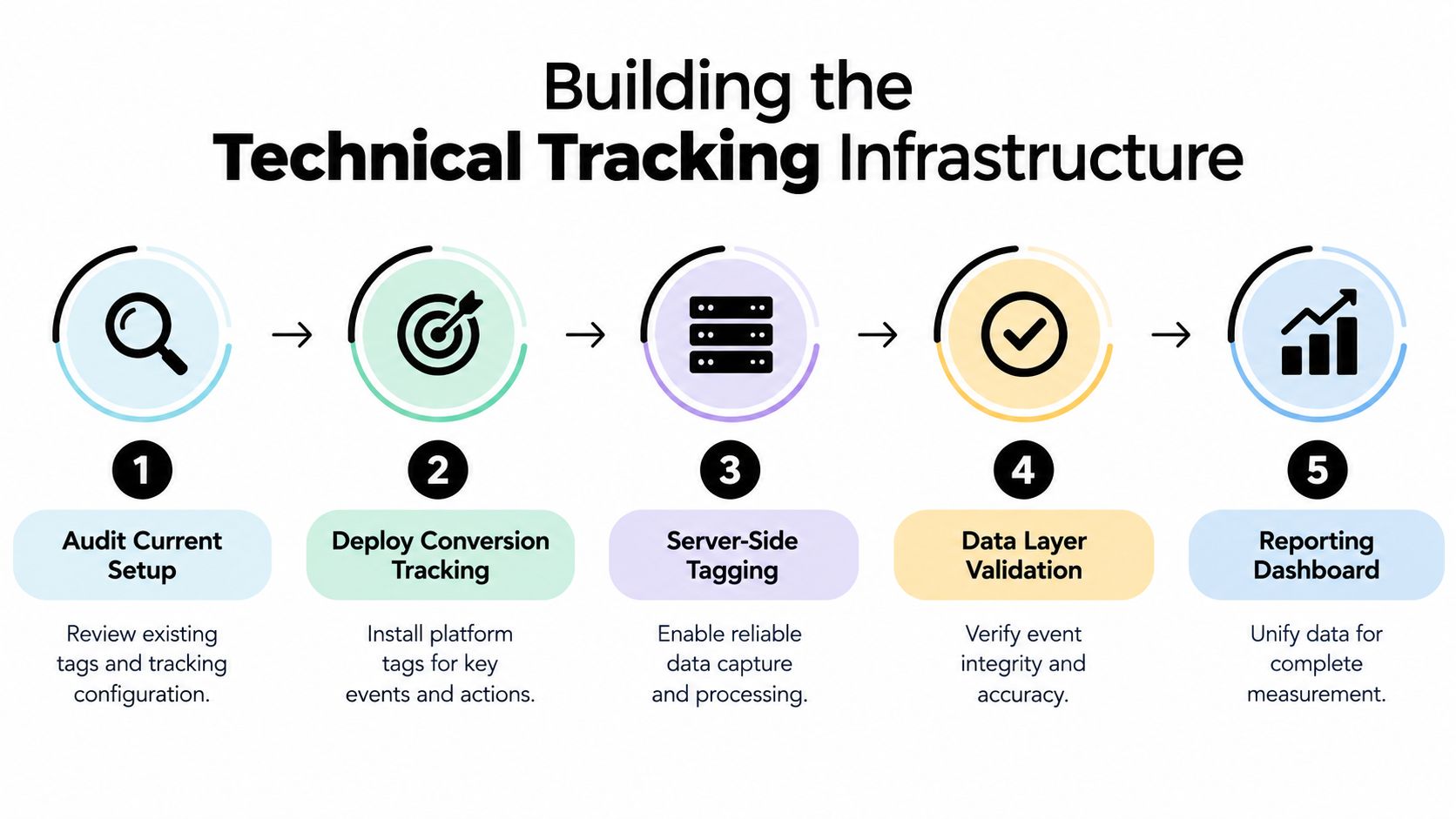
You can't manage what you can't measure. Before launching or rebuilding campaigns, I want to know whether the website records the events that matter and whether those events reach Google Ads and Meta with enough context to support optimisation.
A Shopify store and a WordPress site need different implementation choices, but the principle is the same. The tracking layer must reflect the customer journey from ad interaction to product view, cart activity, checkout and purchase, or from search impression to qualified enquiry and booked appointment.
Start with a measurement audit
I begin by documenting the existing setup rather than adding another tag immediately. That means reviewing Google Tag Manager containers, Google Analytics events, Google Ads conversions, Meta Pixel activity, consent behaviour and the platform's own order or lead records.
The audit should answer practical questions:
- Does a purchase fire once, or can page refreshes create duplicates?
- Does the event include transaction value and currency?
- Are internal staff and test orders excluded?
- Does a contact form submission represent a genuine lead?
- Can phone calls be connected to the campaign and keyword that generated them?
- Are events still recorded when browser-based tracking is limited?
The conversion statistics report from Landra is useful background reading when reviewing how different conversion points should be considered across a customer journey. It doesn't replace account-specific validation, but it can help teams distinguish between an early interaction and the commercial event that should guide optimisation.
Configure Google Tag Manager carefully
A clean Google Tag Manager container gives the team a controlled place to manage tags and triggers. The implementation should be organised around a documented data layer, consistent event names and clear ownership of each platform tag.
For a Shopify store, I want purchase data to include the order identifier, value, currency and product information. For WordPress, the approach depends on the ecommerce or form system, but the event still needs to be tested against the actual business outcome.
The process is usually:
- Map the customer journey: List the events that matter for products, enquiries and calls.
- Define the data layer: Decide which values each event must pass.
- Build triggers: Trigger on confirmed actions, not loose page views.
- Deploy platform tags: Connect Google Ads, Analytics and Meta.
- Test in preview and live environments: Check event timing, duplication and values.
- Document the container: Record what each tag does and who maintains it.
A container full of unnamed tags and overlapping triggers isn't a technical asset. It's a future reporting problem.
Add server-side signals where they improve reliability
Browser-only tracking can lose information because of consent choices, browser restrictions, connection changes and checkout flows that move between domains or systems. Meta's Conversions API installation can supplement browser events by sending server-side events from a connected system.
For Shopify businesses, that may involve native integrations, an approved app or a custom connection using the Shopify API. The right route depends on the store's checkout setup, data requirements and development resources. The implementation must avoid duplicate events, so event IDs and matching logic need to be checked rather than assumed.
For WordPress, custom Gutenberg blocks can help create consistent lead forms, product modules and conversion components. They don't automatically create better tracking, but they can provide a controlled structure for passing predictable data into the data layer.
Measurement only helps when the event has commercial meaning. A button click isn't equivalent to a completed order or a qualified enquiry.
Google's concentration in Australia makes accurate Google Ads conversion signals particularly important. Automated bidding can process data quickly, but it can't determine whether a badly configured event represents genuine value.
Choosing the Right Campaign Strategy for Your Business Model
Ecommerce and service businesses can both use Google Ads, but their campaign architecture shouldn't look the same. A Shopify retailer needs product data, feed quality and purchase-value tracking. A plumber, dentist or beauty therapist needs location control, call handling and lead-quality feedback.
Ecommerce campaigns need structured product information
A beginner's guide to Google Shopping ads should start with Merchant Centre, not bid strategy. Australian guidance notes that a Merchant Centre account is required to upload product information and connect it to an ecommerce platform, as explained in this Australian ecommerce advertising guide.
The feed should accurately represent:
- Product titles and descriptions.
- Price and availability.
- Brand, category and product identifiers.
- High-quality images.
- Landing-page URLs.
- Shipping and returns information.
For Google Shopping ads for dropshipping, feed accuracy is even more important because availability and delivery expectations can change quickly. A product that appears attractive in an ad but arrives late, lacks clear shipping information or is no longer available creates commercial and customer-service problems that bidding can't solve.
Standard Shopping gives more direct control over product groups, bids and query analysis. Performance Max can access a wider range of Google inventory and automate more decisions, but it also requires stronger inputs and careful interpretation.
| Consideration | Standard Google Shopping | Performance Max |
|---|---|---|
| Control | More direct product and query management | Greater automation across inventory |
| Visibility | Easier to isolate product-group behaviour | Requires broader reporting interpretation |
| Best fit | Structured testing and controlled catalogue promotion | Validated stores ready to expand reach |
| Main risk | Limited reach if segmentation is too narrow | Weak inputs can spread spend inefficiently |
PMAX vs Google Shopping ads isn't a choice between an old tactic and a new tactic. It's a question of control, data quality, inventory and business readiness. I don't use Performance Max to hide a weak feed or compensate for missing purchase values.
Service campaigns need intent and response speed
For Google Ads for service-based businesses, campaign structure should reflect the way people buy. A high-intent search for an emergency electrician often demands a call. A planned renovation may begin with a contact form or quote request. A clinic may need appointment bookings, phone calls and directions.
Separate campaigns by:
- Service: Avoid combining unrelated offers where the search intent differs.
- Location: Keep Melbourne suburbs and service areas visible in reporting.
- Brand and non-brand intent: Protect existing demand without disguising prospecting performance.
- Conversion action: Distinguish calls, quote forms, bookings and low-value interactions.
For Google Ads for contact form submissions, track the confirmation event rather than the form page load. Then import qualified outcomes from the CRM, because a spam enquiry and a revenue-producing customer shouldn't carry the same optimisation value.
Campaign priority in Google Ads also needs a commercial reason. Product segmentation, brand protection and prospecting each serve different roles. A higher priority setting isn't a substitute for clean inventory, sensible targets or profitable economics.
For a broader perspective on effective PPC campaign management, focus on whether the strategy connects targeting, conversion tracking and optimisation rather than treating each setting as an isolated lever.
Meta requires a different testing rhythm
A Facebook Ads agency should distinguish between demand capture and demand creation. Google often responds to an existing query. Meta can introduce a product to someone who wasn't actively searching, so the creative must earn attention before the product page gets a chance to convert.
My Meta Ads creative testing process starts with distinct angles, not tiny wording variations. I might test a product demonstration against a customer problem, a comparison against a social proof concept, or a founder-led explanation against a short-form lifestyle execution. Each variation needs a clear hypothesis and a defined success event.
Mastering Facebook ads doesn't mean abandoning a campaign after an early fluctuation. It also doesn't mean refusing to stop a weak concept. Review spend, quality of traffic, landing-page behaviour and purchase signals together. Facebook ads, don't quit too early, but don't use patience to excuse poor creative or broken measurement.
Instagram Shop and Facebook Shop can shorten the path from discovery to product browsing, provided the catalogue, availability and checkout experience are maintained. They should complement a strong Shopify store rather than become a substitute for product data discipline.
Aligning Web Development with Conversion Rate Optimisation
Paid traffic exposes website weaknesses quickly. A shopper arriving from a product ad expects the landing page to confirm the product, price, availability and next step without making them hunt through the site.
That makes WordPress development, WordPress design, Shopify development and Shopify design part of PPC management. The ad platform controls the visit. Your site controls what happens next.
Build landing pages for the traffic you buy
A product feed may send a shopper to a product page, while a broad category ad may need a curated collection. Sending both visitors to the homepage creates unnecessary work for the customer and weakens the relevance between query, ad and page.
For a WordPress website, a WordPress website developer can build reusable landing sections rather than forcing the marketing team to edit the core theme. Custom blocks in Gutenberg are useful here. They can provide controlled modules for product benefits, trust elements, comparison tables, FAQs and enquiry forms, while keeping the page editor accessible to non-developers.
That work might sit with a WordPress developer in Melbourne or a broader WordPress development company, depending on the project. The key requirement isn't the label. It's the ability to preserve performance, accessibility, analytics and maintainability while improving the conversion path.
Relevant services might include:
- WordPress development: Custom templates, integrations and content structures.
- WordPress design: Mobile-first layouts that support product discovery and trust.
- WordPress web developer support: Ongoing landing-page and tracking changes.
- WordPress developer Sydney support: Useful for brands operating across Australian markets.
- WordPress development Melbourne: Local collaboration for businesses needing regular strategic input.
Shopify requires commercial development decisions
A Shopify developer should understand more than themes. Product data, collection architecture, checkout constraints, fulfilment information and app interactions all influence paid traffic performance.
Custom Shopify apps built with Shopify CLI can support workflows that standard apps don't handle cleanly. Examples include bespoke product configuration, internal merchandising tools, data synchronisation or customer-service workflows. Custom work costs more upfront, so I only recommend it when the workflow has a clear operational or commercial benefit.
Shopify API work also needs restraint. A custom integration that passes useful order data into analytics or a CRM can improve decision-making. An unnecessary integration can introduce maintenance risk, privacy issues and duplicate records. The objective isn't to use an API because it sounds advanced. It's to remove a measurable constraint.
A Shopify development crash course for business owners should cover the difference between a theme adjustment, an app configuration, a custom Shopify app and a Shopify API integration. Those choices have different budgets, ownership implications and support requirements.
If you're comparing Shopify developers in Melbourne, ask how the proposed development will affect feed quality, page speed, conversion tracking and ongoing campaign operations. That answer tells you more than a gallery of attractive storefronts.
Capturing Offline Conversions with Automated Call Tracking
For ecommerce, the purchase usually happens online. For tradies, dentists, doctors, restaurants, hairdressers and beauty therapists, the decisive conversion often happens on the phone.
A call can be worth far more than a form submission, but only if the business answers it, records its source and follows through. Without call tracking, a Google Ads report may show clicks and form fills while missing the enquiry that became a booked job.
How we use Twilio call infrastructure
We set up a custom number through Twilio and connect it to the business's advertising and booking workflow. The number can route calls, capture campaign information and support an automated answering service that operates 24 hours, doesn't get sick or tired, and can book appointments into a calendar or Calendly.
The system can help with:
- Call answering: Customers receive a response outside normal office hours.
- Appointment booking: The assistant can place suitable appointments into the business calendar or Calendly.
- Lead qualification: The business can define the information required before a booking.
- Call recording and review: Teams can assess whether the traffic produces useful conversations.
- Offline conversion imports: Qualified calls can be sent back to Google Ads for optimisation.
- Missed-call reduction: Fewer callers are left without a next step.
For tradies, a missed emergency enquiry can mean lost business. For a salon or clinic, the same problem may appear as an empty appointment slot. Restaurants and medical practices also need reliable routing, clear opening information and an efficient booking path.
Compare the call tracking stack
CallRail and GoHighLevel can both be considered when selecting call tracking software for PPC call campaigns. Twilio provides flexible communications infrastructure, while the final setup may involve a CRM, booking platform and reporting layer.
The choice should follow the workflow:
- Define the valuable call: Not every connected call is a qualified lead.
- Create source visibility: Record campaign, ad group, keyword or landing-page context where possible.
- Connect the CRM: Store disposition, appointment status and revenue outcome.
- Import qualified conversions: Feed meaningful outcomes into Google Ads.
- Review recordings responsibly: Use them to improve ads, landing pages and staff response.
- Test routing: Confirm that calls reach the right person or automated assistant.
The Australian phone-number format guide is helpful when checking how numbers should be presented to callers and systems. Number formatting is a small detail, but inconsistent presentation can create confusion across ads, websites, directories and call software.
Automated call answering isn't a replacement for a good team. It gives the team a better chance to capture demand when nobody is available to answer immediately. For businesses that rely on phone enquiries, that infrastructure can protect the value of the PPC budget far more effectively than another round of bid adjustments.
Evaluating and Partnering with the Right Agency
A good agency conversation should quickly move beyond “How many clicks can you get?” Clicks are a delivery metric. Ecommerce businesses need to understand profitable revenue, contribution margin, product-level performance, customer quality and the reliability of the tracking behind those numbers.
When evaluating a marketing agency Melbourne, ask to see how it handles account access, tracking ownership, reporting definitions and development dependencies. A provider that can manage Google Ads but can't explain your Shopify feed or analytics setup may struggle to protect performance when the website changes.
Use a practical selection framework
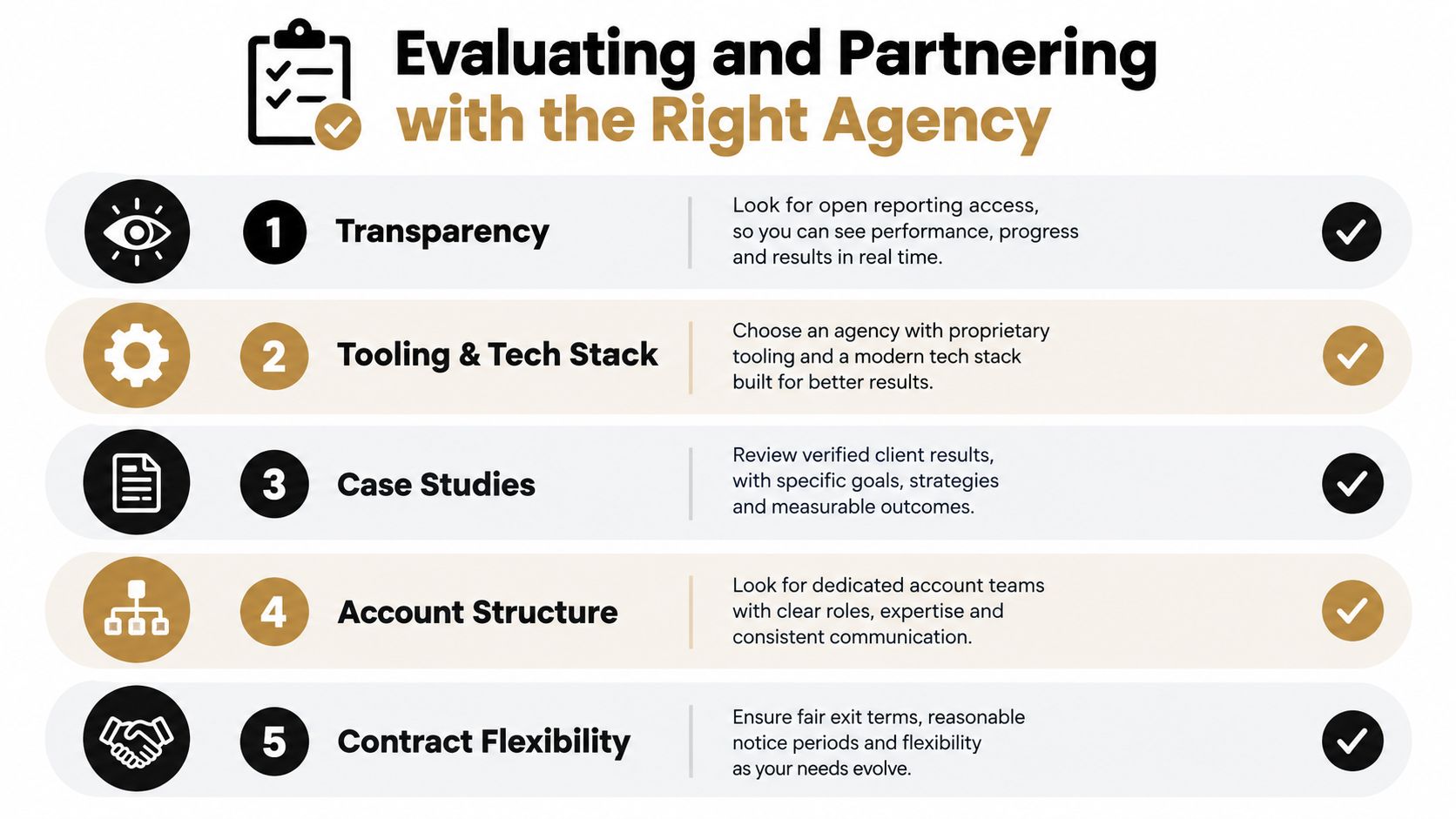
Look for evidence in five areas:
- Transparency: You should have access to the relevant advertising accounts, conversion definitions and reporting context.
- Tooling and technology: The agency should explain how it uses Google Tag Manager, Google Analytics, Meta Conversions API, product feeds, CRM data and call tracking.
- Relevant experience: Ecommerce work should include catalogue, feed, checkout and margin considerations, not only lead-generation screenshots.
- Account structure: You should know who makes decisions, who handles implementation and how often strategy is reviewed.
- Contract flexibility: The agreement should explain ownership, notice periods, access and what happens when the relationship ends.
A sound onboarding process
A useful onboarding process should make the work visible before the first major spend decision. I'd expect these stages:
- Discovery: Understand products, margins, locations, customers and business constraints.
- Audit: Review account structure, search terms, feed health, tracking and landing pages.
- Strategy: Decide campaign roles, budgets, audiences, conversion events and priorities.
- Implementation: Configure tags, feeds, creative, landing pages and CRM connections.
- Launch: Check settings, exclusions, destinations, tracking and approval status.
- Optimisation: Review commercial data, improve weak points and scale only when evidence supports it.
A report should explain what happened, why it matters and what will happen next. It shouldn't hide behind an attractive dashboard that combines branded demand, returning customers and new-user acquisition into one inflated result.
Consistency matters because paid advertising doesn't become reliable through one launch. Product availability changes, competitors adjust offers, tracking breaks after site updates and customer behaviour shifts by season. Marketing your business requires consistency, but consistency doesn't mean repeating the same campaign forever. It means maintaining measurement, reviewing evidence and making deliberate improvements.
Alpha Omega Digital is a Melbourne-based web and paid advertising agency that works with WordPress and Shopify businesses on development, conversion strategy, Google Ads, Meta campaigns, tracking and marketing automation. The team also services clients in Sydney, Brisbane, Newcastle, Perth, Adelaide, Darwin and Hobart.
If you're a business with a paid ads budget of at least 3k a month, I'd love to offer you a low risk deal, a month of paid ads management FREE. Alpha Omega Digital can audit your tracking, campaign structure, Shopify or WordPress experience and conversion path, then build a practical plan around profitable growth. Visit Alpha Omega Digital or contact the team to apply now.
[email protected]
Read more insights from our team on web design, paid ads, and growth strategy.