Australia's plumbing services industry turned over about $25.1 billion in 2026 across roughly 32,067 businesses, with the number of firms growing at a compound annual rate of 1.2% between 2021 and 2026, according to IBISWorld figures reported by Rocking Web. Demand is not the constraint. Being visible and answering first is.
The same local-search reporting puts 46% of Google searches with local intent, and home-services and trades queries trigger the Google local pack about 74% of the time. Three map results, a star rating and a call button settle most jobs before anyone reaches a plumber's website.
Search demand also splits into two journeys that share a keyword tool and nothing else. Someone with a burst pipe at 9pm on a Sunday needs a phone answered in seconds. Someone pricing a hot water replacement next month wants a quote, a licence number and a reason to trust you. Marketing built for one of those buyers usually fails the other, and that's where plumbing ad budgets leak.
What Digital Marketing for Plumbers Really Means
Digital marketing for plumbers isn't a channel, it's a chain. Each link hands work to the next: the map listing creates the visit, the website creates the call, the ad creates the urgent enquiry, the review settles the choice, and the follow-up rescues the ones that slip. Break one link and the money spent on the others goes nowhere.
A plumbing business can easily spend $4,000 a month on Google Ads while its homepage has no tap-to-call button above the fold. The ads work. The page doesn't. That's not a traffic problem, it's a plumbing problem in the plumbing, so to speak, and it's fixable for free.
The six parts of a plumbing marketing system
- Getting found. A verified Google Business Profile with the right categories, service areas and photos, plus a page for each suburb you serve. This is the highest-return, lowest-cost work in the whole list.
- Converting the visit. A mobile page that states the service and the suburbs in the first line, with a call button visible without scrolling. More on the specifics further in.
- Capturing urgent demand. Search ads split by intent, so an emergency term lands on a one-screen call page and a planned term lands on a service page with pricing context and a quote form.
- Building trust. Recent reviews, a licence number, insurance details and photos of real jobs. Someone is letting a stranger into their house.
- Recovering the leaks. Missed-call text-back, a 24-hour answering layer and quote reminders. Most plumbing marketing spend is lost here, one unanswered call at a time.
- Proving the result. Call tracking and booked jobs by channel. Impressions don't pay the van lease or the apprentice's wage.
The two cheapest parts do the heaviest lifting. The profile and the review ask cost nothing, and they decide whether the paid parts earn a return. Get those right before you increase an ad budget.
The whole stack on one screen
| Channel | What it does for a plumber | First action this month | Starting budget | Main KPI |
|---|---|---|---|---|
| Google Business Profile and local SEO | Puts you in the map pack when nearby customers search | Claim and fully complete your profile with service areas and photos | Free | Calls, direction requests, profile views |
| High-converting website | Turns visitors into calls and quote requests | Add tap-to-call and quote buttons visible on the first mobile screen | Free if you fix the three basics yourself, then a one-off rebuild | Conversion rate, calls, form submissions |
| Google Ads (Search) | Captures high-intent searches like emergency plumber near me | Launch one emergency campaign and one planned-work campaign | $50 to $100 a day in media spend | Cost per qualified call or lead |
| Reviews | Wins the click before the customer phones anyone | Ask every completed job for a Google review via a text link | Free | Review count, rating, recency |
| Lead follow-up | Recovers missed calls and nudges quotes to acceptance | Set up missed-call text-back and a quote reminder sequence | Free to start with text-back, a small monthly fee for a tracked number | Answered-call rate, quote-to-job rate |
| Measurement and call tracking | Shows which channel produces booked jobs | Install GA4, Google Tag Manager and a call tracking number | Free for GA4 and Tag Manager, a per-number fee for tracking | Booked jobs and revenue by channel |
Read the budget column as a first month, not a permanent ceiling. The Google Ads figure is media spend, and it's the only row where stopping the payment stops the result. Everything else keeps compounding after you've built it.
Order matters more than budget. A paid click that lands on a page with no call button is a donation to Google's shareholders, so fix the listing and the website before you buy traffic, then set up measurement, then scale the ads. Reviews and follow-up run in parallel from week one because they're free and they compound.
Local SEO and Google Business Profile for Plumbers
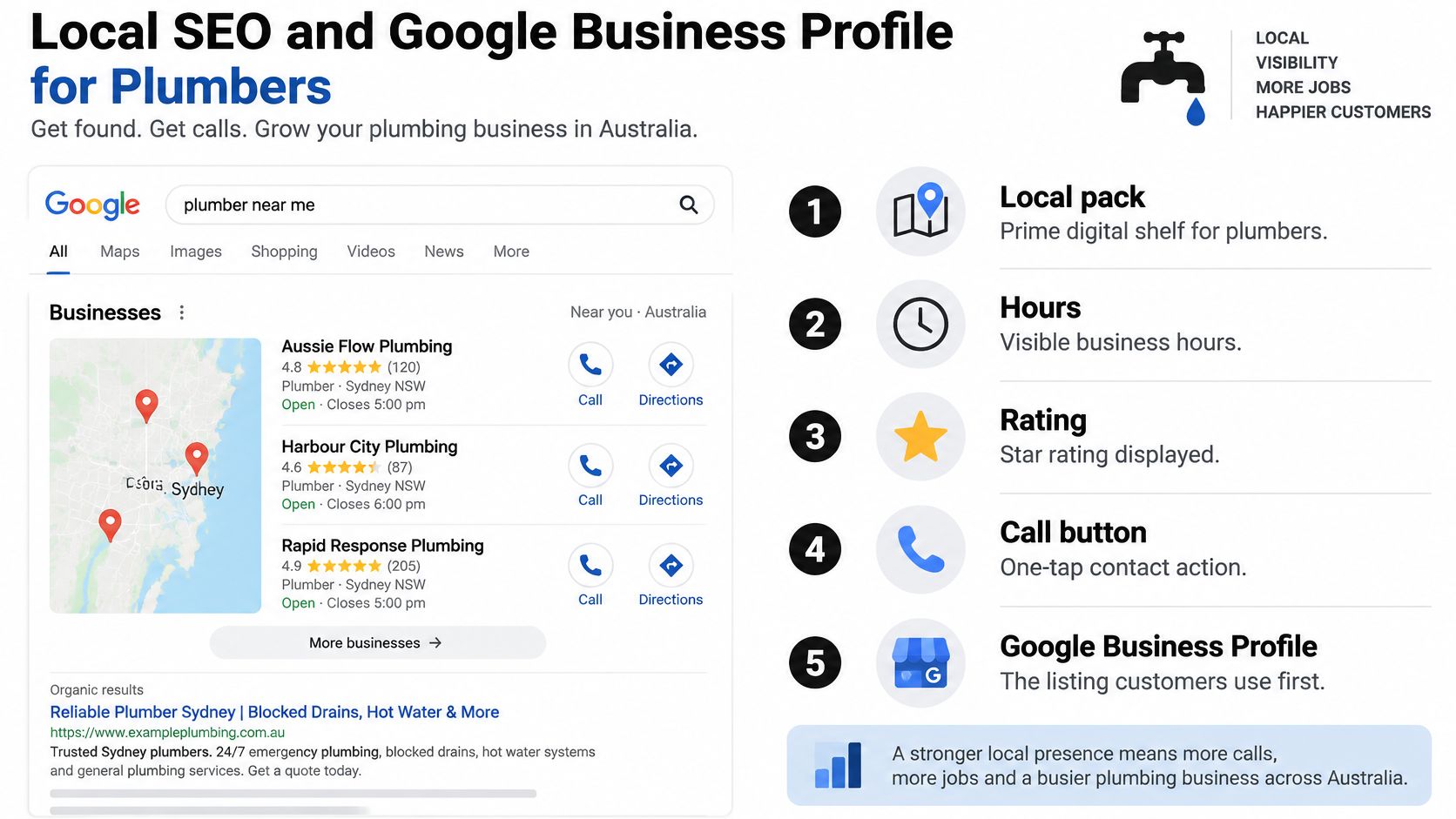
The local pack is the shelf that matters. Type "plumber near me" into a phone and three map results appear above the organic listings, each showing opening hours, a star rating and a one-tap call button. You either sit in that block or you sit below it, and on a phone, below it means off-screen.
Here's the checklist I'd hand an admin on their first day, and the result they should be aiming for.
Setting up the profile, step by step
- Claim and verify the listing. If a previous owner or an old agency set it up, request ownership rather than creating a duplicate. Duplicates split your reviews and confuse Google.
- Set the primary category to Plumber. Then add secondaries that match how people search: emergency plumbing service, drain cleaning, hot water system installation, gas fitting, blocked drain clearing.
- Define service areas by suburb. Working from home means hiding the street address and listing the suburbs you cover. A pin on a residential street in a suburb you never visit generates calls you'll decline.
- Match name, address and phone character for character with the website footer and every directory. "Plumbing Pty Ltd" and "Plumbing" are two different signals to a machine reading citations.
- Upload real job photos weekly. Vans with signage, before-and-after shots of a burst pipe repair, the team at the workshop. Stock images do nothing for trust and slightly less for ranking.
- Post once or twice a month. A seasonal reminder works better than a discount: cold snap pipe protection, hot water service before winter, storm drain clearing.
- Seed and answer questions. Add the five you get on the phone most often, then answer new ones within a day. Both buyers and machines read them.
Suburb pages that don't get filtered
One page per target suburb, and each page has to earn its place. Copy the same template with the suburb name swapped and Google treats the set as doorway pages, and a reader spots it in three seconds.
- A unique opening naming something true about the area and the housing stock. A 1970s brick home in Rowville and an inner-city terrace in Fitzroy have different pipe problems.
- Two or three jobs completed there, described in plain language, ideally with a photo.
- A named testimonial from that suburb wherever you have one. Borrowing a review from three suburbs away doesn't count.
- An embedded map, your service radius and a response-time promise for that area.
- One call to action, repeated once near the top and once at the bottom.
Two hundred words of genuine local detail beats 800 words of filler every time I've tested it.
Citations and a realistic timeline
Set up and correct your listings on Yellow Pages, TrueLocal and Hipages with identical name, address and phone details, then add anything local such as a chamber of commerce or supplier directory. Inconsistent details across those sites suppress the profile you spent a week perfecting.
Where to start with no budget: the profile, the weekly photos and the review ask. All three are free, and together they move more calls than a website rebuild.
Timelines, so you don't panic in week two: profile fixes usually show within weeks, while suburb pages typically take two to three months to rank. Both keep improving as you add photos and reviews, which is why the plumbers who win local search are usually just the ones who didn't stop.
A Plumber Website Built to Convert
A sample of 359 Australian tradie homepages found that 274 of them, or 76.3%, failed at least one of three basics: clearly explaining what the business does and where it operates, showing a tap-to-call button on the first screen, or offering a way to request a quote, according to the 2026 tradie website index from Service Scale. The same study found sites meeting all three requirements had a median of 34 Google reviews, against 17 among the rest.
That second number is the interesting one. Conversion basics and review volume travel together, because the operator who cares about one usually cares about the other. Neither is expensive. Both are decisions.
Your homepage serves two different visitors, and they want opposite things. The emergency caller has water on the floor and will spend about five seconds looking for a phone number. The planned-work customer, the one pricing a hot water unit swap or a bathroom renovation, will scroll for proof and a quote form. Build the first screen for the emergency caller and the rest of the page for the planner.
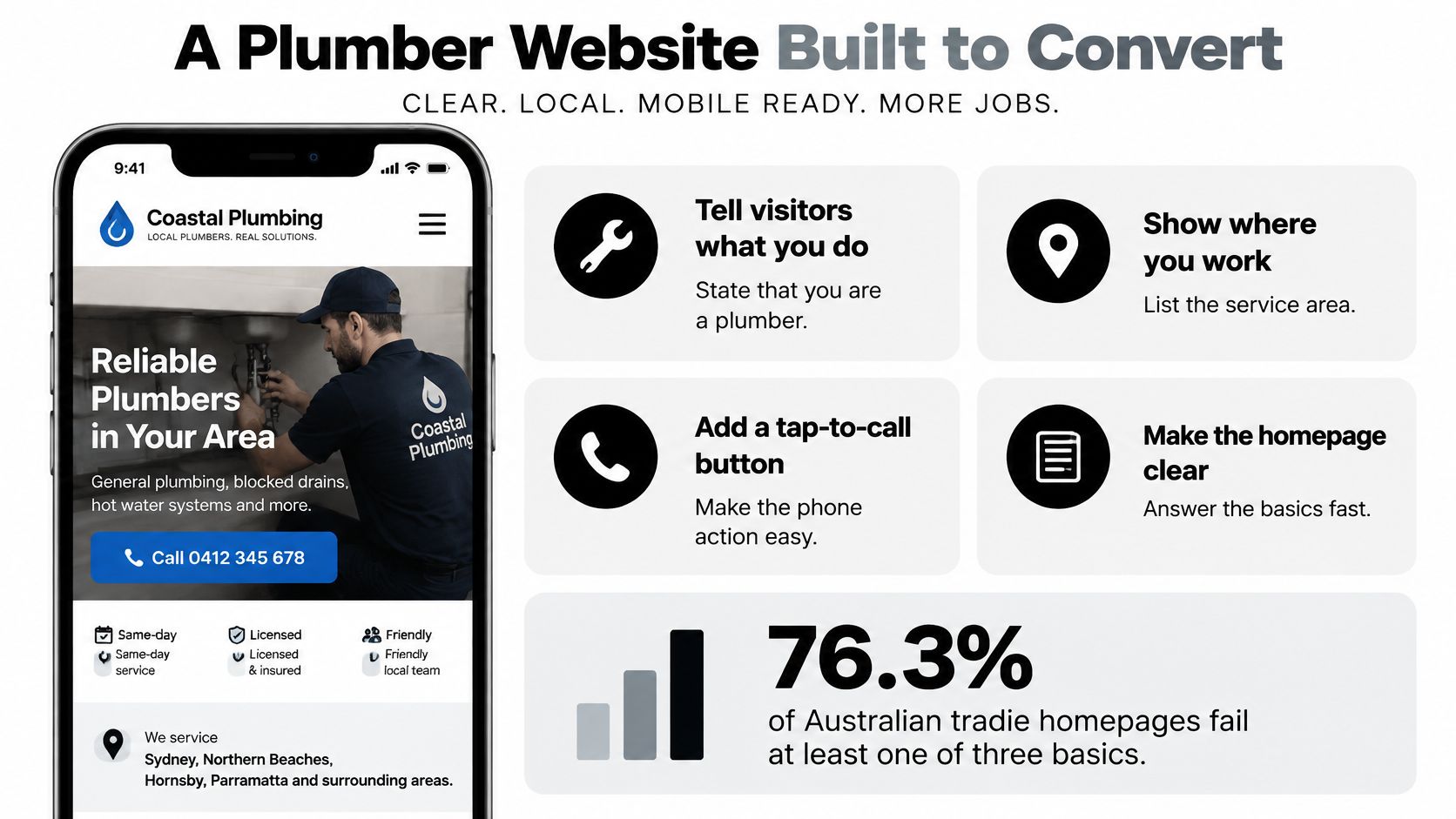
What a visitor meets in the first five seconds
Walk the page in the order a caller does, on a phone, on a slow connection, one-handed.
- A headline that names the service and the suburbs. "Emergency plumber in Brunswick, Coburg and Pascoe Vale, 24 hours" beats "Welcome to our website" by a wide margin.
- A call button visible without scrolling. It sits at the top of the screen where the thumb already rests, large enough to hit while walking.
- A sticky call bar on mobile. It should follow the thumb down the page and never cover the form.
- Availability and licence details near the top. "Licensed and insured, Vic licence number, on the road now" answers the question a caller is asking.
- A quote button for the planner. "Request a quote" in the same first screen catches the customer who was never going to call at 11pm anyway.
If you want a walkthrough of how the page structure and the call tracking fit together, this covers the setup end to end.
The form that actually gets used
Five fields, no more: name, phone, suburb, job type, and a photo upload. The photo field is the one plumbers skip and the one that wins work, because a customer who uploads a picture of a leaking hot water unit has already decided to talk to you.
The job type field does double duty. Split it into "urgent" and "book a time" and you can respond differently to each: an urgent submission triggers an immediate callback or SMS, while a planned-work request goes into a quote queue you answer by end of day. That split is how you stop treating a burst pipe and a kitchen tap replacement as the same lead.
"Jane has done an absolute superb job building our website, the whole process has been so smooth to do. She really takes the time to listen to what you want to try and achieve and always gives you the best advice on what she thinks is best for you. I cannot recommend Alpha Omega Digital highly enough." Ari Melissas, Amari Plumbing and Gasfitting
If your quote requests still arrive through a generic Google Form, you're running a form that can't confirm a submission, can't route by job type and can't fire a conversion event. Swapping it is a small job: switch from Google Forms to a form tool that sends the customer a confirmation, tags the job as urgent or standard, and logs every submission so you can count it later.
Price cues, proof and the platform underneath
Publish a starting call-out fee and say plainly that the full cost is quoted before work begins. Emergency callers mostly want to know you answer the phone and show up fast, so response time and licence number do the convincing. Planned-work customers shop on trust instead, so give them your licence number, public liability insurance, a workmanship guarantee, and a before-and-after gallery with at least six recent jobs.
On platform, I'd take a fast, plain WordPress build over a bespoke site that takes four months. Fast hosting, a form plugin, sticky call buttons and a page you can edit yourself beat a beautifully engineered site nobody can update. If you'd rather not touch it, a WordPress developer can hand over a finished build in weeks, not quarters.
Tonight's audit: open your site on your phone. Can you tell what the business does and where it works, see a call button, and request a quote, all without scrolling or tapping twice? If any answer is no, you've just found the cheapest win in this entire guide.
Measure What Actually Produces Booked Jobs
Every plumbing marketing decision comes back to one number: cost per booked job. Not cost per click, not impressions, not the reassuring upward line on a traffic chart. If a channel costs more per booked job than you make on the average job, it's a hobby.
Set the events before you set the budget
Install GA4 and Google Tag Manager first, then define conversions precisely. For a plumber I'd track four: calls from ad call assets, calls over 60 seconds from landing pages, contact form submissions, and calls from the Google Business Profile. Anything shorter than a minute is usually a wrong number or a hang-up.
Australian government guidance on measuring digital performance treats conversions like purchases and sign-ups as the actions worth counting, which is the right instinct. The same guidance gives useful diagnostics: a bounce rate around 70% suggests content, links, functionality or load speed need attention, roughly two pages per session is a standard average, and more than three minutes of session duration is considered healthy. Treat those as smoke detectors, not targets.
Then put a tracking number per channel in front of the phone. CallRail and Go High Level both do this well, and the difference is simple: with per-channel numbers, your dashboard shows which spend produced answered, qualified calls. Without them, every phone enquiry is unattributed and every budget decision is a guess.
The KPIs that decide next month's money
| Metric | What it tells you | Healthy range | Where to track |
|---|---|---|---|
| Cost per qualified call | Whether emergency spend turns into real job opportunities | Below a quarter of your average job value | Google Ads plus call tracking |
| Answered-call rate | Whether leads actually reach a human | Above 80% during business hours | Call tracking or Twilio logs |
| Form submission rate | Whether planned-work pages convert visitors | 5-10% of landing page visits | GA4 with Google Tag Manager |
| Quote-to-job rate | Whether follow-up turns quotes into work | One in three or better on planned work | CRM pipeline |
| Cost per booked job | The number that decides if marketing pays for itself | Less than your margin on the average job | Dashboard combining ads, calls and CRM |
Judge the two job types on different metrics, because they fail in different places. Emergency campaigns live or die on answered-call rate and cost per booked job. Planned campaigns live or die on quote requests and quote-to-sale rate, where a cheap lead that never converts is more expensive than an expensive one that does.
When to judge a campaign
Give a new campaign two to four weeks and at least 30 conversions before you form an opinion on smart bidding. Below that, the algorithm is still learning and you're reading noise. Then review monthly, kill the keywords with the worst cost per job, and move that money to the suburbs and job types that book.
Kill vanity reporting. Impressions and clicks are inputs. If your monthly report doesn't show calls answered, forms submitted and jobs booked, it isn't a report, it's a receipt.
Google Ads Campaigns That Bring in the Right Jobs
"Plumber near me" carries an estimated A$161,300 in monthly search value nationally at an average cost per click of about A$10.08, the highest combined value among the local-service categories tested in an independent Australian local-search analysis. It's also a market where Google Local Services Ads are reportedly unavailable in Australia, so the acquisition plan has to be built on standard Search campaigns, a strong profile, local organic pages and tracked calls.
Two campaigns, two buyers
Never let an emergency search and a planned search share a campaign, a budget or a landing page. The buyer, the urgency and the conversion are different.
Emergency campaigns use phrase and exact match only, on terms like burst pipe, blocked drain, no hot water and gas leak. Ad copy leads with licence details, 24/7 availability, same-day service and the suburb names. The click goes to a one-screen page built around a call button, opening hours and a licence number. Nothing else.
Planned campaigns cover hot water replacement, gas fitting, renovations and maintenance. These buyers compare, so the landing page carries pricing context, finance options, reviews, before-and-after galleries and a quote form. Longer copy earns its place here. It costs you money on an emergency page.
What I'd do with $3,000 a month: roughly 60% into emergency search, 30% into planned work, 10% into brand. Then shift toward planned work as the quote-to-job rate improves, because a $4,000 hot water replacement makes a $150 lead look cheap.
Negative keywords that pay for themselves
A plumbing campaign without negatives buys DIY researchers, job seekers and people looking for a washer. Add these at launch: how to, DIY, yourself, fix, repair guide, jobs, job, careers, salary, apprenticeship, course, training, TAFE, parts, fittings, Bunnings, free, cheap.
Review the search terms report weekly for the first month. It's where you find the terms you never imagined would trigger your ad, and it's the cheapest optimisation available to you.
Budgets and what a lead should cost
I'd start an emergency campaign at $50 to $100 a day in media spend, and budget for a qualified lead landing somewhere between $60 and $150 in metro areas. Those numbers move with competition, so treat them as a starting range to test rather than a fixed price. At a $10 average click, a 10% enquiry rate puts you near $100 per enquiry, which is why tracking from day one matters more than any clever ad copy.
| Campaign | Intent | Example keywords | Landing page focus | Primary conversion | Budget share |
|---|---|---|---|---|---|
| Emergency Search | Urgent, call now | burst pipe plumber melbourne, emergency plumber near me, no hot water repair | One-screen page with tap-to-call, hours and licence | Phone calls from call assets and the landing page | 50-60% of budget |
| Planned Work Search | Researching and comparing options | hot water system replacement cost, gas fitting quote, bathroom renovation plumber | Service page with pricing context, reviews and quote form | Form submissions plus follow-up calls | 30-40% of budget |
| Brand | Already knows your name | your business name and suburb | Main site or dedicated brand page | Calls and form submissions | 5-10% of budget |
One structural note: if the phone isn't answered, none of the above matters. The next section is where most of the money escapes.
A Review Engine That Wins the Click
Reviews are the tiebreaker. Someone comparing two plumbers with similar prices and similar response times picks the one whose last three reviews are from this month and whose owner replies to them. That's the whole decision, made in under a minute.
The ask, at the moment it works
- Ask when the job finishes. Not the next day, not in a fortnightly batch email. Right then, when the customer is thanking you.
- Make it one tap. A short Google review link sent by text, or a QR card the technician leaves with the invoice.
- Send it same day. A text within an hour works far better than an email the following morning.
- Automate the trigger in your job management software or CRM so no completed job goes unasked. The ask should fire off the job status, not off your memory.
- Reply to everything within 24 to 48 hours. Thank the good ones by name and mention the suburb and the job.
- Never buy, swap or fake reviews. Suspensions are hard to reverse and customers can smell a wall of identical five-star ratings.
Target a steady two to four new reviews a month rather than a burst of twenty followed by silence. Recency is what a customer reads, and a profile that gains reviews every month looks like a business that's busy.
The line that works on the phone: "If you were happy with the job, a quick Google review helps other people in the suburb find us. I'll text you the link now." Say it before you pack up, not after.
Replying without making it worse
Answer a negative review once, factually, without arguing. Acknowledge the problem, state what you did about it, and invite them to call you directly on a named number. Then stop. The reply isn't for the person who left it, it's for the twenty people reading it and deciding whether you handle problems like an adult.
Never respond while you're annoyed. Draft it, walk away, come back after lunch, then post. A single angry reply can undo years of good reviews.
Where the reviews should appear
Embed the latest three on the homepage and on every quote page, quoted verbatim with first names and suburbs. Use them in follow-up emails to people who asked for a quote and went quiet, and in the text-back message you send to missed calls. A review is the only marketing asset you own outright, generates for free and can reuse in six places.
Follow Up on Every Call and Quote
Roundups of Australian local SEO statistics put the overwhelming majority of local business discovery online, and plumbing follows the same pattern. Nearly every enquiry you'll ever receive starts on a screen. The expensive part isn't generating it. It's what happens in the four minutes after.

Emergency calls and planned quotes fail in completely different places, so fix them separately. Emergency work fails at the missed call. Planned work fails at the silence after the quote goes out.
Emergency calls fail at the missed call
- Route every ad and profile call to one tracked number so a missed call is visible rather than invisible. If three phones ring for one number, nobody knows what was lost.
- Send an instant text-back within a minute. Apologise for missing the call, ask for the job type and the suburb, and say when you'll ring. The customer has already called someone else, so speed is the whole game.
- Call every new enquiry back within five minutes during business hours. Returned calls are the highest-converting traffic you'll ever get, and they cost nothing.
- Put a 24-hour answering layer in front of that number. I'd use a live answering service or an automated system that qualifies the job, captures the suburb and address, and gets the booking into your calendar before the customer rings the next plumber. It doesn't take lunch, doesn't call in sick and doesn't go home at 5pm, and for a one-van operation it's the difference between a full week and a phone full of voicemails.
Quotes fail at the silence
Planned work needs a sequence, because the customer is comparing three quotes and the one that follows up is the one that wins. Run it in your CRM, whether that's HubSpot, Go High Level or whatever your job software offers.
- Quote sent the same day, with the scope, the inclusions, the licence details and a clear expiry.
- Reminder at 48 hours. One line: "Just checking you received the quote, happy to answer anything."
- Friendly check-in at day seven, then move them to a monthly nurture list rather than the bin.
Track quote-to-sale rate by job type. If hot water replacements convert at one in three and bathroom renovations at one in ten, you don't have a marketing problem, you have a qualification problem, and no ad budget fixes that. Keep the two numbers in separate columns on the same report, because blending them into one conversion rate hides the leak.
The Friday missed-call review
Spend fifteen minutes each Friday reading the list of unanswered calls. Tag each one with what happened next: called back, texted and booked, or gone cold. When the same hour or the same day keeps appearing, fix the cause rather than the symptom: extended hours, a second phone, better call routing or a roster gap on Saturday mornings. One recurring cause is worth more than a month of optimisation.
Your 30-Day Action Plan and Where to Get Help
Four weeks, roughly two hours a week, in the order that produces calls fastest. Emergency work comes first because those jobs close the same day; planned work goes last, once the tracking and follow-up exist to support a longer quoting cycle.
- Week 1. Claim and complete the Google Business Profile with every service and suburb. Add tap-to-call and a short quote form to the site. Install GA4 and Google Tag Manager with the four conversions defined.
- Week 2. Launch the emergency Search campaign with call tracking and the full negative keyword list. Write the one-screen call landing page.
- Week 3. Switch on the review ask for every completed job. Set up missed-call text-back and the 24-hour answering layer. Publish two suburb pages with real local detail.
- Week 4. Launch the planned-work campaign aimed at hot water replacements, renovations and other quoted jobs. Automate the quote follow-up sequence. Hold the first dashboard review and cut anything with a cost per booked job above your margin.
The budget rule. Under about $1,500 a month, run this yourself. It's a few hours a week and the free wins come first. Between $1,500 and $3,000, run it yourself and book one agency review after the first month of dashboard data, so the conversation is about real numbers rather than opinions. Above $3,000 a month in paid ads, hand it over. At that level the optimisation and the tracking are worth more than the fee. When you do hand it over, the ad spend still goes to Google separately; what the fee buys is campaign management and the judgement that comes with it.
Alpha Omega Digital is a Melbourne digital marketing agency that runs Google Ads for plumbers, builds conversion-focused WordPress sites and sets up the tracking that shows which suburb and which job type pays.
If you're weighing up whether to hand it over, Alpha Omega Digital offers a free 45-minute strategy session: we review your site and your current setup and show you exactly what we would fix before you commit to anything. Have a project in mind? Apply now through the contact page at Alpha Omega Digital.
Alpha Omega Digital
Read more insights from our team on web design, paid ads, and growth strategy.