You open the church Facebook page, stare at the blinking cursor, and realise the problem isn't just “what should we post today?” It's whether the page is doing any real ministry at all. I've seen that tension a lot. Teams start with good intentions, then drift into posting service times, a Bible verse tile, a flyer for youth night, and the occasional sermon clip. After a while, the feed feels more like admin than outreach.
That's why Christian social media needs a reset. Not a trend-driven reset. A ministry reset.
Used well, social media isn't a side project for the volunteer who knows Instagram. It's a digital front door, a pastoral touchpoint, and often the first interaction someone has with your church or ministry. People don't always visit a building first. They watch, scroll, read comments, and form impressions before they ever walk in. If your online presence feels cold, stale, confusing, or one-directional, that's what they'll expect in person too.
Rethinking Your Digital Front Door
Most churches still treat social media like a noticeboard. Service time. Event graphic. Registration link. Repeat next week.
That approach misses where attention resides. In Australia, social platforms are already where people spend time. According to Australia-focused digital market reporting cited by NRB, there were about 20.9 million social media user identities in Australia in 2025, representing roughly 81.9% of the population, alongside 25.5 million internet users. The same reporting places social media advertising spend at about US$3.6 billion in 2025, which tells you something important. Your ministry isn't posting into an empty room. You're posting into a crowded, highly competitive feed.
What Christian social media actually is
Christian social media isn't just faith content published online. It's the practice of creating digital spaces where people can:
- Encounter your community before they visit
- Receive encouragement during the week
- Ask questions without stepping into a building
- Stay connected after Sunday
- Respond to invitations in a low-friction way
That changes the job of the channel.
A healthy church account doesn't only announce. It welcomes. It answers. It reflects the texture of real community. It helps a nervous newcomer feel less alone. It gives regular members a simple way to stay engaged between gatherings.
Practical rule: If your feed only makes sense to people who already attend, it isn't functioning as a front door.
The mindset shift that helps
The strongest shift is moving from publishing content to serving people in-platform.
That means asking better questions before you post:
| Old question | Better question |
|---|---|
| What should we upload today? | What would help our audience take one small step? |
| How do we fill the content calendar? | How do we stay present and useful through the week? |
| How do we promote this event? | How do we make this feel welcoming to someone new? |
For most ministries, that leads to simpler, better output. Fewer generic graphics. More real faces. Shorter copy. Clear invitations. Faster replies. Better follow-through.
What doesn't work anymore
Some habits consistently underperform in practice:
- Posting only announcements because they matter internally
- Uploading sermon posters with too much text that no one can scan quickly
- Using church language without context for people outside the congregation
- Treating every platform the same and assuming one post fits all
- Ignoring comments and messages as if social is a one-way broadcast tool
Christian social media works when it reflects pastoral care, not just communications admin. If someone lands on your page tonight, they should quickly understand who you are, what kind of people you serve, and what step they can take next.
Choosing Your Digital Mission Field
A church posts on Instagram, Facebook, YouTube, and TikTok for three months. The sermon clips are cropped differently on each channel. Comments sit unanswered. One platform gets event flyers, another gets recycled quotes, and none of them feels alive. I see this pattern often, and it usually comes from good intentions paired with thin capacity.
The better move is to choose a digital mission field before building a content habit. Pick the platforms your team can steward. For faith-based organisations, that means more than reach. It means asking where conversations can happen, where trust can grow, and where your team can keep people safe once they respond.
One well-led platform beats four neglected ones
Each platform has its own culture, expectations, and pace. Copying the same post everywhere usually weakens the result and increases admin work. It also creates a pastoral problem. If people comment with prayer requests, questions, or personal disclosures, a scattered team can miss them.
That is why platform choice is a ministry decision, not just a marketing one.
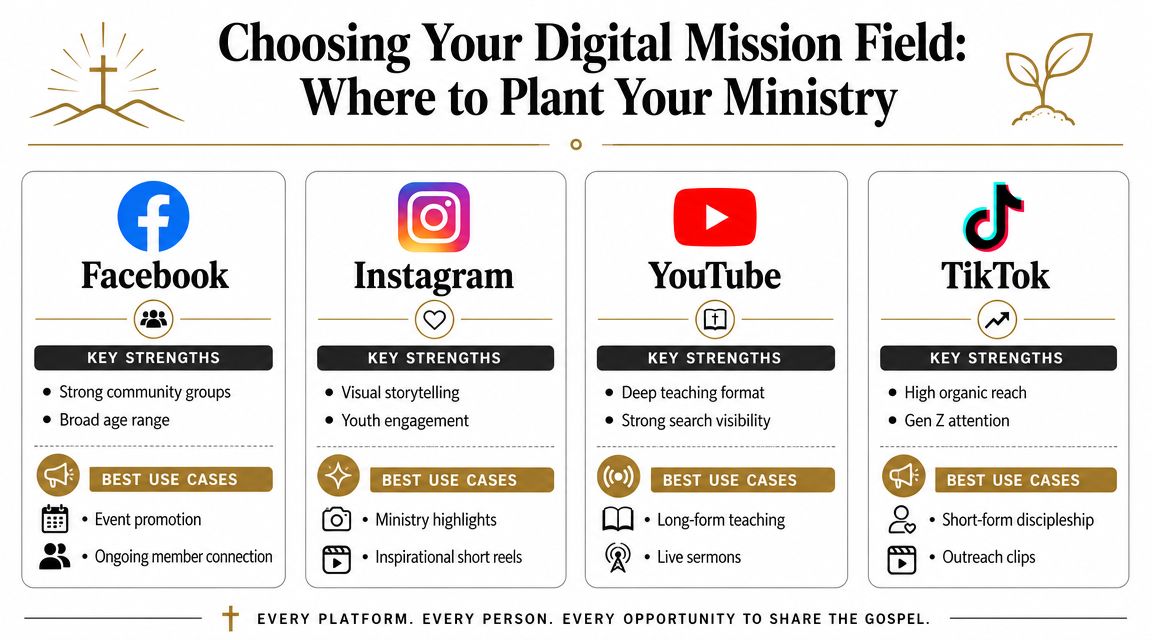
A Facebook audience often expects updates and discussion. Instagram is stronger for visual storytelling and quick relational signals. YouTube gives room for searchable teaching and longer watch time. TikTok rewards direct, native short-form communication that feels human, not repurposed.
Choose based on ministry fit
Start with the outcome you need, then match it to the platform.
| Platform | Usually strongest for | Watch-outs |
|---|---|---|
| Groups, local communication, ongoing interaction with established communities | Public pages can become bulletin boards if nobody owns replies and moderation | |
| First impressions, church life, Reels, Stories, younger adults and families | Pretty posts without conversation often get attention but little real connection | |
| YouTube | Sermons, teaching series, testimonies, search-driven discovery | Requires steady packaging work, especially titles, thumbnails, and clear structure |
| TikTok | Outreach, short discipleship clips, simple face-to-camera content | Fast feedback cycles can pressure teams to chase trends instead of mission fit |
Build for interaction, not just distribution
Many ministries still choose platforms based on where they can push content most easily. That is the old broadcast model. A stronger approach is to ask where your organisation can host healthy interaction.
If your team cannot moderate comments, respond to direct messages, or move sensitive conversations into safer follow-up channels, growth can create problems you are not ready to handle. I would rather see a church run one active Instagram account with clear response habits than four channels that collect unanswered pastoral needs.
This is also where planning matters. Good platform selection gets easier when your team can map cadence, ownership, and response windows in advance. Simple content tools for social media marketing can help a ministry decide what belongs on a public feed, what should stay in a private group, and what needs a person to follow up offline.
Match the platform to the next step
Different platforms support different kinds of response.
If the goal is helping existing members stay connected during the week, a Facebook group or messaging-based environment may work better than chasing public reach.
If the goal is helping new people decide whether to visit, Instagram often does that job well because it shows tone, people, and everyday church life quickly.
If the goal is answering ongoing spiritual questions, YouTube is often the better home because people search with intent.
If the goal is early outreach to people with little church background, short-form video can open the door. It still needs a next step. Comments, direct messages, signup forms, and in-person invitations all need a clear owner.
A practical setup for small teams
Small ministry teams do better with a simple structure:
- One public platform for discovery
- One space for deeper community or follow-up
- One realistic publishing rhythm your team can sustain for at least six months
That setup forces healthy trade-offs. It reduces duplication, makes moderation easier, and helps your team notice whether people's responses are meaningful.
A church reaching young adults might use Instagram for public storytelling and private group chat or small-group follow-up for real conversation. A teaching ministry may get more value from YouTube first, then use short clips elsewhere to point people back to fuller teaching.
Coverage is not the goal. Consistent presence, safe interaction, and clear next steps are what make a digital mission field worth investing in.
Crafting Content That Connects
A church posts a sermon clip on Monday, a verse graphic on Wednesday, and an event flyer on Friday. The feed stays active, but comments stay thin and no one knows which post prompted a conversation, a prayer request, or a visit. That is usually not a message problem. It is a content design problem.
Good Christian social media content gives people a clear way to respond. It creates conversation, not just distribution. The shift from broadcasting to community-building starts here.
Build around content pillars, not random ideas
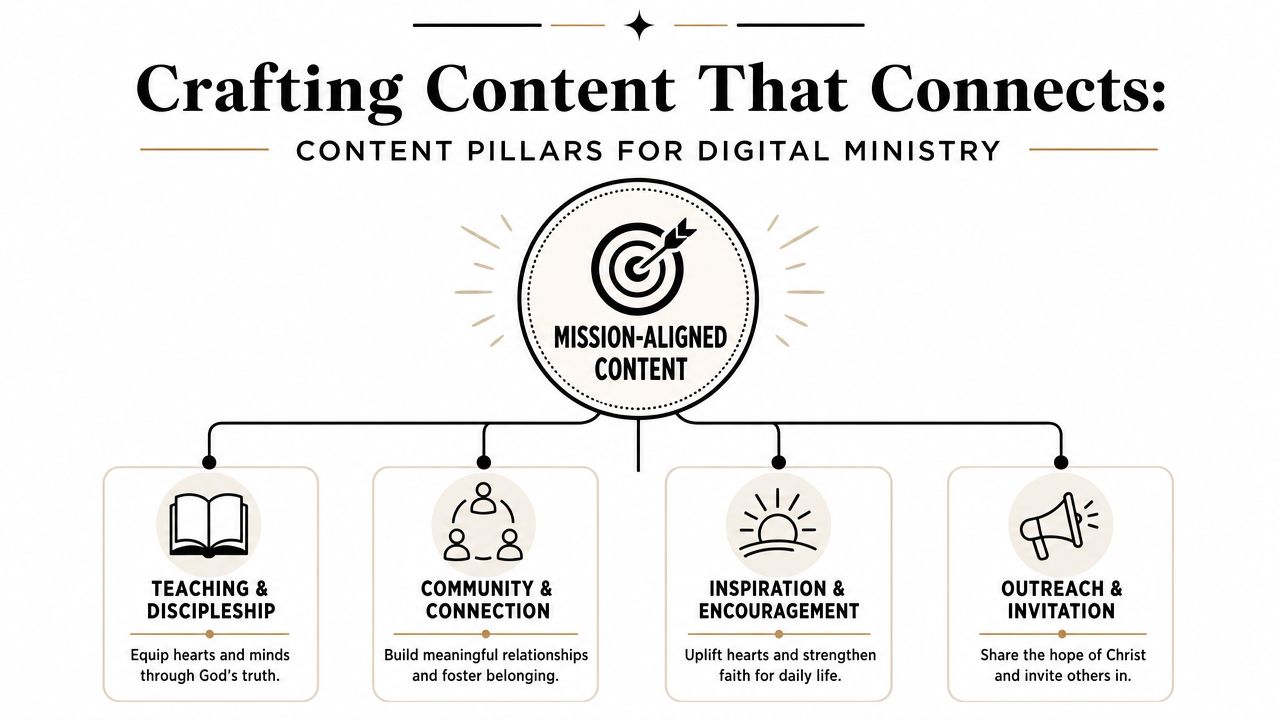
Teams stay consistent when they choose a small set of recurring content pillars and use them on purpose. Four is usually enough for a church or ministry team to plan well without turning every week into improvisation.
Teaching and discipleship
This includes sermon clips, short scripture reflections, Q and A posts, devotional thoughts, and simple explainer videos. Get to the point fast. Social audiences decide in seconds whether to keep watching, so the application should appear early, not halfway through.
Community and connection
Many ministries underuse this category, even though it often does more to build trust than polished branded posts. Show real people. Volunteer stories, leader introductions, baptism moments, behind-the-scenes photos, and honest snapshots of church life help newcomers see whether they could belong.
Inspiration and encouragement
Scripture, prayer prompts, testimony moments, and short encouragement videos fit here. The standard is simple. If the post sounds like it could have come from any account, it will probably be ignored. Specific, human language connects better than generic uplift.
Outreach and invitation
Event invites, courses, seasonal services, youth gatherings, support groups, and newcomer pathways belong in this pillar. Clear beats clever. People need to know who the invitation is for, what will happen, and what step to take next.
This kind of structure does more than save time. It also helps with moderation and follow-up. If a post is meant to start conversation, someone on the team needs to be ready to answer comments and messages.
Shape the message for the platform
As noted earlier, different platforms train people to expect different kinds of content and different speeds of interaction. A sermon that serves people well in a room usually needs editing before it serves people well in a feed.
I have seen churches waste effort by posting the same asset everywhere and calling it a strategy. That approach saves time at first, but it often lowers response because each platform rewards different behavior. Short-form video needs a quick opening and captions. Stories need interaction. YouTube can hold longer teaching if the title and thumbnail make the topic clear.
A better workflow is to start with one core message and adapt it into formats people will use:
- Instagram Reel with one clear takeaway and on-screen captions
- Story sequence with a poll, question box, or prayer prompt
- YouTube upload for the full teaching or testimony
- Facebook discussion post built around one practical application point
- Email or website article for people who want the fuller explanation
Respect for the platform shows respect for the audience.
| Original asset | Better repurposing approach |
|---|---|
| Full sermon | Clip 2 to 4 short sections, each built around one clear idea |
| Event flyer | Record a short invite from a real person who can explain why it matters |
| Bible verse graphic | Add one sentence of application and a caption that asks for a response |
| Testimony | Use short vertical video, then offer a longer written version on your site |
The useful question is not, “What should we post today?” The better question is, “What response are we trying to invite, and what format gives that response the best chance?”
Keep the production light and the process clear
High production value is helpful, but it is not the main factor. Clear audio, steady framing, readable captions, natural light, and concise editing usually matter more than expensive gear. For churches, consistency beats polish that takes too long to produce.
That trade-off matters. A team that spends six hours making one beautiful post often disappears for the next two weeks. A team with a simple process can keep showing up, answer comments, and learn what prompts conversation.
If consistency is the weak point, structured content tools for social media marketing can help organise pillars, draft workflows, and approval steps without creating confusion across staff and volunteers.
Later in the workflow, video becomes important for moving from passive scrolling to actual attention.
What usually falls flat
Some patterns repeatedly weaken church content because they ask for attention without giving people a reason to engage:
- Static quote tiles with no context or next step
- Sermon clips that take too long to reach the main point
- Promotional posts filled with insider church language
- Stock photos that do not reflect the actual community
- Identical cross-posting with no edits for format or audience behavior
The strongest feeds feel relational. They show real faces, ask real questions, and make room for people to answer. That is how content starts supporting digital community instead of filling a calendar.
Nurturing Your Online Flock
A large audience can hide a weak community. That's one of the most common traps in Christian social media.
It's easy to think the job is done when posts go up on time and follower numbers inch upward. But a social presence that gets passive views without conversation often isn't building much at all. The deeper question is whether your online ministry helps people belong, participate, and move closer to real community.

Posting isn't the same as building community
One recent discussion reported that only 16% of respondents who view social media as more helpful than harmful specifically pointed to its ability to connect believers and build community, according to AG News coverage on social media and faith. That doesn't prove churches can't build meaningful community online. It does highlight a practical problem. A lot of the conversation still centres on individual use rather than measurable community formation.
That gap shows up in ministry accounts all the time. Plenty of pages publish encouragement. Fewer create interaction. Even fewer build pathways for newcomers to move from public content into actual relationship.
What stronger engagement looks like
Healthy digital community usually leaves visible signs:
- Comments that go beyond “Amen”
- Direct messages asking follow-up questions
- Members tagging friends
- People responding to stories and polls
- Conversations that continue into in-person events or groups
Those signals matter more than broad reach without response.
Ask questions people can answer quickly
Long theological prompts often get ignored in public feeds. Better questions are short, open, and easy to join.
Examples:
- What's one thing you're praying for this week?
- Which line from Sunday stayed with you?
- Have you ever felt nervous visiting a church for the first time?
The point isn't to manufacture engagement. It's to lower the barrier to honest participation.
Reply like a pastor, not a brand
If someone comments, reply. If they ask a question, answer it. If they send a message about attending for the first time, don't leave them sitting there while the team debates who handles inbox duty.
Response quality shapes culture. Fast, warm, clear replies tell people they're not talking to a content machine.
A quiet inbox often means people don't think anyone's really there.
Public page and private space are different jobs
Many ministries improve once they separate functions.
A public page is for discovery, first impressions, and broad communication. A private group or moderated community space is often better for deeper discipleship, prayer requests, follow-up discussion, and ongoing conversation.
Here's a simple comparison:
| Public page | Private group |
|---|---|
| Welcomes newcomers | Deepens belonging |
| Shares church-wide updates | Supports ongoing discussion |
| Optimised for visibility | Better for vulnerability and care |
| Lower trust environment | Higher trust if moderated well |
That distinction matters because not every conversation should happen in public comments.
Moderation is ministry work
If you want healthy interaction, moderation can't be an afterthought.
Set clear boundaries for comments, private messages, prayer request handling, and volunteer conduct. Decide in advance how you'll respond to spam, harassment, trolling, pastoral disclosures, and crisis messages. It helps to document who has access to accounts, who replies, and when issues get escalated to pastoral staff.
A few essential principles help:
- Protect vulnerable users by removing abusive or predatory behaviour quickly
- Use two-adult oversight in youth-facing spaces where appropriate
- Move sensitive pastoral issues offline when privacy matters
- Don't argue in comments when a direct response or moderation action is wiser
Community doesn't grow because a church posted more. It grows because people felt seen, safe, and able to participate.
Measuring What Truly Matters
A church can post every week, keep the branding tidy, and still miss the point.
I have seen teams celebrate a high-reach post while missing the quieter signals that point to ministry impact. The post that gets broad visibility is not always the one that starts a real conversation, prompts a visit, or helps someone ask for prayer. Christian social media needs measurement that reflects relationship, trust, and next steps.
Consistency still matters. A regular publishing rhythm gives people a reason to return and gives your team enough data to review patterns over time, as outlined in this Christian social media marketing guide. But the goal is not to feed the algorithm for its own sake. The goal is to learn what helps people move from passive viewing to active participation.
Measure interaction, not just attention
Likes and follower growth have some value. They show surface-level interest and can help you spot content that catches attention quickly. On their own, though, they are weak indicators of community health.
Better signals usually include:
- Saves, which suggest the post was useful enough to revisit
- Shares, which show someone wanted to pass it on
- Thoughtful comments, especially when people respond to each other
- Direct messages, which often indicate trust, curiosity, or a pastoral opening
- Link clicks, especially to event pages, sermon resources, volunteer forms, or plan-a-visit pages
These metrics track participation more closely than applause.
A church trying to build community should also watch for patterns in conversation quality. Are people asking sincere questions? Are regular attenders welcoming newcomers in comments? Are prayer or testimony posts creating healthy follow-up? Those signs matter more than raw reach if your ministry goal is connection rather than broadcasting.
Use a review rhythm your team can keep
Complicated dashboards often die after two weeks. A simple review process works better.
Weekly review
Look for posts that led to meaningful engagement. Review the topic, format, caption style, and timing. Save examples so the team can spot repeatable patterns.
Monthly review
Compare content categories against ministry goals. Testimony clips may drive more shares. Invitation videos may bring more website visits. Short devotional posts may generate more saves than polished graphics. The point is to shift effort toward what helps people respond, not just what looks finished.
Quarterly review
Tie social activity to real ministry outcomes. Ask welcome teams how many visitors mention Instagram or Facebook. Check whether a campaign increased registrations, volunteer enquiries, or small group interest. Review whether private conversations led to follow-up from pastoral staff.
One warning here. Some of the most meaningful outcomes on Christian social media are hard to count cleanly. A message from someone asking for help may matter more than a post with wide reach. That is why churches need both numbers and human observation.
Build a dashboard that reflects ministry goals
| Metric | Why it matters |
|---|---|
| Shares | Shows content felt relevant enough to pass on |
| Saves | Signals ongoing value, especially for teaching or encouragement |
| Comments with substance | Indicates active response rather than passive scrolling |
| Direct messages | Often reflects trust and a willingness to engage privately |
| Website clicks | Connects social content to clear next steps |
| Attendance or sign-up correlation | Helps link digital activity to offline participation |
For most churches, native platform analytics are enough to start. Add campaign tags if you want to track what happens after the click. If reputational issues distort engagement or create public confusion, leaders also need a plan for managing reputation damage on social media.
The strongest teams do not measure social media as a content output. They measure whether it helps people feel welcomed, respond, return, and take one clear step closer to community.
Navigating Digital Risks and Responsibilities
A church can have excellent content and still run an unsafe digital environment. That's why risk management belongs inside your social strategy, not off to the side in a forgotten policy folder.
This issue becomes urgent wherever ministries work with children, teenagers, vulnerable adults, or private pastoral conversations. Too many teams focus on reach and encouragement while leaving moderation standards vague, inbox procedures unclear, and youth interactions under-supervised.
Safety isn't optional
Experts interviewed about online harm have warned that grooming, exploitation, and abuse can occur on mainstream platforms and in private message channels, with research cited in that discussion indicating one in three kids has experienced sexual advances on Instagram, as referenced in this child-safety interview on social platforms. For churches and youth ministries, that should reset priorities immediately.
A social channel used by a ministry is not just a communications asset. It's a safeguarding environment.
Policies every ministry should have
You don't need a legal document full of abstract language. You need workable rules your team can follow.
Staff and volunteer account access
List who has access to each account, where credentials are stored, and who can publish, reply, delete, or moderate. Remove access promptly when roles change.
Youth communication rules
Decide whether leaders can message minors directly, what platforms are approved, whether parents are included, and how supervision works. Private, unmonitored communication should raise immediate questions.
Comment and inbox handling
Create a process for harassment, self-harm disclosures, abuse reports, suspicious contact, and pastoral care messages. Some issues need a public moderation response. Others must be escalated privately and quickly.
Privacy and consent
Get clear permission before posting identifiable photos of children or vulnerable people. Be cautious with testimony content, prayer requests, and sensitive stories. Not every meaningful ministry moment belongs online.
Reputation matters too
Churches also need a plan for conflict, misinformation, impersonation, and damaging public accusations. The tone of Christian witness matters, but so does a disciplined response process. If your team ever needs a practical framework for managing reputation damage on social media, that checklist is useful because it focuses on response steps rather than emotional reaction.
Other responsibilities that get missed
Risk management in Christian social media also includes ordinary operational issues:
- Copyright for music, sermon clips, images, and livestream elements
- Data handling for forms, registrations, and direct message follow-up
- Role clarity so moderators know when to escalate to pastors or leadership
- Documentation so serious incidents aren't handled casually or forgotten
A careful ministry doesn't become fearful. It becomes trustworthy.
That trust is built when people know the church takes their wellbeing seriously online, not only in person.
Your First Steps to a Thriving Digital Ministry
Many teams don't need a huge relaunch. They need a cleaner starting point.
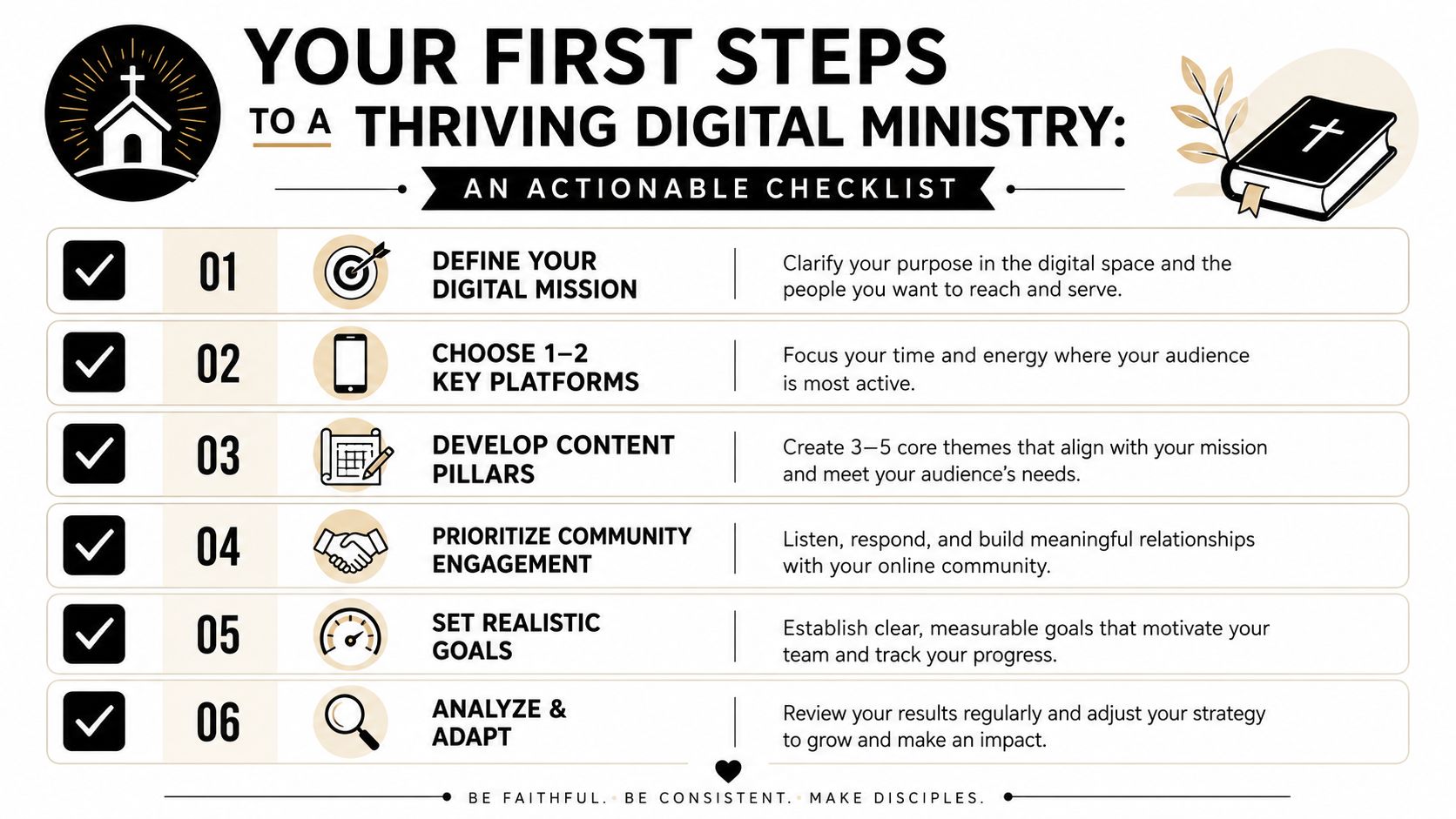
The best Christian social media strategies are usually less complicated than people expect. They're intentional. They choose a few clear goals, build a manageable rhythm, and create a ministry environment people can engage with safely.
Start with one outcome
Pick the main result you want from the next season.
Not five results. One.
Examples include:
- more first-time visitors feeling comfortable to attend
- better midweek engagement with existing members
- stronger visibility for a key ministry
- clearer follow-up pathways for people exploring faith
Once that's clear, decisions get easier. Platform choice gets easier too. So does content planning.
Build the first month before you build the year
A lot of churches stall because they try to solve the whole strategy at once. Don't do that. Plan one month with discipline.
Week-by-week rhythm
Use a basic structure such as:
- one teaching post
- one community post
- one encouragement post
- one invitation post
That's enough to create movement without overloading the team.
Assign real ownership
Decide who films, who writes captions, who schedules, who replies, and who reviews results. Shared responsibility often becomes no responsibility unless names are attached.
Small teams do better with a simple system they can repeat than an ambitious system they abandon.
Audit the profile like a newcomer would
Before publishing anything new, check the basics:
| Checkpoint | What to look for |
|---|---|
| Bio and description | Clear wording about who you are and where to start |
| Profile and cover images | Up to date and recognisable |
| Pinned content | Helpful for a first-time visitor |
| Link in bio | Sends people to the next clear action |
| Recent posts | Reflect real people, real ministry, and a welcoming tone |
If the page feels confusing to someone outside church culture, clean that up first.
Put guardrails in place early
Even small ministries need a lightweight safety framework before growth increases the workload.
Make sure you have:
- a moderation rule set
- a response process for direct messages
- clear child-safety boundaries
- consent practices for photos and stories
- a way to escalate sensitive issues
That foundation gives your team confidence. It also protects the people you serve.
Review, adapt, repeat
After the first month, don't ask whether everything “worked.” Ask what created the strongest signs of trust, interest, and next-step behaviour. Keep what helped. Drop what felt dutiful but empty. Improve one thing at a time.
Christian social media becomes effective when it stops trying to impress and starts trying to serve. That shift changes the feed. Beyond that, it changes the kind of community your feed invites people into.
If you're building a church, ministry, or values-led organisation and want sharper help with digital strategy, Alpha Omega Digital is a Melbourne-based agency working across web, paid media, and digital growth. If you're a business with a paid ads budget of at least 3k a month, they're offering a low-risk deal: get a month of paid ads management free. Apply through the contact page.
[email protected]
Read more insights from our team on web design, paid ads, and growth strategy.