If you're running an ecommerce store in Melbourne, this usually feels familiar. Traffic is coming in from Google Ads, Meta, organic search, or email, but sales don't line up with the attention you're paying for. The store looks decent, the products are solid, and yet too many visitors browse, hesitate, and leave.
That's where conversion rate optimization in Melbourne becomes less of a nice extra and more of a core growth system. I've seen plenty of stores spend months chasing more clicks when the core issue sits lower in the funnel. The product page is vague. The cart creates doubt. Mobile users hit friction. Tracking stops at the checkout and tells you nothing about lead quality, repeat buyers, or assisted conversions.
For ecommerce brands, CRO isn't just button testing. It's the work of removing friction across the whole buying journey. That includes the site build, page speed, offer clarity, trust signals, tracking setup, ad-to-landing-page alignment, and what happens after a customer submits a form, starts checkout, or calls your business.
Your Melbourne CRO Journey Starts Here
A lot of Melbourne business owners come to us at the same point. They've already done the hard part of getting attention. Their products are live, campaigns are running, and people are landing on the site every day. What's missing is the next step. Visitors don't move through the journey cleanly enough to buy.
That's why I treat CRO as the bridge between traffic and revenue. It's not only about getting prettier pages or swapping a button colour. It's about understanding user behaviour, identifying what creates hesitation, and fixing the parts of the journey that undermine intent.
For ecommerce brands, this often starts with a simple question. Are you trying to solve a traffic problem or a conversion problem? In many cases, it's the second one.
I've found that good CRO work usually begins when a business stops asking, “How do we get more clicks?” and starts asking, “Why aren't the clicks we already have turning into customers?”
Practical rule: More traffic won't rescue a weak product page, a confusing cart, or a slow mobile experience.
If you want a broader framework for thinking about funnel improvement before getting into tool setup, this guide to conversion strategies for businesses is worth reading. It lines up well with how we approach ecommerce growth here in Melbourne, especially when the problem sits across multiple steps instead of one obvious page.
The upside is real. Across Australia, websites convert at roughly 1.78%, and that same roundup notes expected movement toward 2 to 4% as CRO adoption matures, which gives Melbourne businesses plenty of room to improve with disciplined optimisation work (Australian CRO benchmark data).
The Foundation Finding What's Broken in Your Store
A Melbourne retailer can spend thousands on Google Ads and paid social, see decent click-through rates, and still have a store that underperforms because the handoff from ad to landing page to checkout breaks down. I see this a lot. The website gets blamed first, but the core problem often sits across the full journey, from mismatched ad intent to missing tracking after the sale.
That's why we start with measurement, not mockups.
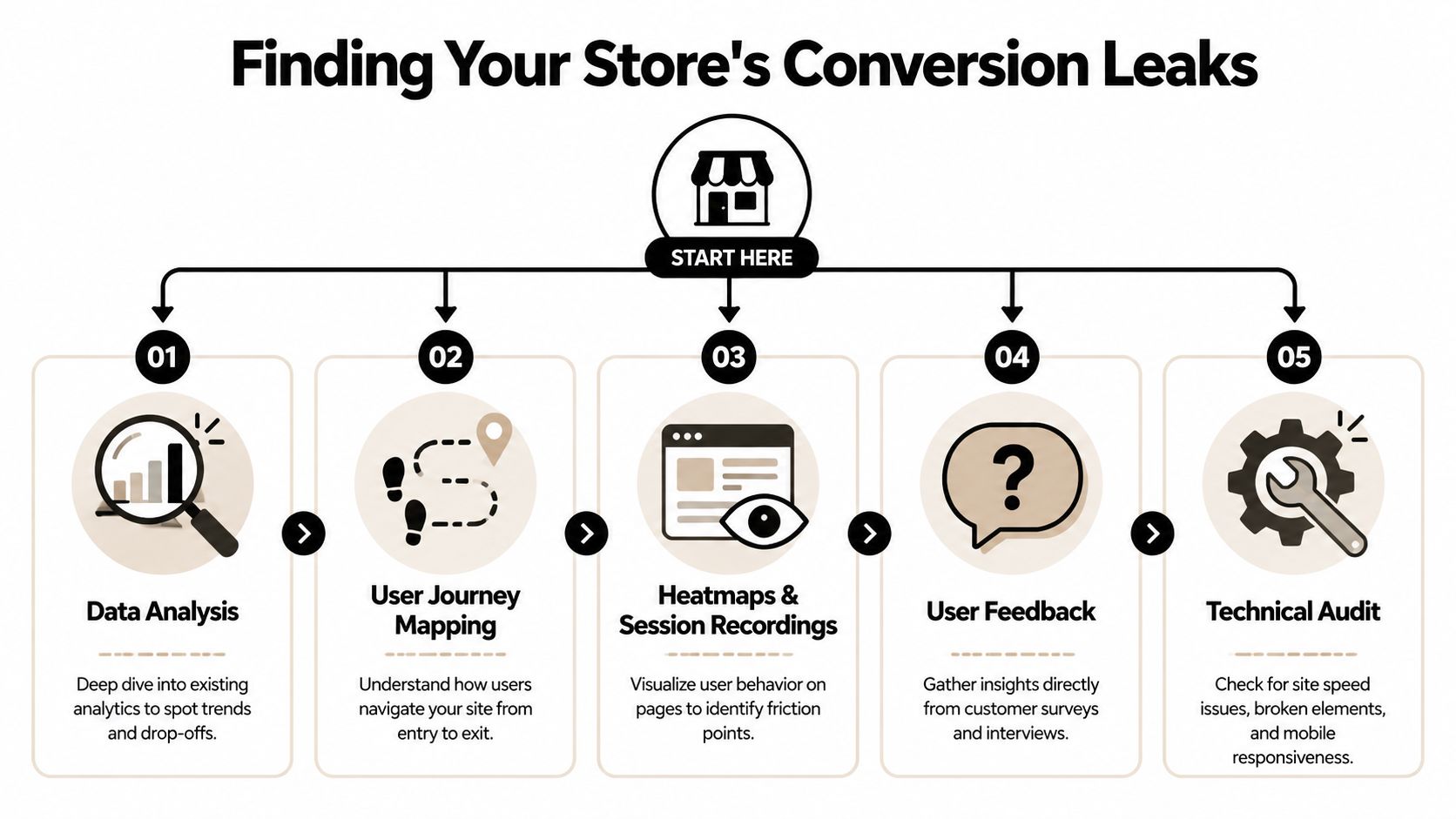
Set up the data layer before touching the design
If tracking is patchy, every CRO decision gets harder. For ecommerce stores, the baseline is usually GA4 and Google Tag Manager configured properly enough to answer the questions that affect revenue, not just pageviews.
We want to know:
- Which device type loses the most high-intent traffic
- Which traffic sources bring visitors who leave before engaging
- Which funnel step creates the sharpest drop-off
- Whether shoppers interact with product content before they abandon
- Whether leads and sales can be tied back to the campaign that generated them
On Shopify, that often means checking product view, add-to-cart, checkout, and purchase events, then making sure the values passed into GA4 and ad platforms are usable. On WordPress and WooCommerce, it usually takes more manual GTM work because plugin-based tracking is often incomplete, duplicated, or inconsistent.
Then we add behaviour tools such as Microsoft Clarity or Hotjar. That's where vague feedback turns into visible friction. You can watch a user tap a size guide that feels broken on mobile, hesitate when shipping details are hidden too low on the page, or abandon a checkout form that asks for too much before trust is established.
Segment first, diagnose second
Blended averages hide the truth.
A Melbourne fashion client can look healthy at account level while mobile traffic from Meta is struggling badly and branded desktop traffic from Google is carrying the numbers. If you review everything together, the store appears fine. If you split the data by device, source, landing page, and location, the weak points usually show up fast.
We use that segmented view to prioritise where to look first. Start with the biggest drop-off tied to the highest-value traffic. Then check whether the issue is message match, UX friction, trust, speed, or broken tracking.
Here's the audit lens we use most often:
| Audit area | What we look for | Common issue |
|---|---|---|
| Traffic source | Ad and search intent alignment | Landing page doesn't match the promise |
| Mobile UX | Scroll depth, tap behaviour, page speed feel | Product info buried or sticky elements blocking action |
| Product pages | Image interaction, variant selection, FAQs | Users want proof before they buy |
| Cart and checkout | Exit points, hesitation, backtracking | Shipping shock or hidden friction |
| Technical layer | Scripts, broken elements, event firing | Reporting gaps and sluggish page load |
The trade-off is simple. The more segmented your analysis gets, the smaller your sample sizes become. For a lower-traffic store, that means resisting the urge to over-interpret one week of recordings or one campaign's dip. For a larger account, it means you can afford to separate paid social visitors from organic search users and treat them like different audiences, because they are.
Look beyond on-site metrics
This part gets missed all the time in CRO projects.
A store can improve add-to-cart rate and still fail to improve profit if low-intent campaigns are filling the funnel, if phone orders are invisible in reporting, or if Meta is missing server-side purchase signals and starts optimising toward weaker traffic. For Melbourne businesses that rely on both ecommerce and enquiries, I want the journey connected end to end.
That means checking whether the landing page reflects the ad that brought the click. It means confirming the site build, whether custom Shopify or WordPress, supports clean event tracking. It also means measuring what happens after the form fill or purchase with tools such as the Meta Conversions API and call tracking, so paid media platforms can optimise toward real outcomes instead of shallow on-site activity.
I've seen stores redesign product pages when the bigger issue was that the offer in Facebook Ads promised fast local delivery and the site buried shipping details until checkout. I've also seen lead-gen businesses obsess over form conversion rate while half their best enquiries were coming through phone calls that no one had attributed properly.
What usually matters more than visual polish
Visual polish has a role, but conversion losses usually come from friction that affects decision-making.
The first checks are usually practical:
- Message match: Does the page continue the promise made in the ad, email, or search listing?
- Trust: Are returns, delivery timing, reviews, and payment confidence visible at the right moment?
- Speed and stability: Does the page stay responsive on mobile once scripts, apps, and tags load?
- Decision support: Can a first-time visitor understand the product, compare options, and resolve doubts quickly?
Stores rarely have one isolated problem. More often, they have a stack of smaller issues. A slower mobile page, weak product proof, poor tracking, and an ad-to-page mismatch can each shave a bit off performance. Together, they suppress revenue enough to make every channel look less effective than it should.
A proper audit gives you a ranked list of issues tied to customer behaviour and business impact. That's the point where CRO stops being website tinkering and starts becoming revenue work.
Building Smart Hypotheses From Real User Data
A Melbourne retailer can spend weeks debating a new homepage look while the actual conversion loss sits somewhere else entirely. I've seen paid traffic from Google Ads land on a product page, trigger plenty of interest, then stall because delivery timing, store pickup, or return terms were still hard to find on mobile. The hypothesis should start there, with the moment revenue gets stuck.
Good CRO hypotheses come from observed behaviour across the full customer journey, not from opinions about what the page should look like. That means linking ad intent, landing page behaviour, checkout friction, phone enquiries, and post-purchase attribution before a single test goes live.
What a useful hypothesis actually looks like
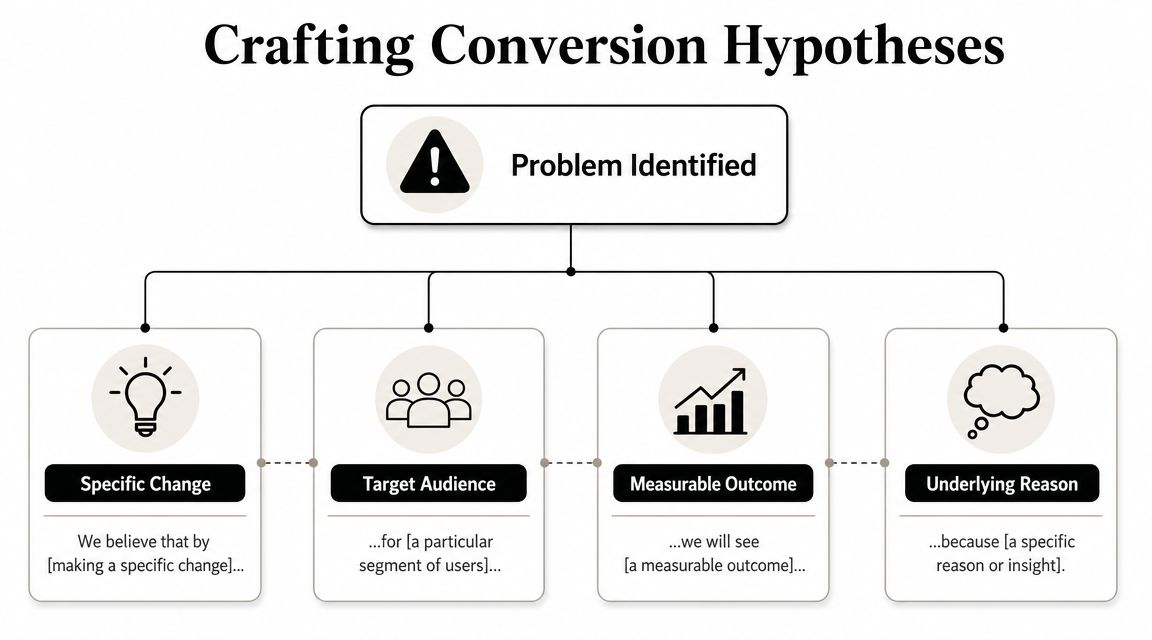
A strong hypothesis names four things clearly:
- Specific change: what will change on the page or in the flow
- Audience: which visitors the change is meant to help
- Outcome: the behaviour expected to improve
- Reason: the evidence behind the idea
For example, if paid social traffic is arriving on a Shopify product page and mobile users keep opening shipping accordions before they add to cart, the hypothesis might be: placing delivery timing and returns policy higher on the page for first-time mobile visitors will improve add-to-cart rate because those users are trying to resolve purchase risk before committing.
That gives the team something testable. It also gives developers, media buyers, and analysts a shared reason for the change.
Why weak hypotheses waste time
I've worked on enough Shopify and WordPress builds to see the same pattern. Teams often choose the most visible change rather than the highest-friction point. They ask for a new hero, a different font scale, or a redesigned announcement bar because those changes are easy to discuss. They are much harder to justify if the underlying problem sits in product comparisons, shipping ambiguity, checkout hesitation, or broken attribution from calls and form fills.
Good hypotheses stay close to user behaviour and commercial intent. If a search visitor lands on a high-intent service page but ends up calling instead of submitting a form, the page test should be tied to that behaviour and the call should be tracked properly. If Facebook traffic bounces because the landing page drops the offer that the ad introduced, the hypothesis should address message match before anyone touches the broader layout.
Big wins do happen. They are not something I plan around. The better approach is to build a queue of evidence-based ideas that remove one important point of friction at a time and stack gains across the journey.
Prioritise by impact and effort
We score hypotheses with a simple impact-versus-effort filter because development time is limited and not every idea deserves a sprint.
| Priority type | Example | Why it goes there |
|---|---|---|
| High impact, low effort | Add clearer delivery and returns info on PDPs | Fast to implement and often removes hesitation |
| High impact, higher effort | Rebuild mobile product gallery or cart flow | More dev work but can fix major friction |
| Lower impact, low effort | Rewrite microcopy on form fields | Worth testing if tied to a clear issue |
| Lower impact, high effort | Full redesign without evidence | Usually a poor first move |
This is also where technical capability affects the pace of CRO. If the hypothesis points to template logic, mobile hierarchy, or checkout friction, the fix may require custom WordPress development, Gutenberg blocks, Shopify theme edits, or a more specific product template. As a digital marketing agency Melbourne brands often approach for growth support, we've found the best results come when strategy, development, and tracking are connected. If a store needs implementation support, Shopify developers in Melbourne can handle the build side of CRO changes without splitting the thinking from the execution.
A weak hypothesis creates activity. A sharp one gives you a reason to test, a clearer build brief, and a better shot at measuring real revenue impact after the click.
Running Experiments That Actually Move the Needle
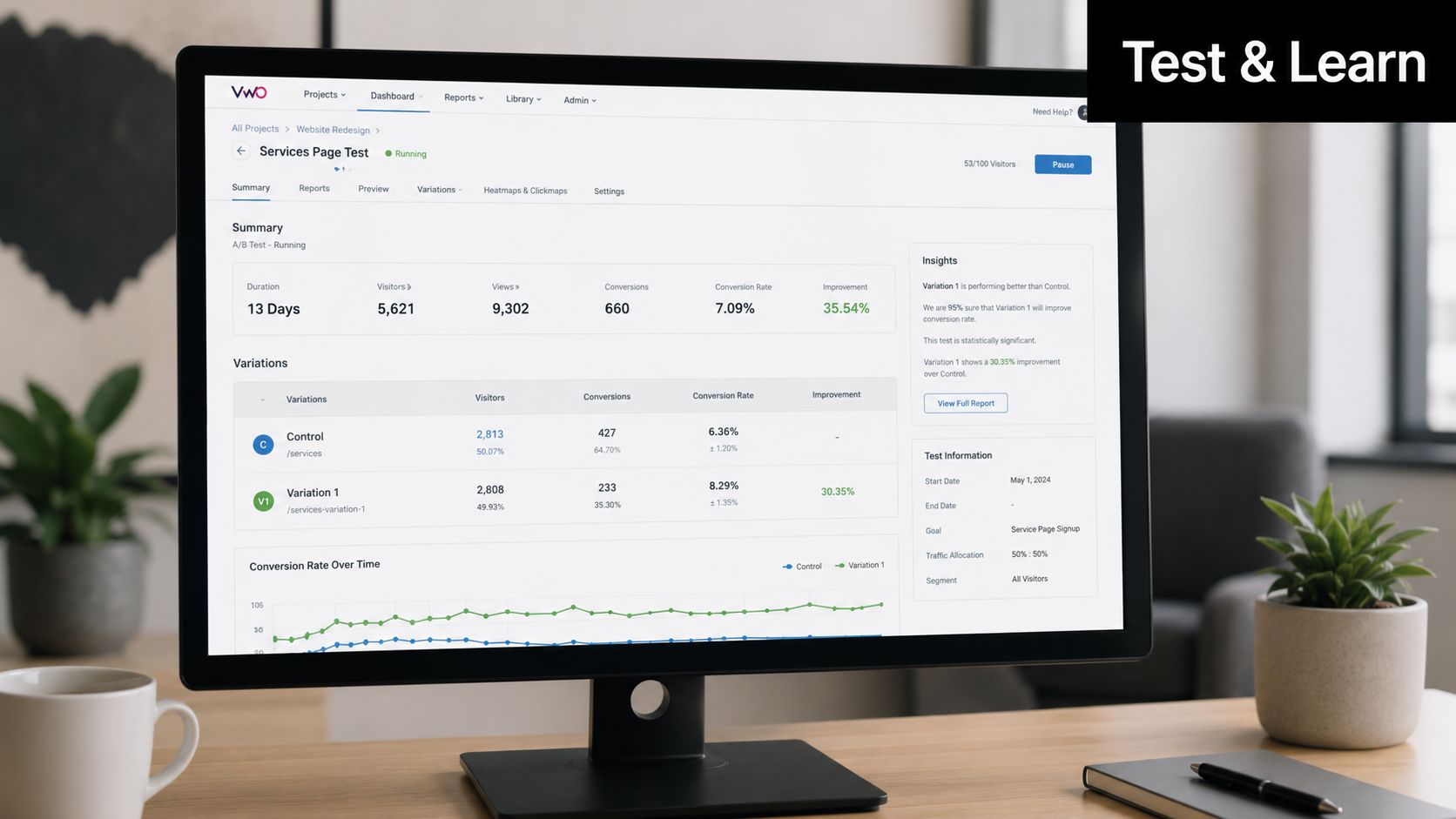
Testing sounds straightforward until you run into the messy parts. Traffic is uneven. Stakeholders want quick answers. Someone declares a winner after three days because one version looks ahead. Consequently, a lot of CRO programs lose credibility.
The test itself matters less than the discipline around it.
Choose experiments that can teach you something
I prefer experiments that answer one meaningful question at a time. If you change the headline, product gallery, reviews placement, pricing display, and CTA all at once, you may get a result, but you won't know why it happened.
For ecommerce, the most useful test areas usually fall into a few buckets:
- Offer clarity: bundles, shipping language, returns policy, guarantees
- Trust placement: reviews, UGC, payment badges, delivery expectations
- Page structure: image order, mobile hierarchy, sticky add-to-cart bars
- Form friction: fewer fields, stronger copy, cleaner validation
- Ad-to-page continuity: landing pages that match campaign intent
Global CRO benchmark summaries make these categories worth testing. They note that live chat can increase conversions by up to 48%, exit pop-ups can add roughly 2% to 5%, and customer reviews can lift conversions by 34%, which makes them strong hypotheses for local testing rather than assumptions to copy blindly (UX friction and CRO test ideas).
Keep your experiment setup clean
A/B testing on Shopify or WordPress can happen through specialist tools, testing platforms, or controlled theme changes depending on the stack. The method matters less than the cleanliness of the setup.
I look for four things before launch:
- One core hypothesis
- A clearly defined primary conversion
- Reliable event tracking through GA4 and GTM
- Traffic consistency across the test window
If you're running paid traffic, this also means checking that campaign intent matches the page being tested. There's no point improving a landing page for shoppers looking for one thing while your Meta ads attract a colder audience expecting another.
For brands investing in Google Ads or Meta, I also recommend getting Meta Conversions API and server-side or improved event tracking sorted early. Not because it's trendy, but because bad attribution makes good tests look inconclusive.
Don't stop the test because you're bored
This is probably the most common mistake I see. A test goes live, one variant jumps ahead, and everyone wants to ship it by Thursday. Then the following week it reverses.
That's why we don't rush to call winners. Short-term movement can be noise, especially around promotions, payday cycles, weekends, and campaign changes.
If your team wants certainty after a few days, they don't want testing. They want reassurance.
A test should run long enough to capture normal behaviour, not just a lucky patch of traffic. That matters even more for Melbourne ecommerce brands with mixed traffic from organic, paid social, Google Shopping, and repeat customer email flows.
A useful walkthrough on test thinking sits well here:
Separate learning tests from rollout changes
Not every experiment needs to become a permanent site-wide update. Some are discovery tests. They tell you that a segment responds better to urgency, that mobile users need proof higher on the page, or that paid social traffic needs a tighter landing page than branded search traffic does.
That insight becomes powerful when you feed it back into campaign structure. A marketing agency Melbourne businesses hire for both paid ads and CRO should be able to test pages and refine media strategy together. Otherwise, ad teams keep buying traffic for a funnel the site team hasn't fixed.
Advanced Tracking for Measuring True Business ROI
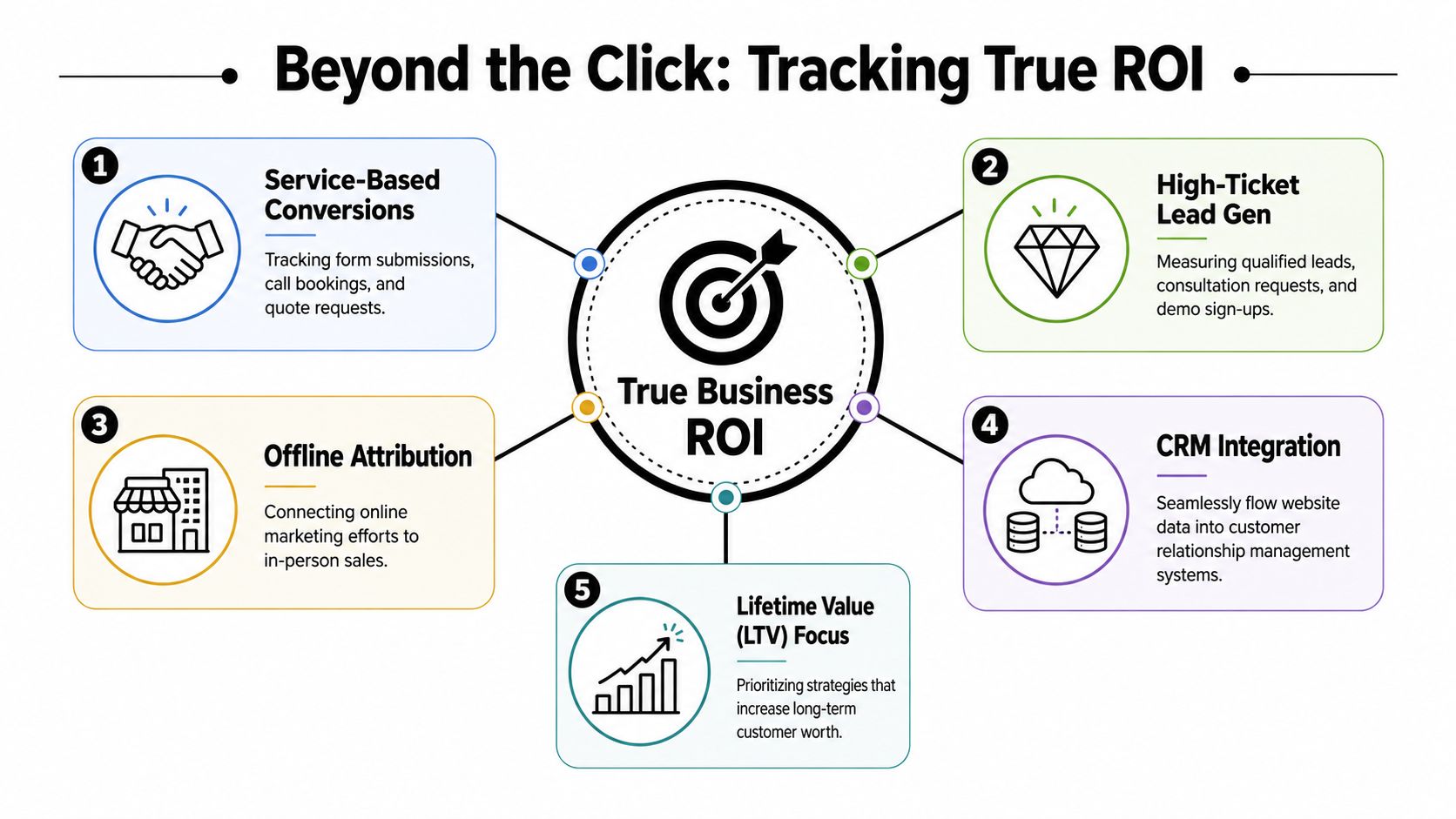
A lot of CRO advice ends at the form submission or checkout confirmation. That's fine if every conversion happens online and every sale is final at that moment. However, plenty of Melbourne businesses don't work like that.
Some ecommerce stores sell high-consideration products and close buyers after several visits. Some brands rely on phone calls before purchase. Some combine online research with in-store sales. For service-led businesses, the website form is often only the start of the sale.
That's why I care just as much about post-conversion measurement as I do about page-level optimisation.
Website conversions are only part of the story
There's a real gap in local CRO content here. Many pages explain A/B testing, heatmaps, and landing page tweaks, but they stop short of showing how to connect those efforts to qualified leads, CRM stages, and actual revenue. That gap matters even more now because privacy changes and weaker last-click reporting make clean attribution harder, especially for SMBs (measurement gap in Melbourne CRO content).
For practical decision-making, I want answers to questions like:
- Which channel generated the call that turned into a sale
- Which landing page drove quote requests that closed
- Whether paid social leads are cheaper but lower quality than Google Ads leads
- Which campaigns assist purchases even if they don't get final-click credit
The setups that make this measurable
A proper tracking stack can be very helpful. Depending on the business model, we'll usually connect several layers:
| Tracking layer | What it helps measure |
|---|---|
| GA4 and GTM | On-site behaviour and funnel progression |
| Meta Conversions API | Stronger event visibility for Meta campaigns |
| Google Ads conversion actions | Lead and sale signals tied back to campaign data |
| CRM integration | Lead quality, pipeline stage, closed revenue |
| Call tracking | Which source or campaign made the phone ring |
For call-heavy businesses, tools like CallRail are useful. In more custom setups, Twilio can be used to assign campaign-specific numbers and route calls based on source or business need. We've also seen demand for AI-assisted answering flows that can capture enquiries after hours, book appointments into a calendar or Calendly, and reduce lost opportunities from missed calls. The value isn't the novelty. It's that missed calls often mean invisible revenue leakage, and standard website reporting won't show it.
The page didn't fail because the user didn't buy online. The tracking failed because it stopped measuring too early.
Why this changes how you judge CRO
Once CRM and call data are connected, your view of CRO gets better fast. A landing page with fewer form submissions might still be stronger if the leads are more qualified. A product-focused paid campaign might appear average on last-click reporting but still influence later sales. A simpler quote form may increase volume while lowering quality, which means the test result isn't automatically a win.
Conversion rate optimization Melbourne businesses need extends beyond on-site tweaks. The primary job is joining user experience, traffic quality, attribution, and sales outcomes into one decision system.
Scaling Your Wins Into Consistent Growth
One winning test is useful. A repeatable system is where true value sits.
The stores that improve steadily don't treat CRO like a once-a-year project. They build it into how they operate. They review funnel data regularly, turn findings into hypotheses, test changes, implement the wins properly, and feed those learnings into ads, email, SEO, and product merchandising.
Turn temporary wins into permanent assets
Development quality matters. If a test proves that a better PDP layout lifts engagement, the next step isn't leaving the winning version taped together with scripts and workarounds. It's building it properly.
On WordPress, that often means creating reusable Gutenberg blocks so the team can roll out proven layouts across category pages, landing pages, and content pages without rebuilding from scratch every time. For ecommerce teams running WooCommerce, it may mean refining template logic and reducing plugin bloat that slows pages down.
For Shopify, scaling wins can involve theme updates, custom sections, Shopify API work, or lightweight app functionality that supports what the data already showed. Sometimes it's a small interface tweak. Sometimes it's a more custom experience for bundles, subscriptions, or product education.
Keep the feedback loop tight
The businesses that get the most from CRO usually do three things well:
- They document test learnings: not just winners, but failed ideas too
- They prioritise performance over preference: evidence beats internal taste
- They tie site changes back to channels: paid traffic, SEO, email, and social all benefit
This matters even more because demand for CRO has climbed over time. Search interest for the term “conversion rate optimisation” has increased by nearly 500% since 2012, and the same source notes that a 1-second delay in page loading time can reduce conversions by 7%, which is a strong reminder that technical execution and site speed belong inside the CRO conversation, not outside it (CRO demand and page speed impact).
What doesn't scale well
A few things usually slow progress down:
- Redesigning before diagnosing
- Adding tools without fixing tracking
- Testing too many variables at once
- Treating every audience the same
- Leaving development bottlenecks unresolved
I've seen stores invest heavily in creative, ad spend, and new landing pages while keeping a clunky mobile experience that no campaign can rescue. Good development fixes that. Whether that means WordPress developers in Melbourne for custom build work or a more optimized ecommerce stack, the principle is the same. Growth compounds when the site can absorb and scale what testing discovers.
Ready to Convert More Melbourne Customers?
If your store is getting traffic but not enough sales, the answer usually isn't more guesswork. It's better diagnosis, cleaner tracking, sharper hypotheses, and a site that removes friction instead of adding it.
That's the practical side of conversion rate optimization in Melbourne. It connects UX, development, analytics, paid media, and revenue measurement. It asks better questions than “should we change the button colour?” It asks where intent is being lost, which users are struggling most, and how to prove that a change improved the business rather than just the page.
For ecommerce brands, this also means choosing partners who can work across the full stack. A digital marketing agency Melbourne businesses trust for CRO should understand Shopify development, WordPress design, Google Tag Manager, GA4, Meta Conversions API, paid landing pages, and what happens after the click. If those pieces are split across too many providers, opportunities get missed in the handover.
We work with businesses in Melbourne and across Australia, including Sydney, Brisbane, Perth, Adelaide, Darwin, Hobart, and Newcastle. Some come to us for Shopify or WordPress development. Others need paid media, tracking, landing pages, or support connecting campaigns to real revenue outcomes.
If you've got a paid ads budget of at least 3k a month, there's a simple offer on the table. Get a month of paid ads management free and apply through the contact page.
If you're looking for a practical Alpha Omega Digital partner that works across CRO, paid ads, WordPress, Shopify, tracking, and conversion-focused development, get in touch through the contact page. If your business is spending at least 3k a month on paid ads, I'd love to offer a low-risk deal with a month of paid ads management free.
Alpha Omega Digital
Read more insights from our team on web design, paid ads, and growth strategy.