You're probably in one of two spots right now.
Either you've run Facebook ads yourself, watched money go out, seen a few clicks and maybe some likes, and wondered why sales didn't follow. Or you've already hired someone, looked at the reports, and still couldn't tell what was really working. That's where most Melbourne businesses get stuck.
I've seen it with eCommerce stores on Shopify, service businesses on WordPress, and founders trying to scale with a mix of Meta, Google Ads, and email. The ads aren't always the main problem. A lot of the time the issue sits underneath them. Bad tracking. Weak landing pages. No real testing process. Or a store setup that makes attribution messy and optimisation almost impossible.
For Australian brands, that problem has become more technical. Privacy changes have made browser-only tracking unreliable. If your setup still relies on the basics and no one has touched Google Tag Manager, Meta Conversions API, GA4, or server-side events, there's a good chance you're judging campaigns with incomplete data.
That's why a serious Facebook Ads agency doesn't just launch ads. It fixes the measurement layer, tightens the offer, improves the destination, and gives you a system you can scale. If you're comparing agencies, or looking for a marketing agency Melbourne business owners can trust with real ad spend, this is the part most articles skip.
Struggling with Facebook Ads in Melbourne
A Melbourne retailer switches on a Meta campaign at the start of the week. Add to carts show up. Traffic looks healthy. By Friday, sales feel soft, Meta is claiming more revenue than Shopify, GA4 is telling a different story again, and the owner is left wondering whether to cut spend or push harder.
I see that pattern all the time.
The frustration usually starts with the wrong diagnosis. Business owners blame the audience, the creative, or Facebook itself. Sometimes those are part of it. More often, the bigger problem sits in the tracking and attribution layer, especially for Australian eCommerce brands still relying on browser-only Pixel data after iOS14.
Why the numbers stop making sense
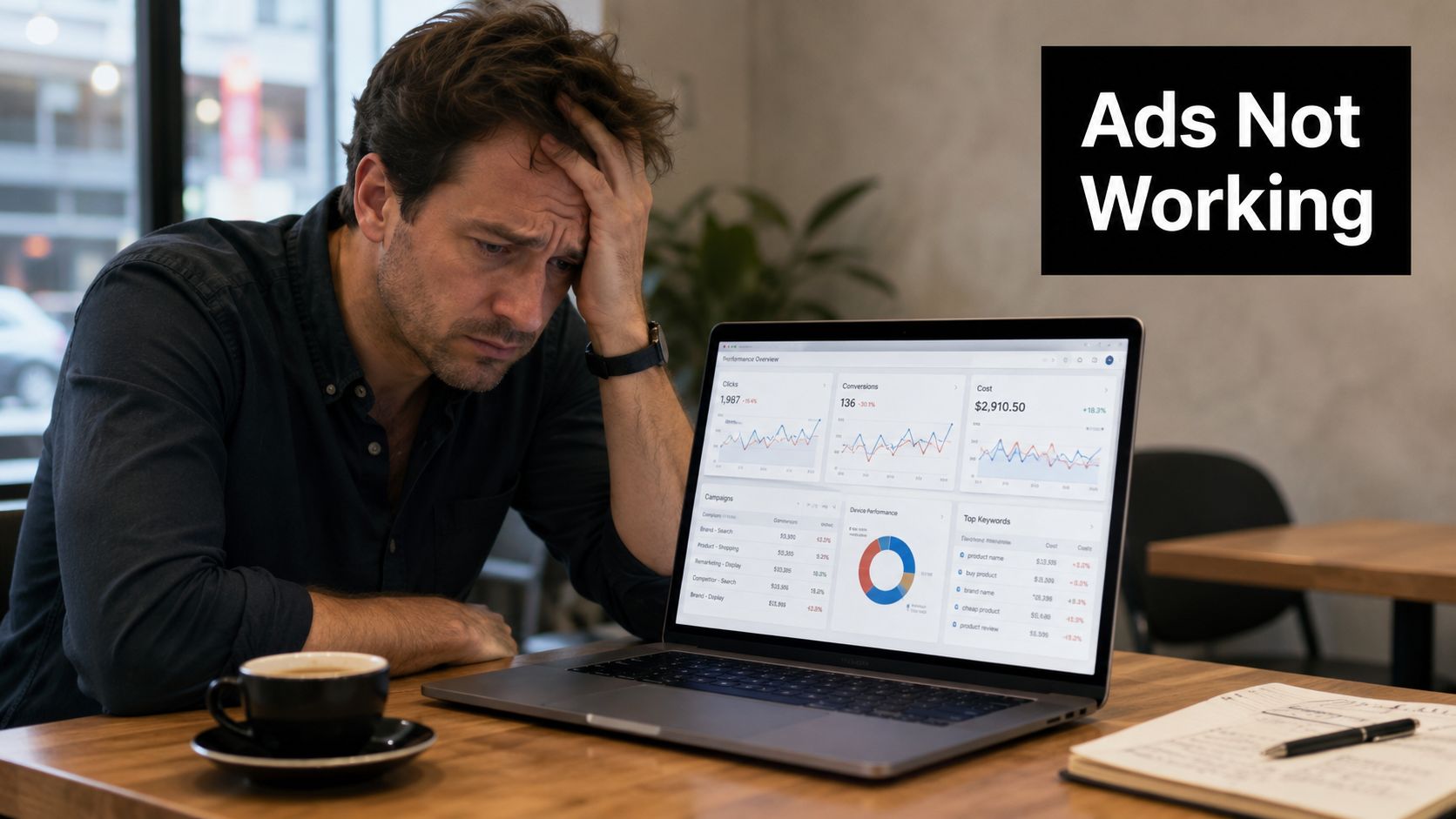
A lot of Melbourne businesses are trying to judge campaign performance with partial information. The ads manager shows purchases. Shopify shows a lower number. GA4 underreports some conversions. Retargeting audiences look smaller than expected. The account still spends money, but confidence disappears.
In my experience, that is the point where business owners start making expensive decisions. They pause campaigns too early, back winners that are only being over-attributed, or keep weak offers running because the reporting makes them look acceptable.
For Australian stores, the attribution gap is not a theory. It is an operational issue. If Meta Pixel is firing in the browser but server-side events are not set up properly through Meta Conversions API and Google Tag Manager, reported ROAS gets harder to trust. I have audited plenty of accounts where events were firing twice, purchase values were inconsistent, or key actions were missing from the funnel entirely. The owner thought they had an ad problem. They had a measurement problem.
Practical rule: If your agency cannot explain how events are passed, deduplicated, and checked against actual sales data, they are buying traffic without giving you a reliable way to judge it.
Melbourne businesses get stuck for understandable reasons
The market is crowded. Freelancers, offshore buyers, broad digital agencies, and new operators all pitch similar outcomes. On the surface, they sound close enough. Once spend increases, the gaps show.
A proper setup usually reaches far beyond ad copy and budget changes. An eCommerce account often depends on your Shopify theme, product feed, GTM container, GA4 setup, event mapping, checkout flow, and post-click user experience. If your website needs work before paid traffic can convert, that is where working with a web design Melbourne team can affect results just as much as campaign management.
I have found that struggling accounts rarely fail because of one dramatic mistake. It is usually five smaller issues stacked together.
What shows up in struggling accounts
Boosted post habits
A boosted post gets reach. It does not replace proper campaign structure, conversion optimisation, or audience segmentation.Weak product or service pages
Paid traffic lands on pages with thin copy, slow load times, weak trust signals, or no clear next step.Poor tracking setup
The Pixel is installed, but CAPI is missing, event match quality is low, GTM is messy, or no one has tested purchase events end to end.Creative fatigue
Ads run too long, frequency climbs, and the account keeps spending on tired creative because no testing rhythm is in place.Erratic decision-making
Campaigns get switched off before enough data comes in, then relaunched from scratch with no clear learning carried forward.
Some of these problems sit in Ads Manager. Some sit on the site. Some sit in operations after the click.
The black-box feeling usually has a technical cause
When a founder says Facebook ads feel like gambling, I understand why. If attribution is off, the account starts teaching the wrong lessons. A campaign that assists conversions across channels can look weak. A campaign getting too much platform credit can look profitable when it is not.
That gets worse when a business is running Meta alongside Google Shopping, email, and organic social. Each platform reports performance differently. Without a clean setup, the owner is comparing channel reports that were never measured the same way in the first place.
I do not treat Meta CAPI as a nice extra anymore. For stores spending serious money, it is part of basic setup. Server-side tracking through GTM gives Meta a cleaner signal, improves event coverage, and gives the business a better shot at judging actual return instead of platform noise. It does not solve every problem, but it removes a lot of avoidable guesswork.
Reach is not the issue
Australian businesses can still buy attention on Meta. The real question is whether the account can turn that attention into measured profit.
The wrong setup wastes good traffic. I have seen solid products fail because traffic was sent to collection pages with poor filtering, no product-specific angle, and unclear purchase intent. I have also seen service businesses generate leads at a reasonable cost, then complain that Facebook leads are bad when the actual issue was slow follow-up, weak qualification, or a vague offer.
That is why I treat ad performance as a system, not a line item.
What this looks like in practice
A Melbourne eCommerce brand launches a new range and sends paid traffic to a generic category page. The creative is decent. Demand exists. But purchase tracking is inconsistent, add-to-cart events are firing poorly, and no one has validated what Meta reports against the store backend. After one rough week, the owner cuts spend and decides the channel has stopped working.
I would not call that a failed Meta campaign. I would call that a business trying to scale without a reliable measurement layer.
The same logic applies to service businesses. If lead forms are producing poor-fit enquiries, the issue may be in the offer, the form structure, the landing page, or the sales process after submission. Ads can amplify good systems. They can also expose weak ones quickly.
What improves results
The businesses that get traction usually accept one hard truth early. Ads do not repair broken foundations.
If your Shopify store has friction in the product pages or checkout flow, you may need help from Shopify developers in Melbourne. If your service site runs on WordPress and the forms, templates, or mobile UX are dragging down conversion rate, you may need a WordPress developer in Melbourne. If GTM, GA4, Pixel, and CAPI are not configured properly, no audience tweak is going to fix reporting confusion.
That is usually the underlying reason businesses start struggling with Facebook ads in Melbourne. They are not just missing a media buyer. They are missing the technical and operational setup that lets Meta learn from the right data.
What a Real Facebook Ads Agency Actually Does
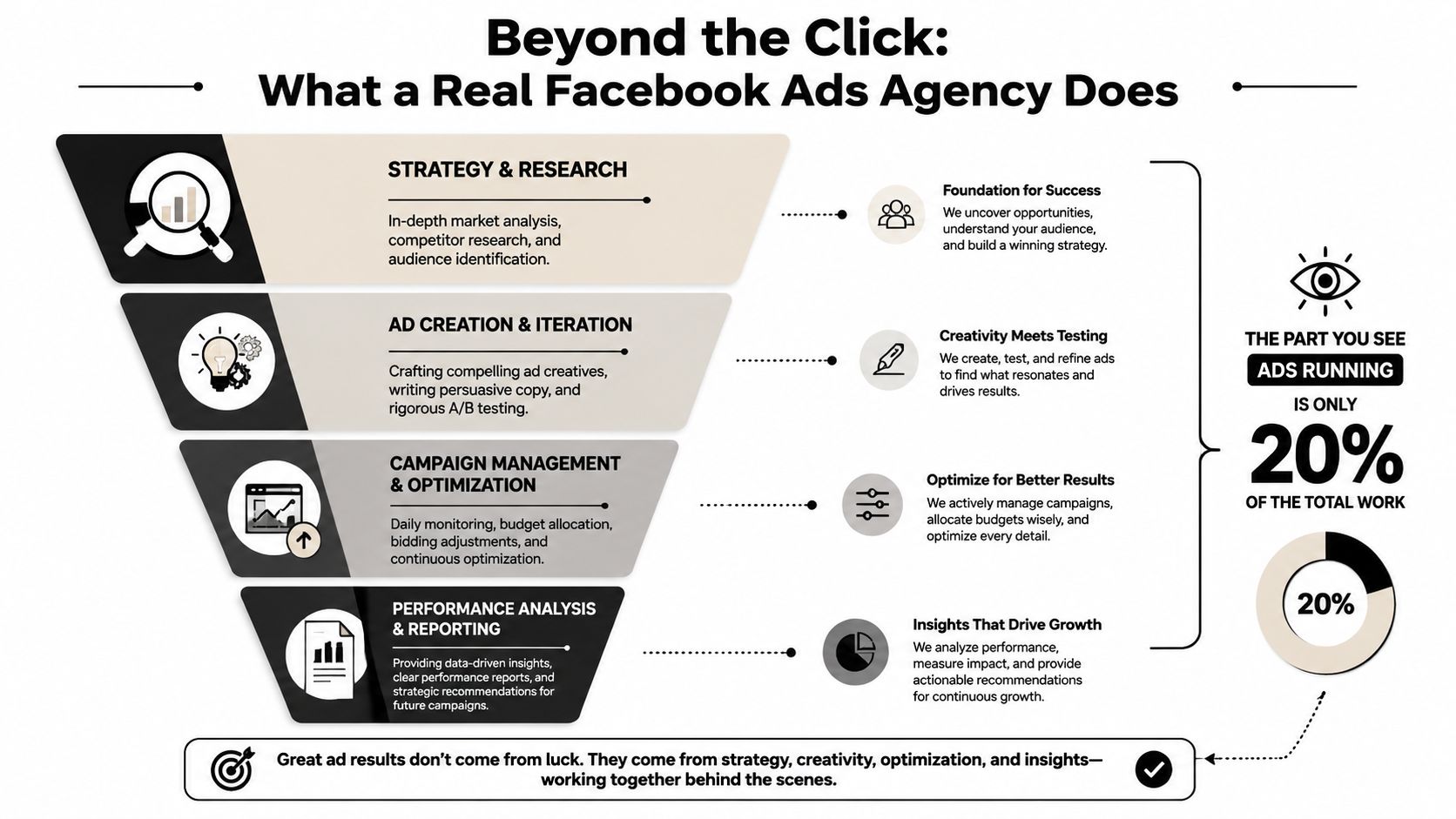
A Melbourne retailer can spend $150 a day on Meta, see traffic rise, and still have no clear read on what drove sales. Meta reports one number. Shopify shows another. GA4 says something else again. At that point, the agency's job is not just ad delivery. It is sorting out the system behind the spend so decisions are based on something real.
That is the part many businesses miss when they compare providers. They look at ad creative, package tiers, or how polished the sales deck feels. Useful, but secondary. The core work sits underneath. Offer clarity, account structure, tracking accuracy, landing page performance, and the speed of testing all affect whether paid traffic turns into profit.
Boosting posts is not media buying
Boosted posts have a use. I have used them for local awareness, event promotion, and social proof on content that is already getting traction. But that is a small slice of Meta advertising.
Agency work means building campaigns around intent. Cold prospecting needs a different message and budget logic from retargeting. A product catalogue campaign needs different inputs from a lead generation campaign for a clinic, tradie, or professional service. If everything sits in one campaign with vague targeting and no testing plan, the account usually burns spend before it learns anything useful.
The website sits inside the ad system
Paid traffic does not land in a vacuum. It lands on a product page, a collection page, a booking form, or a service page that either helps the conversion or kills it.
I treat site issues as part of account management because they affect performance every day. On WordPress builds, that often means tightening mobile layouts, reducing form friction, or improving landing page structure with WordPress development support. For eCommerce, the review is different. I look at product page trust signals, collection logic, checkout friction, and whether the feed is clean enough for catalogue campaigns to work properly.
For eCommerce accounts, I usually check four things first:
Collection structure
Shoppers need to find products fast, especially on mobile.Product page trust
Shipping, returns, reviews, and product detail need to answer hesitation quickly.Mobile buying flow
A clunky add-to-cart or checkout flow wastes paid clicks.Feed quality
Poor titles, broken variants, and inconsistent attributes weaken catalogue performance.
Technical setup separates operators from account babysitters
The gap becomes evident in Australian accounts. Plenty of providers can write ad copy, cut UGC-style videos, and talk about hooks. Fewer can explain how they validate purchase events, deduplicate browser and server signals, or troubleshoot attribution gaps after iOS14.
In my experience, this is often the difference between an account that scales and one that stays stuck in reporting arguments. If Meta Pixel, GA4, GTM, and the Meta Conversions API are not set up properly, optimisation gets messy fast. You start chasing the wrong campaign, pausing winners, or increasing budget on traffic that looks good in-platform but does not show up cleanly in backend sales data.
For Australian eCommerce brands, that measurement gap is not a side issue. It directly affects how confidently you can judge ROAS. A real Facebook ads agency deals with that upfront. It reviews event priorities, checks domain verification, tests CAPI implementation, compares platform reporting against store data, and flags where attribution is likely to under-report or over-credit.
What the work actually looks like week to week
Good agency work is operational. It is not just logging in, tweaking budgets, and sending a screenshot at month end.
| Area | What a real agency handles | What weak providers often do |
|---|---|---|
| Account strategy | Builds campaigns around funnel stage, offer, and business goals | Launches generic campaigns with minimal structure |
| Tracking | Validates events, GTM, CAPI, GA4 alignment | Installs pixel and assumes it's enough |
| Creative process | Tests concepts, hooks, formats, and landing alignment | Reuses one ad until it burns out |
| Reporting | Connects spend to sales, leads, and actual outcomes | Sends screenshots of reach and clicks |
I have found that the strongest accounts follow a simple rhythm. Check signal quality first. Review breakdowns by audience, placement, and creative angle. Look at what happened after the click, not just inside Ads Manager. Then make one or two clear changes you can evaluate.
Full-funnel work matters
Meta rarely works alone. For eCommerce, it often sits beside Google Shopping, email flows, SMS, and conversion rate work on the site. For service businesses, Meta can create demand while Google captures people already searching.
That matters because channel performance can be misread in isolation. A prospect might see a Meta ad, return through branded search, then purchase from an email reminder. Agencies that only report on last-click numbers often miss how the channels support each other. Agencies that only trust Meta's own attribution can overstate its role. The job is to judge contribution accurately, then allocate budget with that reality in mind.
Creative still matters, but it needs context
Creative can carry an account for a while, but only when the offer, audience, and destination page line up. A founder video, a testimonial, a product demo, and a promotional retargeting ad all do different jobs. Mixing them up wastes money.
I usually explain creative testing in terms of variables, not inspiration. Test the hook. Test the angle. Test the offer framing. Test the landing page match. That is more useful than endlessly asking for fresh content without knowing what failed in the first place.
One useful way to judge any agency
Ask what happens before launch and in the first two weeks after spend starts.
A weak answer stays vague. Audience research, ad creation, optimisation.
A strong answer gets specific. It covers account structure, event checks, GTM review, CAPI testing, attribution checks against backend data, landing page risks, feed issues, creative test planning, and the rules for scaling or cutting budget.
That is what a real Facebook ads agency does. It does not just run ads. It builds a measurement and testing system you can trust.
The Core Services That Drive Growth
A campaign can look healthy in Ads Manager and still miss revenue in the backend. I see that a lot with Australian eCommerce stores after iOS 14. Meta reports one version of performance, Shopify reports another, and the founder is left guessing which number to trust. Growth comes from fixing that gap, then building campaigns on top of cleaner data.
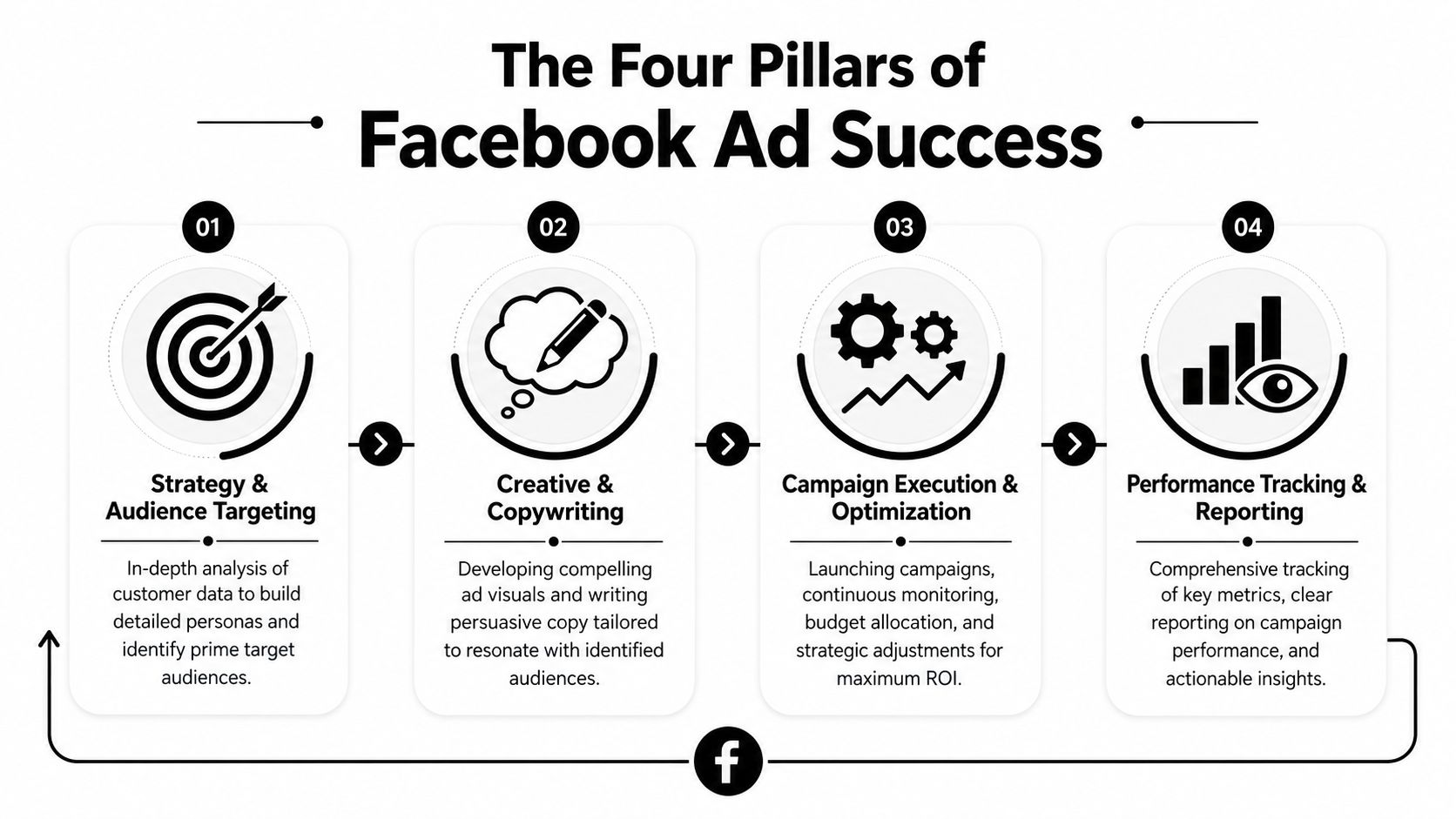
Four services tend to drive the result. Clear strategy, disciplined creative testing, accurate tracking, and steady optimisation. If one is weak, the account usually stalls.
Strategy and audience targeting
Good targeting starts with commercial reality, not audience guesswork.
For eCommerce, that means separating products by intent, margin, price point, and buying friction. A $39 impulse purchase can handle very different creative and prospecting logic from a $249 product that needs proof, comparison, and retargeting support. In my experience, accounts underperform when every product is pushed through the same campaign structure.
For service businesses, the same principle applies in a different form. A local clinic, tradie, or professional service needs ads built around trust and action. The message has to match the lead type you want. Quote requests, phone calls, booked appointments, and brochure downloads are not the same conversion, so they should not be treated like they are.
Channel alignment matters too. If Meta drives the first visit, branded search closes the sale, and email brings people back, the offer and landing page need to stay consistent across all three. Otherwise attribution gets muddy and budget decisions get worse.
Creative testing that behaves like a system
Creative testing works best when each test answers one question.
I usually break it into controlled variables. Test the opening hook. Test the angle. Test the offer framing. Test the page the ad clicks through to. That approach gives you something usable. Randomly swapping in new videos every week gives you activity, not insight.
Meta's own guidance supports structured variation across formats and fresh assets before fatigue drags performance down (Meta creative testing guidance). In live accounts, I have found the same pattern. The teams that refresh with a reason tend to hold efficiency longer than the ones chasing novelty.
A practical test cycle often covers:
Format variation
Static image, short-form video, product demo, founder content, and UGC-style adsHook variation
Problem-led, benefit-led, price-led, review-led, or objection-handling openingsOffer framing
Full price, bundle, limited-time incentive, or risk-reversal messagingLanding page match
Sending each angle to the page that removes the most frictionAudience pairing
Running the same message across prospecting, warm retargeting, and customer segments before scaling
Tracking setup is where profitable scaling starts
This is the part many businesses underestimate. They install the pixel, connect the store, and assume revenue tracking is sorted. In plenty of accounts, it is not.
The setup needs a clean Google Tag Manager container, properly named events, GA4 alignment, and a working Meta Conversions API connection. For Shopify stores, I also check theme conflicts, duplicate purchase events, feed quality, and whether apps are firing their own scripts on top of Meta's native setup. For WooCommerce and custom WordPress builds, the risk is usually plugin sprawl and messy event logic.
The big issue for Australian brands is attribution loss. Browser-side tracking alone misses too much. Server-side tracking through Meta CAPI helps recover signal, improve event matching, and give the algorithm better conversion feedback. But only if the implementation is right. I have seen CAPI installed with broken deduplication, missing value parameters, or the wrong event priority, which leaves the reporting just as unreliable as before.
The same goes for GTM. A cluttered container with overlapping tags, old triggers, and no testing history creates bad data fast. Good implementation is boring in the best way. Clean event design, clear naming, test purchases, parameter checks, and backend validation against what the store records.
Field note: Better tracking improves measurement. It does not rescue a weak offer, poor margins, or a slow product page.
Ongoing optimisation decides whether the account scales
Once campaigns are live, the work shifts from setup to judgement.
Optimisation means knowing what to cut, what to protect, and what to test next. A weak audience and a weak creative should not keep spending just because click-through rate looks decent. A profitable ad set should not be reset every second day because someone got nervous. Over-editing is one of the fastest ways to ruin a stable campaign.
I use a short list here:
Cut weak combinations early
Stop wasting spend on ad and audience pairings that are not producing quality actions.Protect profitable segments
Leave room for stable performers to keep learning before making unnecessary edits.Refresh before fatigue gets expensive
Replace tired inputs before CPA starts drifting up.Check site behaviour alongside platform metrics
Add-to-cart rate, checkout progression, average order value, and refund patterns often explain what Ads Manager cannot.Scale with restraint
Increase budgets where signal quality is strong, not where volume merely looks promising.
Why these services work best together
Plenty of Melbourne businesses treat media buying, tracking, landing pages, and store setup as separate jobs. That usually creates reporting gaps and slower decisions.
The better model is a connected system. Creative testing informs audience strategy. Tracking tells you which sales Meta helped generate. Landing page behaviour explains why one angle converts and another stalls. Optimisation gets sharper because the inputs are cleaner.
That matters most for Australian eCommerce brands trying to measure ROAS properly after iOS 14. If the tracking layer is weak, every decision built on top of it gets weaker too.
Measuring Success Beyond Vanity Metrics
Reach doesn't pay wages. Likes don't cover stock. Cheap clicks don't mean much if the wrong people are landing on the site and leaving.
The metric I care about most is Return on Ad Spend. In the Australian market, a Facebook ads campaign should target a minimum ROAS of 4:1 to be considered profitable for eCommerce brands, meaning $4 in revenue for every $1 spent on ads (Australian ROAS benchmark for Facebook ads). That doesn't mean every campaign starts there. It means that's the commercial standard the account should be working towards.
Why vanity metrics mislead business owners
A lot of reports still lead with impressions, clicks, link CTR, reactions, comments, and reach. Those numbers can help diagnose delivery, but they don't tell you whether the ads are making money.
I've had plenty of conversations where a business owner thought a campaign was doing well because the click volume looked healthy. Then we checked the landing page behaviour, the product page engagement, and actual sales quality. The campaign wasn't profitable. It was just active.
That distinction matters because activity feels like progress. Profit is progress.
What I look at instead
For eCommerce, I care about whether the campaign drives measurable sales and whether those sales hold up once you compare them with what's happening in the platform and on the store itself.
For service businesses, the analysis shifts slightly. Form submissions can be useful, but they're often a poor proxy for commercial value if lead quality is all over the place. In those accounts, call quality, booking rate, and follow-up speed become much more important.
A cleaner reporting stack usually includes:
Revenue-focused outcomes
Sales value, attributed purchases, and whether the store can scale profitablyLead quality checks
Not just how many enquiries came in, but whether they were worth chasingCall tracking
Essential for businesses that win jobs over the phoneFunnel behaviour
Product views, carts, checkouts, and post-click intent signals
Service businesses need better proof than form fills
If you run PPC for tradies, clinics, beauty businesses, restaurants, or local operators who rely on calls, the ad platform alone won't tell the full story. That's where call tracking becomes useful.
I like using a custom number through Twilio when a business needs tighter attribution and better lead handling. The setup can support 24 hour call answering, it doesn't get sick or tired, and it can book appointments directly into your calendar or Calendly. For businesses that miss after-hours calls, that can protect revenue that would otherwise disappear. I've seen this matter most for tradies, hairdressers, beauty therapists, dentists, restaurants, and doctors where the customer often calls the first business that answers.
That also ties back to broader paid media work. If you're running Google Ads for plumbers or any local service campaign, a call-handling layer can be the difference between “leads were expensive” and “the campaign paid for itself”.
The best reporting question isn't “How many clicks did we get?” It's “Which ads produced profitable actions the business could actually close?”
Good measurement changes how you manage creatives
Once the measurement layer is clean, decisions get easier.
You can see which ad format generates real buyers, not just soft engagement. You can compare video against static. You can tell whether a broad audience produces weak traffic or whether the landing page is failing warm traffic. Without that, every creative discussion turns subjective.
This is why how to measure success in Facebook ads shouldn't start with platform engagement. It should start with business outcomes, then work backwards into the metrics that support them.
A simple commercial lens I use
If a campaign creates sales at healthy margins, it stays. If it creates noise without commercial value, it goes.
That sounds obvious, but plenty of accounts stay bloated because no one wants to shut off the “good looking” ads. I've found founders especially need permission to ignore the ego metrics. One flashy creative can get attention and still be a weak business asset.
The same principle applies to related channels. Whether you're running Meta, Google Ads for contact form submissions, Google Shopping for dropshipping, or PMAX versus standard Shopping campaigns, the business should judge the channel by commercial return, not by dashboard theatrics.
How Much to Budget for a Facebook Ads Agency
At this stage, a lot of businesses either underfund the account or choose the wrong agency model.
I don't think there's one perfect pricing structure for everyone. What matters is whether the model encourages good behaviour. If the setup rewards an agency for pushing spend higher regardless of results, that's a problem. If the retainer is tiny and the workload is huge, that's another one.
What the numbers look like in Australia
In Australia, the average CPC for Facebook ads ranges from AUD $1.15 to $3.20, and CPM averages AUD $11.04. The same source notes that most businesses allocate 15% to 25% of their total marketing budgets to Facebook and Instagram campaigns (Australian Facebook ad costs and budget share).
Those figures matter because they shape how much testing you can realistically do. If clicks are costing money and you want enough volume to compare audiences, creatives, and landing page behaviour, tiny budgets make the account sluggish.
I usually tell businesses the budget has to be large enough to produce useful feedback. If you can't afford enough traffic and enough conversion data to learn, you end up reacting to noise.
Why small budgets create bad decisions
Low spend accounts often get judged too quickly. One audience has a bad day, one creative gets a few weak clicks, and the owner wants a full reset. That's not optimisation. That's impatience caused by thin data.
For more serious management, I prefer working with businesses that can support proper testing. The practical reason is simple. You need enough spend to test creative, compare audiences, and refine the funnel without choking the campaign before it has a chance to settle.
That's also why the offer at the end of this article is limited to brands with a paid ads budget of at least $3,000 a month. Below that, the room for meaningful iteration gets tighter.
Common Facebook Ads agency pricing models
| Model | How It Works | Best For | Potential Downside |
|---|---|---|---|
| Flat monthly retainer | You pay a fixed management fee each month regardless of spend | Businesses with stable budgets and ongoing campaigns | Can feel expensive if the budget is very small |
| Percentage of ad spend | Agency fee rises or falls based on how much you spend on ads | Brands scaling aggressively with larger media budgets | Incentives can drift toward higher spend, not better efficiency |
| Hybrid model | A base fee plus a smaller percentage of spend or project component | Businesses needing both strategic oversight and flexible scaling | Can be harder to compare across agencies |
What I think works best
For many SMBs and eCommerce brands, a flat retainer keeps the relationship cleaner. The agency gets paid to improve the account, not to convince you to spend more for the sake of it.
That said, some businesses prefer a hybrid model when they're in a growth phase and need extra input around launch periods, catalogue work, or seasonal pushes. ECommerce brands running heavy sale periods may need more frequent creative turnover, product feed maintenance, and store-side support than a standard month involves.
Your website budget and tracking budget still count
Buyers often make a mistake, believing ad budget is the whole investment.
It isn't.
If your store needs Shopify design, product template work, building custom Shopify apps using Shopify CLI, Shopify API integration, or feed cleanup, that work affects ad performance. If your WordPress site needs template fixes, building custom blocks in Gutenberg, event cleanup, or better landing page UX, that affects ad performance too. If your GTM setup is poor, setting up Google Tag Manager containers becomes part of the media budget conversation because it directly changes how you measure and optimise.
Budgeting questions worth asking before you hire
Can we afford enough spend to learn?
If the answer is no, delay the campaign or narrow the goal.Do we need store or landing page work first?
Traffic only helps if the destination converts.Will the agency handle tracking setup properly?
If not, your reporting will stay muddy.Are we budgeting for consistency?
Marketing your business is consistency, not random bursts of spend.
A reliable digital marketing agency Melbourne businesses hire should be honest about this. If the budget isn't enough to do the job properly, you should hear that upfront.
How to Choose the Right Melbourne Marketing Agency
You sit through the discovery call, hear the usual promises, and by the end it all sounds polished. Then the campaign goes live, sales reporting never quite lines up, and nobody can explain why Meta says one thing while Shopify or your CRM says another. I see that problem a lot with Melbourne businesses that have already been burned once.
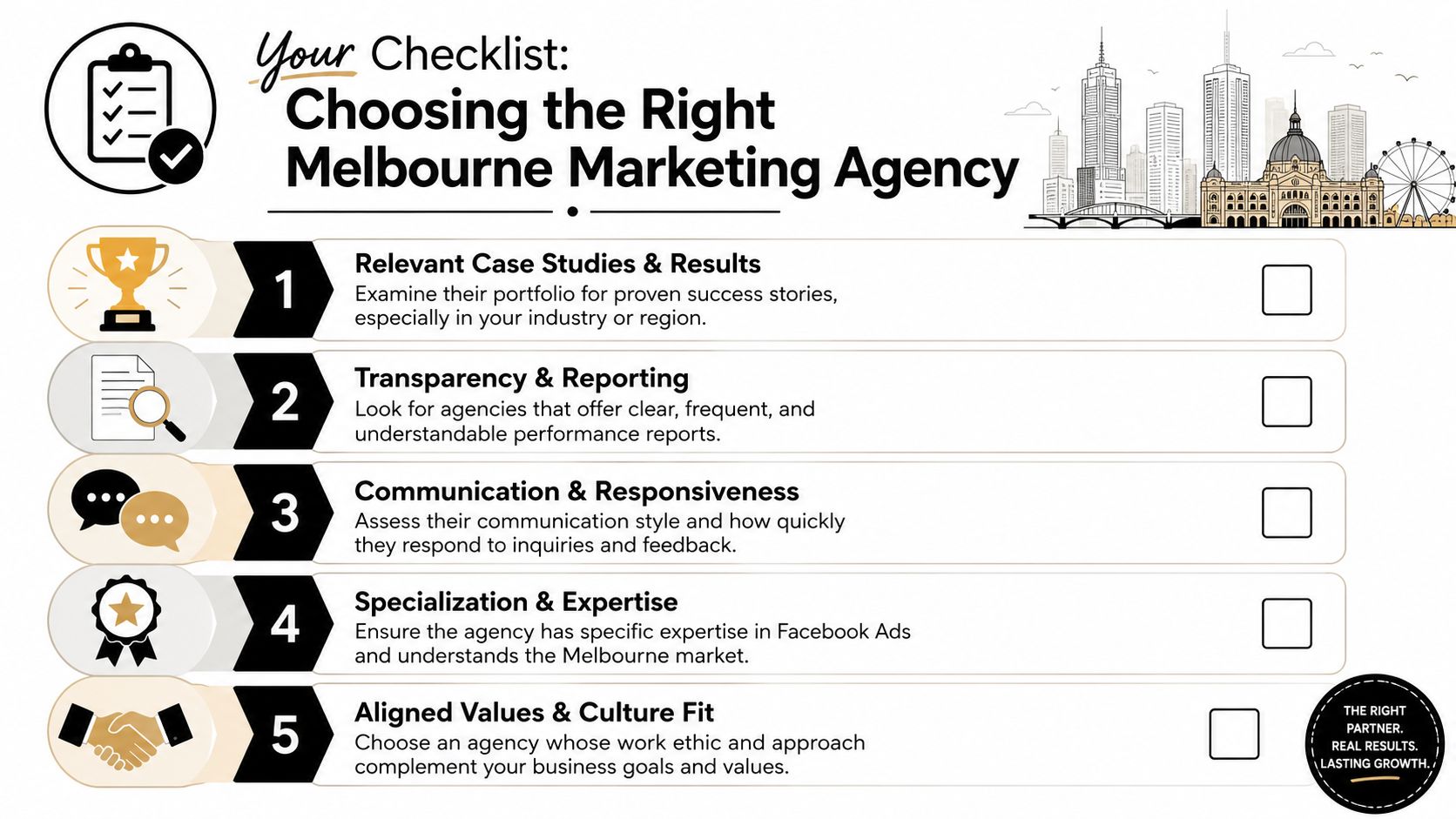
The right agency should be able to explain the gap between platform reporting and real business results, then show you how they close it. In Australia, that usually means understanding post-iOS14 attribution properly, setting up Meta Conversions API well, and using GTM in a way that gives you cleaner event data. If an agency cannot speak clearly about that, keep looking.
Start with what they measure
An agency's reporting habits tell you a lot.
If the first conversation is full of impressions, reach, engagement, and vague brand chatter, I get cautious. Useful reporting should connect ad spend to cost per acquisition, MER or ROAS where relevant, lead quality, revenue trends, and the reliability of the tracking layer underneath it all.
Ask to see a real report. Not a cherry-picked Ads Manager screenshot from a good week. Ask how they separate diagnostic metrics from business metrics, how they annotate changes, and how they explain a period where Meta performance looked strong but backend sales did not match. In my experience, that answer tells you more than the pitch deck ever will.
A lot of businesses looking for a marketing agency Melbourne team can trust also need help outside paid social. If that applies to you, it helps to check whether the agency shows real depth in related areas like eCommerce marketing and development support.
Ask about tracking before you ask about creative
Creative drives performance, but bad measurement ruins decision-making.
That is why I usually test an agency's technical thinking early. If they can explain attribution clearly, there is a decent chance they know how to optimise with discipline instead of guesswork.
Ask questions like these:
- How do you set up Meta Conversions API for Shopify or WordPress?
- Do you use GTM to control event logic and improve data quality?
- How do you deduplicate browser and server events correctly?
- How do you test whether purchases, leads, and add-to-cart events are firing properly?
- How do you compare Meta reporting against GA4, Shopify, and CRM data?
Those answers should be specific. In my experience, good operators can walk you through event priority, match quality, deduplication, and the trade-off between speed of setup and accuracy of reporting. Weak agencies usually drift into broad language about algorithms and optimisation.
Their web capability tells you a lot
Paid social rarely fails in isolation. It usually breaks at the handoff between the ad, the landing page, the offer, and the tracking setup.
An agency does not need to be a full-scale dev shop, but they do need enough hands-on capability to diagnose what is hurting conversion once the click lands. That includes WordPress development, WordPress design, Shopify development, Shopify design, landing page structure, product page friction, mobile UX, form handling, and small technical fixes that lift conversion rate.
For eCommerce brands, I also want to hear that they understand product feeds, catalogue behaviour, collection structure, and how store architecture affects campaign performance. For WordPress sites, I'd expect them to be comfortable with WordPress website developer tasks, conversion-focused page layouts, and custom block flexibility. If they cannot discuss the destination with confidence, they will miss half the problem.
The questions I'd ask in the room
These are the questions that usually expose whether the team is sharp or just polished:
Can you give me an example where you fixed attribution before scaling spend?
I want to hear a real process. Audit the pixel, review GTM, implement CAPI, test events, compare against platform sales, then optimise from cleaner data.What is your process for creative testing?
Good answers cover offer angle, hook variation, format mix, testing windows, and how they decide whether a result is strong enough to iterate.How do you decide when to pause an audience or ad?
Serious media buyers use thresholds, context, and conversion data. They do not kill ads on a hunch after a rough day.What happens if traffic quality looks fine but the site converts poorly?
The answer should include page review, speed checks, merchandising, form friction, checkout issues, and event validation.Who will I speak to each month, and what will that conversation include?
I prefer fewer meetings with better analysis. You want clear actions, not padded account management.
A useful video on choosing the right fit is below.
Red flags that come up often
Don't hire an agency because they speak confidently about ads. Hire them because they can explain how tracking, creative, landing pages, and reporting affect each other.
A few warning signs come up again and again:
They avoid technical detail
Plenty of strategy talk, very little implementation detail.They promise fast wins without qualification
Good accounts still need time to test, clean up data, and learn.They cannot explain attribution loss in plain English
If they work in paid social in 2026, they should already know how post-iOS14 reporting gaps affect decision-making.They stay inside the Meta silo
Strong paid social work often overlaps with analytics, search, email, CRM, and site UX.They never ask about your margins, stock, fulfilment, or sales process
That usually means they are optimising surface-level metrics.
One more practical filter
Check how the agency presents itself online. Their site should be clear, fast, and technically sound. Their local presence should look maintained. Their service pages should read like they were written by people who do the work, not by people recycling broad claims.
I also pay attention to whether they can speak sensibly about adjacent services that affect paid media performance, such as Google My Business, local SEO, PPC for tradies, Google Ads for service based businesses, and call tracking. That does not guarantee they will run a strong Meta account, but it does tell you whether they understand how a real business gets leads and sales across more than one channel.
Real Results From Real Melbourne Businesses
Results usually look boring before they look exciting.
That's one of the hardest things for business owners to accept, especially when they've already had a poor experience with a previous agency. The first impulse is often to judge the campaign in a week or two, then rip everything up if sales don't surge immediately. That impatience kills more good campaigns than Meta does.
For Melbourne-based businesses, dependable lead quality and sales trends from Facebook ads typically become clear only after 60 to 90 days of consistent testing, optimisation, and follow-up refinement (Melbourne Facebook ads testing window). I agree with that. The first phase is usually about cleaning the account, fixing the data, and learning what the market responds to.
An eCommerce example that started badly
One Melbourne store came in with the classic symptoms. Shopify site, plenty of products, decent photography, and a Meta account that looked busy but unreliable. The founder was frustrated because some days Meta claimed sales, some days Shopify told a different story, and nobody could explain the gap.
The first move wasn't creative. It was cleanup.
We reviewed the store flow, simplified where paid traffic landed, checked product categorisation, and sorted out the measurement layer. That included GTM event work, better Meta event handling, and a cleaner approach to the product catalogue. Only after that did creative testing mean anything.
What changed once the setup was cleaner
The account became easier to read.
Instead of guessing whether a video was “performing”, we could compare ad sets against clearer signals. Some creatives that looked strong at the top level turned out to attract weak buyers. Others looked quieter but brought in better carts and steadier purchase behaviour.
That's why I keep telling founders not to obsess over surface metrics. A clean setup often reveals that your favourite ad isn't your best ad.
A service business example with a different bottleneck
Another Melbourne business had the opposite issue. The ads were generating interest, but the business kept missing calls after hours. The owner assumed the campaign had a lead quality problem. It didn't. The business had a response problem.
We shifted the setup so leads coming from paid campaigns had a better handling path, including call routing through a custom number. Once missed calls stopped falling through the cracks, the campaign became much easier to judge fairly.
This is common with local services. If the enquiry process is messy, the ad account gets blamed for operational leakage.
Why “don't quit too early” matters
A lot of businesses stop right before the useful information appears.
The first few weeks often reveal what's broken. The next phase reveals what's promising. Only after enough testing and refinement can you tell what deserves scaling. That's true whether you're mastering Facebook ads, fixing Google Shopping ads not spending budget, comparing PMAX vs Google Shopping ads, or improving Google ads for contact form submissions.
Here's what tends to happen over a proper working period:
Early phase
You identify broken tracking, weak destinations, and obvious mismatchesMiddle phase
The account starts showing patterns across audiences, offers, and creativesLater phase
You cut waste, lean into profitable segments, and improve the economics
What sustainable improvement actually looks like
It usually doesn't look dramatic day to day.
It looks like fewer bad clicks. Better landing page behaviour. Better match between product, offer, and audience. Better reporting confidence. Better follow-up. More trust in the numbers. Then, once the account has stable winners, spend decisions become calmer and smarter.
Good ad accounts don't become profitable because someone found a secret button. They improve because the business stays consistent long enough to learn what the market is actually saying.
The less glamorous truth about results
The best-performing campaigns I've seen usually had discipline behind them.
Someone refreshed creatives on time. Someone cleaned up the site. Someone fixed tracking. Someone paid attention to checkout friction. Someone looked at lead quality instead of celebrating junk enquiries. Someone resisted the temptation to panic after a rough week.
That's the difference between random ad activity and a proper growth system.
If you run an eCommerce brand, that may involve better Shopify development, stronger collection logic, Instagram Shop and Facebook Shop setup, product feed care, and aligned Google Shopping ads for dropshipping if you're selling in a competitive market. If you run on WordPress, it may mean WordPress development Melbourne support, cleaner landing pages, and better analytics before paid traffic can do its job.
The account performance you want usually sits downstream of several smaller fixes.
Your Low-Risk Offer A Month of Free Ad Management
You've probably seen this play out before. Ads look busy, reports look fine at a glance, but sales data and platform data never quite line up. The account gets judged on incomplete numbers, good campaigns get turned off too early, and nobody fixes the tracking problem underneath it.
That gap is where a lot of Melbourne businesses lose money. In my experience, post-iOS14 performance work is as much about measurement as media buying. If Meta can't see purchases properly through clean browser and server-side events, ROAS reporting gets shaky and decision-making gets worse with it.
If your business has a paid ads budget of at least $3,000 a month, here's the offer. Get a month of paid ads management free. You cover the ad spend. The management for that first month is on us.
That includes strategy, account review, setup guidance, campaign build, creative direction, tracking review, and optimisation. If the account needs cleaner event setup through Meta Conversions API and Google Tag Manager, we'll tell you plainly. I've found this is often the difference between an account that looks inconsistent and one you can scale with confidence.
It's a practical way to test fit before committing to ongoing fees.
This suits businesses that are ready to act. If your store or site needs technical cleanup alongside the ads, that can be scoped as part of the growth plan, whether that means Shopify work, WordPress changes, better landing pages, or stronger tracking implementation.
Alpha Omega Digital is a marketing agency based in Melbourne, Australia, and also services clients from Sydney, Brisbane, Newcastle, Perth, Adelaide, Darwin, and Hobart. If you've got a project in mind, apply through the contact page.
If you're looking for a practical Alpha Omega Digital option and your business has a paid ads budget of at least 3k a month, apply through the contact page and get a month of paid ads management FREE.
[email protected]
Read more insights from our team on web design, paid ads, and growth strategy.