A Melbourne ecommerce client came to us after burning budget on boosted posts, recycled creatives, and reporting that looked busy but said nothing. The account wasn't broken because Meta had stopped working. It was broken because nobody had built a real operating system around it.
That's the difference with Facebook Ads for agency work. The ads are only one part of the job. The core work starts earlier, in onboarding, tracking, offer clarity, landing page fit, creative testing, reporting, and the commercial model behind the relationship.
Building Your Agency's Facebook Ads Playbook
When I first started managing client ad accounts, the biggest mistake wasn't bad copy or weak targeting. It was inconsistency. One client got a careful setup. Another got rushed into market because they wanted leads quickly. A third came in with old Pixels, messy catalogues, and three people requesting access from different Business Managers.
That kind of chaos kills performance before the campaign has a chance.
A proper Facebook Ads for agency playbook gives you a repeatable standard. It stops every account from turning into a custom rescue mission. It also protects your margins, because the more your team improvises, the more unpaid labour gets baked into delivery.
What the playbook actually needs
Most agencies overcomplicate this. A useful playbook isn't a giant SOP folder no one reads. It's a working system that answers a few practical questions:
- What are we trying to drive: Purchases, qualified leads, booked calls, or something else.
- What data do we trust: Pixel events, Conversions API events, CRM status, Shopify data, call tracking, or form submissions.
- What has to be in place before launch: Access, tracking, domain verification, creative assets, product feed, landing pages, and reporting.
- How do we make decisions after launch: CTR, CPC, cost per result, and ROAS matter. Vanity engagement doesn't.
For ecommerce brands, I also tie ads to the store stack early. If the client is on Shopify, I want to know how the theme handles speed, product templates, collection filtering, and app bloat. If they're on WordPress, I want to know whether the site was built by a proper WordPress developer or stitched together with plugins that break event tracking every time someone updates the theme.
Where agencies usually go wrong
The most common problems aren't exotic. They're basic operational misses.
| Problem | What it causes | What we do instead |
|---|---|---|
| Launching before tracking is checked | Unreliable optimisation | Validate events before spend |
| Using one campaign for everything | Mixed intent and confused reporting | Split by funnel stage and intent |
| Narrow targeting too early | Delivery issues and weak learning | Start broader, then refine |
| Reporting on clicks only | False confidence | Tie reporting to business outcomes |
Practical rule: If your team can't explain why an ad account is structured the way it is, the structure probably came from habit rather than strategy.
I also think agencies should keep learning from operators outside their own bubble. If your team is handling content ideation, workflow automation, and social planning as part of delivery, it's worth taking a look at how other teams discover Direct AI's recommendations for social media workflows. Not because AI replaces strategy, but because it can remove repetitive production work.
What a Melbourne operator sees differently
Running campaigns in Australia has its own rhythm. Melbourne ecommerce brands often want national reach, but their strongest customer density sits in a few metro pockets. Service businesses want suburb-level efficiency without choking delivery. Agencies that only know textbook media buying tend to over-segment too early.
A good digital marketing agency Melbourne businesses can rely on doesn't just know Ads Manager. It knows how creative, tracking, web build, and budget discipline fit together. That's the playbook worth building.
Client Onboarding and Technical Setup Done Right
Most account problems start in the first week. Not in the creative. Not in bidding. In setup.
If onboarding is sloppy, everything downstream gets harder. Results look inconsistent. Attribution gets noisy. The client starts questioning the numbers. The account manager spends more time troubleshooting than improving performance.
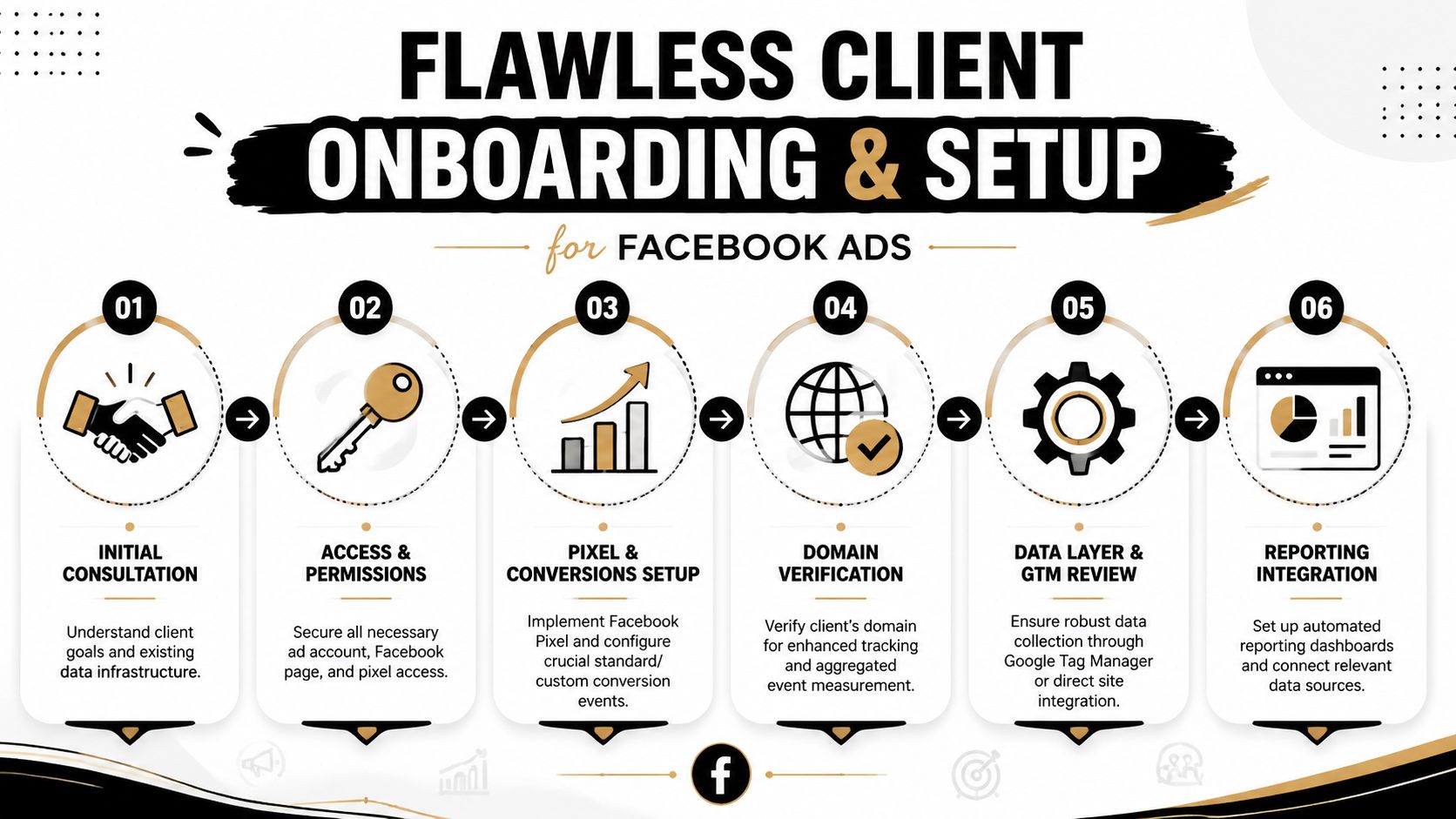
The non-negotiables before launch
I treat these items as mandatory:
Business access is correct
We need access to the ad account, Facebook Page, Instagram account, Pixel, catalogue, and domain-related settings where relevant.The domain is verified
This matters for event control and cleaner setup inside Meta.Pixel events are mapped properly
Purchases, add to cart, initiate checkout, lead, complete registration, contact, and any custom events need to reflect how the business sells.Conversions API is installed
For Shopify stores, this can be straightforward if the stack is clean. For WordPress sites, we often run it through Google Tag Manager or a direct integration depending on the build quality.Reporting sources are aligned
Ads Manager alone isn't enough. We compare against platform data, site analytics, and where possible, CRM or call outcomes.
Why broad setup discipline matters in Australia
Meta's own guidance says ad sets with audiences of at least 2 million often perform better, and it recommends starting with at least $5 and running campaigns for more than six days so the delivery system can learn effectively, according to Meta's ad pricing guidance. For Australian accounts, that matters because clients often want tight local targeting from day one, especially across Melbourne and Sydney, and they accidentally box the algorithm in.
That's why setup and planning sit together. Technical work isn't separate from media buying. The way you configure tracking affects how confidently you can run broader audiences and trust the signals coming back.
How I approach Shopify and WordPress builds
Shopify is usually cleaner, especially if the client hasn't stacked too many apps on top of the theme. We review the event flow, product feed quality, checkout path, and any custom app behaviour that might break standard events. If there's custom functionality, the handover from the developer matters. That's one reason brands working with Shopify developers Melbourne teams often get to stable tracking faster.
WordPress can be excellent, but only when the build is organised. A custom theme, good use of GTM, and sensible plugin discipline make life easy. A bloated page builder setup with overlapping scripts makes event debugging painful.
A lot of “Meta tracking issues” are really site implementation issues.
For teams experimenting with workflow automation around reporting or campaign analysis, this guide on how to connect AI to Meta Ads is useful. It helps frame where automation can sit without replacing the judgment calls that still need a media buyer.
Architecting Campaigns for Ecommerce Success
A messy campaign structure usually looks active from the outside. Plenty of ad sets. Plenty of activity. No clean read on what's working.
For ecommerce, I still like a straightforward funnel architecture because it keeps decisions clear. Top of funnel finds demand. Middle of funnel nurtures it. Bottom of funnel closes it. That doesn't mean every account needs a dozen campaigns. It means every campaign should have a job.
Australia gives you room to do this properly. Meta reported that 19.2 million people were reachable by Facebook ads in early 2024, equal to roughly 71% of the population, as summarised in this Facebook ads data reference. For agencies, that scale means there's enough depth for prospecting, retargeting, and lookalike work without exhausting audiences too quickly.
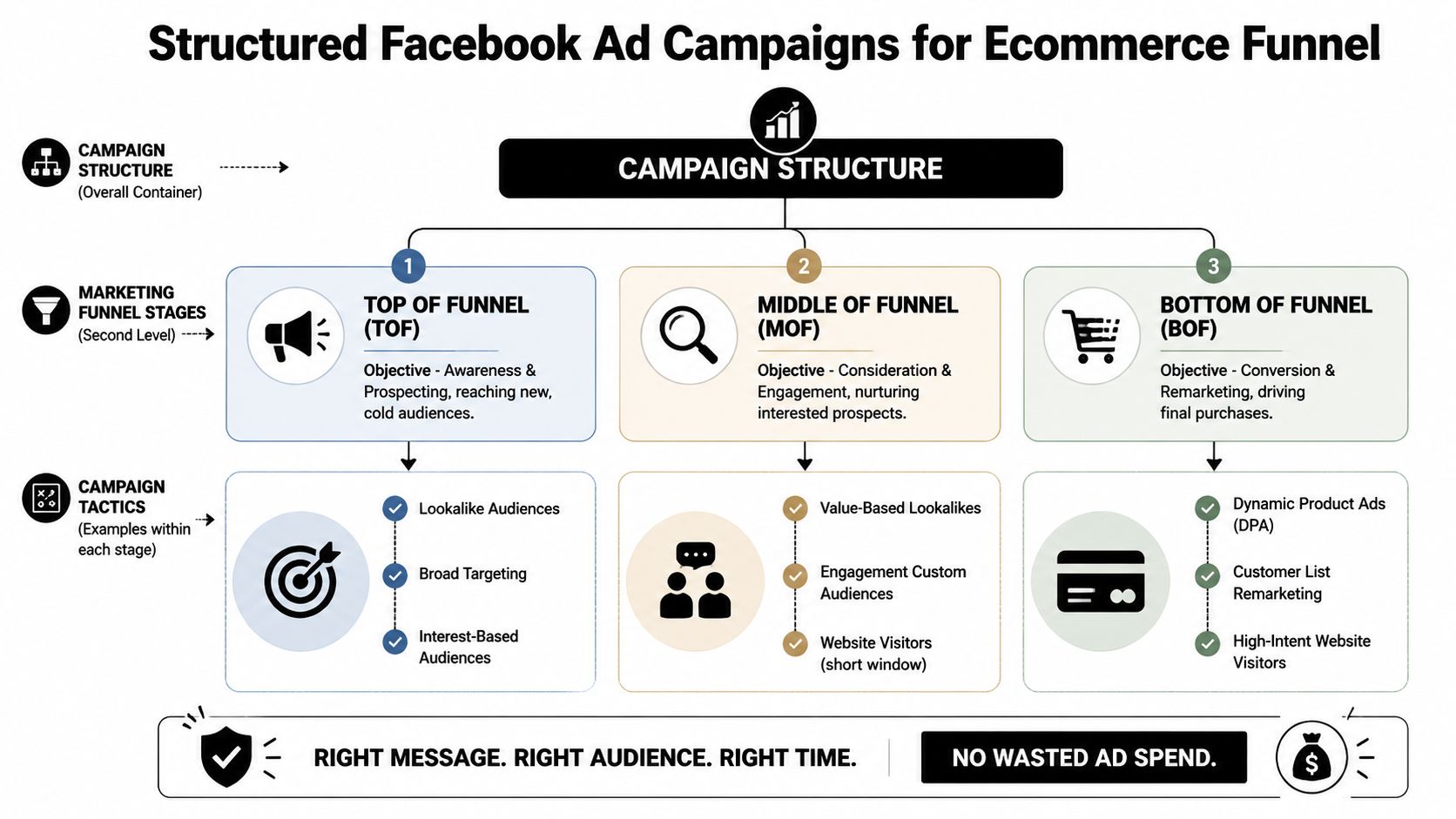
Top of funnel finds new buyers
At this stage, most brands either win or stall.
For prospecting, I prefer broad targeting, strong creative angles, and enough budget to let the system move. Interest targeting can still help in some categories, but I don't build the whole account around stacking detailed interests anymore. Lookalikes can work well too, especially when the source data is clean.
At this stage, the ad should do one of three things well:
- Stop the scroll
- Frame the problem
- Create enough curiosity to earn the click
If the prospecting ad can't do that, the rest of the funnel never gets enough quality traffic.
The video below gives a useful visual overview of funnel thinking for paid social teams.
Middle of funnel handles doubt
People who clicked, watched, browsed, or engaged are given another reason to come back. For Shopify stores, this often means product education, social proof, founder-led explanation, or comparison-style creative. For WordPress ecommerce builds, especially in niche stores, it can mean explaining the category better than the competitors do.
Here's a simple view of how I separate intent.
| Funnel stage | Audience type | What the creative needs to do |
|---|---|---|
| TOF | Cold audiences | Introduce the offer clearly |
| MOF | Site visitors and engagers | Reduce hesitation |
| BOF | High-intent users | Remove friction and close |
Bottom of funnel closes the sale
Dynamic product ads, cart viewers, checkout starters, and customer list remarketing handle the heavy lifting. The mistake is making BOF too large a percentage of the budget when TOF is weak. You can't retarget your way out of poor prospecting.
A serious ecommerce marketing agency also needs to look beyond Ads Manager here. If the landing page is slow, the mobile product page is cluttered, or checkout feels harder than the ad promised, Meta gets blamed for a conversion problem the website created. That's where a digital marketing agency Melbourne operator with web capability has an edge.
A Relentless Creative Testing Process
Most underperforming Meta accounts don't have a targeting problem. They have a creative problem.
I've seen brands spend weeks debating campaign settings while running the same tired video, the same static image, and the same generic headline. Then they wonder why performance plateaus. Meta can distribute. It can't make a weak ad persuasive.
Test one variable at a time
The cleanest creative process is boring on purpose. We isolate one variable and test it against a control. That might be:
- The hook in the first seconds of a video
- The angle such as problem-aware versus solution-aware
- The format like image, video, UGC-style clip, or carousel
- The CTA and how directly it asks for action
When teams change all of that at once, they learn nothing. They may find a winner, but they won't know why it won.
A robust workflow should validate creative using CTR, CPC, cost per result, and ROAS, while also checking delivery diagnostics, overlap, frequency, and signs of fatigue, based on this practitioner guidance from Toptal. That matters because a clicky ad that doesn't convert can fool an inexperienced team into scaling too early.
What goes into the brief
I don't like vague briefs that say “make it punchy” or “we need something that converts.” Good briefs are practical. They tell the designer, editor, or content creator what job the ad must do.
A solid brief includes:
- Offer context so the creative matches the commercial goal
- Audience awareness level so the message isn't too advanced or too basic
- Desired action such as purchase, add to cart, or submit lead
- Visual constraints from the site, product packaging, or brand guidelines
- Known objections pulled from support tickets, sales calls, or reviews
What usually works better than polished brand ads
For ecommerce, especially on Meta, over-produced creative can make a brand look expensive and distant. Some categories do better with slick creative, but many convert better when the ad feels closer to how real customers talk.
That often means:
- Founders on camera explaining the product plainly
- Problem-solution demos rather than cinematic lifestyle edits
- Comparison angles that help buyers decide
- Landing-page-consistent visuals so the click feels coherent
If your team needs help speeding up concept generation or variations, it's worth exploring tools that boost your ad campaigns. I wouldn't hand strategy over to a generator, but I will use tools to produce more testing volume faster.
Creative rule: Don't kill an ad because you're sick of looking at it. Kill it when the audience is giving you a clear reason.
There's also a web piece to this. The best creatives usually reflect what the store already does well. Strong product pages, useful custom sections, and clean mobile layouts feed better hooks and better ad angles. That's one reason store design and paid social work better when they're planned together.
Daily Optimisation Bidding and Budgeting
Good optimisation isn't constant fiddling. Most weak campaign management comes from too much touching, not too little.
A lot of agencies panic early. They see a rough day, change bids, swap creatives, narrow audiences, and reset the account before Meta has enough signal to stabilise. Then they blame volatility.
What I check every day
Daily checks shouldn't turn into daily overreactions. I'm looking for patterns, not excuses to make changes.
The daily review usually centres on:
- Spend pacing so the account is delivering
- Cost per result trends rather than isolated hourly swings
- CTR and CPC movement as indicators of creative response
- Frequency and fatigue signs when an audience has seen too much of the same ad
- Breakdowns by placement or audience if something looks off
I don't optimise off clicks alone, but I do use click behaviour as an early signal. If CTR drops and CPC rises while conversion quality also slips, the ad is often tiring or the message has lost relevance.
Budgeting around learning, not hope
One of the most practical rules in Meta buying is that the budget has to fit the conversion goal. Practitioner guidance commonly cites needing approximately 15 conversions in a 30-day window for the algorithm to learn effectively, according to this practitioner reference. If the spend level can't realistically produce that volume, the campaign stays noisy and every decision becomes guesswork.
That's why I budget backwards from target CPA.
If a client wants purchases, leads, or booked consults at a certain acquisition cost, I'll sanity-check whether their monthly media budget can support enough conversion volume. If it can't, I'd rather narrow the objective than promise stability the account won't have.
Most “Facebook doesn't work for us” accounts were underfunded for the outcome they were chasing.
Bidding decisions that are actually useful
For many ecommerce accounts, I start simple. Highest volume often gives the cleanest learning path when the account is new, the offer is still being validated, or the creative is still rotating. Cost controls become more useful when the account already has history and the margin tolerance is clearer.
I also separate decisions by timeframe:
| Timeframe | Main question | Typical action |
|---|---|---|
| Daily | Is anything clearly broken? | Fix delivery or tracking issues |
| Weekly | Which combination is improving? | Reallocate budget carefully |
| Fortnightly | Is the structure still right? | Consolidate or expand testing |
The agencies that win here aren't the ones making the most edits. They're the ones making fewer, better edits.
For clients asking how much to spend, my answer is rarely a fixed number. It depends on margin, conversion rate, AOV, and sales cycle. But the principle stays the same. Spend enough to gather signal, then scale what earns the right to scale.
Reporting That Proves Your Agency's Value
Most agency reporting is written for the agency, not the client.
A client doesn't need twelve screenshots from Ads Manager and a paragraph about reach. They want to know whether the spend produced profitable sales, qualified enquiries, or booked work. If they can't see that quickly, they'll start questioning both the campaign and the agency.
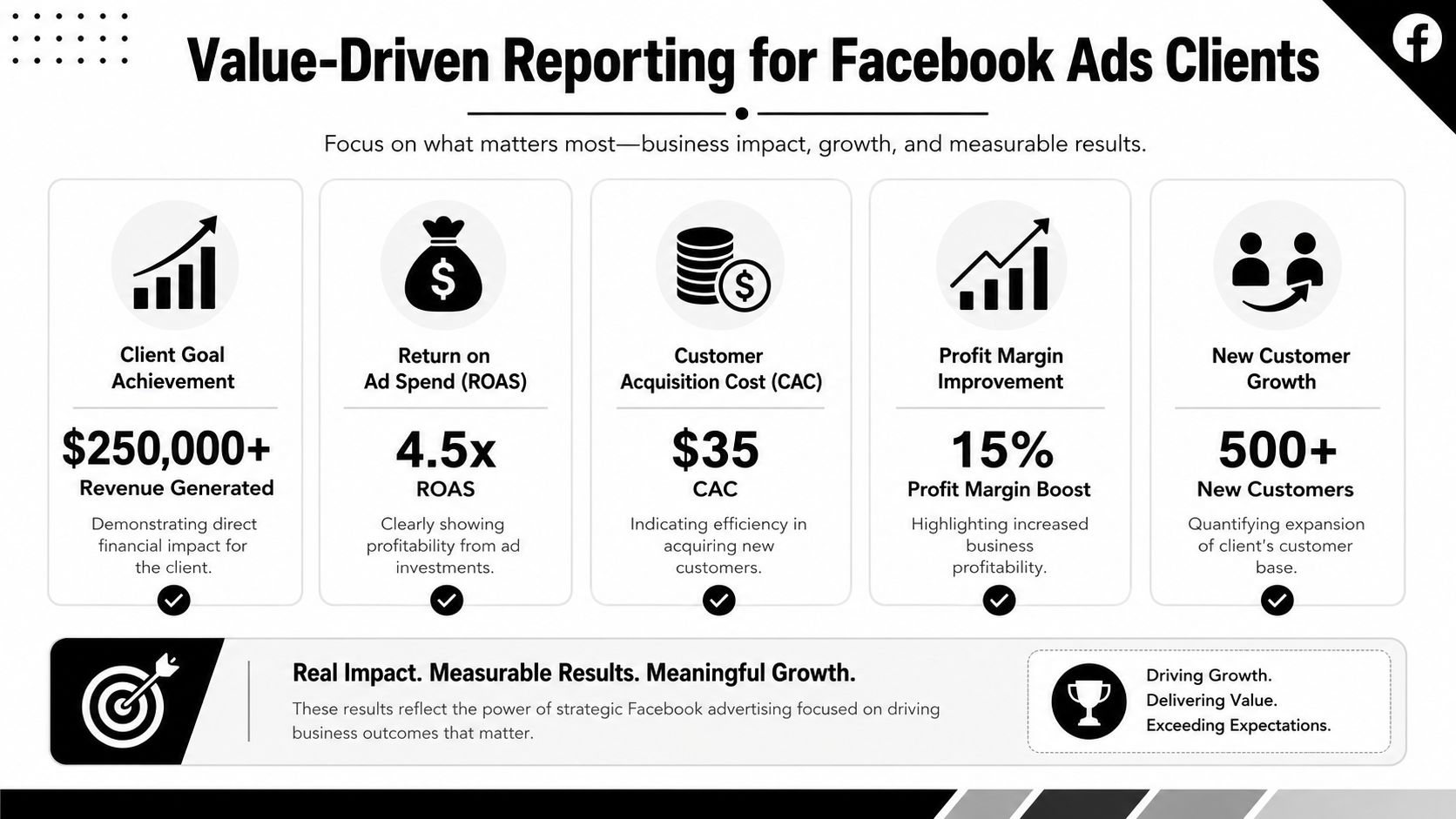
What I put in a client report
My reporting structure is simple on purpose. It starts with business outcomes, then explains what drove them.
The report usually includes:
- Core outcome metrics such as purchases, leads, booked calls, or qualified submissions
- Efficiency metrics like CPA or ROAS where they're relevant to the client model
- Context for change so the client knows why results moved
- Clear next actions rather than generic commentary
I'm also careful not to let Meta reporting stand alone when the sales process continues off-platform. For service businesses, contact forms are one signal. Phone calls are another. Missed calls can wreck campaign economics even when the ads themselves are working.
Why call tracking matters more than many agencies admit
For tradies, clinics, hairdressers, beauty businesses, and hospitality operators, leads often come by phone before they ever become a sale. If you don't track calls, you can't see the full value of the campaign.
We often recommend a custom number setup through Twilio with call tracking layered into the reporting workflow. The practical upside is strong even before you add automation. You can see which campaigns drive calls, route enquiries properly, and review what happened after the call came in. On top of that, clients can add features like round-the-clock answering, appointment booking into a calendar or Calendly, and tighter follow-up for missed enquiries.
That's especially useful for PPC campaigns where speed matters, such as Google Ads for plumbers or local service campaigns that generate high-intent phone leads.
Clients stay longer when they can connect ad spend to real business activity without needing your team to translate every number.
Reporting should tell the truth, even when it's uncomfortable
If a campaign is getting cheap clicks but poor lead quality, say it. If the ads are strong but the landing page is weak, say that too. If the client's sales team is slow to respond, that belongs in the conversation because it affects results.
This is also where a broader service mix helps. If the issue sits in tracking, UX, store speed, or form friction, the agency should be able to identify it clearly. That's where services like GTM setup, Google Analytics configuration, Meta Conversions API installation, and site-side fixes become part of real reporting, not technical add-ons.
Scaling Clients with Aligned Pricing Models
A lot of agency-client tension has nothing to do with ad performance. It comes from a pricing model that subtly pushes both sides in different directions.
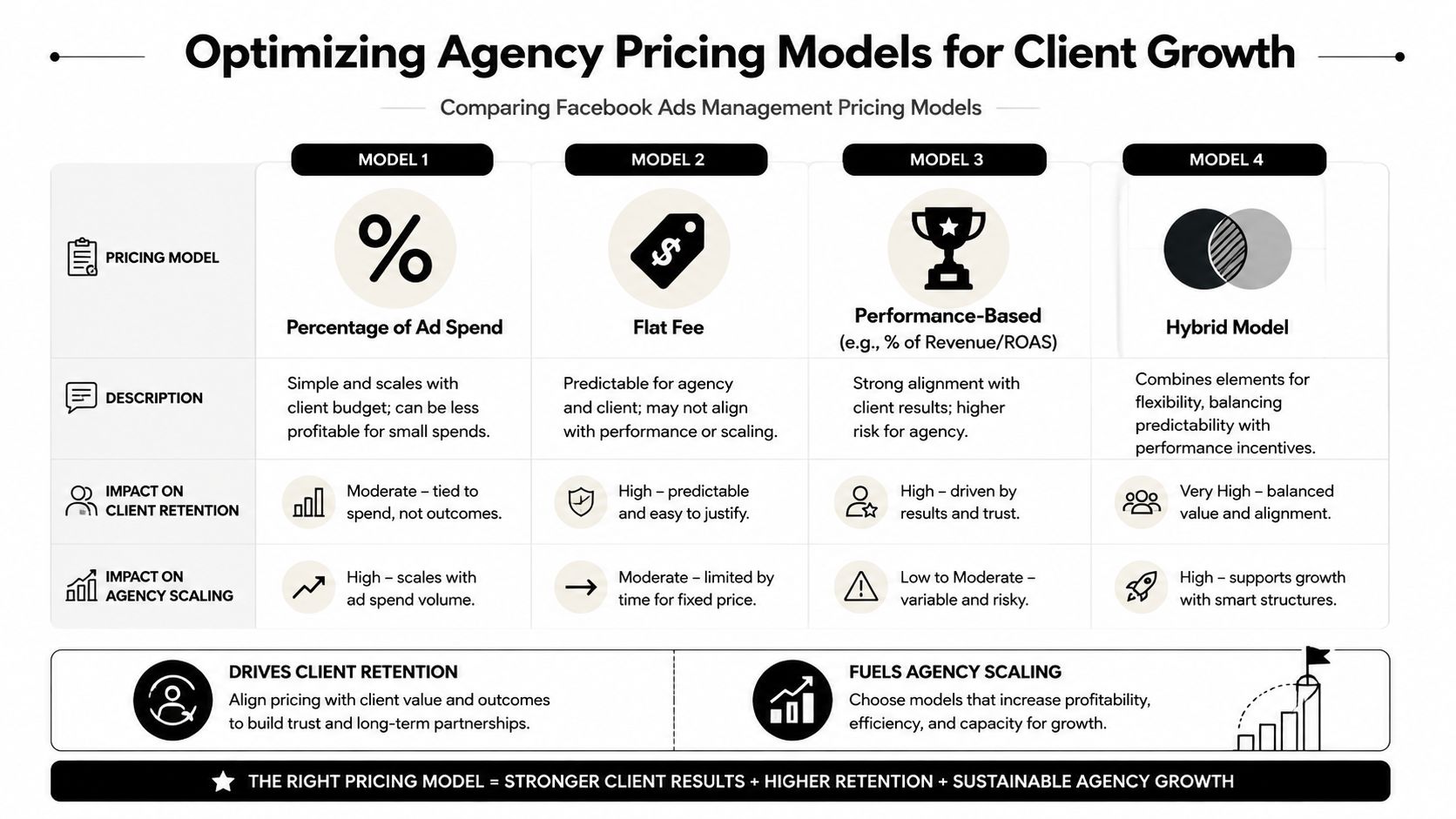
The standard flat fee is easy to sell because it sounds simple. The problem is what happens later. Once the scope gets heavier, the agency protects margin by doing less, not more. The client expects more because they're spending longer and trusting the agency more. That conflict sits under a huge number of “performance has gone stale” relationships.
Why flat fees often stop working
A 2025 report stated that 74% of AU agencies still rely on flat-fee models and that this can lead to a 22% average drop in campaign efficiency for clients after 12 months, creating a clear opportunity for agencies to differentiate with outcome-linked pricing. I don't cite that as a cheap scare tactic. I cite it because the pattern is familiar in real life. Flat fees often reward account maintenance, not aggressive growth work.
When the commercial model doesn't reward scaling, agencies start protecting process instead of pursuing upside.
Better ways to structure the relationship
I don't think there's one perfect pricing model for every account. I do think there are better fits depending on the client.
| Model | Where it works | Main weakness |
|---|---|---|
| Flat fee | Small, stable scopes | Weak alignment when scope expands |
| Percentage of spend | Scaling media budgets | Can reward spend growth over profit |
| Performance-based | Strong tracking and trust | Harder to implement without clean data |
| Hybrid | Most mature client relationships | Needs clear terms and clean reporting |
For many ecommerce brands, a hybrid model works best. There's a base management fee that covers strategic and operational work, plus an outcome-linked component tied to revenue, ROAS bands, or agreed growth milestones. That keeps the agency invested in scale without turning the whole deal into a gamble.
The real filter is trust plus measurement
Performance-based pricing sounds great until the tracking is a mess. If the site attribution is unreliable, the CRM isn't maintained, or offline sales aren't fed back, you end up arguing about numbers instead of building the account.
That's why pricing can't be separated from operations. If you want aligned incentives, you need aligned data. Agencies doing Facebook Ads for agency services at a high level should think like operators, not just media buyers.
I also think this is where buyer-intent service positioning matters. A marketing agency Melbourne business owner hires for outcomes, but they often need broader capability behind the ads. That might include web design Melbourne, Shopify support, WordPress development, GTM, Google Analytics, Google Ads, and local SEO. The more integrated the growth work is, the easier it is to justify a commercial model built around results rather than task lists.
Becoming Your Client's Growth Partner
The agencies that keep clients longest aren't always the ones with the flashiest presentation or the loudest promises. They're the ones with reliable systems.
That means disciplined onboarding. Clean tracking. Campaign architecture that makes sense. Creative testing that produces learning instead of noise. Reporting that ties activity to outcomes. And a pricing model that doesn't drift away from the client's goals after the honeymoon period ends.
Growth comes from the full stack
The ad account matters, but it never works alone. Ecommerce growth usually sits at the intersection of media buying, landing page UX, offer clarity, feed quality, analytics, and checkout experience.
That's why a real digital marketing agency Melbourne operator needs to think across the whole funnel. Sometimes the fix is a better ad angle. Sometimes it's a faster product page. Sometimes it's a cleaner GTM implementation, a better Conversions API setup, or tighter product page blocks built by a competent WordPress developers Melbourne team. For Shopify brands, it can be a theme refinement, app cleanup, or custom functionality that removes friction before the sale.
What consistency actually looks like
Most wins come from doing ordinary things well, over and over:
- Launching only after setup is clean
- Testing creatives in a controlled way
- Giving campaigns enough room to learn
- Fixing site-side friction without blaming the platform
- Having honest conversations with clients about budget and expectations
That same mindset applies across channels. It's useful for Meta, but also for Google Ads, Google Shopping, PMAX versus standard Shopping decisions, local SEO, Google Business Profile work, and service-business lead gen. The channel changes. The operational discipline doesn't.
I've found that clients trust you more when you tell them what won't work, not just what might. Tiny budgets with big expectations usually disappoint. Weak landing pages drag good media buying down. Reporting without attribution creates arguments. None of that is fixed by adding more ad sets.
A practical agency today also needs enough technical range to support the media work. That includes WordPress design, WordPress development, Shopify design, Shopify development, Meta Conversions API installation, Google Tag Manager container setup, GA tracking, Facebook Shop and Instagram Shop setup, and where needed, custom development such as Gutenberg blocks or Shopify app work. Not because every client needs all of it, but because paid traffic exposes weak infrastructure fast.
If you're a business with a paid ads budget of at least 3k a month, I'd love to offer you a low risk deal- get a month of paid ads management FREE. Apply now through our contact page.
If you need a team that combines paid media, Shopify and WordPress execution, and practical conversion tracking, Alpha Omega Digital works with businesses across Melbourne and around Australia, including Sydney, Brisbane, Newcastle, Perth, Adelaide, Darwin and Hobart. Have a project in mind? Get in touch through the contact page.
[email protected]
Read more insights from our team on web design, paid ads, and growth strategy.