Your Facebook ads are generating enquiries, but the diary still has gaps. Someone wants a price for mice, another caller lives outside your service area, and an after-hours termite enquiry sits unanswered until the next morning. Ads Manager shows leads. Your bank account tells a less encouraging story.
I'd judge Facebook ads for pest control by booked, paid jobs, not by how cheaply someone submits a form. For a Melbourne operator, that means matching the pest to the season, advertising only where technicians can attend, and treating call handling as part of the campaign rather than an office task.
Pest Types, Buyers and Seasons to Target
Facebook works for pest control when the offer matches a problem the buyer already recognises. A homeowner hearing scratching in the roof needs a different message from a café manager organising routine cockroach management.
Use these Melbourne windows as a campaign planning calendar, not a diagnosis or a promise that pests only appear in certain months.
| Pest group | Likely buyer | Peak window in Melbourne | Ad angle |
|---|---|---|---|
| Termites | Homeowners and pre-purchase buyers | Spring swarming, September to November | Free inspection and timber check |
| Rodents | Homeowners and landlords | Autumn to winter, April to August | Same-day exclusion and entry-point proof |
| Spiders | Households and renters | Late spring to summer | Family-safe treatment and reviews |
| Cockroaches | Cafés, restaurants and strata managers | Year-round | Compliance audit and scheduled plan |
| Wasps and bees | Homeowners | Spring to autumn | Same-day removal for safety |
| Ants | Homeowners | Spring and summer | Recurring treatment plan |
Match the offer to the decision-maker
Termite advertising needs to distinguish a preliminary timber check from a formal inspection report. Only advertise a free inspection if you provide it, and explain what's included before someone books.
Rodent buyers want more than bait placement. Show how you identify entry points, what exclusion work involves, and whether follow-up is included. Don't promise same-day exclusion before confirming access, scope and technician availability.
For spiders, explain treatment precautions and re-entry instructions rather than making an unconditional family-safe claim. Renters can enquire, but your booking process should establish who can authorise and pay for the work.
Commercial cockroach messaging should focus on documentation, access arrangements and scheduled management. An audit offer shouldn't imply that your inspection guarantees regulatory compliance.
Practical rule: Advertise the service you can actually deliver, not the most attractive version of it.
Bee enquiries also need triage. Identify whether relocation through a suitable beekeeper is appropriate rather than treating every bee enquiry as an extermination job.
In a November 2024 survey of 296 Australian small-business owners across 20 industries, 59.1% used Facebook for marketing, according to Reckon's small-business advertising survey. That establishes business adoption, not pest-control profitability. Your bookings will depend on whether the pest, buyer, location and offer belong together.
How to Set Up Your Account, Pixel and Campaign
Build the reporting before buying traffic. You should be able to submit a test enquiry, find it in your CRM and identify its campaign before the first prospect arrives.
This setup flow keeps ownership, tracking and launch checks together.
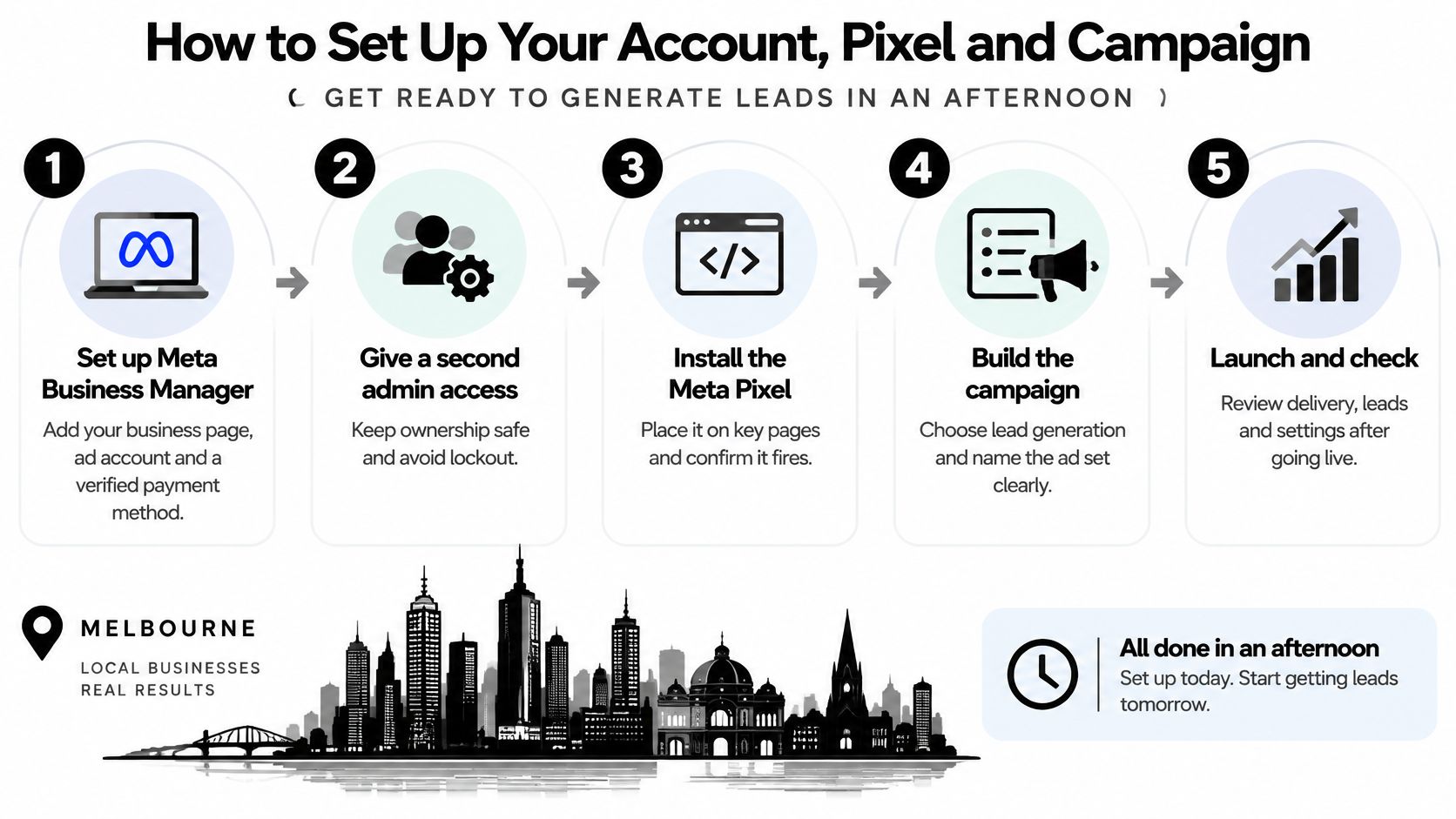
Establish business ownership. Add your Facebook Page, ad account and payment method to your Meta business portfolio. Give another trusted staff member appropriate administrative access, enable multifactor authentication, and avoid leaving ownership attached solely to a departing employee.
Install and test the Meta Pixel. Use your website integration or Google Tag Manager, then confirm events in Meta Events Manager. Track successful form submissions, not just submit-button clicks, because validation errors shouldn't count as enquiries.
Configure the Conversions API. Connect your website or CRM to send supported server-side events, with appropriate privacy controls. Use matching event IDs to deduplicate browser and server events; the Conversions API improves your measurement options but doesn't bypass consent requirements or recover every missing conversion.
Choose the objective that matches the outcome. Use Leads for supported form, website or calling workflows available in your account. Traffic can help diagnose a landing-page journey, but it optimises for visits rather than qualified enquiries, so I wouldn't make it the default booking strategy.
Separate materially different pest offers. Give rodents and termites distinct ads, forms and reporting tags. Use separate ad sets where budgets justify it, but don't launch every pest group simultaneously if each would receive too little spend to produce useful evidence.
Name campaigns consistently. Include the pest, suburb cluster and launch date in a readable naming convention. Check delivery, event activity and CRM records after launch rather than assuming an approved ad means the whole system works.
Build the budget from job economics
Start with an allowable acquisition cost, calculated after labour, materials, travel, overheads and your required margin. Then assess whether your available budget can produce enough bookings to support a meaningful test.
For a hypothetical group targeting eight monthly bookings, allocating $1,600 means allowing $200 in advertising spend per booking. That's a planning assumption, not a Melbourne benchmark, and a $350 job value alone doesn't establish that it's profitable.
The reporting mistake I'd avoid is one generic offer for every pest with no pest-level tags. You can consolidate delivery without losing the ability to identify which service produces revenue.
Targeting Suburbs and Audiences Without Wasting Spend
Facebook's audience is large enough that your main constraint should be serviceability, not finding an obscure interest category. Meta's advertising data, compiled by DataReportal's Digital 2024 Australia report, estimated Facebook's potential Australian advertising reach at 16.65 million people in early 2024. That's potential ad reach, not verified monthly active users or a forecast of your customers.
For a Melbourne operator, I'd draw the initial map around technician routes, then remove suburbs you can't serve reliably. A circular radius around a depot can look sensible while ignoring traffic, river crossings and the direction your team travels.
Broad coverage versus suburb clusters
- Wide radius with broad interests: This gives Meta more delivery opportunities, but you may pay for enquiries that create expensive travel or cannot fit your promised response window.
- Tight suburb clusters with pest-specific creative: This makes local offers and scheduling easier to manage, but excessive restriction can leave too few prospective buyers for consistent delivery.
Say your technician schedule supports Dandenong, Noble Park and Springvale. Start with that operational footprint rather than advertising across Melbourne and hoping callers accept a delayed appointment.
For a bayside route, Brighton, Hampton and Sandringham might belong together. Don't combine them with distant suburbs because all the locations have previously produced a customer.
Use customer signals without overengineering
Age settings and property-related interests can help where available, but they don't reliably identify every homeowner or landlord. Meta changes its targeting options, so inspect the controls in your account before building a strategy around a particular interest.
Upload eligible customer information through Meta's customer-list process only where you have the necessary rights and permissions. Hashing supports matching; it doesn't remove your privacy responsibilities.
A lookalike seed built from completed, profitable jobs is more relevant to your objective than an undifferentiated list of website visitors. Still, treat it as a test rather than assuming it must outperform broader local delivery.
Before launch, check:
- Drive time: The advertised area matches actual technician availability.
- Location controls: Available exclusions and delivery settings reflect your service boundaries.
- Delivery capacity: The audience isn't so restricted that ads struggle to spend.
Creative Angles That Earn Booked Enquiries
Good pest-control creative names a pest, a place and a next step. A technician explaining rodent entry points is more useful than a stock image paired with a generic promise to eliminate pests.
Real service imagery can help buyers understand who'll attend and what happens next.

- Same-day callout: Suitable for urgent rodent, wasp or cockroach enquiries when capacity exists. State availability conditions and the callout or inspection fee so urgency doesn't become a stream of price-only calls.
- Free termite check: A clear entry offer for homeowners and pre-purchase buyers. Explain its scope, exclusions and whether a formal written report costs extra.
- Before-and-after proof: Show a sealed rodent entry point or completed bird-proofing work. Obtain permission and remove identifying property details.
- Review-led video: Useful for recurring plans and strata buyers who need confidence in reliability. Use genuine reviews with permission, and don't interpret cheap video views as booking success.
- Seasonal reminder: Connect the offer to a recognisable concern, such as spring termite activity or rodents seeking shelter as conditions cool.
Test the message, not everything simultaneously
I'd start with a small set of distinct creative concepts for the same pest and location. Agree on a testing period and minimum spend, then change a single element, such as the opening line, image or offer, so the result is interpretable.
A Brighton café cockroach audit is a stronger hypothesis than a generic Melbourne pest image because it addresses an identifiable commercial concern. It still has to prove itself through qualified enquiries and bookings.
For turning an approved concept into short video variants, the ImagesArt AI guide to ad clips offers production context. Don't use generated footage as evidence of work your technicians completed.
This video provides an additional advertising reference.
Use the customer's language in the opening, such as hearing mice in the roof at night. Mention licences, insurance or accreditation only when held and relevant.
Your testing checklist is simple: a defined variable, an agreed spend limit and a decision date.
Lead Forms, Landing Pages and Call Handling
A lead form isn't successful because someone completes it. It's successful when your team can understand the request, contact the person and organise appropriate work.
Instant forms keep the enquiry inside Facebook and suit straightforward callback offers. A landing page gives you room for service coverage, treatment information, reviews and credentials, but adds loading time and another step. Neither format automatically produces better customers.
Ask enough to qualify the enquiry
Keep the initial form practical:
- Pest type: Include an unsure option so customers don't have to diagnose the problem.
- Suburb: Confirm service coverage before requesting a full street address.
- Property type: House, unit or commercial premises.
- Urgency: Immediate help, an upcoming appointment or preventative planning.
- Contact preference: Phone or another supported method, with a usable contact detail.
Don't require detailed property histories, interior photographs or sensitive personal information just to request a callback. Ask for additional access or safety details when a staff member can explain why they're needed.
Place plain consent wording above submission, identifying the business that will respond and how the details will be used. Link to your actual privacy policy and keep optional marketing permission separate from the service enquiry.
In DataReportal's Digital 2026 Australia report, 43% of Australian users reported concern about how companies handle their data. Collecting less unnecessary information is sensible customer service as well as a practical privacy measure.
Make the callback operational
Set an explicit response target for staffed hours. For example, a business might choose a 15-minute callback target, then measure whether its roster can meet it rather than treating that target as an industry guarantee.
The person answering needs the pest, suburb, offer and available appointment slots before the phone rings.
A custom number through Twilio can form part of an around-the-clock answering workflow. Twilio supplies communications infrastructure; answering, qualification and appointment booking require additional software, configuration or staff.
An automated answering workflow doesn't get tired or take sick leave, but it can fail or misunderstand a caller. Test escalation, calendar availability, Calendly integration and outage handling, and don't let it diagnose infestations or give unsupported treatment advice.
Assign a named callback owner, use campaign-specific forms and map tracking numbers to pest groups. Logging a missed call isn't the same as resolving it.
Metrics That Show Booked Jobs, Not Just Leads
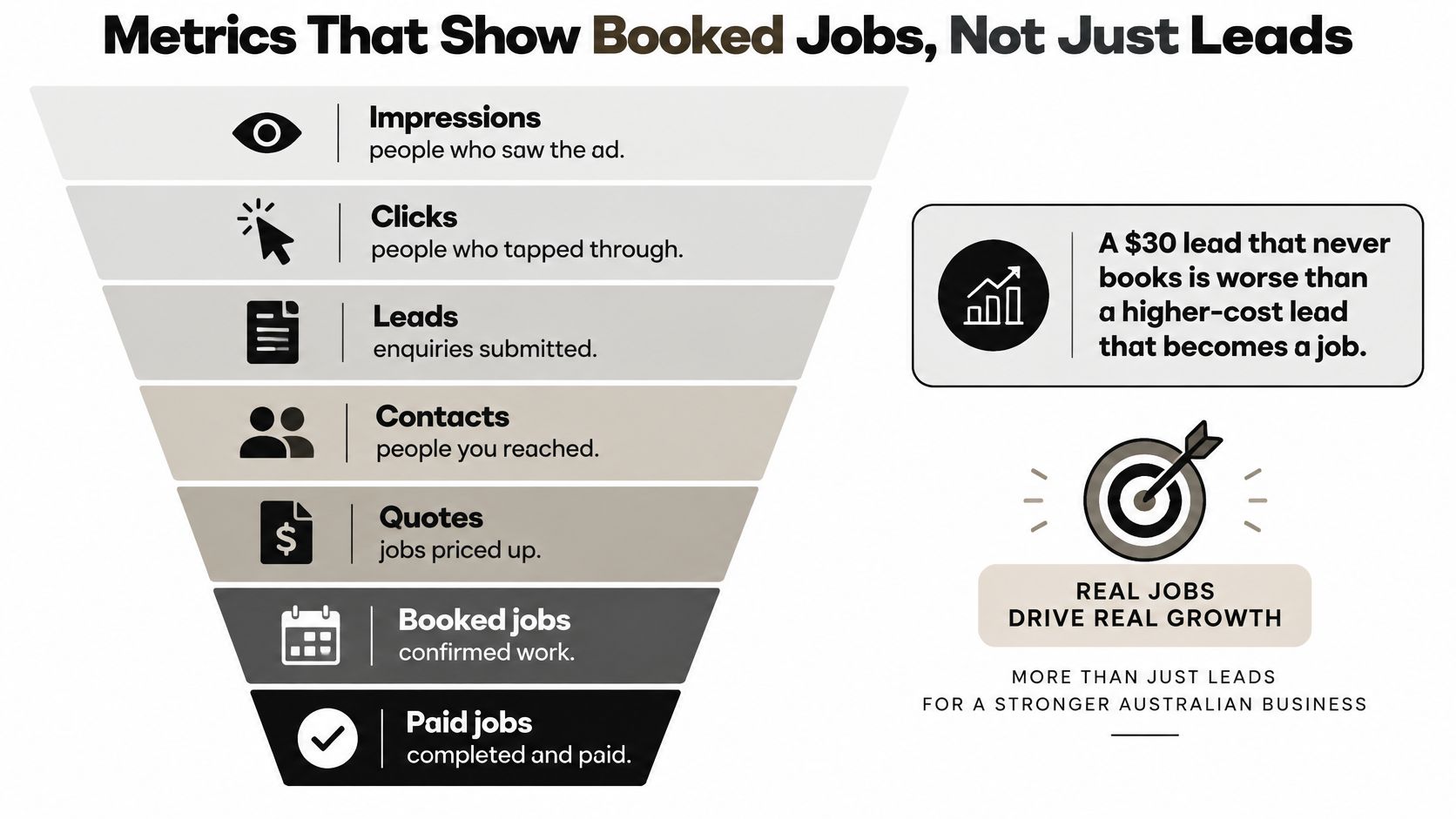
Cost per lead is a diagnostic metric, not the commercial result. A hypothetical $30 lead that never books is worse than a $60 lead that becomes profitable work.
Track the complete journey: impressions, clicks, leads, contacts, quotes, booked jobs and paid jobs. Each stage answers a different operational question.
Use this funnel to keep advertising activity separate from completed revenue.
| Metric | Where to read it | What it tells you | Check when |
|---|---|---|---|
| Cost per lead | Ads Manager results column | Cost to get a form or call | Weekly |
| Lead-to-booked-job rate | CRM or booking system | Share of leads that become a booked job | Monthly |
| Cost per booked job | Ad spend divided by booked jobs | The real acquisition cost | Monthly |
| Average response time | Lead log or call system | Speed from enquiry to first contact | Weekly |
| Revenue per pest group | Paid invoices matched to campaign | Whether the ad pays back its spend | Monthly |
A worked example
Suppose a rodent campaign spends $1,600, generates 40 leads, produces 12 quotes and books eight jobs at $350 each. These are hypothetical figures, not expected results.
The arithmetic is:
- Lead-to-booking rate: Eight bookings divided by 40 leads equals 20%.
- Cost per booked job: $1,600 divided by eight equals $200.
- Booked revenue: Eight multiplied by $350 equals $2,800.
- Booked revenue return: $2,800 divided by $1,600 equals 1.75 times advertising spend.
That last figure isn't profit. It also isn't collected revenue until the work is completed and paid, so reconcile cancellations, refunds and unpaid invoices before judging the return.
Connect the records
Store campaign identifiers, pest group and enquiry source in the CRM. Record contact attempts, quote outcomes, bookings and invoice status without counting repeat calls as new customers.
Allow an initial observation period with enough activity to assess delivery. Significant edits can disrupt learning, but not every edit automatically restarts it.
I'd use a 30-day review window as a planning rule, while recognising that low-volume campaigns may need longer to produce reliable evidence. Set a separate loss limit so patience doesn't become permission for uncontrolled spending.
Common Problems and How to Fix Them
Leads arrive, but nobody books. Before blaming Facebook, inspect the offer and the conversations: are customers expecting a free service, asking only for a price, or discovering that you don't cover their suburb?
Price-only enquiries often follow vague advertising. Name the pest, service area and inspection fee, and explain what happens after the enquiry. You may receive fewer submissions, but you'll have a clearer basis for assessing their value.
Creative fatigue is another possibility when costs climb. Don't replace an ad just because staff are bored with it; look for deteriorating enquiry quality, rising frequency and weaker response before refreshing the concept.
A troubleshooting reference
| Symptom | Likely cause | Fix |
|---|---|---|
| Leads arrive but nobody books | Vague offer and price-only enquiries | Name the pest, suburb and inspection fee in the ad |
| Cost per lead climbs over several weeks | Ad fatigue from the same creative | Consider a two-to-three-week creative rotation as a testing schedule, then adjust to performance |
| Budget is not spending | Audience too narrow or bid cap too tight | Widen serviceable coverage or lift the cap for a controlled test |
| Leads from outside the service area | Radius drawn around the office, not drive time | Redraw by drive time and exclude outer suburbs where controls allow |
| Calls missed after hours | No call answering or tracking number | Route a dedicated tracking number to an answering workflow with escalation and booking access |
| Spend with no recorded leads | Pixel or form tracking broken | Check pixel events and form delivery before making optimisation changes |
Check measurement before rebuilding the campaign
Say a Dandenong operator receives termite enquiries, but Ads Manager records none because successful form submissions aren't firing an event. The campaign appears unproductive even though the inbox contains leads.
Submit a test form, inspect the confirmation event and verify that the CRM receives the record. Then assess the offer and audience. Changing targeting won't repair a broken event.
Pause with a reason: Stop immediately for broken destinations, misleading claims or uncontrolled spend. Don't stop a functioning test simply because the latest days were quiet.
Some repairs are small configuration tasks, such as correcting a trigger or routing a tracking number. Rebuilding landing-page messaging, producing new creative or restructuring technician coverage takes more coordination.
Consistency means keeping a controlled test running long enough to learn. It doesn't mean ignoring failed tracking, poor customer handling or an acquisition cost your margins can't support.
Book a Strategy Session Before You Spend
I'd start with a single pest offer and a serviceable suburb cluster, then put a defined review date and spending limit against the test. Confirm the tracking, booking workflow and callback owner before launch.
For anyone comparing a digital marketing agency in Melbourne, the useful question is what will be measured and changed, not how many leads an agency promises. Alpha Omega Digital is based in Melbourne and also serves Sydney, Brisbane, Newcastle, Perth, Adelaide, Darwin and Hobart.
Get a practical starting plan
Our free 45-minute strategy session includes a review of your site and exactly what we would fix first. You can also review our managed Meta campaign approach before discussing your pest-control offer.
Advertising budgets are paid separately unless otherwise agreed, and we're responsible for campaign management only. We don't guarantee specific marketing or business outcomes, so the decision to continue should rest on measured commercial results.
If you have at least $3,000 a month in paid advertising budget, you can apply for a month of paid ads management free through our contact page. Book the strategy session to establish what needs fixing before you spend.
At Alpha Omega Digital, we offer a practical review of your website and paid advertising plan, with pest-control campaigns assessed against bookings rather than form volume alone. Book your free strategy session to identify the first changes to your offer, tracking and enquiry handling.
Alpha Omega Digital
Read more insights from our team on web design, paid ads, and growth strategy.