You're probably here because one of two things is happening. Either your Google Ads account is spending money without giving you enough confidence in what's working, or you're about to hire a Google Ads agency and you don't want to get locked into months of vague reporting and weak follow-through.
I've seen both sides in Melbourne. A business owner searches for a digital marketing agency Melbourne or marketing agency Melbourne, gets a polished proposal, signs too early, and then finds out the agency can talk about clicks but not conversion tracking, landing page friction, feed quality, or why mobile leads look different from desktop enquiries. That gap matters more now than it used to.
A serious Google Ads agency isn't just there to change bids. They need to understand attribution, Shopify and WordPress constraints, GTM, GA4, server-side signal quality, Meta Conversion API, call tracking, landing page speed, and the commercial differences between an eCommerce store and a service business. If they can't work across that stack, they're only managing part of the problem.
Your Foundations Before You Search for a Google Ads Agency
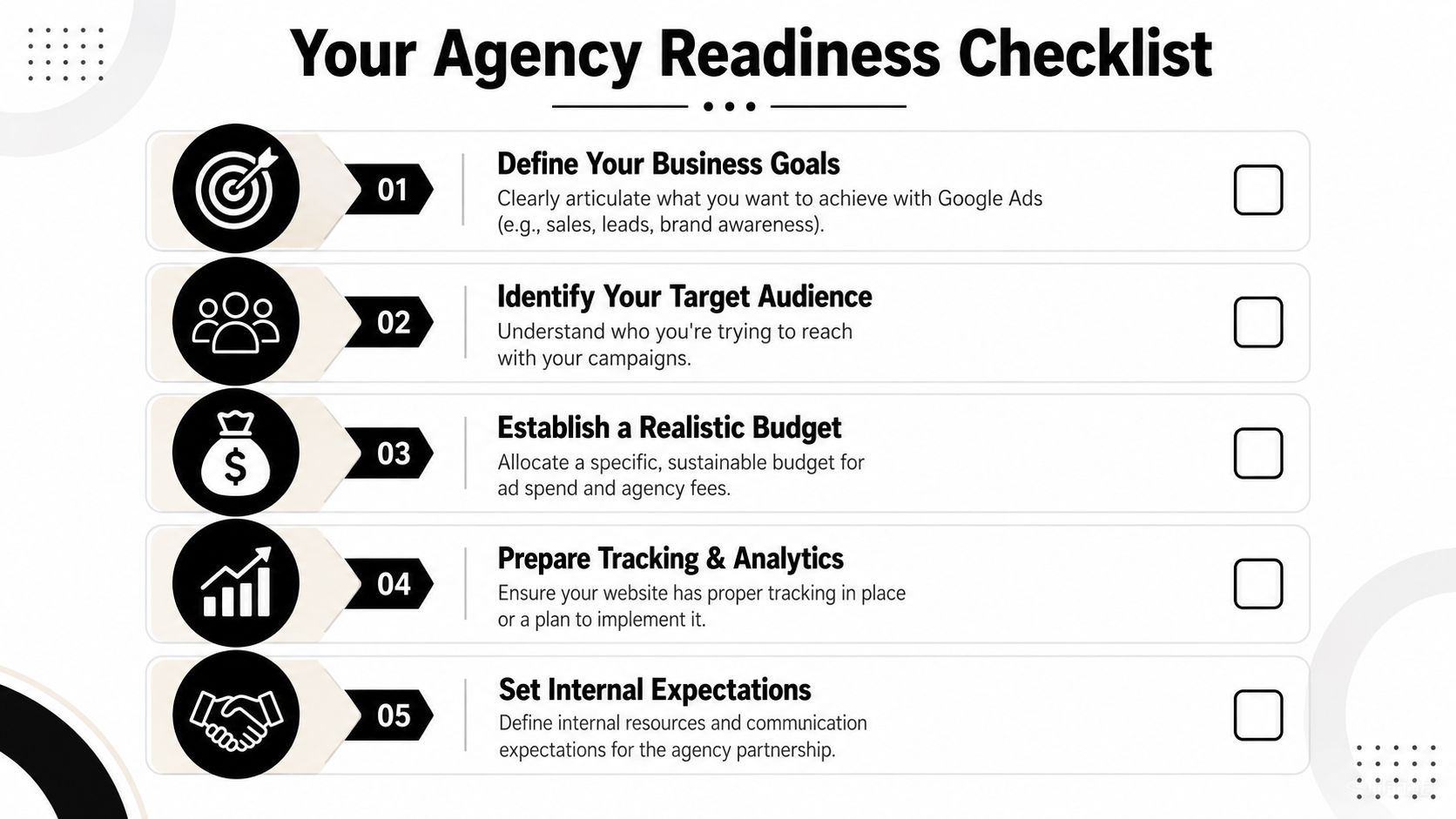
Before you shortlist agencies, sort out your own foundations. Neglecting foundations often leads to most problems. A business hires help before defining what a win entails, then gets frustrated when the account improves in one direction but not the one that really matters.
For some Melbourne businesses, success means online sales through Shopify. For others, it means qualified phone calls, booked consultations, or contact form submissions that turn into real jobs. Those are not the same objective, and they shouldn't be measured the same way.
Google Ads matters here because search isn't a side channel in Australia. In the December 2023 quarter, Australian internet advertising revenue reached A$4.2 billion, and search advertising accounted for A$1.76 billion, or roughly 42% of the market, according to the IAB Australia figures referenced here. If you're investing in growth, this is one of the most commercially important channels you can get right.
Decide what a conversion actually is
A lot of business owners say they want more leads when what they really want is better leads.
That sounds obvious, but it changes everything. If you run an eCommerce store, a purchase is usually the primary conversion. If you run a service business, the primary conversion might be a phone call longer than a certain threshold, a booked quote, or a contact form from a target suburb.
Use a short internal checklist:
- Primary conversion: What action directly links to revenue.
- Secondary conversion: Micro-actions like add to cart, email signup, or brochure download.
- Lead quality filter: What makes a lead useful, not just cheap.
- Sales feedback loop: Who in your business confirms whether the lead was good.
- Tracking method: GTM, GA4, ad platform conversion imports, CRM, or call tracking.
Practical rule: If your sales team and your agency define a “lead” differently, reporting will look healthy while revenue feels flat.
Businesses benefit from understanding broader Pay Per Click marketing strategies, especially if you're comparing search, Shopping, retargeting, and paid social rather than treating Google Ads in isolation.
Set a budget you can actually sustain
One of the first questions I get is how much it costs to start Google Ads. The honest answer is that there isn't one flat number that suits every business. A Melbourne plumber, a niche Shopify brand, and a cosmetic clinic will enter very different auctions.
What matters more is whether your budget can support testing, learning, and enough conversion volume to make decisions. If your budget is too thin, you end up judging performance off scraps of data. Then owners panic, agencies react, and campaigns get changed before they've had a fair chance.
Think in three layers:
- Media spend for the actual clicks.
- Agency fee for strategy, build, optimisation, reporting, and technical work.
- Conversion infrastructure such as landing page improvements, GTM fixes, product feed cleanup, or call tracking.
Get your measurement stack ready
If tracking is weak, everything downstream gets blurry.
That applies whether you use WordPress, WooCommerce, Shopify, or a custom setup. Your Google Ads agency should inherit a clean structure, but you also need enough internal clarity to grant the right access and explain what matters commercially.
Here's the minimum I'd want ready before an agency starts:
| Area | What should be in place |
|---|---|
| Website access | Admin access to WordPress or Shopify |
| Analytics | GA4 property connected and checked |
| Tagging | GTM container access and event review |
| Ads | Existing Google Ads account access, not a new account built from scratch unless necessary |
| Business data | Clear list of products, services, margins, and geographic priorities |
If you rely on phone leads, don't wait until after launch to figure that out. Call attribution should be planned before campaigns go live.
The Modern Agency Evaluation Checklist
A polished sales deck tells you almost nothing. I'd rather see how an agency thinks through messy account structure, poor tracking, weak product feeds, and mixed-intent search terms. That's where the actual work is.
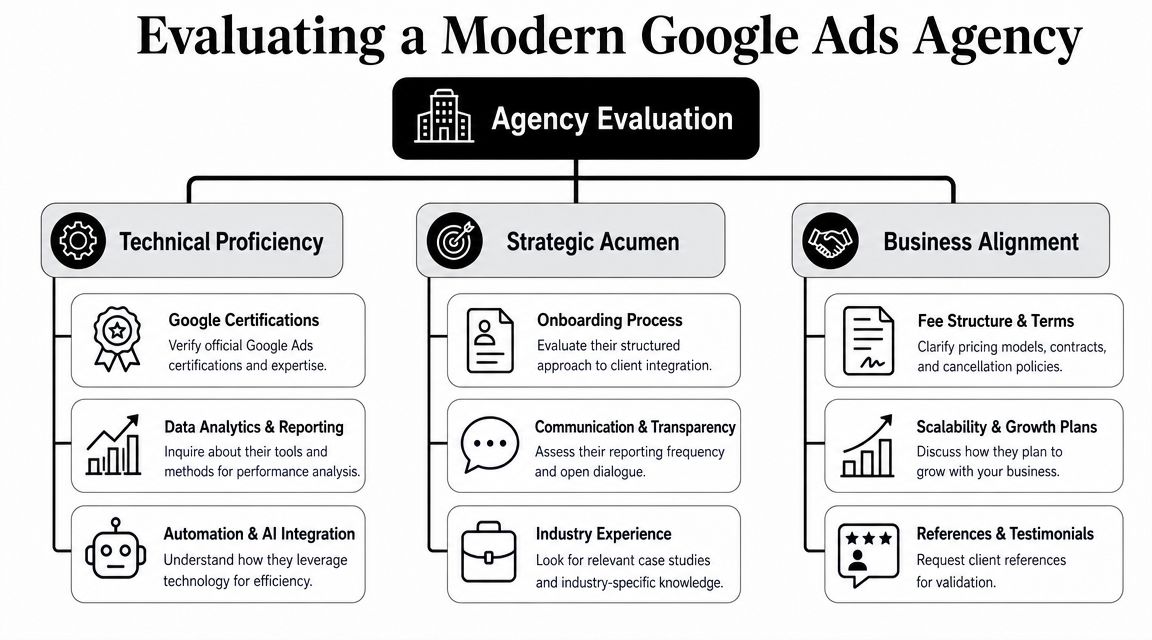
A modern Google Ads agency should be strong in three areas. Technical setup, commercial strategy, and post-click improvement. If they only talk about ad copy and bid changes, they're too narrow for most Australian businesses.
Look at how they optimise, not how they pitch
A strong optimisation process has a recognisable shape. The agency should be segmenting performance by device, location, and audience before touching bids, and high-level guidance also notes that Smart Bidding with broad match can deliver 25 to 35% more conversions at the same CPA, with a 2:1 or better revenue-to-spend ratio used as the main success lens rather than vanity metrics like clicks, as summarised in this Google Ads metrics reference.
That matters because blended account averages hide problems. I've seen mobile drive volume but not quality, metro suburbs outperform regional traffic, and broad campaigns look fine until you inspect the search terms report properly.
Ask the agency how they review:
- Device splits: Mobile and desktop rarely behave the same way.
- Location cuts: Melbourne-wide targeting often hides suburb-level differences.
- Audience overlays: Returning visitors, customer lists, and in-market audiences can behave very differently.
- Search term quality: This tells you whether intent is commercial or just curious.
- Path length and lag: Especially important when the sale doesn't happen on the first click.
Good agencies don't optimise the average. They isolate where efficiency breaks.
Check whether they understand the full stack
At this juncture, many agencies falter. They can run campaigns, but they can't fix the website, feed, or tracking issue that's causing underperformance.
For eCommerce, ask direct questions about Shopify. Not just app installs, but whether they understand product feed structure, collection logic, variant issues, Shopify API limitations, and what happens when Performance Max and Standard Shopping compete for the same inventory. If they mention PMAX vs Google Shopping, they should explain the trade-off clearly rather than pretending one format always wins.
For service businesses, ask about contact forms, call tracking, and landing page build. If your forms are poor, if your thank-you events don't fire properly, or if your WordPress site is slow, ad management alone won't save the account.
Technical capability often shows up in small details:
- GTM and GA4 fluency: Can they audit event firing and conversion duplication?
- Meta Conversion API knowledge: Helpful when your paid media mix includes both Google and Meta.
- WordPress development support: Useful for custom landing pages, Gutenberg blocks, and faster deployment.
- Shopify development understanding: Important for feed troubleshooting, theme edits, and conversion UX.
A business looking for a partner might compare a broader eCommerce marketing agency with a more focused Google Ads agency. The right choice depends on whether your main constraint is channel execution or the wider store and tracking stack around it.
Judge them on decision quality
I pay attention to how agencies answer trade-off questions.
If you ask about broad match and automation, do they explain when it helps and when it burns budget? If you ask about Shopping ads not spending, can they discuss feed health, campaign priority, product eligibility, and query coverage? If you ask about lead generation, do they talk about conversion quality instead of just form volume?
Here's a practical scorecard:
| Evaluation area | What good looks like | Red flag |
|---|---|---|
| Reporting | Clear link between spend and business outcomes | Dashboard spam with no interpretation |
| Tracking | GTM, GA4, CRM, call attribution discussed early | “We'll sort tracking later” |
| Strategy | Account structure tied to intent and business model | One generic template for every client |
| Creative | Ads and landing pages tested together | Copy tweaks only |
| Platform knowledge | Can explain Search, Shopping, PMAX, remarketing trade-offs | Pushes one campaign type for everyone |
The best agencies now create value through systems. Measurement, creative testing, feed quality, landing page relevance, and first-party data. That's where the edge is.
Critical Questions to Ask Before You Sign Anything
You can learn more in fifteen minutes of sharp questions than in an hour of agency presentation slides. Don't ask whether they're results-driven. Every agency says that. Ask how they work when the account gets difficult.

Questions that expose whether they understand modern Google Ads
The value of a Google Ads agency has shifted. The question isn't who can lower CPC. It's who can improve conversion quality, first-party data strategy, measurement, and landing page performance in a more automated environment, as argued in this analysis of modern Google advertising agencies.
That shift should shape your questions.
Ask them:
- How do you define a quality conversion for a business like mine?
- What would you want to audit in our GTM, GA4, and Google Ads setup before making changes?
- How do you report on phone calls, contact forms, purchases, and assisted conversions?
- What do you do when Google's automation starts spending but lead quality drops?
- Who handles landing page changes if the campaign problem is post-click, not in-platform?
If they answer in generic terms, keep digging. A capable agency should be comfortable talking about event accuracy, attribution windows, form quality, search term pruning, and landing page message match.
Ask for process, not promises. A useful answer sounds operational.
Questions for Melbourne service businesses and local operators
If your business depends on local demand, your paid strategy shouldn't live in a silo. Google Ads, Google Business Profile, landing page relevance, and suburb-level intent all interact.
That's why I'd ask:
- How do you coordinate paid search with local search visibility?
- How do you handle location-level bid adjustments and suburb targeting?
- Can you separate branded traffic from non-branded lead generation?
- What call tracking setup do you recommend for service campaigns?
- How do you measure leads from maps, calls, forms, and repeat visitors together?
If you need a stronger grounding in nearby visibility, this guide to local search optimization is worth reading because it helps frame how paid and local presence support each other rather than compete.
Questions for businesses on WordPress or Shopify
A lot of paid campaigns fail because the site can't support the strategy. If you're on WordPress, ask whether they can work with themes, plugins, custom landing pages, and performance issues. If you're on Shopify, ask whether they understand feeds, collections, product titles, variants, and app conflicts.
I'd be direct:
| Ask this | Why it matters |
|---|---|
| Can you work with our developer or make front-end changes yourself? | You don't want ad performance waiting on a third party for every fix |
| What's your experience with contact form tracking and thank-you page logic? | Lead attribution often breaks here |
| How do you improve low-converting product pages? | Shopping and PMAX depend on the page, not just the feed |
| Can you support WordPress and Shopify issues tied to conversion rate? | Good agencies don't stop at the click |
If your site needs hands-on support, that's where a capable WordPress developer or a specialist Shopify developer becomes part of the paid media conversation, not a separate afterthought.
The First 90 Days What to Expect from Your New Agency
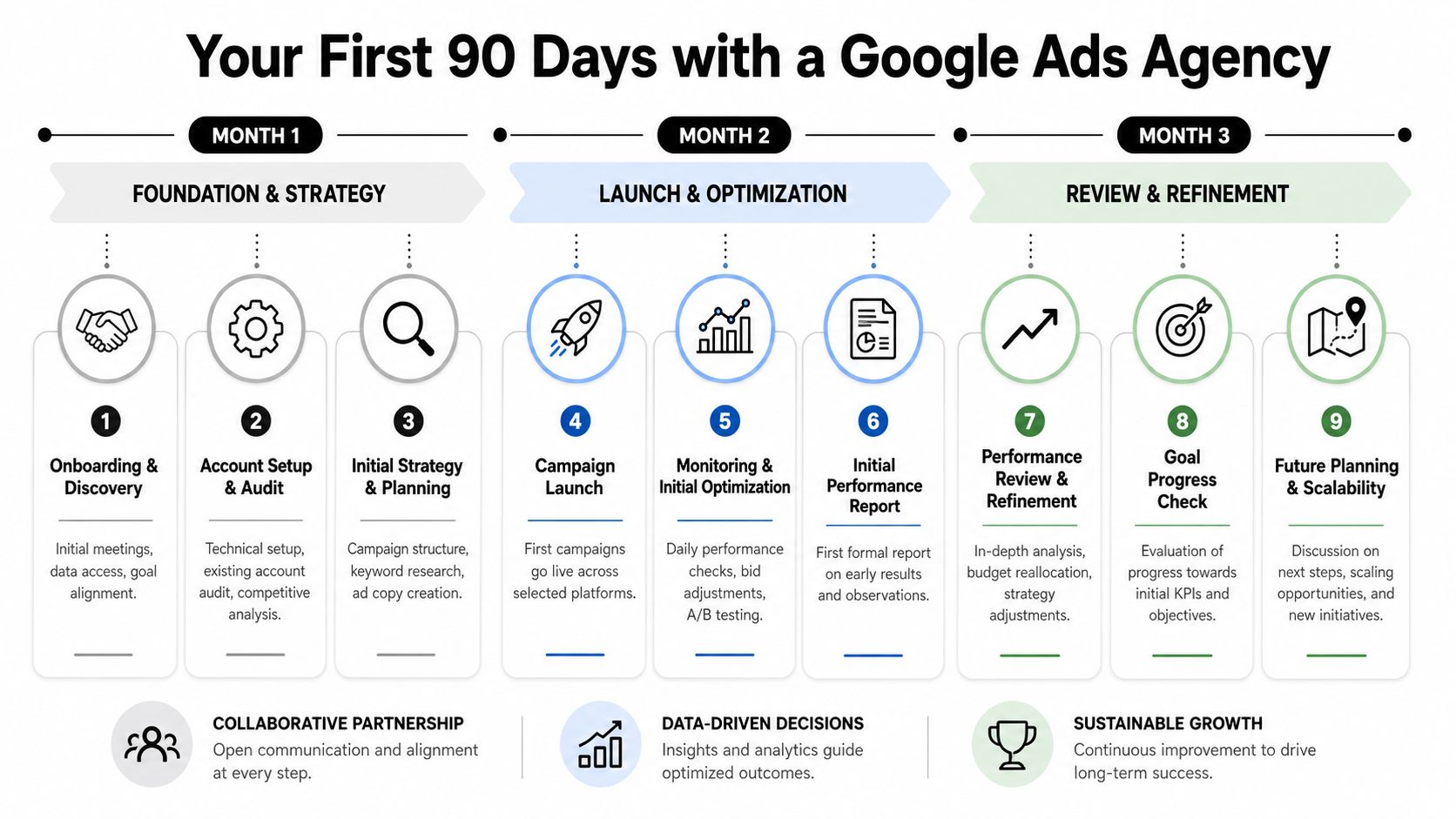
The first three months usually tell you whether the partnership is built properly. Not whether every KPI is perfect yet, but whether the agency is organised, technically competent, and making decisions from real signal instead of guesswork.
Meaningful performance changes in Google Ads typically take 6 to 12 weeks, and guidance for mature campaigns often points to 4:1 ROAS or better as a strong target where margins allow, along with 80 to 90% impression share on profitable keywords, based on this industry guidance for evaluating Google Ads experts. That's why smart clients don't judge a fresh engagement after a handful of days.
Month one needs access, audits, and cleanup
In the opening weeks, a good agency should be collecting access, checking data, reviewing history, and finding structural issues.
That usually includes account audit work, conversion review, search term analysis, location checks, audience setup, landing page inspection, and if relevant, Merchant Center and feed review. If they start changing everything before they understand what was already happening, that's careless.
Month one should feel methodical. You should see organised questions and a clear rationale for what gets changed first.
Month two should show measured changes, not chaos
At this stage, campaigns go live or existing campaigns get restructured enough that cleaner learning begins.
For eCommerce, that may mean separating brand and non-brand, revisiting Shopping structure, refining PMAX inputs, or improving product data. For service businesses, it often means tightening geographic intent, improving lead tracking, and pruning search terms that look active but don't convert into useful enquiries.
Early movement is useful. Early certainty usually isn't.
You want an agency that can explain what they're learning from device behaviour, search intent, and lead quality. Not one that celebrates every spike.
Month three should bring sharper budget allocation
By this stage, you should be getting stronger insight into where budget belongs.
That doesn't mean every account is ready to scale hard. It means the agency should know more about which campaigns deserve protection, which keywords are misleading, which suburbs perform, and whether your site is helping or hurting conversion.
A healthy month-three review usually includes:
- Performance by segment: Device, location, audience, and search intent.
- Tracking confidence: Whether the data is reliable enough for stronger automation.
- Budget reallocations: Spend shifted based on evidence, not instinct.
- Post-click findings: Landing page friction, feed issues, or form drop-off.
- Next-step roadmap: What gets tested next and why.
If your provider also handles web support, it helps when paid media and site changes happen together. Some businesses prefer a broader partner such as a web design Melbourne firm or a specialist Facebook Meta ads agency that can coordinate across channels, but the key is still the same. Clear decisions, clean tracking, and realistic pacing.
Common Pitfalls and How We Do Things Differently
Most agency problems aren't dramatic. They're operational. Leads aren't tracked properly. Search terms aren't reviewed often enough. Landing pages stay unchanged for months. Reports are full of channel metrics and light on business truth.
I've seen campaigns where the platform looked fine but the business was losing money because form spam, poor call handling, and weak follow-up never made it into reporting. That's why I'm sceptical of agencies that define success too narrowly.
Where agencies commonly let accounts drift
The pattern is familiar. They launch. They automate heavily. They send a dashboard. Then the account runs on momentum.
Here's the cleaner comparison.
| Common Pitfall | The Alpha Omega Digital Difference |
|---|---|
| Generic lead tracking with no phone attribution | We prioritise call and lead tracking so service businesses can see where enquiries are coming from |
| Campaign changes without checking site friction | We work across ads and site performance, including WordPress and Shopify issues that affect conversion |
| Heavy reliance on platform automation with weak data inputs | We focus on measurement quality, search term review, landing page relevance, and first-party signal setup |
| Reports centred on clicks and impressions | We try to tie reporting back to leads, sales quality, and commercial outcomes |
| Separate web and media teams causing delays | We can handle both marketing and website implementation in the same workflow |
| Missed inbound calls outside business hours | We can set up custom call handling workflows using Twilio-based systems for better lead capture |
That last point matters more than many businesses realise. For tradies, clinics, salons, dentists, restaurants, and other appointment-led operators, a missed call is often a missed customer. We've built custom call flows around Twilio so campaign traffic can route through a dedicated number, support round-the-clock answering logic, and connect with booking workflows such as your calendar or Calendly. The practical benefit is simple. More captured demand, fewer lost enquiries, and clearer attribution on paid campaigns.
Why technical depth changes campaign outcomes
This is the part many business owners only discover after a bad agency experience. Ad management and website capability can't be fully separated.
If your landing page needs custom sections, faster load times, cleaner forms, or better message match, you need someone who can implement that. If your Shopify store has collection issues, feed inconsistencies, or theme friction that hurts product page conversion, the ad account will feel the impact.
That's one reason some businesses choose one technical partner instead of splitting responsibility across multiple vendors. At Alpha Omega Digital, the work spans paid media, WordPress, Shopify, tracking, and conversion-focused implementation. For a business owner, that often means fewer handoffs and faster fixes.
The practical edge for Australian businesses
The trade-off is simple. A pure media buyer may be fine if your site, tracking, CRM, and feed setup are already strong. But many small and mid-sized businesses don't start there.
If you're in Melbourne and comparing a digital marketing agency Melbourne option against a freelancer or offshore setup, ask who will fix the problem when the issue sits between ad platform, website, analytics, and lead handling. That's where a lot of wasted budget hides.
For businesses that need broader support around builds and conversion performance, it also helps to work with experienced WordPress developers in Melbourne, especially when paid traffic is landing on pages that need custom layout, speed work, or stronger enquiry flow.
Your Next Step to Google Ads Success
Choosing a Google Ads agency gets easier when you stop judging agencies by presentation quality and start judging them by operational depth.
You want a partner that asks good questions early. One that cares about conversion definitions, data quality, landing pages, product feeds, mobile behaviour, lead quality, and what happens after the click. If they can't talk clearly about those things, they're not ready to manage a serious growth channel.
For Melbourne eCommerce brands, the conversation should include Shopify structure, Shopping strategy, PMAX inputs, and margin-aware decision making. For service businesses, it should include calls, forms, suburb targeting, tracking, and what your team does with leads once they come in. The agency should understand your business model, not just the ad interface.
That's the standard I'd use whether you're hiring a specialist Google Ads provider, a broader marketing agency Melbourne, or a more technical digital marketing agency Melbourne partner.
If you're a business with a paid ads budget of at least $3k a month, I'd love to offer you a low risk deal. Get a month of paid ads management free. Apply through our contact page.
If you want a technical growth partner that can work across Google Ads, Shopify, WordPress, tracking, and conversion systems, take a look at Alpha Omega Digital.
Alpha Omega Digital
Read more insights from our team on web design, paid ads, and growth strategy.