You might be in that spot right now. You've boosted a few campaigns, watched clicks come in, and then realised the phone still isn't ringing with the right jobs, or your online store is getting traffic that doesn't convert. On the Gold Coast, that gets expensive fast.
Google Ads can work brilliantly here, but only when the account is built around local intent, clean tracking, and a landing experience that helps people take action. If you run a service business, that usually means tighter suburb targeting, sharper negative keyword control, and proper call tracking. If you run eCommerce, it means your feed, campaign structure, product pages, and measurement all need to line up.
A lot of business owners don't need another agency pitch. They need an honest look at what makes a Google Ads agency Gold Coast campaign produce leads and sales, and what burns budget.
Growing Your Gold Coast Business Can Be Tough We Get It
A common pattern on the Gold Coast looks like this. A business owner launches campaigns with good intentions, targets broad keywords, uses the home page as the landing page, and then gets enquiries from outside the service area or clicks from people who were never going to buy. The account looks busy, but the business doesn't feel growth.
We've seen that with tradies, clinics, retailers, and online stores. The frustration usually isn't that Google Ads did nothing. It's that it did the wrong thing. It generated activity instead of qualified demand.
What wasted spend usually looks like
A local service campaign can go off track in a few ways:
- Broad targeting: Ads show outside the suburbs you service.
- Weak search intent control: You pay for research queries instead of buyer queries.
- Poor landing flow: People click, then get confused or distracted.
- No clean measurement: You can't tell which campaign drove the call or form.
For operators building better systems around lead handling and customer experience, it can also help to explore LunaBloom AI's platform if you're thinking beyond ads and into how enquiries get managed after the click.
A bad Google Ads setup rarely looks broken at first. It looks active.
That's why transparency matters. If a campaign is attracting the wrong suburb, wrong search, or wrong message match, someone needs to say it early and fix it before another month disappears.
Why Google Ads Is a Non-Negotiable for Gold Coast Businesses
Google Ads matters on the Gold Coast because buyers don't search in a vague way. They search with intent. They want a plumber near them, a treatment nearby, a store with a specific product, or a service they can book now. When your business shows up at that moment, you're not interrupting attention. You're meeting demand.
Google Ads has been used in Australia as a major local-search channel because it can target ads by keyword, location, and audience, which is especially relevant for Gold Coast businesses competing for high-intent searches such as service and retail queries. Local agency positioning also reflects a market focused on measurable lead generation and ROI rather than broad brand awareness, and one example cited is that Media Booth says it has more than 10 years of digital marketing experience on the Gold Coast, which signals a mature specialist PPC market in the region according to this Gold Coast Google Ads market overview.
Why local intent beats passive attention
For most businesses, Google traffic is different from social traffic.
With social ads, you're often creating demand or catching interest mid-scroll. That can work, especially for remarketing and creative testing. But with Google Search, someone is already telling you what they need. The job is to interpret that intent properly.
That matters even more in a city like the Gold Coast, where demand can split across:
- Residents searching for local services
- Visitors looking for nearby options
- Shoppers comparing products before buying
- Urgent searches where speed matters
If you're a tradie, that may mean high-value emergency searches. If you're in eCommerce, it may mean product-led searches with stronger purchase intent than most paid social traffic. If you're in hospitality, tourism, or beauty, it may mean location-led searches where proximity and offer clarity matter more than clever branding.
Where businesses usually get it wrong
A lot of campaigns fail because they treat all clicks as equal. They aren't.
Here's the actual trade-off:
| Approach | What happens |
|---|---|
| Broad reach with loose targeting | More traffic, lower relevance, weaker lead quality |
| Tighter intent and suburb control | Fewer wasted clicks, stronger conversion potential |
| Generic ad copy | More impressions, less qualified response |
| Specific service and location match | Better alignment between search, ad, and landing page |
A good Google Ads agency Gold Coast strategy doesn't chase attention for the sake of it. It filters for intent.
Why this channel is hard to replace
SEO matters. Social matters. Email matters. But if you need buyers who are already looking, Google Ads is usually the quickest route to commercial intent. That's why so many Gold Coast businesses keep coming back to it even after a rough first experience.
Practical rule: If people already search for your service or product, there's usually a paid search opportunity worth testing properly.
For eCommerce brands, that often expands into Shopping, branded search protection, and Performance Max. For service businesses, it often starts with tightly controlled search campaigns and location-specific landing pages. Different setup, same principle. Show up when the buyer is already close to acting.
Our Proven 6-Step Process for Dominating Google Ads
The work that produces results in Google Ads is rarely glamorous. It's disciplined setup, strong measurement, and consistent optimisation. That's what separates a campaign that looks busy from one that becomes a reliable lead or sales channel.
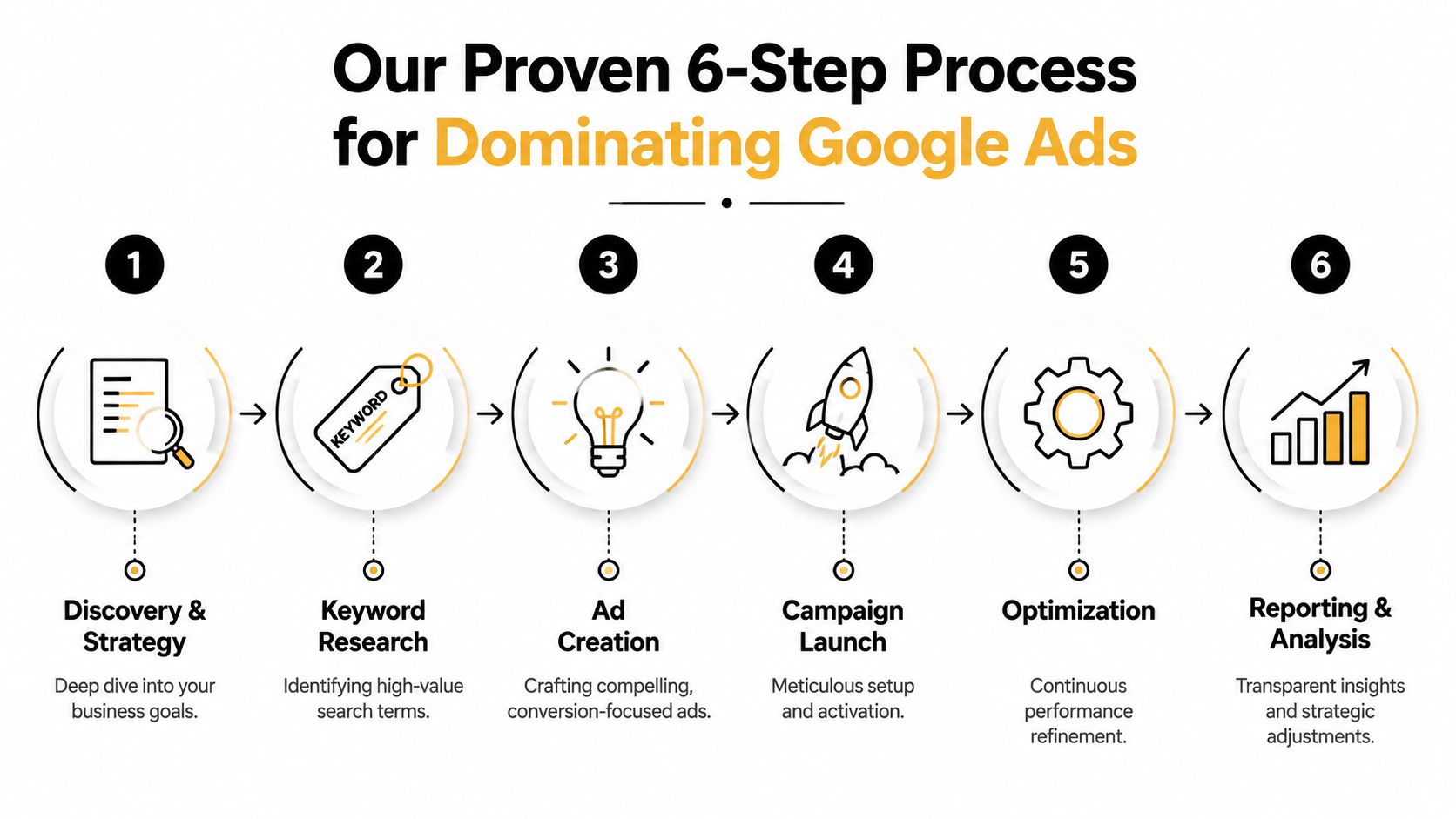
Step 1 and 2 discovery and foundation
We start by looking at the business before we touch the ad account. What are you selling, who do you want, what suburbs matter, what margins matter, and what does a qualified lead look like?
Then we build the measurement layer properly. That can include:
- Google Tag Manager setup: Cleaner event deployment and easier tracking control
- Google Analytics 4 configuration: So traffic quality and conversion paths are visible
- Form tracking: To separate real enquiries from soft interactions
- Call tracking: Important for service businesses where the sale starts on the phone
- Meta Conversions API setup: Useful when paid social supports paid search and you want cleaner multi-channel reporting
For some businesses, we also create a custom call flow using Twilio. That can route calls, record outcomes, and support after-hours handling. When a business misses calls, it often blames the ads. The actual issue is usually what happens after the lead tries to contact you.
A lot of agencies also underestimate operations. If you're comparing systems internally, it's worth reading this guide to find best agency project management software because delivery discipline affects campaign quality more than commonly assumed.
Step 3 launch with control
Once the strategy is mapped, we build campaigns around intent segments rather than dumping every keyword into one bucket.
For service accounts, that usually means:
- suburb and radius decisions
- negative keyword lists
- ad copy aligned to the actual service
- landing pages tied to the search intent
For eCommerce, it can mean product feed clean-up, Shopping structure, branded separation, and campaign segmentation by category, margin, or search behaviour.
For Australian Google Ads management, a practical benchmark is that the first 30 days are often used for structured campaign setup, search-term validation, and early bid and keyword refinement. Google's own support offers 1-to-1 expert help within that initial period, and this aligns with the understanding that early machine-learning optimisation needs human guidance. In a Gold Coast setting, tighter geo-targeting and negative keywords are especially important to stop budget leaking into non-serviced suburbs or irrelevant intent, as noted in Google's Ads expert support information.
Here's a useful overview of the process in action:
Step 4 and 5 optimisation and reporting
Once campaigns are live, the useful questions change. We're no longer asking whether the ads are running. We're asking which search terms deserve more budget, which locations underperform, which devices convert poorly, and whether the landing page is helping or hurting.
This stage usually involves:
- Search term pruning
- Bid and budget adjustments
- Ad testing
- Landing page feedback
- Lead quality checks with the client
We keep reports tied to business outcomes. That means spend, conversions, lead quality, and sales context. Not dashboard theatre.
Most wasted ad spend doesn't come from one dramatic mistake. It comes from small issues left uncorrected for too long.
Step 6 scaling without breaking what works
Scaling is where many accounts lose discipline. A business sees momentum, raises budget too quickly, expands targeting too early, and performance softens.
We scale in layers. New suburbs, adjacent services, stronger remarketing, better landing pages, tighter feed management, or better call handling. Growth is easier to sustain when each part of the system is ready for more volume.
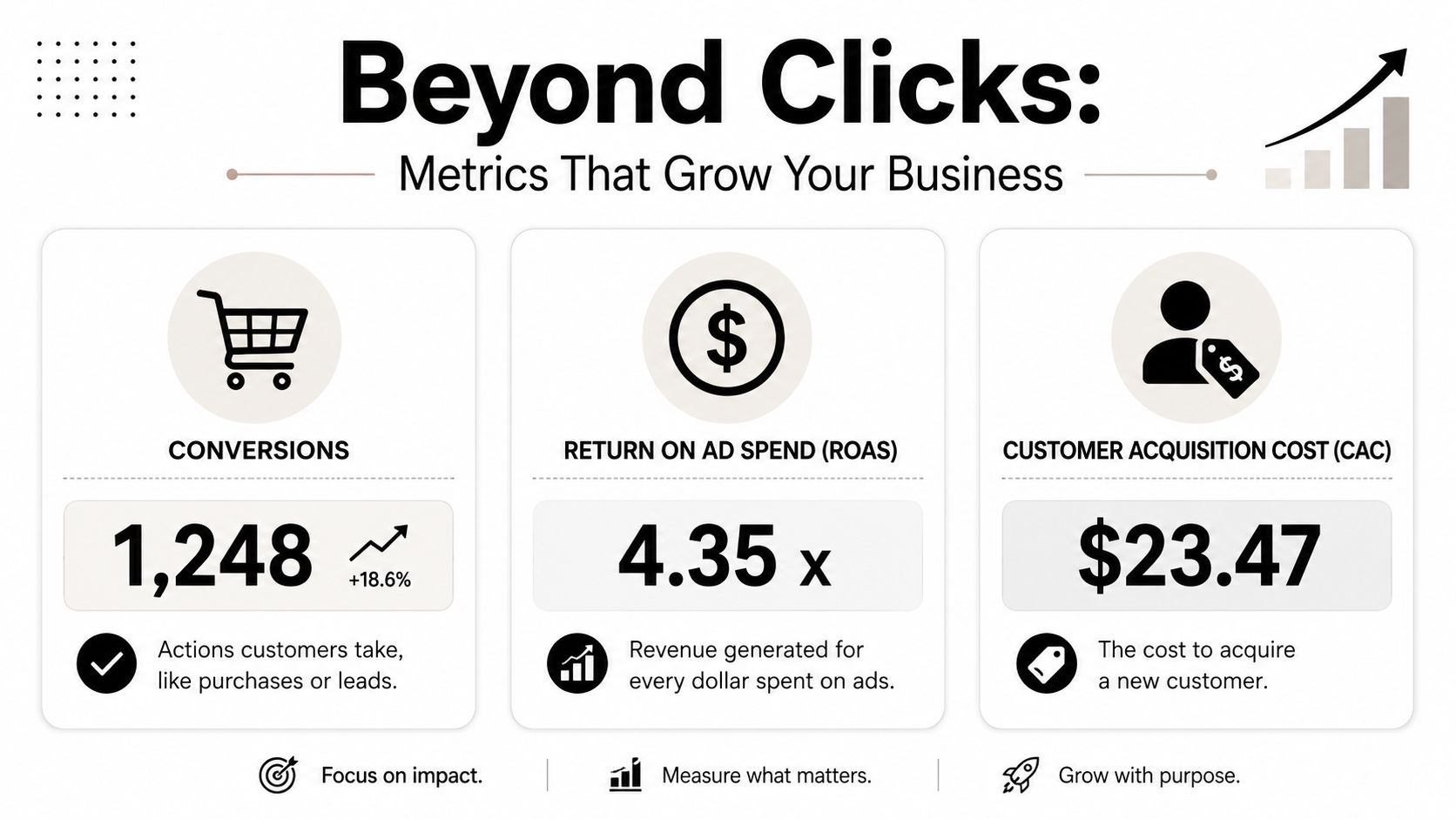
Beyond Clicks The Metrics That Actually Grow Your Business
Clicks matter only if they lead somewhere useful. A lot of businesses have been trained to celebrate traffic spikes, high impression counts, or a lower CPC. Those numbers can be interesting, but they don't tell you whether Google Ads is helping the business grow.
The numbers that matter are the ones tied to revenue and qualified demand.
For service businesses qualified leads matter more than volume
If you're a plumber, electrician, clinic, or other service-based operator, the main question is simple. How much did it cost to generate a lead you'd want to speak to?
That's why we focus on things like:
- Qualified calls: Not every call is sales-ready
- Contact form submissions: But only when they're genuine
- Cost per acquisition: A more useful number than click cost
- Service area match: Leads need to come from places you serve
A campaign can generate cheap clicks and still be poor for the business. If half the enquiries are outside your area, after-hours missed calls, or low-intent tyre-kickers, the account needs work.
For eCommerce sales quality matters as much as revenue
In online retail, top-line sales alone can mislead. One campaign might drive orders but attract low-margin products. Another might bring fewer transactions but stronger revenue quality.
That's why we look at:
| Metric | Why it matters |
|---|---|
| Conversions | Tells you whether traffic becomes action |
| ROAS | Shows how much revenue comes back from ad spend |
| Customer acquisition cost | Helps judge whether scaling is sustainable |
| Average order value | Useful for understanding purchase quality |
If you're managing multiple tools and reporting systems, this breakdown of Keywordme's guide to agency tools is useful because tool sprawl creates reporting confusion fast.
Post-click experience changes the economics
A technically sound Google Ads setup for the Gold Coast should combine location targeting with conversion-focused landing pages and multi-channel measurement, because agencies in the region often position paid search as strongest when paired with conversion-optimised web design and other channels rather than run alone. The performance logic is straightforward. Better message match, faster pages, and clearer user experience usually improve conversion rate and can lower effective cost per lead even when CPCs stay the same, as discussed in this Gold Coast Google Ads and landing page guide.
That's why a weak landing page can subtly destroy campaign efficiency. The ad may be fine. The search intent may be strong. But if the page is slow, vague, or overloaded, people leave.
Bench check: If the ad promises one thing and the page opens with something else, expect weaker conversion performance.
For businesses that want one provider handling both site work and campaign management, Alpha Omega Digital offers paid ads alongside WordPress and Shopify development, which can simplify implementation when tracking and landing page changes need to happen quickly.
Real Results for Australian Businesses Like Yours
The hardest part of hiring any Google Ads agency Gold Coast provider is this. Every agency says they care about results. The useful difference is whether they can explain the mechanics behind those results in plain English.

What a strong eCommerce engagement usually looks like
A typical Gold Coast eCommerce account doesn't struggle because the products are bad. It struggles because the structure is messy.
Common issues include:
- Poor feed quality
- No separation between branded and non-branded demand
- Weak collection or product page UX
- Tracking gaps between ad platform and site
- Over-reliance on one campaign type
When we work on accounts like that, the first improvements often come from cleanup, not creativity. Better product titles, cleaner categorisation, stronger exclusion logic, and more disciplined budgeting usually beat constant campaign tinkering.
If the store runs on Shopify, technical fixes matter just as much as media buying. Theme speed, collection logic, product schema, custom app behaviour, and checkout flow all shape paid traffic performance.
What a strong service campaign usually looks like
For local service businesses, the win often comes from narrowing the account, not expanding it.
A healthier setup usually includes:
- Focused service keywords
- Suburb or service-area alignment
- Call tracking and form attribution
- A landing page built for enquiry, not browsing
- Fast follow-up once the lead comes in
We've seen campaigns improve because the wrong search terms were cut out and the landing page stopped asking visitors to hunt for a phone number. That's not fancy strategy. That's disciplined execution.
Good local campaigns often feel less busy inside the ad account and more productive inside the business.
What to ask an agency before you hire them
Instead of asking for flashy screenshots, ask practical questions:
- How do you track calls versus form leads
- How do you stop budget leaking outside my service area
- What happens in the first month
- Who changes landing pages if conversion rate is weak
- How do you judge lead quality, not just lead volume
Those answers tell you more than any generic promise.
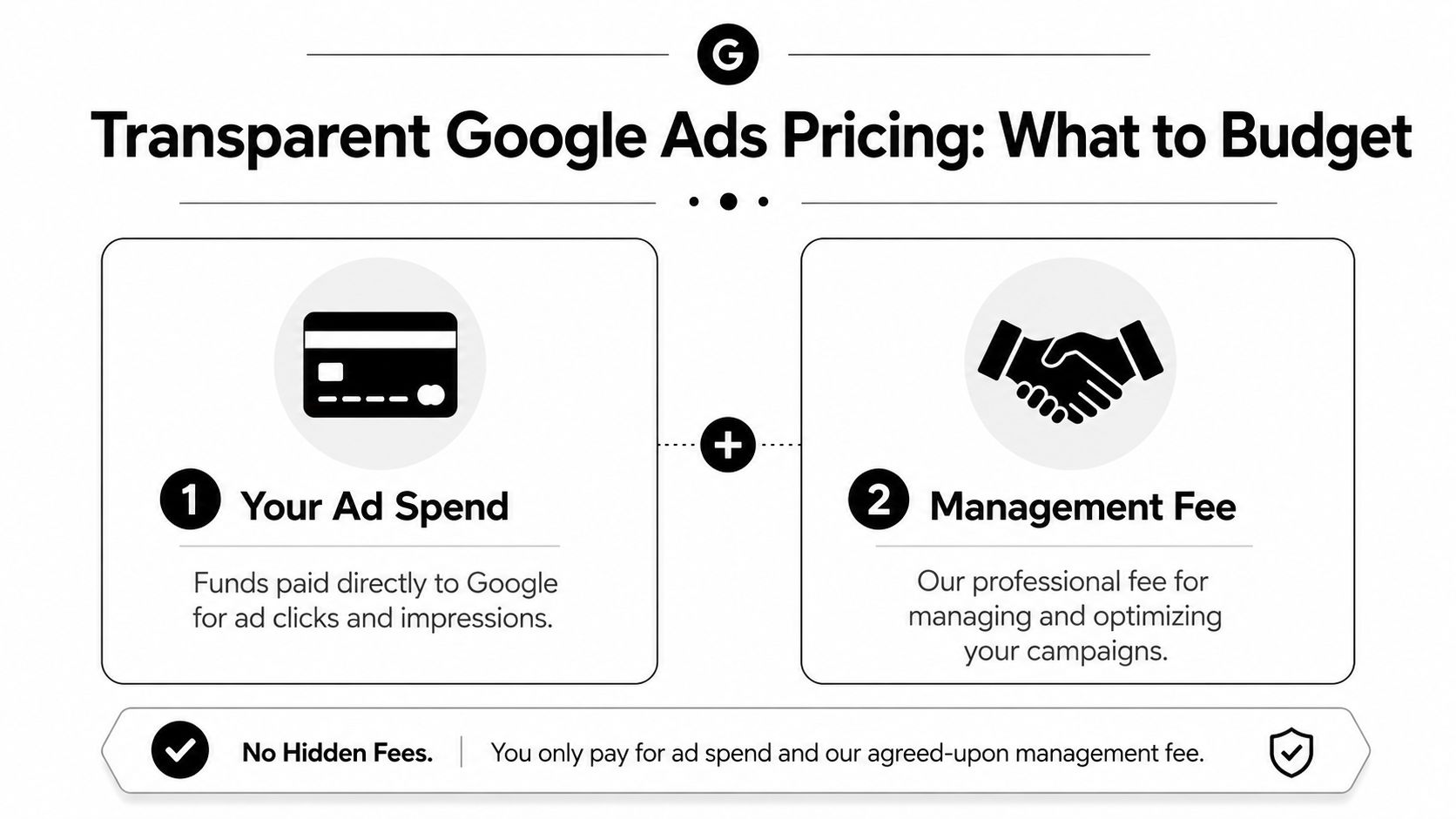
Transparent Google Ads Pricing What to Budget
Most business owners don't need mystery around pricing. They need a realistic sense of what they'll pay, what goes to Google, and what goes to management.
The two parts of your budget
There are always two separate costs.
| Budget component | What it covers |
|---|---|
| Ad spend | Money paid directly to Google for traffic |
| Management fee | Strategy, setup, optimisation, reporting, and oversight |
Those should be clearly separated. If they're blended into one vague number, ask for a cleaner breakdown.
What Gold Coast businesses often see in market
Semrush's 2026 Gold Coast agency data shows listed advertising services in the city with estimated project budgets in the range of $2,500 to $5,000, which gives a practical signal of the scale where businesses in the region may begin engaging specialist support. The same market guidance also highlights clicks, impressions, conversions, and cost-per-acquisition as core metrics to watch, according to the Semrush Gold Coast advertising agency listings.
That doesn't mean every business should spend the same amount. It means serious campaign management usually starts once there's enough budget to gather useful data and act on it.
How to think about budget without guessing
A better way to set budget is to work backwards from commercial reality.
Ask:
- What is a new customer worth to the business
- How many leads or sales can your team handle
- Which services or products have the healthiest margin
- Is the site ready to convert paid traffic
- Can you respond quickly when leads come in
If your budget is too low, the account may not generate enough data to optimise well. If your budget is high but the landing page, offer, or follow-up is weak, you can waste money faster.
A sensible starting budget isn't the one that feels comfortable. It's the one that gives the campaign a fair chance to produce signal.
For many Gold Coast businesses, the right starting point depends less on industry averages and more on lead value, urgency, competition, and how quickly the team can convert demand into revenue.
Your Questions Answered
Businesses usually ask the same few questions before they hire a Google Ads agency. Fair enough. You're trusting someone with budget that should be producing sales, not just reports.
Why hire a Melbourne agency for a Gold Coast business
Because paid search work is less about postcode and more about process, tracking, and commercial judgment.
A good agency doesn't need to sit down the road to understand suburb targeting, service areas, feed issues, or landing page problems. What matters is whether they can build campaigns around local intent, measure properly, and communicate clearly.
There's also an advantage in having an outside view. A team that works across multiple Australian markets often spots weak assumptions quickly because they're not too close to the local noise.
How long does Google Ads take to work
You can get traffic quickly, but good performance still needs a learning period. The first stretch of a campaign is usually about validation. Which search terms are real, which ads attract the right click, which suburbs produce better leads, and whether the landing page does its job.
For that reason, I prefer clients who think in stages rather than overnight wins:
- Initial setup and launch
- Early data review
- Search term and lead quality refinement
- Budget concentration around proven segments
- Gradual expansion if economics hold
If someone promises instant predictability, be careful.
What makes one agency different from another
Three things usually separate a solid agency from a frustrating one.
Measurement discipline
If they can't explain how they track calls, forms, sales, and lead quality, you'll struggle to trust the numbers.
Willingness to challenge weak inputs
Sometimes the campaign isn't the main issue. Sometimes the page is slow, the offer is unclear, the follow-up is late, or the service area settings are wrong. You want an agency that will say that plainly.
Reporting tied to business reality
You don't need a polished dashboard full of vanity metrics. You need to know whether the spend is turning into profitable work or profitable sales.
The best agency conversations are usually the least theatrical. They're specific, commercial, and a bit uncomfortable in the right way.
Ready for Real Growth? Let's Talk.
If you're tired of campaigns that generate activity without producing enough real business, this is fixable. A well-run Google Ads account can become a dependable source of leads and sales, but only when the targeting, tracking, landing pages, and follow-up are all working together.
That applies whether you run a local service business on the Gold Coast or an eCommerce store that needs tighter campaign structure and cleaner measurement. If you've got a paid ads budget of at least 3k a month, there's enough room to build something properly and optimise it with intent.
If that sounds like where you're at, apply through the contact page. The offer is simple. Get a month of paid ads management free, with a low-risk start and a clear look at how the account is handled.
If you're ready to speak with a team that handles Google Ads, Shopify, WordPress, and conversion-focused web work for Australian businesses, get in touch with Alpha Omega Digital.
Alpha Omega Digital
Read more insights from our team on web design, paid ads, and growth strategy.