You're probably looking at a few agencies right now and seeing the same promises on every page. More leads. Better ROI. Smarter strategy. Local expertise. It all sounds fine until you realise most of those claims don't tell you how the work gets done, how results are measured, or what happens once Google's automation starts making decisions inside your account.
That's the issue with hiring a Google Ads agency in Perth. The postcode of the agency matters far less than most owners assume. What matters is whether the team can build clean tracking, structure campaigns properly, manage search intent, and keep Google's automated systems under control instead of letting them burn budget.
I'm based in Melbourne, and I've worked with businesses across Australia, including Perth. The pattern is consistent. The accounts that win aren't the ones with the slickest sales pitch or the nearest office. They're the ones with disciplined execution, strong measurement, tight landing-page alignment, and someone watching the account closely enough to catch problems before they become expensive.
Why Your Perth Business Needs More Than Just a Local Agency
A lot of Perth business owners start with one assumption. If the agency is local, it must understand the market better and therefore perform better.
Sometimes that's true. Often, it's overstated.
The practical issue is usually execution quality and measurement, not geography alone, as discussed in this Perth-focused view on when a local Google Ads agency matters. That lines up with what I've seen in real accounts. If tracking is broken, campaign structure is messy, and leads aren't being qualified properly, a Perth address won't save the account.
Where local knowledge actually helps
There are cases where local context matters a lot:
- Service-area businesses: Plumbers, electricians, cleaners, and similar operators need tight geo-targeting, suburb exclusions, and strong control over service radius.
- Offline conversion businesses: If your sales happen on the phone or after a site visit, the agency needs to understand how to connect ad clicks to real booked jobs.
- Market nuance: Search behaviour can differ by suburb, service area, and local competition level.
That's all useful. But it's not enough on its own.
What actually moves performance
The agency you hire should be able to answer technical questions clearly. Not vaguely. Not with fluffy language. They should be comfortable talking through:
| What matters | Why it matters |
|---|---|
| Conversion tracking | Without it, Google optimises toward the wrong actions |
| Campaign architecture | A poor structure makes search terms, budgets, and bidding harder to control |
| Landing-page alignment | Good ads fail all the time when the landing page is slow, weak, or mismatched |
| Search intent management | Negative keywords and keyword quality stop wasted spend |
| Lead quality review | Not every form fill or call is worth paying for |
Practical rule: If an agency talks more about clicks than conversions, keep looking.
Many “local agency” comparisons go wrong. They focus on being nearby rather than being capable. A strong remote specialist can outperform a weak local team very quickly if they know how to build measurement properly and manage campaigns around business outcomes.
Google Ads is now less manual than most owners think
This matters even more now because Google keeps pushing advertisers toward automation. Smart bidding, broad match, Performance Max, AI-assisted creative. Those systems can work well, but only when the account is feeding Google reliable signals.
If lead quality isn't tracked, if forms are poor, if phone calls aren't logged, or if sales follow-up is slow, automation learns from bad inputs. Then the account starts optimising for cheap noise instead of profitable demand.
That's why I'd frame the hiring decision differently. Don't ask, “Who's the nearest Google Ads agency Perth business owners use?” Ask, “Who can govern this platform properly, measure real outcomes, and make automation work in my favour?”
A local office can be a bonus. It shouldn't be the main reason you hire.
Vetting an Agency The Right Way Credentials and Case Studies
A Perth owner gets on two agency calls. Both sound confident. Both promise better leads. One spends most of the call talking about years in business and a tidy client list. The other gets specific about conversion actions, offline import, call tracking, and how they stop Google's automation from learning from junk leads. That second conversation is usually the one worth having.
Credentials still matter. They just matter in the right order. I care less about broad agency polish and more about whether the team can prove they know how to govern bidding systems, validate tracking, and read account data without guessing.
Credentials that are worth checking
One useful trust signal in Australia is Google Premier Partner status. A Perth agency states that only 3% of Australian agencies hold that status in this overview of Google Ads management in Perth. That makes it a reasonable filter when you are trying to separate dedicated paid media teams from agencies that treat Google Ads as one line item on a long service menu.
The badge does not tell you how well they will run your account. It does suggest they have meaningful platform activity and a stronger connection to Google's training and partner support than the average shop.
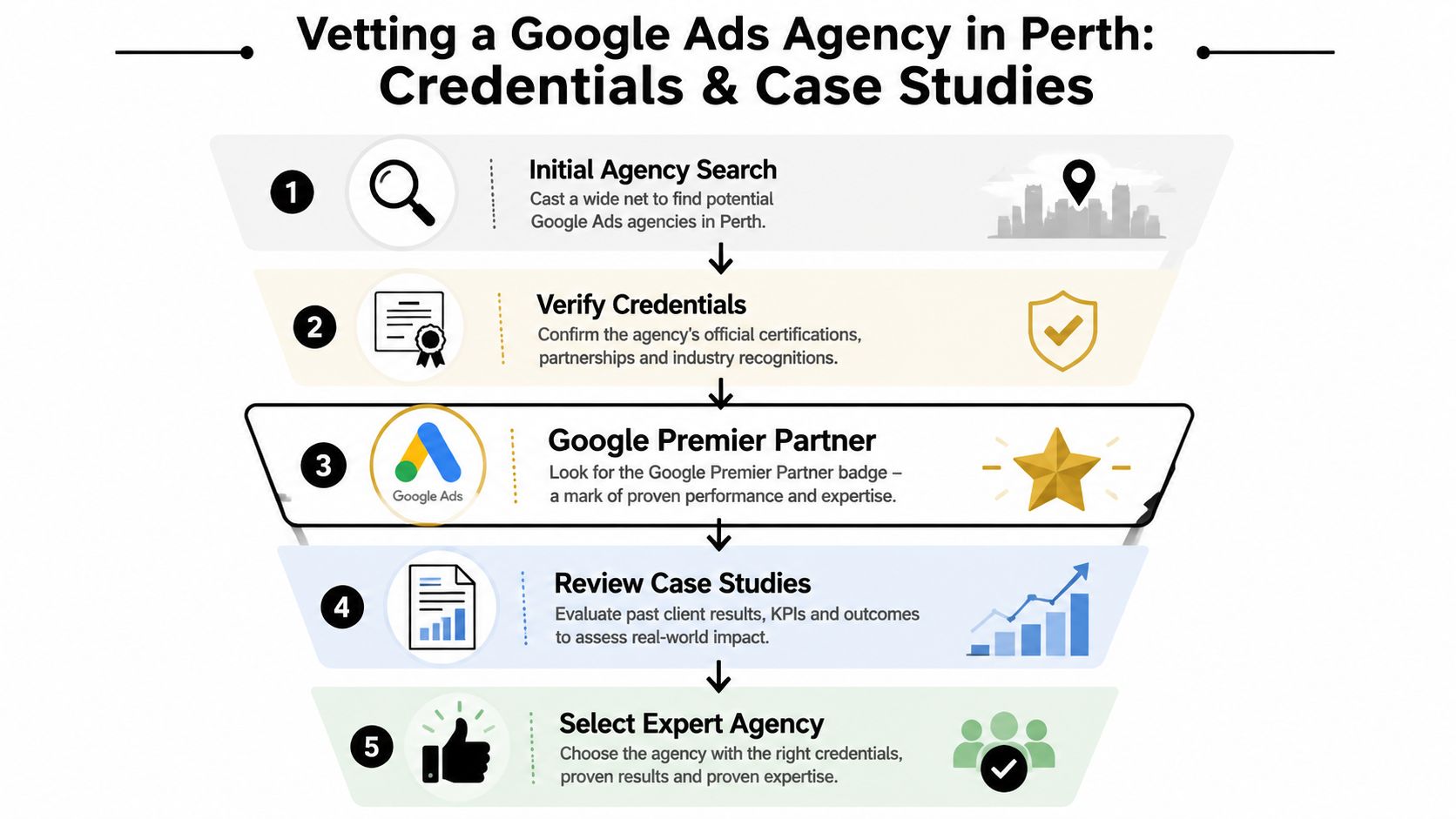
Before I take an agency pitch seriously, I check four things.
Platform depth
Google Ads should be a real operating capability, not a tab on a full-service brochure. Ask whether they can explain search structure, shopping feeds, Performance Max controls, match type use, audience signals, and conversion validation without slipping into vague language.Accreditation with context
Partner badges only help if the agency can explain how that status affects the work. Ask what product support they use, what certifications the delivery team holds, and whether senior strategists stay close to the account after onboarding.Relevant experience
Longevity can help, but only if it maps to your type of business and your sales process. Some Perth providers describe decades of broader industry experience. I would still ask who will manage the account each week, what kind of accounts they handle now, and how they measure lead quality after the click.Technical fit for your business model
A service business needs clean lead tracking and qualification rules. An eCommerce business needs feed management, merchant centre problem-solving, margin-aware bidding, and strong product segmentation. The right agency should be able to speak to your model without forcing the same template onto every account.
How to read a case study without getting sold
Case studies are useful when they explain decisions. They are far less useful when they read like a highlight reel.
A weak case study talks about traffic growth, click volume, or reach. Those metrics can rise while profit goes backwards. A useful case study shows what was wrong, what changed, and how the agency knew the change was working. I want to see evidence that they improved tracking, cleaned up intent, changed bidding logic, fixed landing-page alignment, or tightened qualification so Google could optimise toward better signals.
Good case studies reveal judgment. Bad ones hide behind headline numbers.
I also look for trade-offs. If an agency says they cut wasted spend, did lead volume dip before lead quality improved? If they switched to smarter bidding, what conversion threshold did they wait for first? If they launched Performance Max, what controls stayed in place so branded traffic and low-intent queries did not distort results? Those details tell you whether the team understands the machine they are steering.
For a broader checklist, this guide on vetting a small business marketing firm is worth reviewing alongside your own shortlist. It is useful because it pushes you to assess process, accountability, and decision quality rather than liking the salesperson.
What I'd ask for before signing off
| Ask for this | Why |
|---|---|
| A sample report | Shows what they monitor each month and whether they focus on business outcomes or soft metrics |
| An audit framework | Tells you whether they diagnose tracking, structure, search intent, and bidding, or just run the same pitch every time |
| One case study close to your model | Similar sales cycles matter more than a long list of unrelated wins |
| The delivery team structure | You need to know whether strategy stays with a senior operator or gets handed to junior fulfilment |
| A plain-English tracking walkthrough | If they cannot explain how conversions are recorded and checked, they probably do not control the account tightly enough |
The best agencies make technical work understandable. That usually means they understand it well enough to manage Google's automation instead of being managed by it.
Key Questions to Ask Before You Sign Anything
Most agency sales calls are easy to get through without saying much of substance. That's why your questions matter. If you ask broad questions, you'll get broad answers. If you ask technical questions, weak agencies start wobbling very quickly.
A proper Google Ads workflow should include research, building, execution, and testing, with technical work covering campaign architecture, conversion tracking, landing-page alignment, and smart bidding such as Target CPA or Target ROAS once enough data exists, as outlined in this Australian guide to Google Ads campaign workflow and optimisation.
Questions that reveal how they actually work
Ask these plainly and listen for specifics.
How would you structure campaigns for my business?
They should talk about intent, match type control, branded versus non-branded segmentation, geo settings, and budget allocation. If they jump straight to “we'll test everything”, that's not a strategy.How do you set up conversion tracking?
You want to hear about form submissions, calls, qualified leads, sales events, and how they validate data.What do you optimise toward in the first phase?
The wrong answer is “more traffic”. The better answer usually involves reliable conversion signals first, then efficiency and scaling after that.How do you use negative keywords and search term reviews?
This matters a lot for service businesses and local lead gen. If they don't mention waste control, you'll probably pay for junk clicks.
Questions about automation and lead handling
Google's automation can work. It can also hide poor account management behind nice-looking dashboards.
Ask:
- When do you use smart bidding, and what conditions need to be in place first?
- How do you stop broad match or automated campaigns from drifting into irrelevant searches?
- What do you need from our CRM or sales team to improve lead quality?
If the agency treats lead generation as ending at the form submission, they're leaving money on the table. For many Perth businesses, especially service-based operators, call handling and booking speed matter almost as much as the ad account itself.
That's where practical systems come in. If you want to automate Google Ads lead booking, tools that connect calls and forms to scheduling workflows can tighten the handoff between ad click and appointment. For the right business, a custom phone workflow through Twilio can also help route enquiries, answer after hours, and reduce missed opportunities. It's useful for tradies, clinics, salons, and restaurants where the first response often wins the job.
If an agency never asks what happens after the lead arrives, they're only managing half the funnel.
Questions about assets you own
This one is simple, but people still miss it.
| Question | Good answer | Bad answer |
|---|---|---|
| Will I own the Google Ads account? | Yes, under your business login | “We keep accounts under our master MCC for efficiency” |
| Will I get admin access to GA4 and GTM? | Yes | “We can send reports instead” |
| Who builds or adjusts landing pages? | Clear process with feedback or dev support | “That's outside scope” with no solution |
| How often will strategy be reviewed? | Regular review tied to business outcomes | “We optimise continuously” with no detail |
A solid agency should explain technical work as clearly as a good WordPress developer explains a site build. Clear process usually signals clear thinking.
Understanding Google Ads Pricing Models in Perth
Most Perth business owners don't mind paying for good management. What they hate is paying for vague management. That's fair.
The benchmark I'd keep in mind is that Perth Google Ads management fees typically average $800 to $2,000 per month, and that fee should cover research, setup, optimisation, conversion tracking, landing-page recommendations, and reporting, according to this Perth market guide to Google Ads management fees and performance. The same guide also notes that Perth CPCs average 10% to 20% below Sydney in local agency data, which is useful when you're modelling budget expectations in a local market.
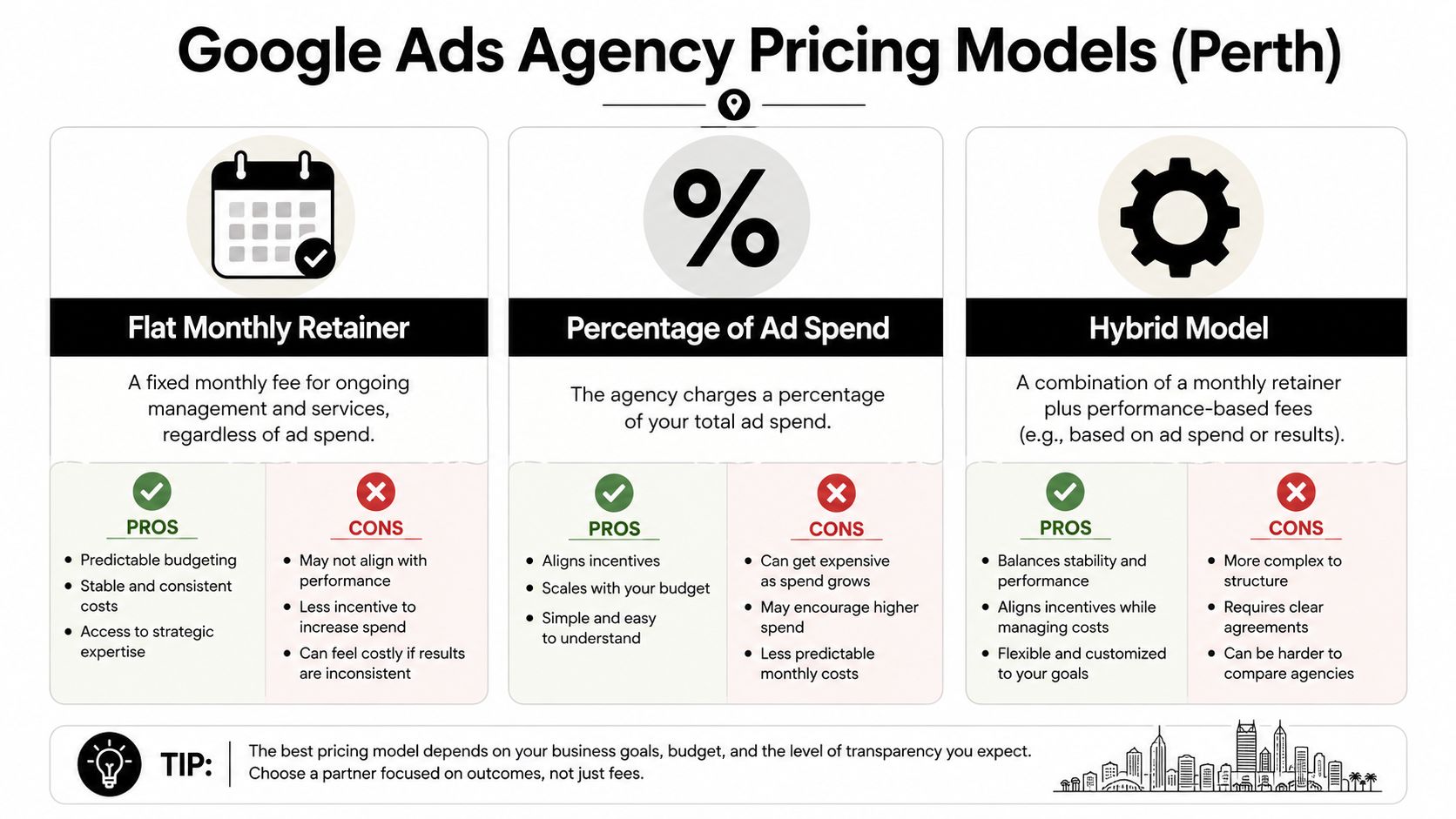
The common pricing models
Here's how I look at them.
| Model | How it works | Good fit | Risk |
|---|---|---|---|
| Flat retainer | Fixed monthly fee | Stable accounts with defined scope | Can drift into low effort if scope is unclear |
| Percentage of spend | Fee rises with ad spend | Scaling accounts with active management needs | Incentive can lean toward spending more |
| Hybrid | Base fee plus extra component | Businesses wanting predictability with some alignment | Can become confusing if not documented cleanly |
What should be included in the fee
A lot of disappointment comes from mismatched expectations, not necessarily bad intent. One owner thinks they're paying for growth strategy. The agency thinks it's being paid to tweak bids and send reports.
For a Perth business, management should usually include:
- Keyword and search intent research
- Campaign setup and account structure
- Conversion tracking oversight
- Negative keyword maintenance
- Ad testing
- Landing-page feedback
- Reporting with actual commentary
If that isn't part of the deal, the lower fee might not be cheaper at all. It might just push work back onto you.
Cheap fees usually create expensive problems
I've seen this a lot. The account gets handed to a junior coordinator, settings are copied from another client, reporting is mostly automated, and the only optimisation happening is small bid adjustments. It looks active. It isn't strategic.
An eCommerce brand, for example, might need ads, feed fixes, product segmentation, tracking checks, and website refinement to work together. That's why many businesses end up wanting more than ad management alone and look for a broader eCommerce marketing agency setup that can connect traffic, store performance, and conversion rate work.
Don't judge a fee in isolation. Judge it against the quality of tracking, testing, and strategic input you're actually getting.
Your First 90 Days What to Expect
The first three months tell you a lot about whether the relationship is going to work. Not because everything should be perfect by then, but because a good agency leaves a trail of clear actions, decisions, and learning.
If the opening phase feels vague, rushed, or overly automated, that usually shows up later as unstable results and hard-to-explain reporting.
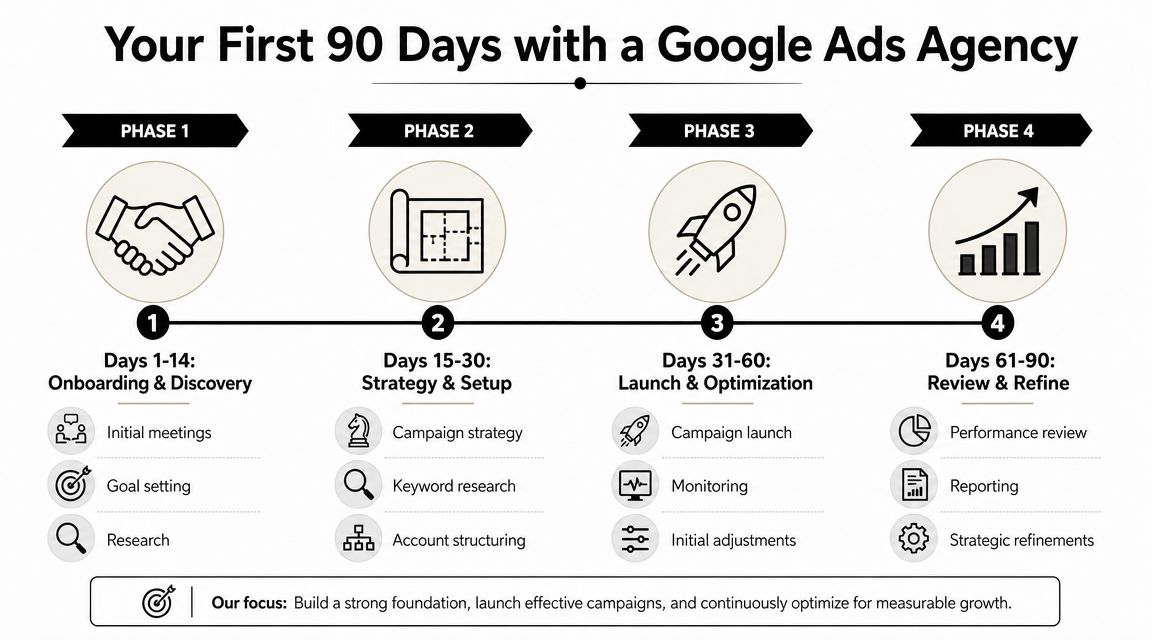
Days 1 to 14
A healthy start isn't about launching fast. It's about getting the basics right.
The agency should gather account access, clarify goals, review historical data, inspect your landing pages, and confirm what counts as a genuine conversion. If you're in eCommerce, that means purchases and revenue tracking. If you're a service business, that could mean calls, booked consultations, or qualified forms.
This is also where hidden problems come up. Duplicate conversions. Broken thank-you page tracking. Forms that don't fire properly. Calls going unanswered. CRM stages that never feed back into the ad platform.
Days 15 to 30
Here, strategy turns into build.
Campaigns get structured, keyword lists are refined, geo settings are checked, ad copy is written, extensions are organised, and exclusions are added. If the agency is competent, they'll also have a view on landing-page fit before anything goes live.
The first launch should be controlled. You're not trying to “scale” yet. You're trying to get clean signals into the account.
For some businesses, this stage also includes supporting setup work in Google Tag Manager, GA4, merchant centre, or site-level updates. One option in that broader mix is Alpha Omega Digital, which works across paid ads, website builds, and conversion-focused development for WordPress and Shopify businesses.
Days 31 to 60
Campaigns are live now, and during this phase weaker agencies get exposed. They either panic and make too many changes, or they disappear and call it “machine learning”.
The right approach sits in the middle. Watch search terms. Review device and location performance. Compare landing-page behaviour. Check call quality. Make measured changes, not emotional ones.
A few things you should expect to hear in this phase:
- What search intent is proving strongest
- Where waste is leaking in
- Whether the landing page is matching the query
- Which conversions look useful and which don't
Days 61 to 90
By now, the agency should have enough account history to stop speaking in generalities.
You want a real review. What's working. What isn't. What should be cut. What deserves more budget. Whether bidding strategy should stay manual or move further into automation. Whether the issue is in the account or after the lead arrives.
That last part gets missed constantly. Sometimes the ads are fine, but the business is slow to answer calls, slow to reply to forms, or weak at turning leads into sales. A mature agency will say that out loud.
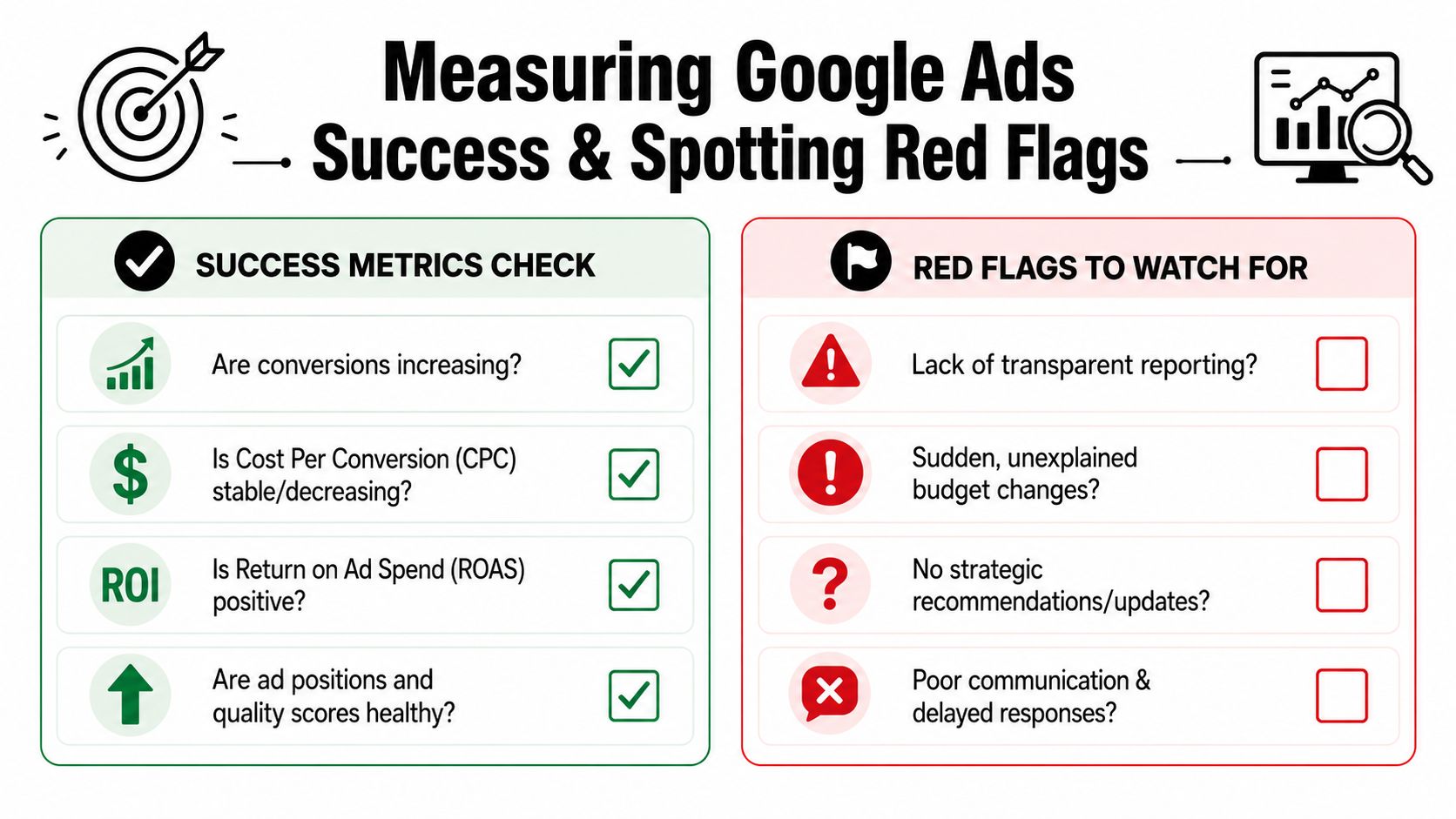
Measuring Success and Spotting Red Flags
Most underperforming Google Ads relationships survive longer than they should because the reporting sounds busy. Lots of charts. Lots of platform terms. Not much clarity on whether the business is getting better customers at a sensible cost.
A practical benchmark often used by Australian agencies is a 4.4% average Google Ads conversion rate for search campaigns, while 10% is described as a rare “unicorn” result, according to this Australian benchmark discussion on Google Ads conversion performance. That benchmark matters for one reason. It keeps your attention on conversions, not clicks.
The dashboard I'd want to see
You don't need a complicated report. You need a useful one.
| Metric | Why it matters |
|---|---|
| Conversions | Shows whether ads are producing desired actions |
| Cost per conversion | Tells you what you're paying for each lead or sale |
| Conversion quality | Stops low-quality enquiries from being treated as success |
| Search term quality | Reveals wasted spend and intent mismatch |
| Landing-page performance | Helps explain why good traffic may still fail |
For eCommerce businesses, I'd also want purchase value and product-level context. For service businesses, I'd want booked jobs or sales-qualified leads, not just raw form counts.
Google Ads doesn't work in isolation either. If your product pages are weak or your checkout is clunky, paid traffic will expose those problems fast. If you want a practical non-platform view on how to optimize your sales funnel, funnel thinking is often more useful than staring at ad metrics alone.
A short explainer can also help if you're reviewing results with your team:
Red flags I take seriously
These are the patterns that usually mean the agency isn't managing thoroughly enough:
Reporting without insight
If every report just repeats platform metrics with no recommendations, strategy is thin.No admin access
Your business should own the account, data, and key assets.No discussion of lead quality
Cheap leads can destroy performance if nobody checks whether they turn into revenue.Constant excuse-making around automation
Automation isn't a shield against accountability.Silence on landing pages
Good agencies don't pretend the website is someone else's problem forever.
If the agency can't connect ad performance to business outcomes, they're managing media, not growth.
What strong communication sounds like
A strong Google Ads agency Perth businesses can trust won't just say “performance is improving”. They'll say things like:
- Search intent is good, but the form is too long.
- Calls from one suburb convert better than another.
- Broad match is surfacing useful queries, but negatives need tightening.
- The campaign is doing its job, but follow-up speed is hurting close rate.
That's the level of honesty you want. Clear. Commercial. Useful.
Ready to Grow Your Perth Business with Google Ads
A Perth owner usually gets to this point after wasting enough budget to know the pattern. Clicks are coming in. Leads look fine on paper. Sales still feel patchy, and nobody can explain which campaigns are producing real revenue versus noise.
That gap is where good agency work lives.
A strong Google Ads agency for a Perth business does more than launch campaigns and send monthly reports. Its core job is setting up clean measurement, giving Google the right conversion signals, and putting guardrails around automation so smart bidding works for your business instead of chasing cheap form fills. That is the difference between an agency that happens to be nearby and one that can improve return on ad spend.
I look for agencies that treat Google Ads as part of an operating system. Search terms, landing pages, offline conversion tracking, call handling, CRM stages, sales feedback, and budget pacing all affect results. If those pieces are disconnected, performance gets distorted fast.
There is also a practical trade-off here. A highly specialised agency may challenge your site, your offer, or your follow-up process more than a generalist will. Some owners find that uncomfortable. The better agencies do it anyway because they know ad account changes alone rarely fix a weak sales process.
If you're comparing options now, ask direct questions and listen for direct answers. Ask how they feed qualified lead data back into Google. Ask who owns the account. Ask what they would change in the first month, and what they would leave alone until the data is clearer. Good operators can explain that without hiding behind jargon.
If you want help from Alpha Omega Digital, the offer is simple. Businesses spending at least $3,000 a month on paid ads can apply for a free month of management through the contact page. Alpha Omega Digital is based in Melbourne and works with businesses across Australia, including Perth.
[email protected]
Read more insights from our team on web design, paid ads, and growth strategy.