You're paying for clicks, the phone's ringing, and your estimator is spending the afternoon explaining that you don't do minor patch-ups or take on apprentices through the quote form. Meanwhile, the extension projects you want aren't turning into booked site meetings.
That's a frustrating way to buy enquiries. Google Ads for construction companies should be measured by cost per signed job, not by how busy the inbox looks. I'd start by tightening what you advertise, proving your suitability before the enquiry, and connecting campaign spend to the work you win.
Campaign Structure by Service and Suburb
Say a Melbourne extensions builder runs a broad campaign around construction company. After weeks of answering students, job seekers and homeowners wanting free quotes for tiny repairs, they increase the budget because the account appears to need more traffic.
I'd fix the structure first. Someone planning an extension needs a different advertisement, page and qualification process from someone looking for urgent roof repairs.
Campaign structure by service intent
| Service campaign | Typical search intent | Landing page | Primary conversion |
|---|---|---|---|
| Residential building | Homeowners planning a new home or major build | Residential builder page by suburb | Qualified consultation booked |
| Renovations and extensions | Homeowners with a defined scope and budget | Renovation page with project gallery | Quote form with project type and budget |
| Commercial fit-outs | Business owners and property managers | Commercial fit-out page with case studies | Site meeting booked |
| Roofing and emergency repairs | Urgent need for a call-back | Emergency page with phone number first | Tracked phone call over threshold |
| Civil and subcontract work | Head contractors and project managers | Subcontract capabilities page | Tender enquiry received |
Construction isn't a single customer market. The Australian Bureau of Statistics reports that Australian construction generated $633.6 billion in total income during 2023–24, including $276.1 billion from construction services.
That breadth is a reason to specialise your account, not advertise every capability in the same campaign.
Build around the work you can deliver
- Separate service intent: Give commercially different services their own campaigns when they need distinct budgets and qualification rules.
- Match geography to travel limits: Target suburbs your team can service profitably, accounting for traffic, supervision and repeat site visits.
- Protect project budgets: Keep major builds separate from small callouts so urgent repair searches don't consume the extensions budget.
This diagram shows the account hierarchy before keywords and advertisements are added.
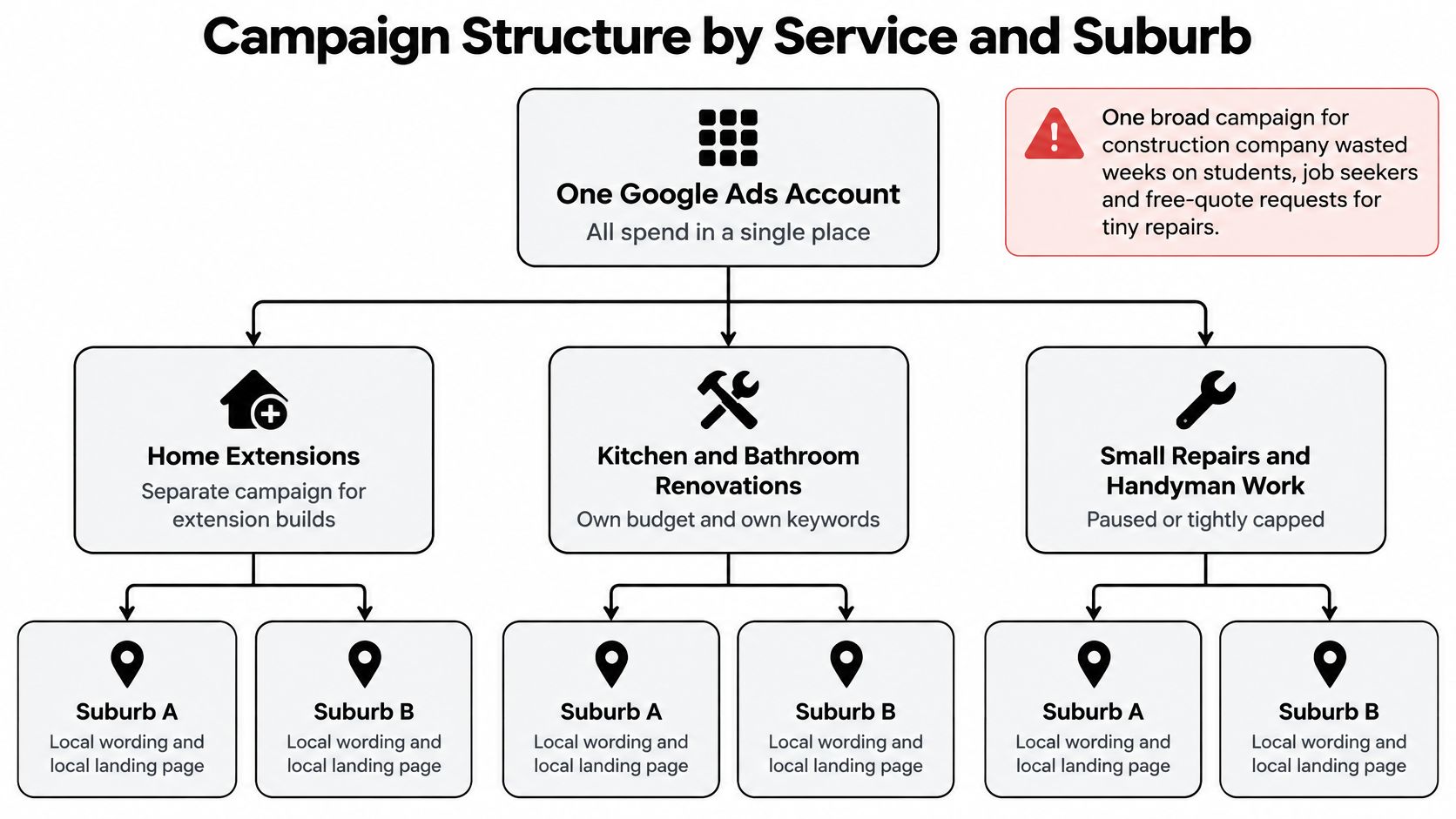
For the extensions builder, I'd sketch separate suburb groups for Mornington Peninsula and inner east Melbourne. Each gets locally relevant ad groups and a landing page showing suitable projects, service boundaries and consultation options.
There's an important platform distinction: standard campaign budgets sit at campaign level, not ad-group level. If those suburb groups need independent budget lines, split them into separate campaigns; otherwise, keep them together and compare geographic performance before adding complexity.
Finish the planning sheet first
Before opening Google Ads, record your services, suburbs, practical drive times, average job value and available project capacity. Beside each service, write the action that counts as a win.
For an extensions builder, that might be a confirmed consultation with an owner whose address, scope and budget fit. It shouldn't be any interaction that happens to trigger a tag.
Keywords to Target and Negatives to Block
Search patterns and how to treat them
The reference volumes below come from Uppercut Digital's Australian construction keyword analysis, which reports approximately 6,600 monthly searches for builders near me, 4,400 for construction company and 2,400 for construction company near me.
| Search pattern | Monthly searches | Intent | Recommended action |
|---|---|---|---|
| builders near me | Approximately 6,600 | Mixed: homeowners, job seekers, researchers | Test only with tight negatives |
| construction company | Approximately 4,400 | Broad and weak | Exclude or limit to phrase match |
| construction company near me | Approximately 2,400 | Local but mixed | Pair with service and suburb terms |
| [service] + [suburb] + quote | Assess in Keyword Planner for your service area | High project intent | Core keyword for each campaign |
| careers, apprenticeship, salary, course | Volume isn't a buying criterion | Job seeker or student | Add as campaign negatives |
The biggest number isn't automatically the best opportunity. A person searching construction company might want employment, a business definition, a university assignment or a builder.
You pay for the click before you discover which.
Start with specific project language
I'd build the initial keyword list around the service, location and commercial action. Useful patterns include extension builder Mornington, commercial fit-out contractor Melbourne, residential builder Camberwell and roof replacement quote Frankston.
These long-tail keywords give you a clearer connection between what the person wants and what your page offers. They don't guarantee cheap clicks, easy organic rankings or a top advertising position.
Start with exact and phrase match, but don't assume either means literal-only matching. Review actual search terms because matching can reach searches beyond the wording you entered.
Practical rule: If you can't identify the relevant service page and explain why its next step suits the searcher, don't add the keyword yet.
A keyword containing quote can still attract unsuitable projects. Use the advertisement and landing page to establish project scope rather than treating a buying word as proof of qualification.
Block intent you won't serve
Create a shared negative list for employment and education intent where it applies across the account. Add service-specific exclusions at campaign level so they don't accidentally block useful traffic elsewhere.
- Employment: Careers, jobs, salary, vacancies and recruitment.
- Training: Apprenticeship, course, certificate and university.
- Self-service research: DIY, template and how to build.
- Unsupported work: Handyman, tiny repairs or other services you don't offer.
Be careful with blanket exclusions. A commercial contractor might need searches containing subcontractor, while a recruitment-related negative containing contractor could remove relevant opportunities if configured poorly.
Negative keywords also need deliberate match-type choices. Excluding a precise unwanted phrase is safer than blocking an ambiguous word across every campaign.
Review searches against project fit
Make the search terms report a weekly working document. Mark queries as relevant, unsuitable or uncertain, then check whether the associated enquiry became a real opportunity.
Move obvious waste into negatives immediately. For uncertain searches, inspect the destination page and enquiry details before excluding them.
I'd only introduce broad match with Smart Bidding once qualified conversion feedback and a maintained negative list are in place. Broadening an account that only measures raw submissions can help it find more of the wrong enquiries.
Ad Copy and Extensions That Pre-Qualify Clicks
Extension Builder Mornington Peninsula tells a homeowner more than a vague claim about quality construction. It establishes the service and location before you pay for the visit.
I'd write responsive search ads around service and suburb, verifiable credentials, and a useful next step. Use licence or insurance wording only when it's accurate, applicable and suitable for the available ad field.
A practical responsive search ad
| Ad component | Example |
|---|---|
| Headline | Mornington Extensions |
| Headline | Inner East Home Extensions |
| Headline | Book a Site Meeting |
| Description | Planning a home extension? Explore completed projects and check our service areas. |
| Description | Major extension projects only. Share your suburb, scope and budget to discuss fit. |
If the builder has an established minimum project budget, state the actual approved minimum in an eligible description or on the page. Don't invent a dollar amount to make the advertisement feel more specific.
That qualifier may reduce clicks. I'd accept that trade-off if it reduces unsuitable estimating work.
Use assets that help people choose
- Sitelinks: Direct visitors to relevant renovation projects, commercial capabilities and the consultation process.
- Call assets: Display the appropriate tracked number when someone can handle the enquiry.
- Location assets: Connect an eligible, accurate Google Business Profile. Set geographic targeting separately because a location asset doesn't define your service radius.
- Structured snippets: List genuine services such as extensions, renovations and custom homes.
Keep each ad group focused on a coherent service and suburb set. An extension keyword shouldn't trigger a generic roofing message or lead to a page listing every trade.
During the weekly search review, compare unwanted queries with the ad wording. If the copy sounds like a recruitment advertisement or promises small-job availability you don't offer, rewrite it rather than relying solely on negatives.
Landing Pages That Earn Trust Before the Call
The click starts the buyer's assessment. Before sharing plans or booking a meeting, a homeowner wants to know whether you do their kind of work, cover their suburb and can substantiate your credentials.
A construction landing page should answer those questions without requiring a sales call. Attractive design helps, but a polished page without project evidence leaves the buyer doing the verification elsewhere.
Ad Astra Marketing's construction and trade-services report states that 89% of Australians search for a business online before contacting it, even after a recommendation, while 73% read reviews and 68% compare competitors online.
Show evidence before asking for commitment
- Relevant headline: Name the advertised service and genuine service area.
- Verifiable credentials: Display applicable licence details and explain relevant insurance, including home-warranty arrangements where appropriate.
- Project evidence: Show completed work with suburb names, scope and useful captions, subject to client permission.
- Commercial expectations: Explain inclusions, budget suitability, exclusions and how timelines are established.
- Local coverage: Provide a readable service-area map or suburb list.
- Client feedback: Include attributable reviews without presenting exceptional results as guaranteed.
- Clear contact options: Make the phone number and project enquiry action easy to find.
The enquiry should feel like the beginning of a project discussion, not a request to surrender contact details.

An Australian builder-advertising review by Click Click Media found that none of the 20 observed advertisers displayed a licence number or mentioned home-warranty insurance. That's a finding about the observed sample, not proof that every advertiser had a legal obligation to include those details.
Still, it identifies a useful conversion opportunity: make relevant verification straightforward. Have the builder approve credential wording rather than allowing a copywriter to infer coverage.
Qualify without making the form exhausting
I'd ask for project type, budget range and project address alongside contact details. Explain why you need the information and provide a sensible option when the owner hasn't finalised their scope.
Test that qualified form against a shorter version. Compare cost per qualified enquiry, not just submission rate, and check whether your team spends less time rejecting unsuitable jobs.
For a separate roofing enquiry reference, America Roofing's request a free roofing quote page is a concrete example to inspect when considering the customer's next step. It's an overseas reference, not a guide to Victorian licensing or insurance requirements.
On WordPress, I'd prioritise reusable project and enquiry components over decorative complexity. A WordPress development specialist can build maintainable Gutenberg blocks so staff can update evidence without rebuilding layouts.
Finally, load the page on a phone using mobile data. Check how quickly the number and quote button become usable, whether the form keyboard suits each field, and whether sticky buttons obscure important information.
Conversion Tracking Builders Should Set Up
A cheap form fill can be worth less than an expensive site meeting. If both count equally as primary conversions, you're asking Google Ads to optimise towards activity rather than commercial suitability.
Conversion actions and how Google Ads should use them
| Conversion action | How it is captured | Counting rule | How Google Ads uses it |
|---|---|---|---|
| Phone call from ad | Call tracking number or call asset | Call over an agreed duration, confirmed as qualified | Secondary lead until qualified |
| Quote form submitted | Thank-you page or form event tag | Every completed form | Lead signal with low weight |
| Qualified site visit booked | CRM stage imported as offline conversion | Booked and confirmed in the CRM | Primary optimisation signal |
| Quote accepted and contract signed | CRM won deal imported with value | Signed contract value | Value-based bidding target |
| Job invoiced and paid | Accounting or CRM value imported | Final invoice amount | Used to judge profit by campaign |
Capture each stage without double counting
For calls, consider CallRail, GoHighLevel or a custom Twilio integration according to your reporting and routing needs. A duration threshold can filter accidental calls, but it can't tell you whether the caller has a suitable project.
Have the person answering confirm suburb, service, budget suitability and next step. Record a qualification outcome in the CRM rather than assuming a lengthy conversation is valuable.
For forms, configure Google Tag Manager to capture a successful submission, not a button click. Test validation failures, refreshes and repeat visits, then compare Google Analytics events with actual CRM records.
- Preserve attribution: Capture the relevant advertising identifiers and lead details using an appropriately governed implementation.
- Import outcomes: Send confirmed qualification and won-project events back through a supported offline conversion workflow.
- Choose bidding goals deliberately: Don't make every funnel stage primary and count the same opportunity repeatedly.
- Record rejection reasons: Use clear categories for distant suburbs, unsupported work, unrealistic budgets and speculative enquiries.
Weight opportunities by commercial value
Buildern's construction-marketing discussion cites industry evidence of referrals converting at roughly 40%, alongside a separate benchmark in which paid-search enquiries achieved a 17.8% verified sales-qualified-lead rate. These are directional findings with different measures, not directly comparable universal Australian averages.
The useful lesson is to evaluate what happens after the enquiry. Your own qualification and close rates should determine what you can afford to pay.
Use actual historical outcomes to estimate stage values if you adopt value-based bidding. Don't assign arbitrary values that make booked meetings look more profitable than they are.
A signed contract is revenue evidence. Profit still requires labour, materials, subcontracting, overheads and delivery costs.
Keep invoice revenue and project margin separate in reporting. An imported invoice amount alone doesn't establish profit, and a paid invoice shouldn't create another acquisition win for the same job.
The management report should show cost per qualified opportunity and cost per signed contract by campaign, with enough CRM detail to explain why each changed.
How Much Budget a Builder Needs to Start
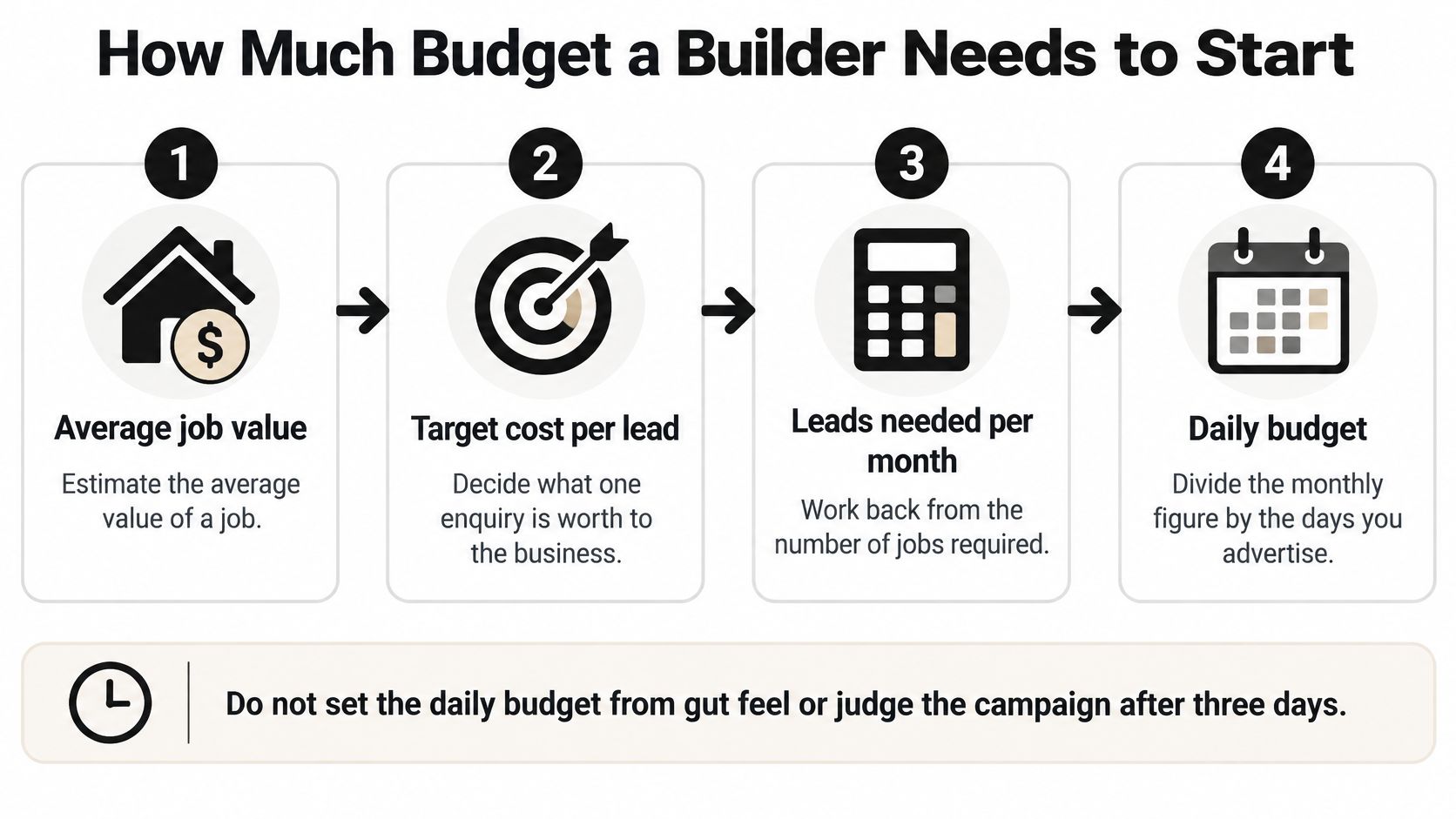
A daily budget picked from gut feel, then judged after a few days of spend, proves nothing about whether the economics work. Construction jobs take time to close, so money spent this week may not appear as a signed contract for weeks. Start with the cost of winning suitable work, then check whether cash and capacity can support the test.
There is no universal starting figure. A builder quoting large projects and a business handling urgent repair callouts need different acquisition models: different job values, different close rates, different sales cycles.
Work backwards from an affordable signed job
- Estimate the average job value you want to win. Use the advertised service, not a blended figure covering unrelated work.
- Calculate your qualified-enquiry close rate. Count confirmed opportunities only, not every phone call and form.
- Set an affordable acquisition cost. Cover materials, labour, overheads and retained margin first; what remains is the most advertising can consume.
- Build the monthly budget. Multiply the affordable cost per signed job by the number of extra jobs you can deliver.
- Allow a meaningful test. I'd give campaign diagnostics an initial two-to-four-week review window, then let the actual sales cycle mature before judging the result at contract level.
Each step feeds the next, so the final daily figure stays tied to real commercial assumptions.
An illustrative calculation in Australian dollars
Suppose a business targets jobs averaging $10,000, signs one in four qualified enquiries, and pays $400 per qualified enquiry. Those hypothetical inputs produce a $1,600 cost per signed job.
The arithmetic is simple: four qualified enquiries at $400 each. Whether $1,600 is affordable depends on what the job contributes after delivery costs, not the headline contract value.
| Illustrative input | Planning implication |
|---|---|
| Average job value of $10,000 | Revenue is not the margin available for advertising |
| One signed job from four qualified enquiries | Qualification and sales follow-up shape acquisition cost |
| $400 per qualified enquiry | Produces a hypothetical $1,600 cost per signed job |
| Limited delivery capacity | Size the budget around work you can actually fulfil |
If the available spend cannot test every service properly, consolidate campaigns. One commercially coherent service area tested well beats a thin budget spread across unrelated project types, where no ad group gathers enough data to judge.
For bidding, manual CPC gives you direct control early on where it is still offered. Maximise Conversions can work once conversion definitions and tracking are dependable. I would not accept an ambitious target CPA because the interface recommends one; set it only when the account has real signed-job data behind it.
Keep cash flow and fees separate
A signed project does not deliver the whole contract value at once. Check deposit timing, progress claims and supplier commitments before raising acquisition spend; the cash flow advice from Blue Gas Express covers the construction side of that planning.
Advertising budgets are paid separately unless otherwise agreed, and Alpha Omega Digital is responsible for campaign management only. Keep media spend and management fees as separate lines so you can measure both the advertising cost of a signed job and the fuller cost of winning the work.
Diagnosing Campaigns That Stall or Waste Spend
The complaint usually sounds simple: the account spends, but the phone stays quiet. Or the phone rings, but nearly everyone wants work you don't do.
Those are different problems. Changing bids, pages, geography and conversion settings together makes it harder to identify which fix helped.
Symptoms, first checks and wait times
These are practical review windows I'd use, not promises that a result will arrive within them.
| Symptom | First check | Wait before judging |
|---|---|---|
| Budget not spending | Daily budget cap, bid level against the auction, keyword list breadth for the suburbs served | Two to four weeks |
| Plenty of leads, poor quality | Search terms report, broad match settings, missing negatives, service radius | Two weeks after new negatives |
| Calls missing or very short | Call asset active, number visible on the mobile page, landing page speed on a phone | One week |
| Cost per signed job rising | Duplicate conversion events, stopped offline imports, values that no longer match margins | Two to four weeks after fixing tracking |
When the budget won't spend
First distinguish underspending from a campaign that spends its allocation but has limited reach. A daily budget cap can restrict delivery, but it doesn't explain an account consistently spending far below its allowance.
Check billing, policy status, ad eligibility, keyword demand and bid competitiveness. Then inspect whether the selected suburbs and keyword list leave enough eligible searches.
I'd fix technical eligibility immediately. For a demand or bidding adjustment, use the review window above while monitoring delivery, and avoid expanding into unsuitable suburbs merely to spend the allocation.
When enquiries don't fit
Read the actual queries alongside the rejected CRM records. A rise in repair enquiries could come from ambiguous keywords, overly broad service language or a page that appears to welcome all job sizes.
Make the smallest relevant change first. After adding negatives, compare newly generated enquiries rather than mixing them with older leads already in the pipeline.
- Wrong service: Tighten the query and advertisement.
- Wrong location: Correct geographic settings and page wording.
- Wrong budget: Clarify suitability before submission.
- No commercial intent: Exclude employment, training or research searches.
When calls or reported wins disappear
Test the number from a real phone, verify routing, and check that mobile visitors can tap it. Distinguish a telephone failure from a reporting failure before pausing useful traffic.
For rising cost per signed job, reconcile the advertising report against the CRM. Check duplicate events, failed imports, stale values and the time between enquiry and contract.
Change discipline: Fix broken tracking immediately, but don't interpret the first corrected report as a new performance trend.
My operating routine would start with data and tracking in the opening week, move to search-term quality in the following week, and review acquisition economics around the month mark. For longer construction sales cycles, keep older enquiry cohorts open until their outcomes are known.
Choosing a Google Ads Partner for Your Construction Business
You can run the account yourself if you have the hours to maintain tracking, review search terms and follow enquiries through to signed work. Hiring a partner makes sense when you need those disciplines handled consistently; the interface itself is rarely the hard part.
Before choosing either route, settle account ownership, website access and who will keep CRM outcomes current. Even a capable campaign manager can't reconstruct a reliable sales history from an inbox full of unlabelled enquiries.
The right conversation covers the advertising and the practical handling of project enquiries together.

Look for an operating plan, not a placement promise
If you're comparing a marketing agency in Melbourne, I'd prioritise clarity about responsibilities over a polished forecast. You need to know who handles the account, who implements tracking, who edits landing pages and who marks opportunities as won or lost.
Use the first conversation to test the proposed approach.
- Campaign judgement: How would they divide your services and suburbs without fragmenting the budget?
- Measurement: How will telephone enquiries and offline outcomes reach the report?
- Initial priorities: What would they fix before increasing spend?
- Landing-page evidence: Who verifies licence details, insurance wording and permission to publish project photos?
- Reporting: Will you receive qualified-opportunity and signed-job costs, with rejected-lead reasons?
- Ownership: Will your business retain access to the advertising account, analytics and relevant assets?
Licence details, insurance wording and published project evidence aren't decoration. They're conversion variables, because cautious clients verify before they call. A homeowner-facing list of questions to ask before hiring remodelers shows exactly what that verification looks like from the buyer's side, and your landing page should answer those questions early.
We offer Google Ads campaign management, including trade-specific services such as Google Ads for plumbers. Because the constraint often sits outside the ad account, our work also covers website development, CRM integrations and marketing automation.
Match the website and follow-up to the business model
Construction suppliers selling products online need a different conversion architecture from builders selling consultations. Our Shopify development services and ecommerce marketing services address that product-led model; project lead generation is a separate discipline with its own tracking and follow-up demands.
For a builder, I'd fix enquiry routing before adding extra channels. A Twilio number can route calls into a CRM, and a configured answering integration can capture project details and book available appointments into a calendar or Calendly.
Treat that as an implementation option. An automated assistant won't handle every construction enquiry, so test availability, escalation, privacy, booking accuracy and failure handling before relying on it for after-hours calls.
This walkthrough adds context ahead of a project discussion.
Agree on scope and realistic expectations
Judge proposals on cost per signed job. Cost per lead alone hides whether enquiries ever become contracts, and a cheap enquiry that goes nowhere is still expensive.
No provider can guarantee rankings, enquiries, ROAS or revenue. Alpha Omega Digital doesn't guarantee specific marketing or business outcomes, including traffic, sales, leads, CPA, conversion rates or search engine indexing.
Paid advertising buys participation in an auction. Organic local SEO and an accurate Google Business Profile support credibility, and none of it removes the need to assess campaign economics against signed work.
We're based in Melbourne and work with Australian businesses. Before you get in touch, know your available media budget and the condition of your tracking and landing pages; a realistic scope starts there. Advertising spend is paid separately unless otherwise agreed, and our responsibility is campaign management.
Alpha Omega Digital provides Google Ads management, conversion-focused websites and CRM integrations that connect construction enquiries with signed work. Submit a project overview through the contact page, or visit Alpha Omega Digital, and we'll come back with clear next steps for your services, suburbs and acquisition targets.
Alpha Omega Digital
Read more insights from our team on web design, paid ads, and growth strategy.