A click for a commercial fit-out search can cost about US$26, according to SEO for Builders Australia's reported Australian construction search costs for 2026. That's a useful way to frame Google Ads for construction: you're buying access to a potential project, not buying a project. Whether that click is worthwhile depends on who searched, what they need built and whether your business can win the work profitably.
I'd rather pay more for a conversation about a suitable, funded project than celebrate cheap enquiries that never reach an estimator. For a Melbourne builder, the useful questions are practical: which jobs deserve their own budget, which suburbs are worth travelling to, who answers the phone and what happens after someone requests a quote?
Australian Click Costs and Monthly Budgets
Australian builders were reported to spend approximately A$1,200 to A$3,000 per month on Google Ads in 2026, with typical CPCs of A$3 to A$18 and CPLs of A$70 to A$200, according to Vex Management's builder advertising benchmarks. Those are planning references, not a price list for your account.
The construction search estimates introduced above also show why you shouldn't adopt a single national cost-per-click assumption. Different services attract different buyers, and the sources even report their figures in different currencies.
Reported Australian construction Google Ads costs in 2026
| Search or benchmark | Reported cost | Source |
|---|---|---|
| Builders near me | About US$9 per click | SEO for Builders Australia |
| Renovation searches | About US$18 per click | SEO for Builders Australia |
| Fit-out companies | About US$26 per click | SEO for Builders Australia |
| Broader builder benchmark, typical CPC | A$3 to A$18 | Vex Management |
| Broader builder benchmark, typical CPL | A$70 to A$200 | Vex Management |
| Broader builder benchmark, monthly spend | A$1,200 to A$3,000 | Vex Management |
Currencies are kept as reported. These figures don't establish an agreed Australian construction CPC, and converting the US-dollar figures wouldn't make the underlying samples directly comparable.
A bathroom renovation and a commercial fit-out shouldn't share a budget because both involve construction. They have different margins, qualification requirements, estimating workloads and sales cycles. The commercial enquiry might justify a higher acquisition cost, but it can also tie up your team preparing a tender you never win.
Pick a test you can afford to finish
For an initial test, I'd choose one billable service and a defined service area. For modest-value work, I'd start towards the lower end of the reported monthly spending band; for larger quoted projects, I'd consider the upper end, provided the business can handle the enquiries.
That's a recommendation about concentration, not a promise that the budget will produce enough contracts. An account spreading limited spend across extensions, roofing, emergency plumbing and office fit-outs may collect activity without producing a useful comparison.
Before launch, decide what would justify continuing:
- Commercial fit: Enquiries match the work your team wants and can deliver.
- Geographic fit: The site is inside an area you can service profitably.
- Sales progression: Relevant enquiries become site visits, priced quotes or tender discussions.
- Financial fit: The potential margin supports advertising and estimating costs.
Budget rule: Don't increase spend because clicks are cheap. Increase it when suitable enquiries progress into work you'd genuinely price.
Keep media spend separate from management fees, landing-page development and tracking implementation. Otherwise, a budget discussion becomes misleading: the owner thinks the full amount reaches Google while part of it funds the work required to run the account.
If the initial test produces irrelevant enquiries, fix targeting before adding money. If it produces good enquiries but no quotes, investigate availability, follow-up and estimating capacity. More traffic won't repair a broken handover.
Campaigns Split by Service and Suburb
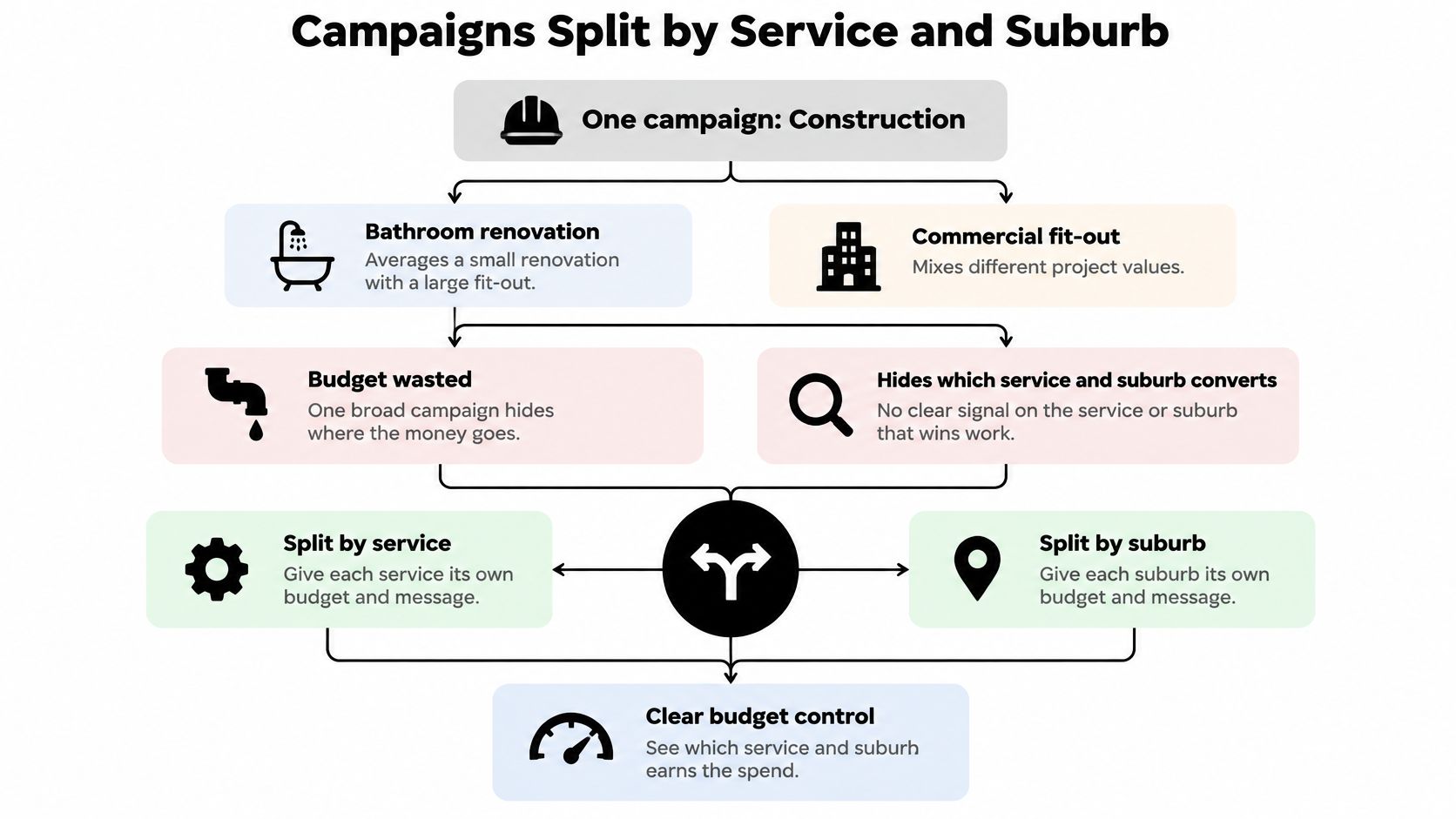
A campaign called Construction hides too much. When bathroom renovations and commercial fit-outs share targeting, ads and budgets, an account-wide average can conceal which service generates worthwhile opportunities.
The market is broad enough to justify greater care. The Australian Bureau of Statistics construction industry overview reports $568 billion in total income during 2022–23, with 68.6% of construction employment concentrated in construction services. That services base includes distinct local offers, not a single interchangeable category of work.
The following flowchart shows the difference between a mixed campaign and a structure an owner can understand.
Build around work you will actually quote
- List the billable services. Separate bathroom renovations, home extensions, roofing, electrical, plumbing and commercial fit-out only where the business offers them. Don't advertise a service merely because it attracts searches.
- Map each service to the suburbs you'll travel to. Emergency repairs may need a tighter radius than a substantial renovation. Include travel, access and supervision costs in that decision.
- Create one campaign per service. Give each offer a controllable budget. Keep branded searches separate when they would otherwise obscure the cost of acquiring unfamiliar customers.
- Add phrase and exact keywords to tightly themed ad groups. Examples include bathroom renovation Brunswick and roof repair Geelong. Use these as relevant targeting themes, not as a reason to manufacture pages for places you don't serve.
- Send each ad group to a matching page. The page should explain the service, identify the service area and provide a quote form and click-to-call option.
- Set a daily budget you can sustain through the sales cycle. Leave room to assess actual opportunities rather than repeatedly pausing and restarting whenever an expensive click arrives.
Control geography without fragmenting the account
Splitting by suburb doesn't mean every suburb needs its own campaign. I'd create separate geographic campaigns when there's a genuine operational difference, such as another crew, a different offer or a need to protect a location's budget.
Otherwise, group sensible service areas and retain location reporting. Excessive fragmentation leaves you managing a collection of tiny campaigns without enough meaningful outcomes to compare.
Check Google Ads location options carefully. For local site-based work, prioritise people physically in your target area rather than assuming anyone interested in Melbourne is a suitable prospect. Exclude locations you won't service, then inspect the locations associated with actual enquiries.
The ad and landing page should make the same promise. An extension ad shouldn't land on a general homepage where the visitor has to work out whether you build extensions at all.
Keep the structure readable enough that the owner can answer a straightforward question: which service, in which area, produced this opportunity? If answering requires combining unrelated spreadsheets, simplify the account and improve lead attribution.
Buyer Intent Filters and Negative Keywords
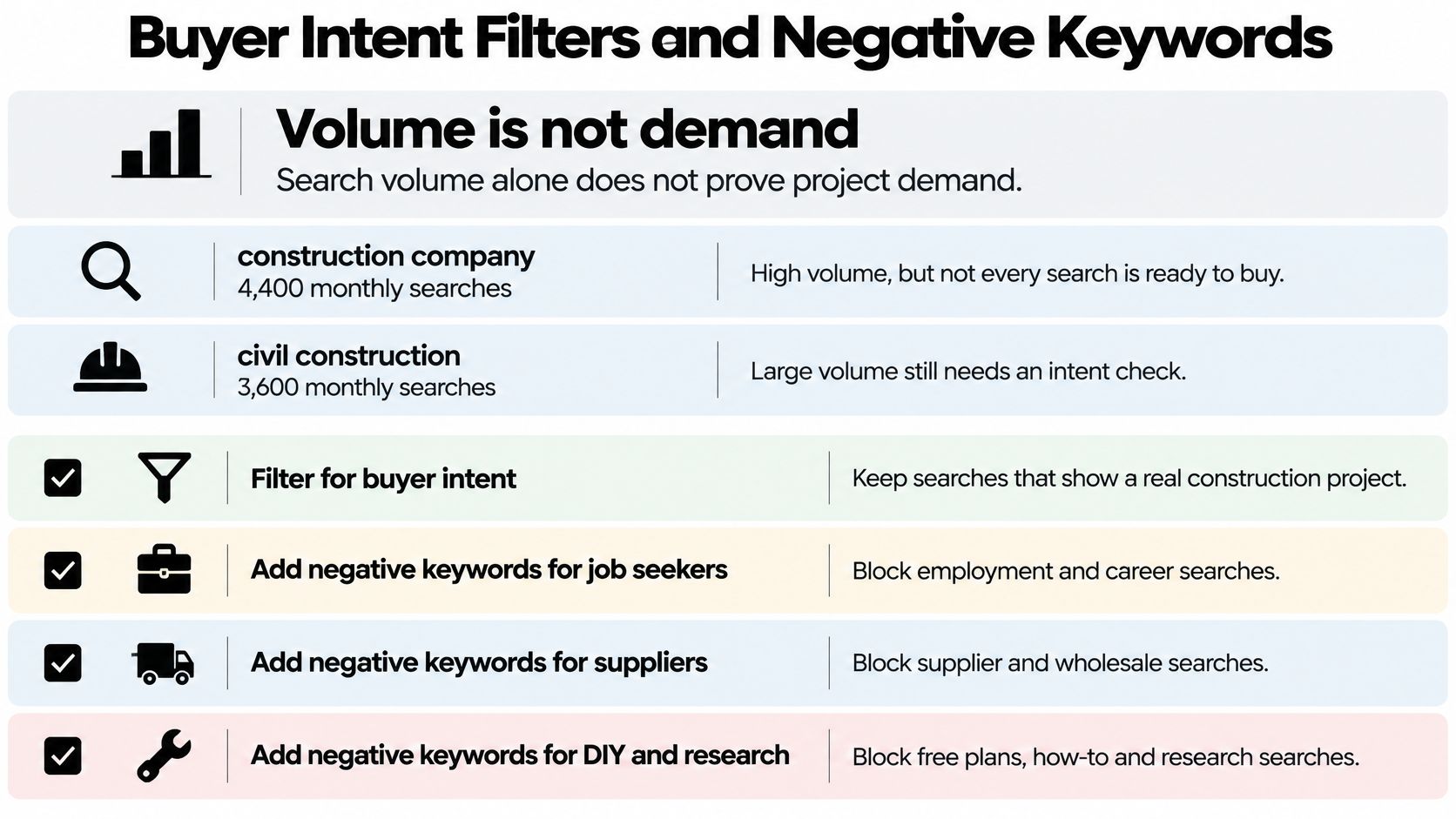
High search volume isn't the same as project demand. Uppercut Digital's Australian construction search analysis identifies roughly 4,400 monthly searches for construction company and 3,600 for civil construction, while explaining that these terms can include substantial research and career-related intent.
A student researching civil construction isn't a procurement manager looking for a contractor. Both can trigger broadly targeted advertising, but only one may be relevant to your sales team. A cheaper click from the wrong audience is still wasted spend.
This visual separates useful project searches from employment, supply and DIY traffic.
Search intent types and how to treat them
| Intent | Typical searcher | Campaign action | Example modifiers |
|---|---|---|---|
| Residential project | Homeowner with a defined job | Own campaign with suburb-specific ads | quote, cost, near me, builder, suburb name |
| Commercial procurement | Developer or facilities buyer | Separate campaign asking project type and value | tender, commercial, fit-out, project value |
| Career and research | Job seeker, student or researcher | Exclude as negatives | jobs, careers, salary, apprenticeship, course, TAFE, university |
| DIY and supply | Hobbyist or materials buyer | Exclude as negatives | DIY, materials only, supplier, cheap, free, plans |
Residential ads should describe a recognisable job and service area. Commercial ads need a different conversation: project type, procurement stage, approximate value and whether the buyer is inviting tenders.
Recruitment belongs elsewhere. If you're hiring, fund and measure that separately rather than allowing employment enquiries to appear as successful project conversions.
Review what people actually searched
During launch, I'd review the search terms report at least weekly, then adjust the frequency to match spending and query volume. Don't assume phrase and exact match remove the need for review.
Start a negative-keyword list covering employment, education, DIY and materials-only intent. Then check each proposed exclusion against the work you sell:
- Employment terms: Jobs, careers, salary and apprenticeship are sensible exclusions for project acquisition.
- Education terms: Course, TAFE and university usually belong outside a contractor's sales campaign.
- Supply terms: Supplier and materials only need filtering when you sell installation rather than products.
- Price and planning terms: Cheap, free and plans require judgement. Excluding free might also block a relevant search for a free quote if the negative is configured carelessly.
A short buyer-modifier list helps prioritise tests: quote, cost, near me, builder and genuine suburb names. These aren't guarantees of readiness. Someone researching renovation costs may still be suitable if their scope, budget and timeframe match your offer.
The video below provides an additional reference while you assess the search intent behind your targeting.
Qualification should continue after the click. Ask for project type, location, indicative budget, timeframe and decision stage without turning first contact into a tender application.
Judge these filters by qualified-opportunity rate and estimated project value, not click-through rate alone. A term with attractive engagement but no suitable projects needs investigation, not applause.
Calls Forms and Mobile Landing Pages
Treat the phone as a sales channel, not a decorative icon in the header. A caller who can't tap the number, reaches an unattended handset or gets transferred without context can disappear before your CRM records a useful enquiry.
Start by testing the complete journey on a real phone. Search, open the landing page, tap the call button and submit the form. A desktop preview won't reveal every mobile keyboard, sticky-header or form-validation problem.
Make the page useful at first glance
The landing page should answer the questions a buyer needs resolved before making contact:
- Service match: Confirm the exact work, such as bathroom renovation or commercial fit-out.
- Location match: State the genuine service area without stuffing suburb names into every sentence.
- Evidence: Show relevant completed work and explain what your business delivered.
- Next action: Offer a clear call button and a short project enquiry form.
- Next step: Explain whether someone will call, arrange a site discussion or request drawings.
For Google Ads for contact form submissions, trigger the conversion on a confirmed successful submission, not merely a button click. Test validation errors and repeat submissions so the account doesn't count failed forms or page refreshes as fresh opportunities.
Use Google Tag Manager's preview tools to inspect the event and Google Analytics to review the journey. Keep one clear implementation record so a later website change doesn't duplicate tags.
A sticky click-to-call button can help, but it mustn't cover the form or project photographs. Compress oversized images, remove unnecessary scripts and check the page on an ordinary mobile connection.
Separate contact from qualification
Set up distinct conversion actions for calls, successful forms, qualified opportunities and quotes issued. Keep diagnostic actions available for reporting without treating every action as equally valuable for bidding.
Call tracking needs to distinguish a new prospect from an existing customer, supplier or wrong number. CallRail and GoHighLevel are options to evaluate, but the selection should follow your CRM workflow, number requirements and privacy obligations, not a feature comparison alone.
An answered call isn't automatically a qualified lead. Someone needs to establish whether the business can quote the work.
Log missed calls and assign responsibility for callbacks. If you use a custom Twilio number or automated answering workflow, test routing failures, human escalation and calendar permissions before sending paid traffic to it.
An automated assistant can collect project details and request an appointment through a calendar or Calendly integration when configured appropriately. Don't let it promise pricing, availability or technical advice that your team hasn't approved.
For the initial form, collect name, phone, email, suburb, project type, rough budget and timeframe where each field serves an estimating purpose. Avoid mandatory file uploads before contact unless drawings are essential.
Review answered-call rate alongside lead quality. Repeated one-ring calls, blank submissions or enquiries your team can't locate warrant a tracking and operational check before a budget increase.
Consent and First Party Lead Data
Construction lead measurement is a privacy problem as well as a technical setup problem. Google's Australian privacy guidance explains the role of Australia's Privacy Act and Australian Privacy Principles in personal-information handling, alongside consent requirements for applicable advertising measurement and personalisation uses.
The practical question isn't how much customer information you can collect. It's what you need to connect an advertising interaction to a legitimate business outcome, and whether you're entitled to use it for that purpose.
Keep the data path short and explicit
A useful measurement path connects the ad interaction, the enquiry record and the eventual sales status. The estimator doesn't need unrelated personal details to establish whether a lead became a site meeting, tender invitation, signed contract or lost opportunity.
Document the flow before implementing integrations:
- At collection: Explain why the form or tracked call collects information and provide an accessible privacy notice.
- In the CRM: Store the project details and attribution identifiers needed for follow-up and measurement.
- At qualification: Record an agreed status rather than leaving the outcome buried in an email.
- During import: Send only eligible data and appropriate conversion values to the advertising platform.
- At retention: Define access and deletion practices instead of keeping every recording and contact indefinitely.
Call recording needs particular care. Configure notices, permissions, storage and access for the jurisdictions involved, and obtain legal advice where the requirements are unclear. A tracking platform's default settings aren't a legal assessment.
Hashing doesn't replace permission
Enhanced conversions can use hashed first-party details, such as email addresses or phone numbers, where appropriate. Hashing doesn't make permission irrelevant, and it doesn't justify collecting information you didn't otherwise need.
Use Google Tag Manager to manage the implementation consistently with your consent setup. Don't allow a newly added tag, embedded form or CRM integration to bypass the choices expressed through the website.
Google Analytics and Google Ads also serve different reporting purposes. Keep personally identifying lead details out of ordinary analytics event parameters and page URLs; store identifiable sales records in the system designed to manage them.
Privacy standard: Collect enough to qualify and follow up, explain the use clearly, and pass only what the measurement purpose requires.
Buying scraped contact lists, concealing tracking or uploading every historical enquiry isn't a substitute for a sound first-party measurement process. Neither is collecting detailed personal information because a form builder makes it easy.
Under-collecting has a cost too. If the team can't associate an enquiry with its outcome, campaign decisions remain tied to raw contacts rather than commercial progress.
The useful middle ground is a clear notice, a proportionate form, a reliable CRM status and an eligible conversion import. Assign someone responsibility for that chain so website, sales and advertising changes don't break it.
Bidding to Project Value Not Cheap Leads
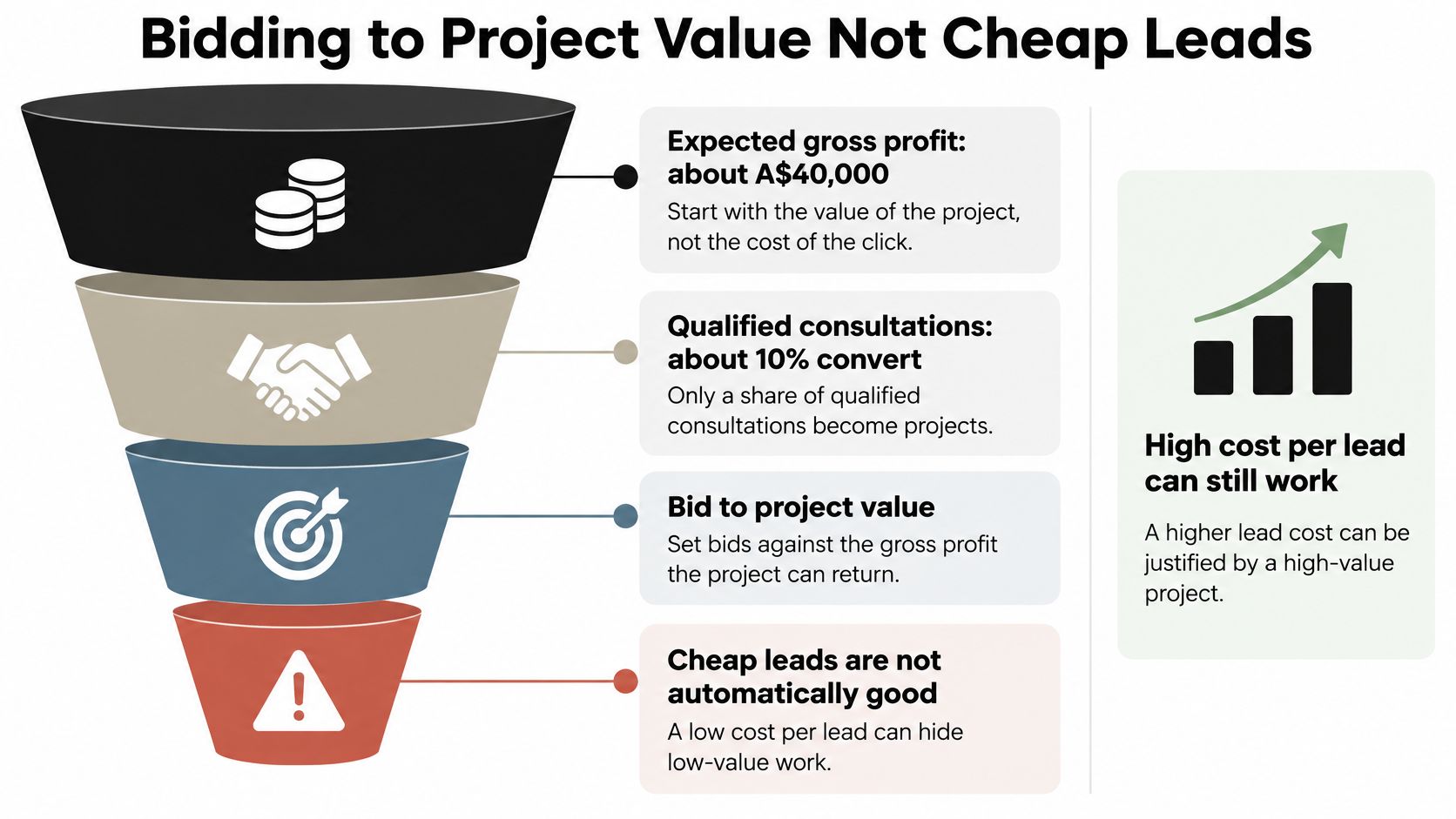
A qualified consultation can have an expected value of about A$4,000 in the worked example from SoudCoh's Australian Google Ads benchmarks: A$40,000 expected gross profit multiplied by a 10% consultation-to-contract close rate, before delivery-risk adjustments. The same source reports that roughly three-quarters of enquiries in comparable Australian trade campaigns were calls, and about three-quarters of clicks came from mobile devices.
That consultation value is an illustration, not a recommended acquisition cost or a universal builder benchmark. You still need an allowance for overheads, estimating time, unsuccessful quotes and the profit you intend to retain.
The funnel below shows why project economics matter more than the cheapest enquiry.
Offline conversion stages and the value each sends
| CRM stage | Value sent to Google Ads | When it fires |
|---|---|---|
| Qualified consultation | About A$4,000 in the worked example, based on 10% of A$40,000 expected gross profit | After a site meeting confirms scope and budget |
| Quote issued | Expected gross profit multiplied by the historical quote-to-contract close rate | When a priced quote goes to the client |
| Signed contract | Expected gross profit of the job | When the client signs |
| Lost | Zero pipeline value in the CRM; adjust an eligible earlier conversion where supported | When the job is declined or goes elsewhere |
Don't add every stage's full value together and report the total as though it represents separate jobs. Choose a deliberate primary bidding outcome or use supported conversion adjustments so the same opportunity isn't repeatedly overstated.
A lost status also doesn't automatically teach Google Ads to exclude similar people. Use it to investigate unsuitable searches, locations and offers, and to correct eligible conversion records where your implementation supports that.
Feed back outcomes the estimator trusts
Define qualified consultation with the sales team. A sensible definition includes service-area fit, a scope you can deliver, credible budget expectations and access to the decision-maker.
Quoting discipline matters because optimistic values produce optimistic bidding. For renovators refining their estimating process, Western Bathroom Renovations' guide to how to quote a bathroom renovation is a relevant practical resource to review alongside your own scope and margin assumptions.
Keep renovations, new homes, civil works and commercial construction economically distinct. Their close rates and expected margins shouldn't be blended just to make a dashboard easier to read.
I'd begin with constrained spending and a bidding approach suited to the account's actual measurement maturity. Move towards value-based bidding when the qualified outcomes are reliable enough to support it, rather than importing guessed values to enable automation sooner.
Allow delayed contracts to mature before judging recent leads against older, completed sales cohorts. Report pipeline value, close rate and signed-contract gross profit with the assumptions visible.
No setup can promise a ranking, lead count, CPA or ROAS. The builder still controls pricing, availability, estimating, sales follow-up and customer service, all of which affect whether a suitable enquiry becomes profitable work.
Brief the Work Before You Spend More
A controlled test needs a clear job target, a team able to respond and enough patience to assess sales outcomes. Hold spending if the service area is vague, calls are going unanswered or no one owns the follow-up after a quote request.
The brief can be short. It must give the owner, estimator and campaign manager the same picture of what counts as worthwhile work.
Write the commercial brief
Record the details that affect whether a job is a good fit:
- Services worth winning: Name the work you want, rather than every service the team could offer.
- Service boundaries: List the suburbs or regions you cover and any travel exceptions.
- Minimum viable project: Set the scope or value below which estimating is not worthwhile.
- Response owner: Name who answers calls and monitors forms, including cover during absences.
- Sales progression: Map how an enquiry moves to a discussion, site visit, quote and contract.
- Capacity constraints: Note availability, licence requirements and work you will not accept.
- Reporting standard: Track qualified opportunities and contract outcomes, not traffic totals alone.
Without those answers, a more capable account can bring in enquiries faster than the business can assess them.
Choose a partner around the work
For a construction business comparing a marketing agency Melbourne shortlist, weigh the proposed qualification process more heavily than confident lead forecasts. Ask what the campaign will exclude, how enquiries will be matched with the CRM and which decisions stay with you.
Alpha Omega Digital is based in Melbourne and offers Google Ads management, including services for plumbers. Project enquiries can include your goals so the team can respond with next steps suited to your budget, timeline and growth target.
Advertising budgets are paid separately unless otherwise agreed. Alpha Omega Digital manages campaigns but does not guarantee specific marketing or business outcomes, such as rankings, enquiries, traffic, sales, revenue, leads, ROAS or CPA.
Bring in a partner once the brief identifies the buyer and the jobs worth winning. That gives both sides a practical basis for deciding what to launch, what to improve and whether more spend makes sense.
Have a project in mind? Share your goals through the contact page, including your services, service area, current website and monthly media budget. Ask how the campaign will be judged against qualified consultations and contracts.
Alpha Omega Digital
Read more insights from our team on web design, paid ads, and growth strategy.