Your Google Ads account shows enquiries, but the diary still has gaps. Someone wants a pump you don't stock, another caller lives outside your service area, and a renovation enquiry goes cold before anyone arranges an inspection. Meanwhile, you're paying for every click.
Google Ads for pool companies should be measured by completed, profitable jobs, not the cheapest enquiry. I'd build the account around the work you want, the suburbs your crew can service profitably and the seasonal demand you can fulfil. That gives you a practical basis for deciding what to spend, what to pause and what to improve.
Campaign Structure by Job Type and Suburb
Say a pool company runs every pool keyword through one campaign. A homeowner wanting regular cleaning shares the same budget and landing page as someone planning a new inground pool. Google can generate enquiries from both, but the owner can't clearly control which type of work receives the money.
Split the account by buying decision instead. Each campaign needs its own budget, relevant landing page and service-specific conversion action.
Campaign groups by buying decision
| Campaign group | Customer intent | Example keyword themes | Main conversion | Primary metric |
|---|---|---|---|---|
| New pool construction | Building a new inground or fibreglass pool | pool builder, inground pool builder, pool design | Quote request or booked consultation | Cost per qualified enquiry |
| Renovation and resurfacing | Resurfacing, retiling or renovating an existing pool | pool resurfacing Melbourne, pool retiling cost | Quote request | Cost per signed renovation |
| Repairs and emergencies | Leaks, pump failure or heater faults needing a fast visit | pool pump repair, pool leak repair near me | Phone call | Cost per booked repair call |
| Maintenance and cleaning | Recurring service or restoring a green pool | pool cleaning service, green pool clean | Phone call or sign-up | Cost per recurring customer |
| Equipment and automation | Heat pumps, filters and pool automation | pool heat pump installation, pool filter replacement | Product enquiry or call | Cost per qualified equipment job |
Australia has approximately 1.6 million domestic swimming pools, while roughly 25,000 new inground pools are built nationally each year, according to Poolwerx's Australian industry overview. That installed base supports a very different buying decision from new construction, so combining both under a generic pool-company campaign hides useful distinctions.
Construction pages should qualify the project, site and desired pool type. Renovation pages need existing-surface details, project photos and an inspection request. Repairs need fault symptoms and a direct call option.
For maintenance, make recurring servicing distinguishable from a green-pool rescue. Equipment campaigns should separate supply-only purchases from installed solutions, particularly when the business also operates an ecommerce store.
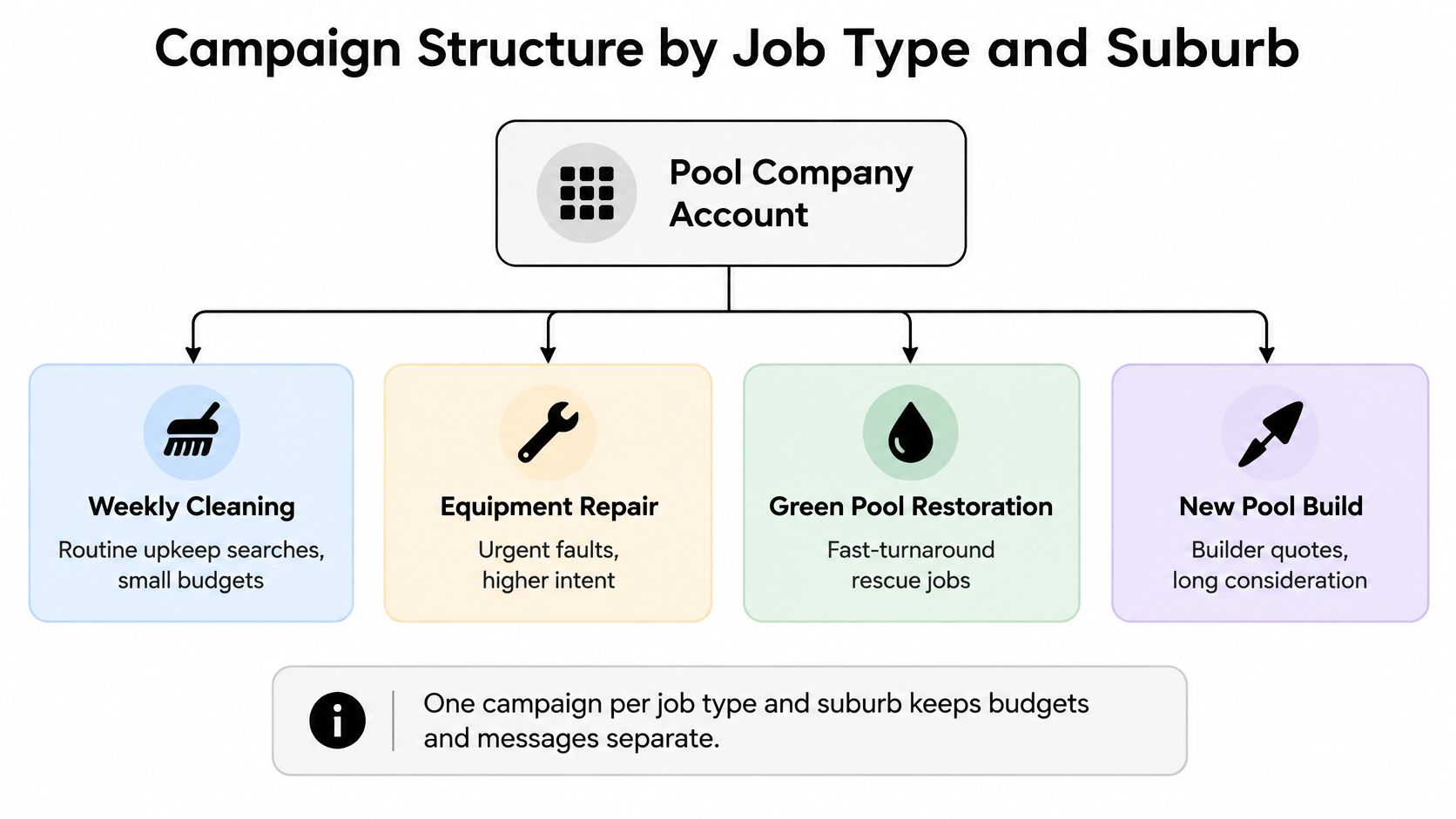
The diagram shows how service-led branches keep different customer needs separate.
Add geography without fragmenting the account
Within campaigns, organise ad groups around closely related services and useful suburb clusters, such as the inner east, south east or northern corridor. Don't create a separate campaign for every suburb unless you need independent budget control. Excessive fragmentation makes a modest budget harder to manage.
Use location settings focused on people in, or regularly in, your service area. A Frankston crew shouldn't pay for urgent Geelong enquiries it can't fulfil.
Keep adjacent services distinct too. Connecticut Fence Works, LLC lets homeowners compare local pool enclosure companies, an example of an enclosure-specific buying journey rather than a cleaning or construction enquiry. It's an overseas resource, not a Melbourne contractor recommendation.
Practical rule: Every campaign should answer a clear question: who's searching, and what do you want them to book?
Keywords, Match Types and Negative Keywords
Pool searches mix homeowners, job seekers, equipment shoppers and DIY researchers. Buying every query containing pool means paying for audiences your team can't turn into customers.
I'd start with specific service phrases rather than chasing volume. Pool resurfacing Melbourne, pool heat pump installation and green pool clean Mornington describe an identifiable need. They're useful high-intent targets, but nobody can promise a top organic ranking or a particular paid position.
A search-term routine worth maintaining
- Choose services you sell. Build keywords from your profitable jobs, not every service associated with swimming pools. Add locations where they clarify buyer intent.
- Begin with exact and phrase match. These give you a more controlled starting point than broad match. Neither is a literal-only filter, so inspect the searches that trigger your ads.
- Test broad match selectively. Use it with suitable automated bidding, reliable conversion signals and established negatives. Don't make it the default while Google is learning from unqualified forms.
- Build a shared negative list. Consider DIY, how to, jobs, careers, courses, second hand, free, inflatable and pool table. Exclude hire only if you don't rent equipment.
- Exclude unsuitable locations. Add out-of-area suburbs when search terms reveal geographic waste, alongside your campaign's location exclusions.
- Review regularly. I recommend weekly checks during the first month, then fortnightly once the account is stable. Review sooner after expanding targeting.
Be careful with blanket negatives. An equipment retailer might want replacement-part searches that a service-only contractor should exclude. Likewise, a renovation business may want cost-related searches because buyers need to establish affordability before booking.
Buyer intent matters more than shared words
Pool cleaning jobs suggests employment intent. Pool cleaner Mornington suggests someone looking for a provider. Similar vocabulary, different commercial value.
Service wording also needs to reflect how customers describe the job. Pool & Landscaping of Vistancia LLC's page for local pool maintenance pros is an overseas example of a maintenance-focused destination, rather than a catch-all page for every pool-related search.
Keep terms that generate qualified calls or booked consultations within your evaluation window. For a short-cycle cleaning campaign, I'd review a term after a fortnight of clicks without contact and pause it if the spend warrants that decision. For construction, allow for the longer consideration process and check whether the keyword has received enough relevant traffic before judging it.
Ad Copy, Call Extensions and Landing Pages
A homeowner searching for resurfacing in Mornington shouldn't land on a homepage that leads with pool chemicals and retail accessories. The ad and page need to confirm the same service, location and next step.
Write a responsive search ad for each tightly themed service group. Don't use the same generic message for repairs, renovations and maintenance.
Build ads around the decision
- Lead with the service and area. A resurfacing headline should identify resurfacing, with a relevant location where space allows.
- Offer different headlines. Include the service, local coverage, an available inspection, relevant proof and the booking action. Rephrasing the same claim gives Google little useful variation.
- Use pinning deliberately. Pin essential wording when it must appear, but don't pin everything. Restricting combinations trades flexibility for message control.
- Explain inclusions. State whether the service includes inspection, water testing, chemical balancing or a written quotation. Only advertise what the booking covers.
- Add useful assets. Call assets, formerly call extensions, should use the appropriate tracking number. Use location assets where your eligible business details support them, and sitelinks that lead to relevant services.
For a repair group, pump faults, leak investigation and an available visit are useful messages. For renovations, project photographs and a clearly described quotation process matter more. A free quote or same-week appointment belongs in the ad only when your business offers it.
Make the mobile page do its job
Put the service area, scope and main booking action near the top. Ask for the suburb, pool type and problem description without turning the form into an interrogation. Include real project images and explain what happens after submission.
Our WordPress development and design work can support service-specific pages and reusable Gutenberg blocks. For a retailer, Shopify design and development should support product selection, delivery information and checkout instead. A product purchase and an installed-service enquiry need different page journeys.
Don't advertise a response time your crew can't meet. A persuasive promise becomes a customer-service problem when the diary is already full.
Test a meaningful variable at a time, such as the offer or headline emphasis. Judge it using qualified contacts, not just a higher click-through rate.
Setting a Monthly Google Ads Budget for Pool Work
Monthly advertising budget equals the required enquiries multiplied by the expected cost per enquiry. Start with signed jobs and work backwards, keeping enquiry definitions consistent.
A quote request isn't automatically a qualified opportunity. Your forecast should show where unsuitable enquiries drop out, rather than assuming every form deserves a sales appointment.
A hypothetical renovation budget
Consider this illustrative scenario, not a market benchmark or promised result:
- Signed-job target: The company wants four renovation jobs each month.
- Consultation close rate: It assumes one signed job from every three consultations, requiring 12 consultations.
- Enquiry-to-consultation rate: It assumes half of quote requests become consultations, requiring 24 quote requests.
- Assumed acquisition cost: At $75 per quote request, the illustrative advertising budget is $1,800 per month.
Those assumptions must be replaced with the company's own figures. If many quote requests are outside its service area, the qualification rate falls and the original forecast no longer holds.
The broader advertising environment doesn't provide a pool-specific price list. RockingWeb's Australian Google Ads adoption overview reports that 65% of Australian SMEs were running active Google Ads campaigns in 2024. That's context for paid-search adoption, not evidence of what a Melbourne pool enquiry should cost.
Set the budget against margin and capacity
- Choose the work target. Decide how many additional jobs the crew can complete without compromising existing customers.
- Calculate the enquiry requirement. Use your qualification, appointment and close rates. Separate construction from maintenance rather than averaging them.
- Allocate by contribution. Favour services that leave enough gross margin after labour, materials, travel and advertising.
- Cap the initial test. I'd plan a 60-day evaluation with controlled daily budgets, while allowing longer for construction deals to mature.
- Review early assumptions. After the first 30 days, inspect qualified-enquiry cost, missed calls and appointment rates before increasing spend.
The answer to how much it costs to start Google Ads is therefore a planning calculation, not a universal package price. Include landing-page work, tracking, management and media spend as separate lines.
Alpha Omega Digital is responsible for campaign management only, and advertising budgets are paid separately unless otherwise agreed. A viable media budget doesn't automatically cover website repairs, CRM work or answering enquiries.
For recurring maintenance, use a conservative customer-value estimate that accounts for servicing costs and cancellations. Don't justify today's advertising bill with years of hypothetical revenue.
Seasonal Google Ads Calendar for Pool Companies
Pool owners can defer maintenance through cold weather, then want equipment checked, water balanced and green pools restored before swimming again. A flat monthly budget ignores that change in urgency.
Australian guidance from EarnSmart's pool-cleaning business guide reports that pool-service income can be 30–40% lower from May to September. Treat that as directional evidence for seasonal planning, not a forecast for your particular Melbourne business.
Seasonal budget and bid moves by period
| Period | Demand focus | Budget and bid move | Measure first |
|---|---|---|---|
| May to August | Winter lull, brand and emergency terms only | Hold brand and emergency budgets, reduce general terms | Weekly booked jobs and call volume |
| September to November | Pool opening, green pool and equipment checks | Raise budgets two to four weeks before opening | Impression share and booked jobs by week |
| December to February | Summer repairs, pumps, heaters and cleaning | Hold steady and favour emergency and repair terms | Cost per booked call |
| March to April | Pre-winter covers, heater servicing and pool closing | Shift budget toward maintenance plans and covers | Recurring contracts signed |
Use the proposed spring ramp as an operational test, not an automatic spending instruction. Your local bookings, weather conditions and technician availability should determine whether it goes ahead.
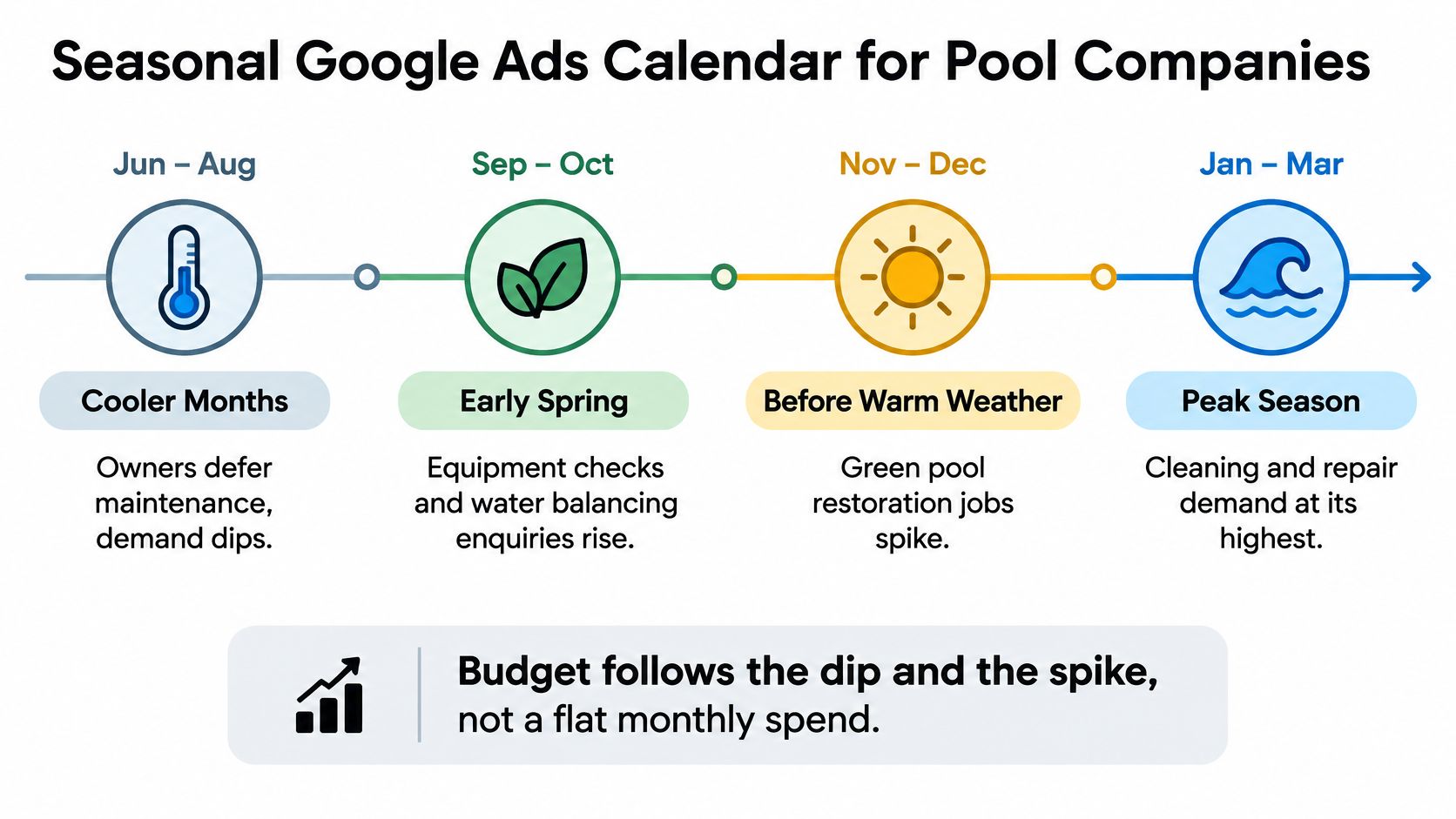
This visual summarises the seasonal planning approach.
Increase spend when the business can use it
Keep brand and urgent repair coverage available throughout the year where it remains profitable. Create separate spring messaging for pool opening, green-pool restoration and equipment inspections so you can adjust that demand without disturbing the base campaigns.
Before raising bids, check search impressions, impression share, calls and booked jobs by week. More impressions without more bookings aren't a sufficient reason to spend more.
Say impressions begin rising in late August, but appointments don't. Hold the budget while checking mobile usability, appointment availability and whether the page clearly states the service area. If callers hear that the next visit is too far away, the constraint is capacity, not advertising reach.
For seasonal pages, make response times and inclusions visible. A green-pool customer needs to understand the assessment and treatment process, not just see a photograph of clear water.
Assign different business values to one-off cleaning, equipment repairs and recurring maintenance. Otherwise, automated bidding may favour the easiest form submission rather than the work that best supports the business.
New construction needs its own planning calendar because research and site preparation don't follow the same timetable as an urgent spring clean. Don't switch off a productive builder campaign merely because routine cleaning slows down.
Raise seasonal budgets when relevant demand produces bookable, profitable work, not simply because the calendar says spring.
Tracking Calls, Forms and Paid Jobs
A form from a tyre-kicker and a qualified resurfacing enquiry can look identical in a basic conversion report. Lead counts describe activity, not profit.
Your records need to show calls answered, suburb, pool type, urgency, estimated value, booked inspection, completed work and gross margin. The technician's notes can be as important as the original keyword.
Phone conversations are part of that measurement process.

Connect advertising to the job record
- Separate call sources. Assign tracking numbers by campaign group, or use dynamic number insertion where session-level attribution is needed.
- Record call outcomes. Capture answered and missed status, duration and qualification. Duration alone doesn't establish whether a caller is suitable.
- Track genuine form success. In Google Tag Manager and Google Analytics, use a confirmed successful submission rather than a button click. Prevent duplicate conversion events.
- Import downstream outcomes. Send eligible qualified leads and completed jobs from the CRM into Google Ads as offline conversions, using consistent values by job type.
- Implement consent controls. Explain tracking clearly, configure Google Consent Mode v2 appropriately and apply the privacy requirements relevant to your business.
Enterprise Plus's small-business privacy guidance highlights consent, Consent Mode v2 and responsible customer-data handling. Consent Mode isn't a way to bypass a visitor's choice, and it doesn't recover every lost individual conversion. Depending on implementation and eligibility, reporting may include modelling rather than a directly observed customer journey.
CallRail, GoHighLevel and a custom Twilio setup are options to evaluate, not interchangeable solutions. Check number availability, attribution, CRM integration, recording consent, ongoing costs and export access before choosing.
The following video is included alongside the call-handling workflow.
Recover missed calls without overpromising
Suppose an owner calls after hours about a failed pump and reaches voicemail. They may call another provider rather than wait.
One possible implementation uses a custom Twilio number with automated answering available around the clock, asks about suburb and pool type, then books an eligible appointment into the team's calendar or Calendly. It needs tested availability rules, failed-booking alerts, emergency boundaries and a route to a human.
Automation doesn't need rest, but integrations can fail and callers can be misunderstood. Don't promise it will save thousands without measured evidence. I'd require human confirmation within an hour where an actual on-call roster supports it, and state the next staffed response time otherwise.
Diagnosing Underperforming Pool Campaigns and Next Steps
A quiet diary does not automatically mean bids are too low. More clicks can indicate that targeting has widened faster than lead qualification. Diagnose the symptom before changing spend, and judge performance by completed, profitable jobs rather than cheap enquiries.
Google Ads symptoms, causes and fixes for pool companies
| Symptom | Likely cause | Fix |
|---|---|---|
| Clicks but no calls or forms | Broad match or wrong suburbs | Move to phrase match, add suburb negatives and check the landing page |
| Calls but few booked jobs | Unqualified searchers or slow answering | Qualify on pool type, suburb and urgency, and answer promptly |
| Budget not spending | Low bids, narrow keywords or weak ad rank | Check impression share, raise bids on high-intent terms, and widen phrases |
| High spend, few paid jobs | Cheap form fills tracked as the goal | Import completed jobs with values set by job type |
| Strong spring, weak autumn | Budget not reset for the season | Apply the seasonal calendar and cut general terms in winter |
Treat these as starting points, not automatic diagnoses. Underspend can also stem from billing, disapproved ads, campaign eligibility or an unsuitable bidding target.
Check the account in a useful order
- Tracking first. Submit a test form and place a test call. Confirm each conversion records correctly, without duplication.
- Search terms next. Review recent queries and separate buyers from researchers and job seekers.
- Bids and budgets after that. Check impression share and lost share due to budget or rank before deciding whether spend is the constraint.
- Commercial results alongside spend. Compare booked and completed jobs by campaign group, allowing time for leads to close.
- Landing page, then ad copy. On a phone, check that the page makes the service area and response expectations clear, and that the call button works.
Cheap forms from outside your service area call for location corrections and a qualifying suburb field, not higher bids. Tracking and negative-keyword changes can affect incoming traffic quickly, but improved profitability takes enough completed jobs to assess. Seasonality also needs to be judged across the relevant demand period. A flat budget can miss the pool cycle: adjust spend as demand shifts, and prioritise the work that produces profitable completed jobs.
For pool retailers, keep product sales separate from service enquiries. Google Shopping, Performance Max and Meta campaigns need product economics and purchase tracking; service-campaign lead targets do not fit them. Local SEO and an accurate Google Business Profile can support discovery, but neither replaces diagnosing paid campaigns.
Alpha Omega Digital is a Melbourne-based digital agency helping Australian businesses grow through Google Ads, websites, SEO and other digital services. Book a free 45-minute strategy session to review your site and discuss what to fix. Share your goals through the contact page to get next steps suited to your budget, timeline and growth target. Advertising budgets are paid separately unless otherwise agreed.
Alpha Omega Digital
Read more insights from our team on web design, paid ads, and growth strategy.