Your phone shows two missed calls from numbers you don't recognise, and it isn't even 8am. One was probably a hot water system that let go overnight. The other was probably someone who rang the next name on the list about ten minutes after you didn't pick up. That gap between a lead arriving and a lead being answered is where most trade advertising money dies, and paid search will expose it faster than any other channel you can buy.
This isn't a tour of the ads interface. It's about deciding which clicks are worth paying for, what a lead has to earn before the campaign switches on, and what to fix when the phone stays quiet. Every number below is tied back to job margin rather than cost per click, because a $60 lead that turns into a $180 repair is a worse outcome than a $180 lead that turns into a bathroom.
How Google Ads Reaches Tradies at the Moment of Need
It's 11:04pm in Brighton. A flexi hose under a kitchen sink lets go and water spreads across the floorboards. The homeowner doesn't open Facebook. She types emergency plumber near me into her phone and taps the first result with a tappable phone number. The businesses sitting in those top ad slots are the ones taking that call tonight. Everyone else is a flyer in a letterbox nobody is reading at 11pm.
Search behaves differently from every other channel a tradie can buy. A boosted social post interrupts someone who may not need a plumber this week, this month, or ever. A search ad appears after the customer has already decided the job needs doing and is actively choosing who to ring. You are not creating demand, but standing in front of demand that already exists, at the exact minute it exists.

Search is one of the largest and fastest-growing segments of Australian online advertising, with a very large slice of that spend going to businesses competing for commercial service searches. Plenty of those businesses are trades. The practical point is simpler than the market size: when someone searches for a tradesperson, they are already sorting through who to call. Your ad either wins part of that attention or leaves it to the next name on the screen.
What that market share means in practical terms
You pay only when someone clicks. You choose the suburbs, or a radius around your depot. You can switch the ads off at 5pm on a Friday and back on at 7am Monday. You see whether it works inside a week rather than waiting three months for a page to creep up the rankings.
That combination is unusual. Local SEO compounds and keeps working after you stop paying, but it's slow. Letterbox drops are cheap per unit and impossible to attribute. Paid search is the only channel where you can put a small budget in on Monday, learn something on Wednesday, and know by Friday whether the suburb and the service are worth another round.
I judge that speed by job margin, not by the cost per click. A cheap click on a low-margin job can waste a tradesperson's afternoon. A dearer click that leads to a booked job with room for travel, labour and materials is the better buy. The search is only valuable if the phone gets answered, the job fits your service area, and the quote converts at a margin that still makes the run worthwhile.
Practical rule: every ad dollar is a bet on a phone being answered. If you can't pick up during the hours the campaign runs, the campaign is paying for a competitor's call.
Before you set a budget, answer three questions.
- Which jobs make money? Not the biggest jobs. The ones that leave the most in your pocket after materials, travel and a second pair of hands. A blocked drain at 40% margin can beat a $4,000 renovation at 30% if the renovation takes two weeks and three quotes to win.
- How far will you travel? Thirty minutes from base is usually the ceiling before a job stops being profitable. Any suburb beyond that is a donation to Google.
- Who answers the phone while the ad is live? You, on a job site with wet hands. An office admin. An answering service. A custom number that picks up after hours. Decide before the campaign launches, not after.
Get those three right and the rest of the setup is mechanical. Get them wrong and no amount of clever bidding saves the account.
Choosing Between Search, Performance Max and Local Services
| Campaign type | Best for | Control over keywords and suburbs | Lead data you get | Start here when |
|---|---|---|---|---|
| Search | Phone calls and form enquiries for named services | High: you choose keywords, suburbs and schedule | Calls, forms and booked jobs once tracking is set up | You want control over spend and want to split emergency from planned work |
| Performance Max | Broad reach across Search, Maps, YouTube and Display | Low: Google chooses placements and many queries | Only as good as your conversion tracking | You already have a proven Search campaign and clean conversion data |
| Local Services Ads | Pay-per-lead for listed trades | Medium: category and area set within Google's system | Lead records held in Google's platform | Your trade and location are eligible and you want a lower-effort start |
| Call-only | Phone-only enquiries from mobile users | Medium: keywords and location settings apply | Call length, missed calls and booked jobs | Emergency work that you can answer during staffed hours |
Search is the default for almost every trade business, and the reason is control. You pick the keywords, the suburbs, the hours and the daily budget. That matters because a burst pipe, a hot water failure and a bathroom renovation do not carry the same margin, urgency or close rate. Splitting campaigns lets a cheap emergency lead stop eating the budget needed for planned work with a better payday. I would rather run two tight Search campaigns with clear job economics than one broad campaign that reports plenty of clicks and hides where the money went.
The demand behind those searches is real and measurable. An analysis of 58 core Australian plumbing, electrical, air-conditioning, roofing and pool-and-spa searches recorded 381,970 searches per month in aggregate, with plumbing at 132,410 monthly searches and electrical at 95,540 in Bring's trades research. That volume gives you something concrete to plan against. The question is not whether people search. It is whether your campaign can turn the right search into a job that still has margin after quoting, travel, materials and missed calls.
What the click costs tell you
The same research puts estimated costs at AUD 79.44 per click for "emergency plumber near me" and AUD 54.77 for "plumber near me". Those numbers scare people off. They should not. They show that urgent searches cannot sit in the same pot as softer, planned-work searches.
At that emergency click cost, a small daily budget can disappear in four clicks. So it gets its own campaign, its own cap and a tight negative keyword list. Maintenance searches, "how to fix", "cost of", and job-seeker queries stay out entirely. If four clicks cannot produce a booked job at that price, I would look at the phone handling and the landing page before blaming the market. A lead that costs less but never converts is dearer than an expensive click that turns into paid work.
Performance Max works when the account has months of clean conversion data behind it. Google decides where the ad appears, so quality depends on how well you have taught the system which enquiries become revenue. Run it too early and it can spend on cheap clicks that never ring. For a tradie, that is the wrong trade. A lower cost per click means nothing if the jobs do not cover travel, quoting time and the calls you missed while on site.
Local Services Ads suits listed trades with a verified licence and a service area inside Google's system. Availability varies by trade category and Australian location, so check eligibility before planning around it. The lower-effort setup can be useful, but you give up some visibility over how leads are qualified. Call-only campaigns make sense for one thing: emergency work you can answer during staffed hours. If nobody answers, the campaign is paying for calls your competitor may get on the next attempt.
My recommendation for a trade business starting from nothing is boring. Run Search for your two most profitable services, split emergency from planned, get call and form tracking live before launch, and give it 30 days. Add Performance Max only after you can name your cost per booked job, not just your cost per lead. Test anything else later.
Working Out a Budget From Job Value and Close Rate
A blocked drain can look expensive at $90 per lead and still be profitable. A bathroom renovation can look cheap at the same price and still lose money after quoting time, travel and follow-up. The budget should start with the job, not the click.
Maximum cost per lead = gross profit per job × quote-to-job rate.
Gross profit is job value minus materials and labour, not revenue. Quote-to-job rate is the share of genuine enquiries that turn into paid work, not the share of quotes you send. If a blocked drain at $180 carries 40% gross margin, that is $72 of gross profit. At a 60% close rate, the most you can pay for that lead is about $43. Spend twice that and you are buying work at a loss, no matter how busy the calendar looks.
Here is the same arithmetic filled in clearly. The figures are illustrative, so swap in your own job values, margins and close rates before setting live budgets.
| Job type | Average job value | Gross margin | Quote-to-job rate | Maximum cost per lead |
|---|---|---|---|---|
| Blocked drain clearing | $180 | 40% | 60% | $43 |
| Small maintenance visit | $220 | 45% | 70% | $69 |
| Hot water repair | $450 | 35% | 50% | $79 |
| Switchboard upgrade | $1,500 | 45% | 40% | $270 |
| Bathroom renovation | $4,000 | 30% | 25% | $300 |
The switchboard row is where many tradies undersell their own economics. At $1,500 with a 45% margin, the job carries $675 in gross profit. At a 40% close rate, that supports about $270 per lead. The bathroom renovation sits similar again: a $4,000 job at 30% margin gives $1,200 gross profit, and a 25% close rate supports about $300 per lead.
That last number explains the most common misunderstanding in trade advertising. A $100 enquiry is a disaster on a $180 drain and perfectly sensible on a $4,000 bathroom. The click cost is identical. The economics are not.
Practical rule: judge a lead by what it leaves after quoting, travel and follow-up, not by what it cost to acquire. Cost per lead is an input. Gross profit per job is the scoreboard.
From lead value to a monthly budget
Take your target booked jobs per month, divide by your close rate to get the leads you need, then multiply by your maximum cost per lead. That is your monthly budget ceiling. If the number looks too high, the trade-off is fewer booked jobs or a fatter margin per job, never a round number pulled out of the air.
I would keep two figures beside every campaign: target booked jobs and maximum cost per lead. Once those are clear, budget decisions become much less emotional. You are no longer asking whether $120 is "expensive". You are asking whether that lead can still leave enough gross profit after the quote, the drive and the second follow-up.
National search data is a direction-finder, not a Melbourne quote. Validate it in Keyword Planner and against what your own search-terms report says after two weeks. Ad spend is paid separately to Google unless otherwise agreed, and Alpha Omega Digital is responsible for campaign management only. Your budget is yours, and it goes to Google, not into a management fee.
An Australian analysis of more than 165 trades found 624,540 annual Google searches for electricians alone, representing 39% of all online trade enquiries, with the study focusing specifically on "trade near me" searches that signal immediate local intent, as reported by Tradie Magazine. That is the traffic you are bidding against. The only sensible way to divide a finite budget across it is by service and suburb, so the emergency electrician campaign and the switchboard upgrade campaign each get funding proportionate to what those jobs earn.
Do this before you touch the account. Fill in your three best job types with real margins and real close rates, calculate the maximum cost per lead for each, then set each campaign's daily budget from that answer. Twenty minutes here stops a campaign from looking busy while buying the wrong work.
How to Set Up a Local Search Campaign Step by Step
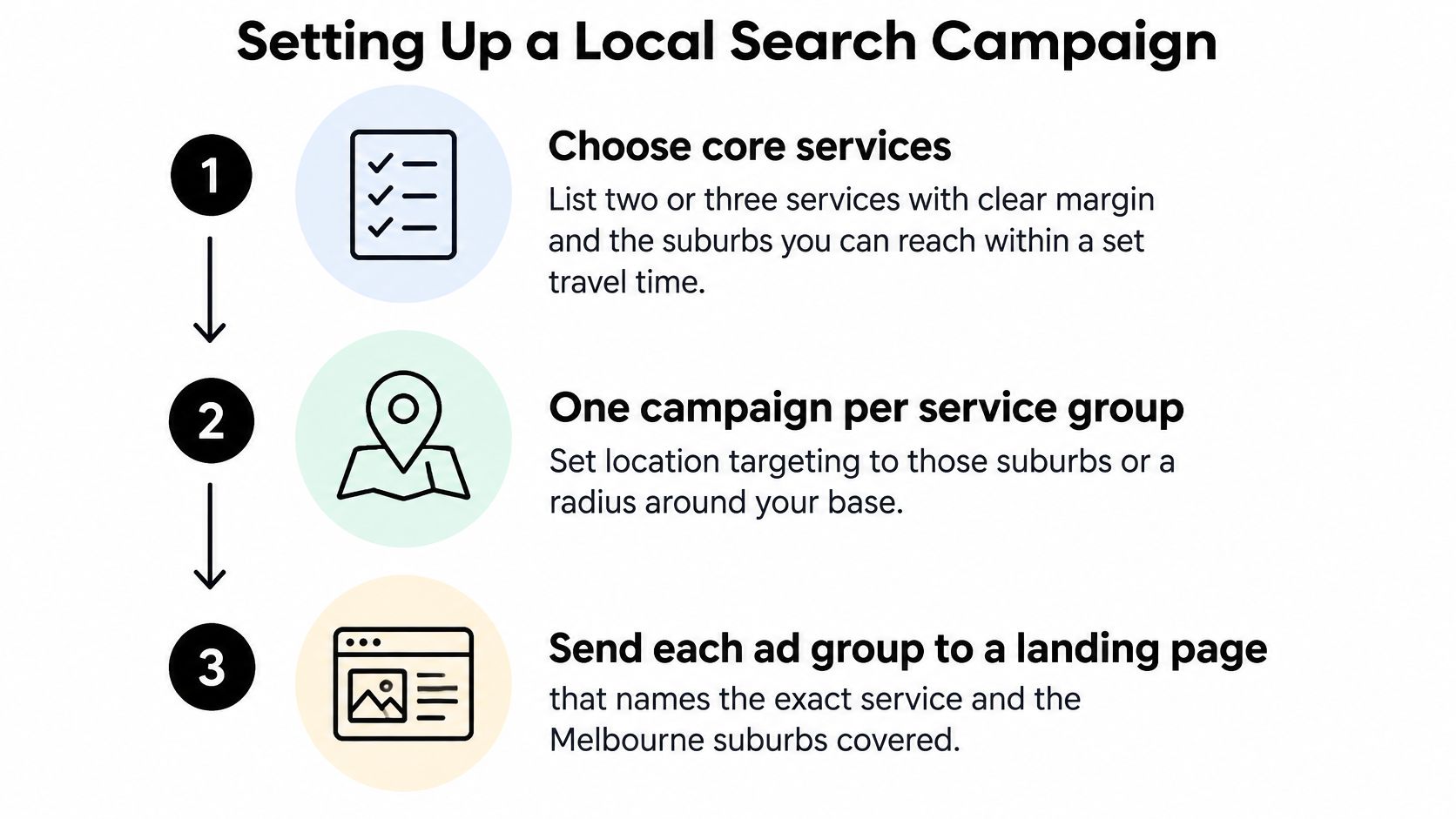
Build the campaign around jobs that can carry their own lead cost. If the margin work has not been done, the daily budgets will be guesses, and the first fortnight of data will be hard to judge because every enquiry looks the same in the report until you know what it earns after quoting, travel and missed calls.
- List two or three services with clear margin and the suburbs you'll reach inside a set travel time. Two services done properly beat eight done generically, because thin budgets produce thin data and few calls.
- Create one campaign per service group. Location targeting goes to those suburbs or a radius around your base. A burst-pipe searcher in Brighton should not see your Werribee ad and spend your budget on a job you do not want.
- Build ad groups by service and suburb within each campaign. Emergency plumber, blocked drain and hot water repair are different buying moments and deserve different ads. Strong message match makes the click more qualified before it reaches the page.
- Use exact and phrase match for your core terms, and load a negative keyword list from day one. Jobs, courses, apprenticeship, DIY, salary, free and cheap all belong there. Broad match can wait until call tracking and form tracking are reliable.
- Write ads that name the service, the suburb, your licence or insurance, and add a call extension. "Same-day blocked drains, South Yarra, licensed and insured" gives the caller a reason to choose you. "Quality plumbing services you can trust" gives them nothing specific to act on.
- Set the ad schedule to hours you can answer the phone. If nobody picks up between 3pm and 5pm on school pickup, take those hours out. You are not refusing work. You are avoiding paid calls that land in voicemail.
- Set conversions for calls over 60 seconds, completed forms and booked jobs. Exclude page views entirely. Page views inflate reports and teach bidding systems to chase browsers instead of enquiries.
- Give each campaign its own daily budget, with a lower cap on the emergency campaign. Work that cap out from the maximum cost per lead, then judge it against job value and close rate. I would rather see fewer calls at a cost the margin supports than a busy phone full of work that cannot cover travel.
For a trade-specific example, our Google Ads for plumbers setup shows the campaign split, the negative keyword logic and how emergency work is separated from maintenance. That separation matters because urgent jobs and planned jobs ask different questions, and they should not compete for the same budget.
Validate before you scale
National search volumes tell you where demand exists. They do not tell you what a Springvale click costs on a Tuesday or whether that enquiry turns into a job. After two weeks, pull the search-terms report and check two things: whether the money went to suburbs you service, and whether the queries were the jobs you wanted. Add irrelevant terms as negatives. Push profitable suburbs with bid adjustments.
Keep the validation tied to the job, not the click. A cheap enquiry that becomes a small quote, a long drive and a missed callback is worse than a costlier enquiry that books well. That is why I judge the report by booked work first, then by call length, form quality and suburb. The paid click is only useful when it leads to a job that still makes money after the actual costs of running the trade business are counted.
If you want a general reference on the questions customers ask before choosing a tradesperson, this step-by-step guide to hiring painters shows how homeowners compare options. Use that thinking to sharpen ad language, then rely on your own search terms and booked-job numbers to decide where the budget stays.
Here's the walkthrough to watch before you build anything, because it covers the settings that waste money on day one.
Turning Clicks Into Booked Jobs With Landing Pages
A click costs the same whether the page converts it or wastes it. The difference shows up later, in margin: a lead that matches the jobs you want at the price you quote is worth paying for, and a lead that burns an hour of quoting and travel before going nowhere is a loss dressed up as an enquiry. The landing page decides which one arrives.

If the ad promised a blocked drain and the page opens on a generic homepage with a photo of a smiling family, the click is wasted before the customer has read a word. Each ad group should point at a page that carries the exact service in the headline, the Melbourne suburbs covered, licence and insurance details where relevant, photos of recent work, real review quotes, and a click-to-call button that sits above the fold on a phone. Planned work gets a short qualification form. Emergency work gets the phone number and nothing competing with it.
Speed is the quiet killer. A page that takes four seconds to load on mobile loses the caller before the phone number finishes rendering. Test it on your own phone on 4G, not the office Wi-Fi.
- One service per page. A page selling hot water repair shouldn't also offer gas fitting, roofing and blocked drains.
- Coverage spelled out. Name the suburbs. "Servicing Melbourne's inner south" is vague. "South Yarra, Prahran, Windsor, Armadale and Toorak" is a promise.
- Scope stated in plain terms. Saying what a job includes and excludes filters out enquiries you would never quote. A clear list of painting quote exclusions explained shows the principle: the customer who reads the boundaries before calling arrives already qualified.
- Proof where the eye lands. Licensed, insured, ABN, years in business, and two or three review quotes with first names.
- A form of three or four fields. Name, phone, suburb, one line about the job. Every extra field costs you enquiries.
- A real photo of a real job. Stock tradespeople are recognisable in a second and they cost you trust.
Credibility does more work here than most tradies expect. In the figures cited in Aidan Coleman's local SEO statistics, 91% of consumers read reviews before visiting a local business, while businesses respond to only about 34% of reviews. That gap is why a page with a dozen reviews and a visible reply to each one converts better than a page with none.
The tracking that makes the page worth building
Count calls longer than a set duration as conversions. Count completed forms. Count booked appointments. Exclude page views, scroll depth and button clicks dressed up as leads, because they flatter the report and mislead the bidding algorithm.
Then send the lead into a CRM and report the numbers that matter: cost per qualified lead, quote rate, booking rate and revenue. Job margin enters the maths here. A cost per conversion of $45 looks excellent until you learn that none of those conversions booked, and a $90 lead looks expensive until it turns into a renovation you quoted in twenty minutes because the scope on the page matched the scope of the job. Judge the lead by what it earns after quoting, travel and the calls you missed while answering it, not by what the click cost.
For call capture, CallRail and GoHighLevel both do the job, and a Twilio custom number is the option I'd reach for when you want every call recorded and something that answers after hours. Whichever you use, run this test this week: open the landing page on a phone, call the number from a mobile, submit the form, and confirm the lead lands in the CRM tagged to the right ad group. If any one of those four breaks, you're paying for enquiries nobody can see.
Why Spend Leaks and How to Stop It
The most expensive thing in a trade ad account isn't a high cost per click. It's a click that arrives while nobody can answer the phone. Trade businesses work on site, often wet, often up a ladder. Traffic that lands during those hours doesn't produce silence. It produces a call to the next business on the list.
| Symptom | Likely cause | Fix |
|---|---|---|
| Clicks but no calls | Landing page loads slowly or hides the phone number | Put a click-to-call button above the fold and test mobile load time |
| Calls at night with no answer | Emergency ads running outside staffed hours | Set the ad schedule to staffed hours and add an automatic SMS reply for after-hours calls |
| Budget gone by mid-morning | Emergency terms bid high at peak times | Lower bids or cap the emergency campaign and review search terms daily |
| Many enquiries, few booked jobs | Broad keywords and low-value jobs | Add negative keywords, split maintenance from renovation and import booked jobs |
| Cost per lead rising for a month | Competitor bidding or falling ad relevance | Check ad relevance, landing page match and keyword quality, then adjust bids |
| Missed calls with no follow-up | No call handling after hours or when on site | Use voicemail qualification or a booking link and confirm callback times |
Clicks with no calls usually means the page did the work of taking the click and then failed to make calling easy. Check the mobile load time and whether the phone number is visible without scrolling. Give it a week before judging, and only change one thing at a time.
Calls at night that nobody answers is the leak that hurts most, because those are often the highest-value enquiries of the day. If emergency ads run until 11pm and your phone goes to voicemail at 5pm, you're funding a service you don't offer.
Budget disappearing by mid-morning points at competitive emergency terms bidding up during peak search hours. Cap the emergency campaign and review search terms daily for the first fortnight, then weekly.
Plenty of enquiries and few booked jobs is a targeting problem, not a budget problem. Price shoppers and out-of-area jobs arrive through broad keywords. Tighten the match types, exclude low-value services, and import booked-job outcomes so Google learns what a real customer looks like.
The one most tradies skip: decide what a missed call triggers. An automatic SMS with a booking link, a voicemail that qualifies the job, or a pause on the ad until someone is free. Leaving it to chance means the enquiry goes to whoever answers first.
Cost per lead rising for a month happens for two reasons: a competitor moved in, or your ad relevance slipped. Check the landing page match and keyword quality before touching bids, and expect one to two weeks before bid changes settle. Landing-page tests need longer, often a month, because the sample size is small.
Speed decides most of these. An enquiry left until tomorrow morning is an enquiry that has usually been booked by someone else by lunchtime.
Check Your Numbers and Take the Next Step
Start with the job, not the keyword. Before spending another dollar, work out what your two most profitable jobs are really worth after quoting time, travel and the calls you miss while on site. Then set the maximum cost per lead from that margin and your close rate. Write it where you will see it. A lead that looks cheap can still be expensive if it rarely turns into a booked job.
Next, check whether your landing page and call handling can keep up with the ad schedule. If ads run until 7pm and nobody answers after 4pm, the schedule is wrong, not the budget. Set a daily budget you can sustain for 30 days, because a campaign switched off in week two has paid for the learning phase and collected little from it. I would rather run a smaller budget cleanly than chase every emergency term and lose the plot by Friday.
For renovation-scale work, knowing your true cost per job is the input the whole budget calculation hangs on. If quoting is where your margin disappears, the Exayard contractor estimating platform is built for that side of a trade business and gives you cleaner numbers to plug into the formula above.
Call handling deserves the same attention as bidding. A custom number provisioned through Twilio answers calls 24 hours a day, never gets sick or tired, and books appointments straight into your calendar or Calendly. For tradies, hairdressers, beauty therapists, dentists, restaurants and doctors, that alone saves work that would otherwise have gone to whoever picked up first. The ads can run in the evening without you holding a phone on a roof.
If you would rather hand it over, Alpha Omega Digital is a Melbourne-based agency that plans, launches and optimises Google Ads for trade businesses, including plumbers. The team covers Search, Shopping, Performance Max and remarketing campaigns, with landing pages, call tracking, GA4, Google Tag Manager, and Google Ads and Meta conversion setup. That matters because good reporting should show which enquiries become work, not just which ads get clicks.
You can apply through the contact page, tell us your trade and your suburbs, and we will tell you whether the numbers support a campaign at all. More detail on how accounts are structured sits on the Google Ads agency page. Alpha Omega Digital also offers a free 45-minute strategy session where we review your site and show exactly what we would fix. Advertising budgets are paid separately unless otherwise agreed, and the agency is responsible for campaign management only. No specific rankings, enquiries, ROAS or revenue are guaranteed.
Jane James
Jane James is an experienced digital marketer focused on Google Ads, Meta Ads and social media. At Alpha Omega Digital she plans, builds and manages paid advertising campaigns and conversion tracking for Australian businesses, with an emphasis on measurable leads and sales rather than vanity metrics.