You're probably in the same spot I see all the time. Your Google Ads account has a bunch of keywords sitting on weak Quality Scores, costs feel heavier than they should, and every article you read tells you to “improve relevance” without showing you what that looks like inside a live account.
My view is simple. If you want to know how to improve Quality Score in Google Ads, stop treating it like a trophy and start treating it like a fault report. That's how we handle it when we audit accounts for ecommerce brands and service businesses around Melbourne. We don't chase perfect-looking numbers for the sake of it. We find the part of the system that's breaking the user experience and fix that first.
For Australian businesses, that matters even more. Smaller local markets don't always reward ultra-tight theory-driven campaign structures if they choke off impression volume. You need a practical balance between relevance and reach. That's where most generic advice falls apart.
Deconstructing Quality Score What Really Matters
Most business owners think Quality Score is a grade. It isn't. It's closer to a diagnostic panel.
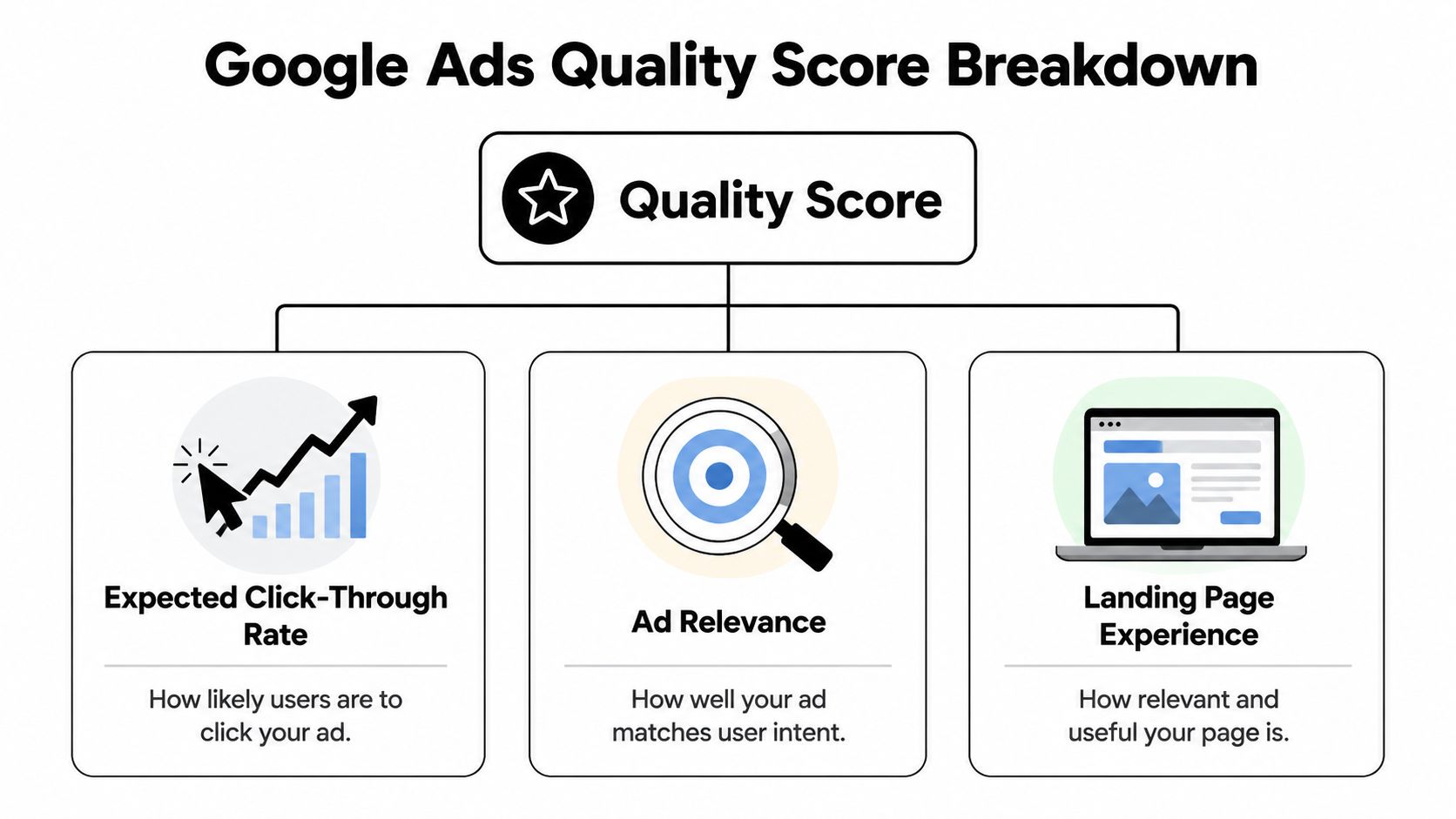
Google's own guidance says Quality Score is assessed using expected CTR, ad relevance, and landing page experience, and it recommends improving those by tightening keyword themes, making ad text more compelling, and making sure the landing page matches search intent. Google also advises using multiple ad groups instead of dumping everything into one group, as outlined in its guide on three ways to improve your quality score.
Expected CTR is your click appeal
Expected CTR is Google's read on whether people are likely to click your ad when it shows.
If your ad looks bland, generic, or disconnected from the search, this component usually suffers. I see this constantly in accounts where one ad group targets everything from broad problem queries to high-intent buying terms. The ad ends up saying nothing specific, so people scroll past it.
For an ecommerce example, if someone searches for a specific product style and the ad says “Shop Quality Products Online”, that's weak. If the ad reflects the category, use case, or offer more clearly, it usually has a better shot at earning the click.
Ad relevance is message match
Ad relevance is simpler than people make it. Does the ad line up with the keyword and the intent behind it?
A lot of campaigns fail here because the account structure is lazy. One ad group holds too many keywords, the headlines try to cover all of them, and the result is a vague ad. That's not smart account management. That's just untidy work.
Practical rule: If one ad group needs to speak to multiple different intents, it probably needs to be split.
For a service business, “emergency plumber”, “blocked drain”, and “hot water repair” might all belong in the same campaign, but they often shouldn't live in the same ad group. They signal different needs. If the ad doesn't mirror that need, relevance drops.
Landing page experience is where most accounts waste money
This one gets ignored because it usually involves website work, not just ad platform work.
If your ad promises one thing and the visitor lands on a page that feels slow, cluttered, or off-topic, you've broken trust. For ecommerce, that might mean sending traffic to a generic collection page instead of the most relevant product category. For service businesses, it often means sending people to a homepage when they needed a focused service page with a strong call to action.
Here's the key shift I'd make if you're serious about learning how to improve quality score google ads campaigns properly. Stop obsessing over the overall score first. Look at which of the three components is weak. That's the bottleneck.
What actually matters in real accounts
I'd think about Quality Score like this:
| Component | What it usually means in plain English | Common fix |
|---|---|---|
| Expected CTR | Your ad isn't winning attention | Sharpen headlines and align them to intent |
| Ad relevance | Your keyword and ad copy don't match tightly enough | Split ad groups and rewrite ads |
| Landing page experience | The page doesn't deliver what the ad promised | Improve message match, UX, and page usefulness |
That framing is far more useful than chasing a mythical perfect score.
A strong Quality Score can still sit inside a poor campaign. If the search terms are weak, the market is small, or the offer is wrong, the score won't save you.
If you're a business comparing agencies, this is often the difference between a thoughtful marketing agency Melbourne operator and someone just clicking recommendations inside the platform. Good management means reading the diagnosis properly, then fixing the right layer.
Auditing Your Account to Find the Real Issues
When I open an account, I don't start by editing ads. I start by finding the keywords that are doing the most damage.
Industry guidance recommends diagnosing keywords in the Keywords view, reviewing search terms weekly, eliminating irrelevant queries, and focusing first on ad groups with the highest impression-weighted spend. It also recommends measuring progress through Quality Score history, landing page experience history, and expected CTR history, not just raw bid changes, as outlined in this guide to improving Google Ads quality score quickly.
Start in the Keywords view
Inside Google Ads, go to your keyword reporting and customise the columns so you can clearly see what's going on.
I want these fields visible:
- Quality Score
- Expected CTR
- Ad relevance
- Landing page experience
- Quality Score history
- Expected CTR history
- Landing page experience history
That gives you a proper diagnostic view. A keyword with a weak score becomes easier to interpret once you can see which component is dragging.
Don't fix every low score keyword
Here, people waste time.
A keyword with a poor score but hardly any impressions isn't where I'd start. I care more about keywords and ad groups that are actively spending, regularly showing, and carrying weak component ratings. That's where the account leak is.
Here's the order I use:
Find high-visibility ad groups first
Look for the areas of the account generating the most impressions and spend.Check which component is below average
Don't guess. If expected CTR is weak, that's an ad problem. If landing page experience is weak, changing bids won't help.Review search terms weekly
Search term junk kills relevance fast. If irrelevant queries keep triggering the ad group, your data gets messy and your ad quality suffers.Expand negative keywords carefully
Negative keywords are one of the cleanest ways to improve relevance because they stop your ads from showing on poor-fit searches.
What a useful audit looks like
When we audit a campaign for an online store, we'll often see a category ad group that looks tidy on the surface but is hiding a mess. The keywords may all be related broadly, yet the search intent isn't the same. Some users want pricing, some want a specific product type, and some are still researching.
If all of that goes to one ad group and one landing page, the quality components start pulling in different directions.
A quick audit table helps:
| What you see | What it usually means | What I'd do next |
|---|---|---|
| Low ad relevance | Ad group theme is too broad | Split keywords by intent |
| Low expected CTR | Ad copy isn't competitive or specific | Rewrite headlines and asset combinations |
| Low landing page experience | Page doesn't match the search or feels weak on mobile | Improve page relevance and UX |
The score is the symptom. The component rating tells you where the disease is.
Audit examples from real account patterns
For service businesses, I often find homepage traffic where a dedicated service page should exist. A plumbing campaign might send every query to one general page, even though the searcher wanted a very specific service. That usually hurts both relevance and landing page experience.
For ecommerce, a common problem is overstuffed category ad groups. One ad set tries to cover multiple product types, and the landing page is a broad collection page. That can work for some traffic, but it rarely gives Google a clear enough signal for stronger component ratings across the whole set.
If you're working with a digital marketing agency Melbourne businesses trust, this kind of audit should be standard. Not a once-a-year clean-up. Ongoing maintenance.
What to track after the audit
Once changes are live, don't judge them by feeling. Track movement in the history columns and compare that with actual business metrics.
I'd keep an eye on:
- Component history trends to see whether your changes improved the diagnosis
- Search term quality to confirm you're attracting the right traffic
- Conversion quality so you don't improve ad metrics while lowering lead or sales quality
That last point matters. A prettier Quality Score means nothing if the account starts bringing in softer traffic.
Boosting Ad Relevance and Expected CTR
This is the part most advertisers can improve fastest.
When ad relevance and expected CTR are weak, I almost always find the same root issue. The campaign structure is too loose. Too many keywords. Not enough intent separation. Ads trying to please everyone and convincing no one.
Tight ad groups beat bloated ones
I don't like stuffed ad groups. They create vague ads, weaker message match, and mixed search term data.
If you sell products online, break out ad groups by clear theme. Not by every tiny variation, but by commercial intent that changes what the shopper wants to see. If someone searches for a product category, your ad should sound like that category. If they search for a specific sub-type, the ad should speak to that.
For service businesses, the same rule applies. “Roof repair”, “roof leak repair”, and “roof replacement” might be related, but the person searching each one is often in a different state of mind. Write for that state of mind.
Write ads that feel like the answer
A good search ad shouldn't sound like marketing copy from a brand meeting. It should sound like the result the searcher hoped to find.
Bad ad copy usually has one of these problems:
- Too broad because it's trying to cover too many keywords
- Too generic because it avoids specific intent
- Too clever and forgets the searcher just wants a clear answer
I'd rather write an ad that is blunt and relevant than one that sounds polished but foggy.
Here's a simple comparison.
| Weak approach | Better approach |
|---|---|
| Premium Services Available | Same-Day Hot Water Repair |
| Shop High-Quality Products Online | Shop Men's Black Work Boots |
| Trusted Experts Across Melbourne | Emergency Electrician Melbourne |
The second version in each pair gives the searcher a reason to click because it reflects the query more closely.
If the headline could fit any business in your category, it's probably too generic to lift expected CTR.
Use the ad to qualify the click
A lot of advertisers think higher CTR means getting more people to click no matter what. That's not the goal.
You want the right click. The ad should attract the user you want and filter out the one you don't. That improves user fit and usually helps downstream conversion quality as well.
For ecommerce, mention product category, brand angle, delivery angle, or use case when it's relevant. For service businesses, mention job type, location, urgency, or contact action if that's what matters most.
Match the ad group to the landing page
Many accounts break at this point.
If the ad group theme is “custom Shopify development” and the ad speaks directly to Shopify build work, don't send the click to a broad homepage. Send it to the most relevant service page. The same logic applies if you offer web builds and want to attract higher-intent traffic looking for a web design Melbourne partner rather than a generalist.
That consistency helps users decide fast. It also helps the quality inputs line up.
Practical improvements I'd make this week
If I were inside your account today, I'd likely do some version of this:
- Split broad ad groups into tighter themes where the search intent clearly differs
- Rewrite headline sets so the primary keyword idea appears naturally and clearly
- Cut weak search terms that muddy the intent of the ad group
- Refresh assets regularly so stale messaging doesn't drag click appeal down
- Align offers to query intent instead of forcing the same angle across every keyword
Don't go too narrow just because a blog told you to
I'll offer a strong view. Tighter structure is usually good, but over-segmentation can become its own problem.
In a smaller Australian market, you can narrow themes so aggressively that the campaign loses flexibility and volume. I've seen this happen with local service accounts where every micro-theme becomes too thin to generate useful data. At that point, the account looks neat but performs worse.
That's why learning how to improve quality score google ads performance properly means balancing relevance with enough traffic to make decisions. Cleaner isn't always better. Useful is better.
If you're comparing providers, that's one of the tells. A smart marketing agency Melbourne businesses can rely on won't just split everything into tiny buckets because it looks advanced. They'll structure around intent, data volume, and commercial value.
Optimising Your Landing Page Experience
Landing page experience is where a lot of campaigns often lose the sale.
You can write a great ad, win the click, and still waste the budget if the page is slow, confusing, or mismatched. I've seen this on both ends of the market. Ecommerce brands with polished products but clunky collection pages. Service businesses with decent ads sending traffic to a homepage that makes people hunt for the next step.

Message match comes first
The landing page should continue the conversation the ad started.
If the ad talks about a specific service, the page should open with that service. If the ad promotes a product category, the page should immediately confirm the shopper is in the right place. Too many advertisers still send paid traffic to generic pages and hope the visitor will figure it out.
They usually won't.
For ecommerce, that means using the most relevant collection or product page possible. For service businesses, it means building focused service pages instead of routing everything to the homepage.
The page needs to be easy on mobile
Most paid clicks are impatient. That's even more obvious on mobile.
If the page loads awkwardly, hides the CTA, shoves key content too far down, or makes forms painful, your landing page experience suffers in practice whether the business owner notices it or not. A fast, clean mobile layout matters because the visitor is trying to make a quick decision, not admire the site.
For Shopify stores, this usually means checking image weight, collection filtering, sticky add-to-cart options, and whether the product page makes buying easy. If your store has UX issues or theme limitations, working with experienced Shopify developers in Melbourne can make the page far more usable for paid traffic.
Relevance beats decoration
A flashy page isn't automatically a better page.
I'd take a plain, focused landing page over a beautifully animated one that buries the value proposition. Visitors need clarity. What is this page? Is it relevant to my search? What do I do next? Why should I trust this business?
That applies whether you sell products or leads.
Here are the basics I'd expect on a solid page:
- Clear headline alignment with the ad and the keyword theme
- Obvious primary CTA such as add to cart, book now, call now, or request quote
- Useful supporting detail that answers likely objections quickly
- Trust elements like reviews, policies, shipping info, or business credentials
- Low friction layout with no confusing next step
A landing page doesn't need to impress your designer. It needs to remove doubt for the buyer.
Service pages on WordPress often need harder editing
This is common in trade, health, home services, and local lead gen accounts. The site looks fine from a brand perspective, but the service pages are weak for paid traffic. They're too wordy, too broad, or built around the business instead of the customer problem.
If that's your setup, sharpen the page. Put the service promise first. Show the area served. Make the form simple. Put the phone number where people can find it. If your build is dragging because the site is heavy or awkward to edit, a capable WordPress developer can usually clean up speed and usability issues quickly.
For anyone wanting a broader checklist, this landing page optimization guide is a useful reference because it focuses on clarity, friction reduction, and conversion intent rather than surface-level design trends.
What I look for on ecommerce pages
Ecommerce landing page issues usually show up in one of three forms:
| Problem | What the visitor experiences | Better fix |
|---|---|---|
| Generic collection page | Too many choices, weak relevance | Send traffic to a tighter category or product page |
| Slow page elements | Delay, bounce, frustration | Compress images and simplify heavy sections |
| Weak purchase path | Unclear next action | Make add-to-cart and key details more obvious |
A lot of stores don't need a rebuild. They need cleaner paid traffic pathways.
A short walkthrough like this can help you review your own page setup before you start changing ads.
Trust and usefulness matter more than hype
Google wants the page to be useful. Buyers do too.
That means your page should answer the obvious questions without making people dig. On product pages, that could be shipping, returns, sizing, compatibility, or usage details. On service pages, that could be response time, service area, pricing approach, process, or proof you've done this work before.
If a paid visitor lands on the page and still feels uncertain after a few seconds, the problem isn't just conversion rate. It's the experience you're sending paid traffic into.
For any business trying to improve quality score google ads campaigns over time, landing page work isn't optional. It's half the job.
Beyond the Score Tracking Testing and Long-Term Success
Here's the part many advertisers need to hear. A 10/10 Quality Score is not the target if chasing it hurts the business.
Google's own help guidance frames Quality Score around three components and makes a useful point for advertisers who know how to read between the lines. It's mainly a diagnostic signal, not a lever you directly optimise, and a high score doesn't guarantee better auction outcomes if the campaign structure is inefficient or the account is starved of demand. That matters in Australia because narrowing themes too aggressively can reduce eligible impressions in smaller markets, which is exactly why a more nuanced approach is needed, as explained in Google Ads Help on about Quality Score.

Accept some imperfection
I'm happy to live with a middling Quality Score on a keyword that consistently brings in strong commercial intent and converts well.
What I won't accept is a low score caused by sloppy structure, irrelevant search terms, or a landing page that makes the user work too hard. That's avoidable. But if a keyword sits in a tougher auction environment or naturally has more constrained ad flexibility, I care more about profitable outcomes than vanity metrics.
That distinction matters.
Use testing to prove changes
Too many account changes are based on hunches. Don't do that.
If you change ad copy, landing page routing, or ad group structure, track the effect properly. Google Ads experiments and controlled account changes are useful because they stop you from making sweeping decisions based on a couple of good days.
I'd look at:
- Lead quality or sales quality after the change
- Conversion rate direction alongside component improvements
- Impression share impact if tighter structure reduced visibility
- Search term quality to make sure cleaner relevance didn't narrow reach too far
Don't trade volume for neatness without a reason
Often, a lot of AU accounts get over-optimised.
A campaign can become so segmented that it loses data density. Then you've got a tidy account with weak learning, less volume, and no real commercial upside. That's not advanced optimisation. That's overhandling.
Good Google Ads management balances relevance, reach, and conversion quality. You need all three working together.
What mature account management looks like
A smarter long-term workflow usually looks like this:
| Focus area | Weak approach | Better approach |
|---|---|---|
| Quality Score | Chase the highest number everywhere | Use the score to diagnose the real bottleneck |
| Structure | Split everything into tiny pieces | Group by meaningful intent and usable data volume |
| Measurement | Judge success by ad metrics only | Compare score movement against conversions and sales quality |
For ecommerce brands, this often means keeping a close eye on conversion value and product intent instead of obsessing over cosmetic account tidiness. If you're running shopping, search, or branded and non-branded traffic together, the account needs commercial logic first.
That's also why a capable ecommerce marketing agency should be thinking beyond keyword diagnostics alone. Quality Score matters, but it's only useful when it supports actual growth.
My rule for deciding when to push harder
I push harder on Quality Score when the weak component clearly points to waste. I back off when the account is already commercially efficient and the next increment is likely to cost more in effort than it returns.
That's the mindset I'd want any digital marketing agency Melbourne business owners hire to bring into the account. Not platform theatre. Not busywork. Judgment.
Your Partner in Growth
Improving Quality Score in Google Ads comes down to disciplined basics. Diagnose the weak component. Fix the ad structure if relevance is poor. Improve the click appeal if expected CTR is soft. Repair the page if the landing experience is failing. Then measure whether those changes helped the business, not just the interface.
That's the practical way to handle how to improve quality score google ads campaigns in Australia. Especially for SMBs and ecommerce stores where market size, search intent, and conversion quality all matter as much as the score itself. A cleaner account should produce better traffic and better outcomes. If it doesn't, the work isn't finished.
I'm based in Melbourne and I've seen the same pattern across accounts from local service businesses to national ecommerce brands. The winners don't chase perfection. They run tighter systems, review search terms properly, write sharper ads, and send paid traffic to pages that make conversion easy.
Alpha Omega Digital is a marketing agency Melbourne businesses use when they want that kind of hands-on paid ads and website thinking. We work with businesses across Australia, including Sydney, Brisbane, Newcastle, Perth, Adelaide, Darwin and Hobart. If you've got a project in mind, contact us.
If you're a business with a paid ads budget of at least 3k a month, I'd love to offer you a low risk deal. Get a month of paid ads management FREE. Apply now through the contact page.
If you want a team that can improve the whole system, from ad structure and search intent through to landing page UX on WordPress or Shopify, talk to Alpha Omega Digital. We help Australian businesses turn wasted ad spend into cleaner leads, stronger sales, and a more reliable growth engine.
Alpha Omega Digital
Read more insights from our team on web design, paid ads, and growth strategy.