You're probably in one of two spots right now.
Either you've already spent money on Google Ads or Meta ads and you're not convinced the sales justify the stress, or you're looking at agencies and trying to work out who understands eCommerce versus who just talks a big game on Zoom.
I see this a lot with store owners in Melbourne. They've got decent products, a clean Shopify theme or a WordPress build that looks fine on the surface, and they're getting traffic. But the numbers underneath are messy. Tracking is patchy. Landing pages are slow or cluttered. Campaigns are built around clicks instead of buying intent. Then someone says the answer is “more budget”, when the underlying issue is the system behind the spend.
That's where performance marketing agencies either prove their worth or expose themselves.
A real performance-focused team doesn't just launch ads and send a report at the end of the month. It connects paid media, tracking, site experience, creative testing, and conversion behaviour into one accountable setup. For eCommerce brands, that matters more than any pitch deck ever will.
Stuck Burning Cash on Ads That Don't Convert?
Clicks can be misleading.
A lot of business owners assume that if people are visiting the site, the campaign must be working. It isn't that simple. I've looked at plenty of accounts where traffic looked healthy, but the store was still bleeding money because the campaign structure was loose, product pages weren't persuasive, and conversion tracking was telling half the story.
The usual pattern looks like this:
- Ads go live quickly: Someone launches Google Ads or Meta ads with broad targeting and generic creative.
- Traffic starts coming in: The dashboard feels promising because there are impressions, clicks, and add-to-carts.
- Sales stay inconsistent: Revenue doesn't line up with spend, or margins disappear after ad costs.
- Decision-making gets reactive: Budgets get cut, campaigns get paused too early, or random changes are made without a testing plan.
That's not a traffic problem. It's a measurement and conversion problem.
Performance marketing fixes that by forcing every part of the funnel to answer a basic question. Did this dollar move the business forward or not? That could mean a sale, a qualified lead, a booked call, a wholesale enquiry, or a repeat purchase. If the activity can't be tied back to a real outcome, it shouldn't sit at the centre of your strategy.
Most wasted ad spend doesn't come from one dramatic mistake. It comes from a pile of small issues that nobody took ownership of.
For eCommerce, the shift is practical. You stop judging campaigns by whether they feel busy. You judge them by whether they produce profitable actions. That changes how you build landing pages, how you tag events in Google Tag Manager, how you structure product feeds, and how you decide whether Performance Max, standard Shopping, branded search, or remarketing deserves more budget.
If your ads feel like gambling, that usually means the setup was never built as a performance system in the first place.
What Exactly is a Performance Marketing Agency?
The common perception of a “marketing agency” is a broad service business that handles a bit of everything. Some branding, some content, some ads, maybe a monthly meeting with polished slides. That model still exists, but it's not what business owners usually need when they want sales from paid traffic.
A performance marketing agency is judged by outcomes first.
That means the conversation starts with conversions, customer acquisition efficiency, revenue quality, and retention signals. Activity matters, but only if it moves those outcomes. A report full of impressions and reach is not enough if the cart stays empty.
In Australia, that shift is already well underway. Adobe's State of Performance Marketing report says performance marketing now absorbs nearly 60% of total marketing spend, and more than half of global senior marketers' budgets are allocated to it through a model built around measurable outcomes like leads, sales, and return on ad spend, as noted in Adobe's State of Performance Marketing report.

What this means in practice
A traditional agency can look busy without being accountable. A performance agency can't hide behind output.
Here's the difference in plain terms:
| Agency approach | What it tends to focus on | What the client actually feels |
|---|---|---|
| Traditional brand-led model | Reach, awareness, creative delivery, campaign activity | “We're doing a lot, but I'm not sure what's working” |
| Performance-led model | Sales, leads, attribution, conversion rate, acquisition efficiency | “I can see where money is going and what it's producing” |
That doesn't mean brand has no place. It does. But if you're an eCommerce operator trying to grow with limited room for waste, you need someone who can tie media spend to commercial outcomes.
The part many agencies still dodge
The hard part isn't launching ads. It's building the feedback loop.
That means clean tracking, good creative, offer clarity, strong product pages, and disciplined optimisation. It also means saying no to weak tactics. If a campaign is bringing low-intent traffic, if your landing page loads poorly on mobile, or if your feed setup is a mess, the agency should say it plainly.
Practical rule: If an agency talks more about impressions than purchases, they're probably not performance-led.
I also think it helps to compare different agency styles before signing anything. If you want another example of how agencies position their performance services, the Full Circle Agency website is worth a look as a contrast point when you're assessing how different firms talk about results, strategy, and execution.
The main thing to remember is this. Performance marketing agencies don't earn trust by being loud. They earn it by making the numbers easier to understand and harder to fake.
The Core Services That Actually Drive eCommerce Sales
A lot of Melbourne eCommerce businesses come to an agency after trying to fix the wrong problem. They increase budget, swap creatives, and test another audience, but the underlying issue sits underneath. The feed is messy. The landing page is slow on mobile. The cart drops people at the shipping step. Tracking is patchy, so the account starts optimising toward the wrong actions.
That is why the services that drive sales usually sit across media, site performance, and measurement at the same time. Search captures active demand. Meta builds interest and brings people back. Email and SMS recover revenue that would otherwise be lost. Site development removes purchase friction. The best agencies connect those pieces instead of treating them like separate departments.
Australian shoppers rarely buy in a straight line. They might first see a product on Instagram, come back through Google, then return later via a direct visit or an email. Siloed channel management usually wastes money because each platform gets judged in isolation instead of against the full buying path.
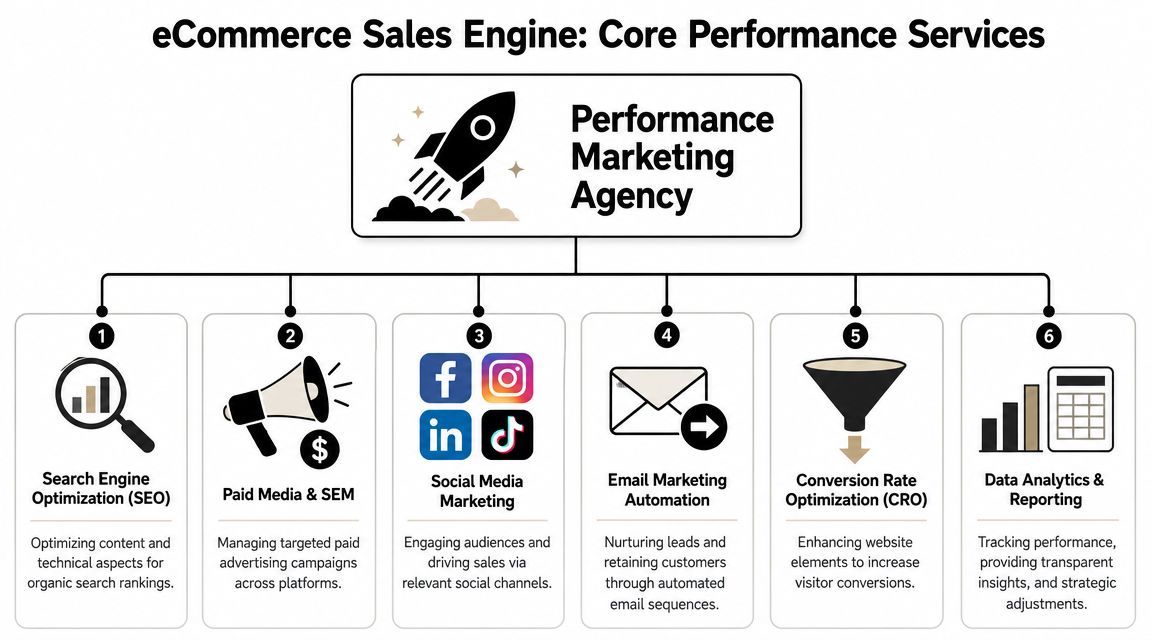
Google Ads that match buying intent
Google Ads can be one of the cleanest profit channels in eCommerce. It can also become an expensive mess fast.
For most product businesses, the work is not just turning on Shopping or Performance Max. It's about account structure, feed quality, query control, margin awareness, and landing page alignment. If branded, non-branded, Shopping, and remarketing all blur together, it becomes hard to see whether the account is finding new customers or harvesting people who were already on their way to buy.
A few patterns show up again and again:
- Feed quality shapes results: Product titles, GTINs, categories, images, and pricing logic all affect how products enter auctions and what traffic they attract.
- Campaign separation matters: High-intent search traffic should not be mixed blindly with broad exploration campaigns.
- Performance Max needs supervision: It works best when the inputs are strong and the exclusions are sensible.
- Product economics should guide spend: A repeat-purchase skincare brand can tolerate a different acquisition profile from a furniture store with a long buying cycle.
I have seen stores blame Google for weak ROAS when the actual issue was a poor product feed and category structure. Paid media exposed the problem. It did not create it.
Meta ads that survive contact with reality
Meta still sells products well, especially for visual categories, bundles, impulse buys, and offer-led campaigns. But the account needs enough creative variation and enough clean conversion data to learn properly.
Audience targeting is no longer the first thing I look at. Creative angle, offer strength, product-market fit, page match, and event quality usually have more impact. A disciplined Meta setup tests different hooks for the same product, different formats for the same offer, and different landing page treatments for the same audience pool.
What tends to hold up in real accounts:
- Different hooks for different objections: Price, quality, speed, proof, gifting, or problem-solution.
- Multiple creative formats: Video, static, UGC-style edits, product demonstrations, carousels.
- Offer variation: Bundles, first-order incentives, free shipping thresholds, product packs.
- Page consistency: The ad promise needs to match what the user sees after the click.
What fails is usually predictable. One creative runs too long. The offer is weak. The landing page is generic. Then the platform gets blamed.
If you are comparing approaches, best Facebook ads agency and Facebook Meta ads agency are useful examples of how agencies describe testing, creative process, and account management.
Your website build affects ad performance more than most agencies admit
Traffic quality matters. So does the store people land on.
I have worked on accounts where a small change to the product page outperformed weeks of media tinkering. Better variant selection. Clearer delivery messaging. A cleaner mobile gallery. Fewer checkout distractions. Those changes often lift conversion rate faster than another round of audience testing.
For Shopify stores, common performance blockers include:
- Slow themes and app bloat
- Weak collection filtering
- Poor product template hierarchy
- Messy cart behaviour
- Broken tracking through checkout steps
For WordPress and WooCommerce stores, the issues are usually different:
- Template inconsistency
- Heavy plugins
- Landing pages built without conversion intent
- Weak category architecture
- Form and event tracking gaps
If your site cannot support the ads, media buying becomes expensive diagnostics.
For platform-specific capability, WordPress developers Melbourne and web design Melbourne help show whether a team can handle UX and build quality, not just campaign setup. If you want a simple way to think about what should be measured once those changes go live, this guide to real estate agent marketing KPIs is built for another industry, but the reporting logic is still useful.
Good ad buying cannot compensate for a store that makes purchasing harder than it needs to be.
Email, remarketing, and revenue recovery
Cold traffic should not carry the whole account.
A strong eCommerce setup uses remarketing, email, and SMS to recover people who viewed products, added to cart, started checkout, or bought once and then disappeared. That includes browse abandonment, cart recovery, post-purchase flows, replenishment reminders, win-back campaigns, and segmented offers based on product interest or customer value.
This layer often looks less exciting than paid acquisition. It is usually more profitable.
The same goes for on-site conversion work. FAQs near the buy button. Clear shipping and returns information. Reviews in the right spot. Better bundle presentation. Mobile sticky add-to-cart. These are not glamorous changes, but they often decide whether paid traffic becomes revenue or just another reporting line.
A short walkthrough helps if you want the platform-side basics in video form before you get too deep into channel strategy.
How We Measure What Matters KPIs and Transparent Reporting
A store owner looks at Shopify, Meta Ads Manager, and GA4 and sees three different revenue numbers for the same week. That is usually the moment trust starts to slip. If the tracking is messy, budget decisions turn into guesswork, and guesswork gets expensive fast.
For eCommerce, measurement has one job. It should help you decide where to put the next dollar with more confidence than the last one.
That matters even more when so much paid acquisition runs through a small group of major platforms. Browser tracking drops out. Attribution gets blurred. Platform reporting claims more credit than it should. The fix is not another prettier dashboard. The fix is better inputs: first-party data capture, cleaner event mapping, stronger platform matching, and a reporting view tied back to the numbers in the store.
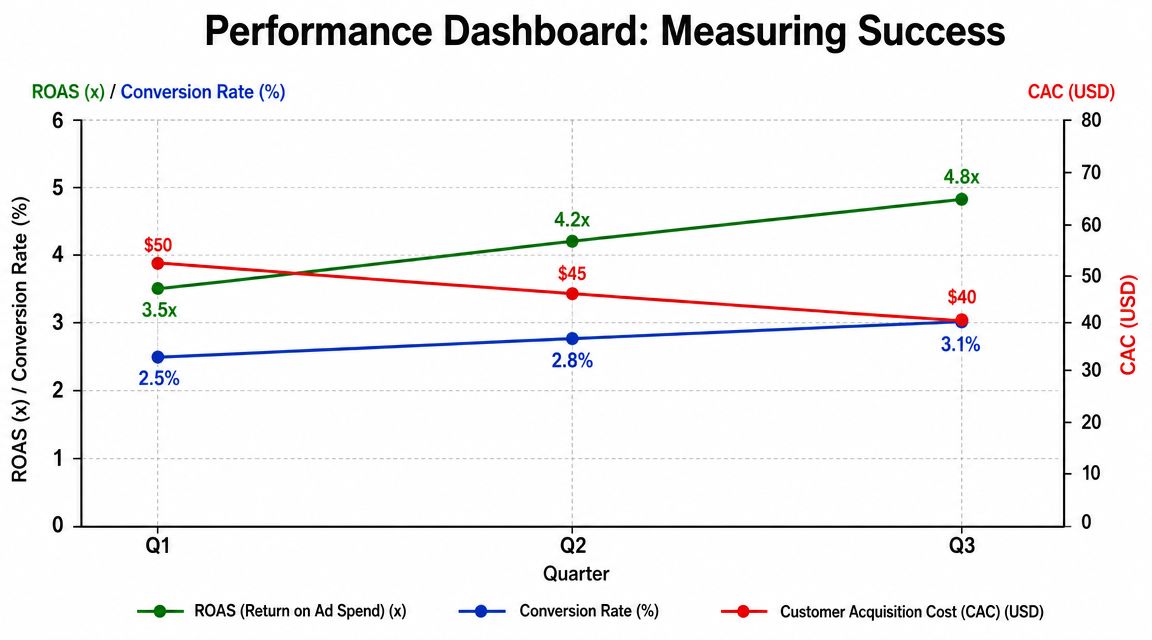
The KPIs that deserve your attention
A lot of agencies throw 20 metrics into a report and call it transparency. That usually hides the issue.
For most Melbourne eCommerce brands, I want a small set of KPIs that connect ad spend to commercial outcomes. Not vanity numbers. Not channel-specific wins that fall apart once you check Shopify.
| KPI | Why it matters | What a bad agency often does |
|---|---|---|
| Conversion rate | Shows whether the site and traffic are working together | Blames ad traffic before checking page speed, product page friction, or checkout drop-off |
| Cost per click | Helps diagnose auction pressure, ad relevance, and click quality | Chases cheap clicks that bring weaker buyers |
| Customer acquisition cost | Shows what it costs to win a new customer | Buries it inside blended reporting so new customer efficiency stays unclear |
| Return on ad spend | Useful if it is checked against margin, refund rate, and average order value | Treats platform-reported ROAS as final truth |
| Retention signals | Shows whether acquired customers are worth more than one purchase | Reports first-sale revenue and ignores repeat rate, time to second order, and customer quality |
The right KPI set also changes by business model. A single-purchase gift brand can tolerate a different CAC than a consumable brand with strong repeat purchase behaviour. A high-AOV furniture store should expect a longer consideration window than a fast-moving beauty brand. Good reporting reflects those differences instead of forcing every store into the same spreadsheet.
If you want a simple KPI example from another industry, this guide to real estate agent marketing KPIs is useful because the reporting discipline is the same. Pick the indicators that tie activity to revenue and decision-making.
The technical setup behind clean reporting
Clean reporting starts well before the report.
In practice, that means getting the setup right across the site, ad platforms, and analytics stack. For a Shopify store, that often includes product view events, add-to-cart, begin checkout, purchase value, and new versus returning customer logic set up properly. For WordPress and WooCommerce, the job is often less tidy because plugin conflicts, theme edits, and custom checkout steps can break tracking without anyone noticing for weeks.
A serious eCommerce setup usually includes:
- Google Tag Manager: Controlled event deployment, testing, and change management without touching the site code every time
- Google Analytics: Clear event naming, revenue tracking, channel comparison, and post-click behaviour analysis
- Meta Conversions API: Better event reliability when browser-only tracking misses part of the path
- Enhanced conversions and offline matching where relevant: Better signal quality when customer value is confirmed after the initial browser session
For hybrid businesses that sell online and close some enquiries by phone, call tracking matters too. If a prospect clicks a paid ad, rings the business, and converts later, that path needs to be captured. If it is not, the campaign that created the lead can look weaker than it was, and budget gets pulled from the wrong place.
What transparent reporting looks like
A useful report answers four questions:
- What happened
- Why it happened
- What changed
- What happens next
That fourth point is where weak agencies get exposed. Screenshots from ad platforms are not insight. Store owners need plain-English interpretation tied to actions. Did a product feed issue cut Shopping visibility? Did a landing page update lift add-to-cart rate but lower average order value? Did a broad audience bring volume but weaker new customer efficiency? Those are the conversations that improve an account.
If reporting does not help you make a decision, it is decoration.
Good reporting should also show the trade-offs. A stronger ROAS can come from tighter retargeting while prospecting dries up. Lower CAC can look great until you realise average order value dropped and refunds climbed. More conversions can hide the fact that branded search is doing the heavy lifting. The point is not to make the numbers look flattering. The point is to make them useful.
Alpha Omega Digital is one example of the kind of team that works across paid media, web development, tracking, and conversion improvements. That mix matters for eCommerce brands because performance problems rarely sit in one place. Sometimes the targeting is off. Sometimes the site is leaking intent. Often it is both.
The Money Talk Performance Agency Pricing Models
Agency pricing gets confusing because different models suit different stages of business.
A small store testing paid acquisition for the first time shouldn't think about fees the same way as a larger operator with stable margins, decent conversion rates, and a clear product-market fit. The problem is that many agencies present pricing as if one model suits everyone. It doesn't.
For Australian SMEs, the question is cost-effectiveness. With 97.2% of Australian businesses classified as small businesses in 2023-24, the hiring decision is often less about chasing more leads and more about reducing waste through better tracking, conversion work, and budget discipline, as noted in this analysis referencing the Australian small business landscape.
The common pricing models
Here's the straight version.
| Pricing model | How it works | Good fit | Watch-out |
|---|---|---|---|
| Flat retainer | Fixed monthly management fee | Stable businesses that want predictable costs | Can reward maintenance over performance if scope is vague |
| Percentage of ad spend | Fee rises with media budget | Bigger accounts with active optimisation needs | Incentive can drift toward spending more, not always spending better |
| Hybrid model | Base fee plus performance component or spend tier | Brands that want shared accountability | Needs very clear definitions upfront |
| Project-based | One-off fee for setup, tracking, landing pages, feeds | Businesses fixing foundations before scaling ads | Doesn't replace ongoing optimisation |
| Pure performance fee | Agency compensation tied closely to outcomes | Rare, usually only with strong tracking and aligned incentives | Easy to misunderstand if attribution isn't clean |
When an agency starts making sense
A business usually becomes ready for agency support when a few things are true at once:
- You already have demand: There's evidence people want the product.
- You can fulfil consistently: Stock, shipping, service, and customer support aren't chaotic.
- You know your margins: Not perfectly, but well enough to judge acquisition quality.
- You're willing to fix the site too: Not just blame the media account.
If you're asking “how much does it cost to start Google Ads?”, the answer isn't one universal number. It depends on your category, competition, product price, conversion rate, and how clean your tracking is. A tiny budget on a broken store doesn't become efficient just because it's small. In some cases, spending less means gathering weak data more slowly.
The right question isn't “What does the agency cost?” It's “Will this setup reduce waste enough to justify the fee?”
That's why I generally prefer clear retainers or hybrids over vague promises. You want an arrangement where both sides know the job. Build the account properly. Improve conversion quality. Track the right events. Report clearly. Optimise with discipline.
If an agency avoids the budget conversation or won't discuss where spend is likely to leak, that's usually a sign they're selling management, not performance.
Your Checklist for Choosing the Right Melbourne Marketing Agency
Monday morning, the sales report is flat, ad spend kept going over the weekend, and nobody can tell you whether the problem sits in the campaign, the tracking, or the site. That is usually the moment a business owner realises they do not need a slick pitch. They need a team that can trace the leak and fix it.
Choosing a Melbourne agency gets easier once you judge them on diagnosis, not presentation.
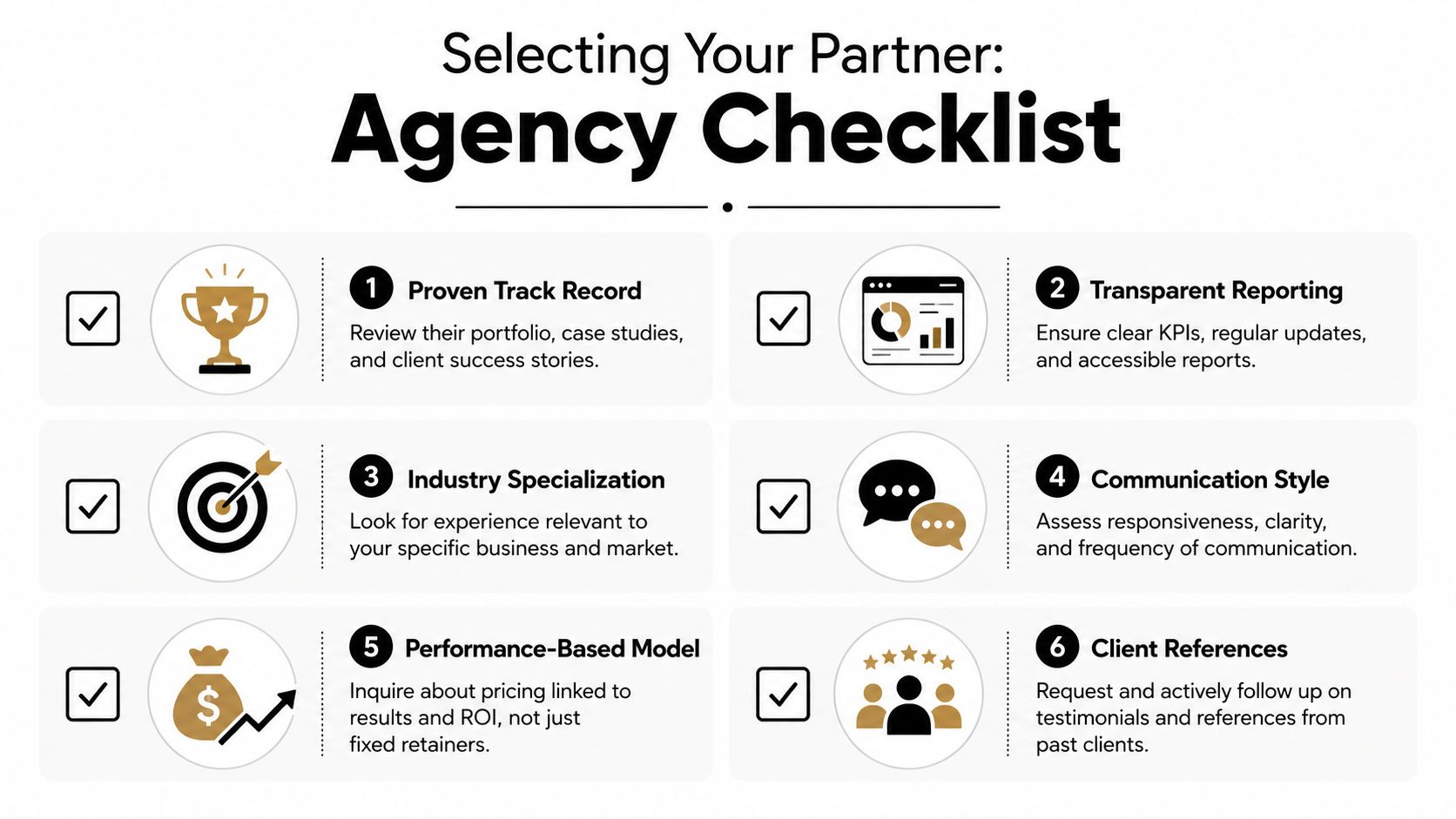
Start with platform fit
Platform fit changes the job.
A Shopify store has its own set of problems. Product feed quality, app bloat, event duplication, theme changes that break tracking, and merchandising decisions that hurt paid performance all show up fast in the numbers. An agency working on Shopify should be comfortable talking about collection structure, checkout constraints, feed rules, and what happens to Meta and Google data after a new app install.
WordPress and WooCommerce are different again. Plugin conflicts, custom templates, form tracking, GTM setup, checkout flow, and page speed issues can all affect conversion rate. If the agency treats Shopify and WooCommerce as basically the same thing, that usually means the technical depth is thin.
Ask direct questions:
- Who handles development work
- How changes are tested before they go live
- How media buyers and developers work together
- What the process is when tracking breaks after an update
- Who is responsible for fixing feed or checkout issues
The answer should sound operational, not vague. You want to hear how they work inside a real store, not a rehearsed service list.
Check how they make decisions
A decent agency can list channels. A good one can explain trade-offs.
Ask them how they choose between PMAX and standard Shopping. Ask what they do when Meta drives cheap traffic that does not buy. Ask what would stop them from scaling budget. Ask how they separate first-time customers from repeat purchases in reporting. Those questions force them to show whether they understand eCommerce economics or just platform settings.
I pay close attention to whether the answer connects media to the site. For example, if a campaign brings in traffic to a slow product page with weak variant selection and unclear shipping info, the media account is only part of the problem. Good operators say that plainly.
Look for red flags early
Some are easy to spot.
- Guaranteed outcomes
- Reporting that stays at clicks, impressions, and ROAS without discussing margin or customer quality
- No serious questions about your store, checkout, or tracking setup
- The same channel mix for every client
- A heavy sales process followed by vague technical answers
A subtler red flag is overconfidence around attribution. If they speak as if every sale can be tied back perfectly across Google, Meta, email, organic, and repeat purchase behaviour, be careful. Real accounts have blind spots. Good agencies explain where measurement is solid, where it is directional, and what decisions they can still make with confidence.
Another one is local ignorance. Plenty of Melbourne eCommerce brands also have a showroom, warehouse pickup, phone enquiries, or service revenue attached to the same brand. An agency does not need to be a local SEO specialist to handle that, but they should understand how branded search, Google Business Profile, and local intent can affect paid performance.
The right agency reduces confusion. They do not add theatre.
Test communication before you sign
Communication problems usually show up before the contract does.
Notice how they answer hard questions. Do they explain issues in plain English? Do they admit uncertainty when the data is messy? Do they tell you what they would check first if Shopping spend drops or Meta events stop firing? That matters more than how polished the proposal looks.
You also need clarity on rhythm. Who runs the account day to day? How often do you review results? What gets escalated quickly? If a feed disapproval cuts off revenue on a Friday afternoon, a slow reply on Monday is not good enough.
For businesses that also depend on leads or phone calls, ask how they handle the gap between click and sale. Form quality, call handling, response time, and CRM follow-up all affect whether ad spend turns into revenue. Agencies that only discuss traffic usually miss the actual source of waste.
A strong Melbourne agency should be able to walk from ad account to landing page to checkout to reporting, and tell you where money is leaking. That is the checklist. Everything else is packaging.
A Great Partnership The Final Piece of the Puzzle
The best agency relationships don't feel like outsourcing. They feel like having a commercially minded operator inside your corner.
That's what eCommerce owners usually need. Someone who can look at the Shopify build, the WordPress templates, the GTM setup, the Google Ads structure, the Meta event quality, and the offer itself, then tell you where the leak is. Not in theory. In the actual account.
NetSuite's agency KPI framework is useful here because it puts the focus where it belongs. Agency value is measured through outcomes such as conversion rate, CPC, and client retention, not just activity, and that measurement-first discipline is a big reason performance-focused teams have become so relevant for Australian businesses, as outlined in NetSuite's marketing agency KPI framework.
That's also why the strongest partnerships usually span more than one discipline. Sometimes the fix is a better Google Ads setup. Sometimes it's a cleaner Meta Conversions API installation. Sometimes it's custom Shopify work, a better WordPress landing page, or tighter product page UX. Sometimes the smartest move is pausing expansion until tracking is fixed.
For businesses that also rely on calls, there's another practical layer. We've set up custom Twilio numbers that handle calls around the clock, never get tired, can answer common questions, qualify leads, and book appointments directly into a calendar or Calendly. For tradies, hairdressers, beauty therapists, dentists, restaurants, and doctors, that can stop a lot of lost business that would otherwise slip through when nobody picks up.
And that's really the difference. Good performance marketing agencies don't just buy traffic. They help build a system that captures more of the demand you're already paying to create.
If you're looking for a marketing agency Melbourne business owners can speak to about paid ads, Shopify or WordPress conversion work, and proper tracking, Alpha Omega Digital is one option to consider. If your business has a paid ads budget of at least 3k a month, there's a low-risk offer on the table. Get a month of paid ads management FREE. Apply now through the contact page. Alpha Omega Digital is based in Melbourne and also works with businesses in Sydney, Brisbane, Newcastle, Perth, Adelaide, Darwin and Hobart.
[email protected]
Read more insights from our team on web design, paid ads, and growth strategy.