You've got three tabs open, three agency decks in your inbox, and they're all saying the same thing. Award winning creative. Data driven. Melbourne based, results obsessed. None of them has told you who'll run your account, what they'll test first, or how you'll know in 30 days if you've hired well. I've sat on both sides of that pitch table, and I'll tell you plainly. Picking a social media advertising agency in Melbourne isn't a creative decision. It's a commercial one, and most founders get sold the wrong thing.
The Shortlist Problem Every Melbourne Founder Hits
I see the same scene every month. A Shopify founder from Richmond, a tradie from Dandenong, a clinic owner in Fitzroy. They've boosted a few posts themselves, sales have stalled, and now they're ready to pay someone proper money to run Meta ads and TikTok. They ring three agencies, sit through three polished calls, and end up choosing whoever sounded most confident.
That's the trap. Confident isn't competent.
Why the wrong hire costs more than doing nothing
A bad agency doesn't just waste the retainer. They burn your ad spend, poison your pixel data with cheap traffic, train your audiences on the wrong buyers, and leave you with an ad account you don't own. I've taken over accounts where the previous agency owned the pixel, the catalogue, even the Instagram Shop connection. The client had paid for months of learning and walked away with nothing they could keep.
If you're spending $3K to $10K a month, a realistic first 90 days isn't instant scale. It's clean tracking, a tested offer, two or three creative angles that get clicks from buyers, and a clear read on your cost per qualified lead or purchase. Anyone promising you more than that before they've seen your margins is guessing with your money.
If an agency can't explain what happens in week two when results are poor, don't wait to find out in week two.
The market you're actually buying into
You're not advertising in a small pond. In January 2025, about 18.5 million Australians aged 18 and over used social media, which was 87.8% of the adult population, according to DataReportal's Digital 2025 Australia report. That same data shows 80.2% of internet users used at least one platform. Your customers are there. So are your competitors.
And they're spending. Total internet advertising expenditure hit $16.4 billion for the 2024 calendar year, up 11.1% year on year, in IAB Australia's Internet Advertising Revenue Report prepared by PwC. Video alone reached $4.5 billion, growing 19.6%, with social platforms taking more than a third of that video spend.
That matters for you because it tells you what good help now looks like. It isn't someone boosting posts from their phone. It's platform specific creative, short form video, proper conversion tracking, and weekly budget decisions tied to revenue. If a marketing agency Melbourne businesses trust can't talk about all four without reading from a deck, cross them off your list. Use the rest of this guide as a filter, not homework. Run every proposal through it before you sign anything.
What a Melbourne Social Advertising Agency Actually Does
Most agency websites mash everything into one vague promise. Strategy, creative, media, growth. I want you to pull those apart, because you're paying for them separately whether the invoice says so or not.
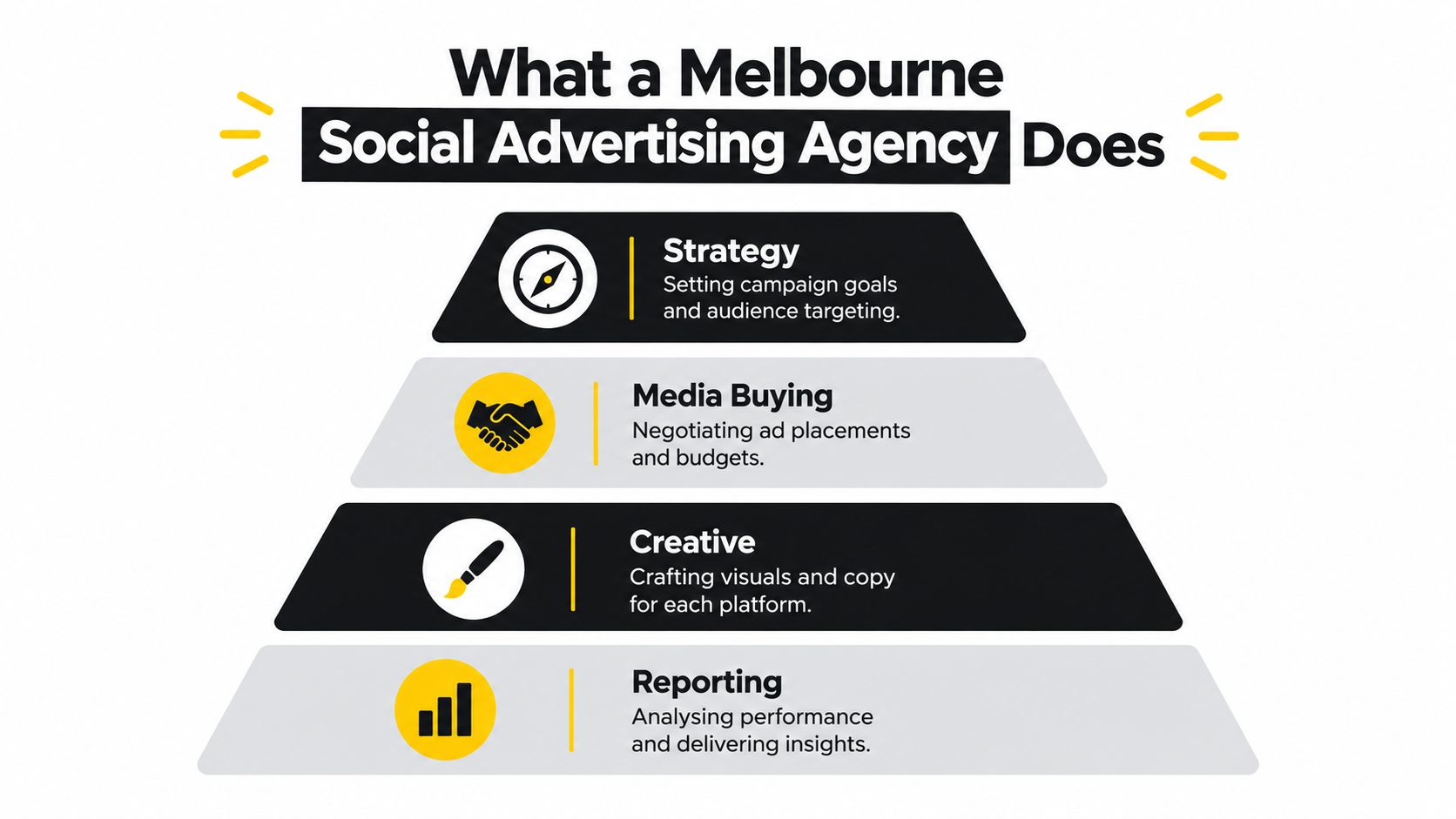
The four layers you are actually buying
Strategy comes first. That means audience research, offer positioning, funnel mapping, and picking platforms based on where your buyers are. Meta for most ecommerce and local services, TikTok for discovery and younger buyers, LinkedIn only if you're selling to professionals who'll pay proper money per lead. If the strategy is just a list of interests to target, you don't have a strategy.
Media buying is the daily work. Building campaigns, splitting prospecting, retargeting, and existing customers so reporting doesn't lie to you, controlling frequency, and moving budget toward what returns. A good Facebook ads agency team will also talk about how social fits beside Google Ads, because search often captures the demand social creates.
Creative is where accounts live or die now. You need UGC style video, product demos, founder led pieces, carousels, and statics built for Reels, Stories, and feed. I've watched polished brand videos lose to a tradie talking to his phone in a ute because the hook was honest and local. Ask who shoots, who edits, and how many new concepts you get each month. If creative is an afterthought, your targeting won't save you.
Tracking and reporting hold it together. That means GTM and Google Analytics set up properly, Meta pixel plus Meta Conversions API, UTMs on everything, and for ecommerce, a clean Shopify API and catalogue feed connection for Instagram Shop and Facebook Shop. Without that layer, you're optimising blind.
The build work nobody mentions in the pitch
Ads send traffic somewhere. If that somewhere is a slow WordPress page or a Shopify product page with no proof, no clear price, and a form that asks for too much, your cost per sale climbs no matter how good the ad is. Serious agencies either build landing pages themselves, through WordPress development and Shopify development, or they work directly with whoever does. That includes page speed, custom sections, and for WordPress, things like building custom blocks in Gutenberg so your team can update offers without calling a developer.
Startups reading this sometimes ask me about raising money to fund all this properly, and if that's you, it can help to find social media marketing seed investors who understand paid acquisition timelines rather than expecting profit in week one.
What is often outsourced quietly
I check who does the work first. Who actually handles your account. In plenty of Melbourne agencies, the person who pitched you never touches it. Creative goes to a contractor, media buying goes to a junior, reporting is an automated PDF nobody reads. That's not automatically bad, but you deserve to know. A proper digital marketing agency Melbourne operator will name your strategist and your buyer, tell you what's done in house, and give you a reporting cadence you can hold them to. Weekly optimisation notes, fortnightly calls, monthly deep dives. If you only hear from them when the invoice lands, you're funding their business, not yours.
The Vetting Checklist Melbourne Founders Can Run in a Day
You don't need a month of meetings. You need one afternoon, a spreadsheet, and the nerve to ask direct questions. This is the exact filter I'd run if I were hiring for my own store.
Run these checks before you talk price
- Named clients, not logos: Ask for case studies with business names, timeframes, and spend ranges. A logo wall with no numbers tells you nothing.
- Live dashboards, not screenshots: Screenshots can be cherry picked from one good week in 2023. Ask to see a live, de identified dashboard and how they read it.
- Account ownership: Your business owns the ad account, pixel, catalogue, Google Tag Manager containers, and Analytics property. Get that in writing before launch.
- Named humans: You want a named strategist and a named media buyer. If they won't name them, you don't have them.
- Category proof: An agency great at fashion ecommerce may be useless for PPC for tradies or booked appointments. Ask what they've run in your category.
- Creative testing process: They should describe a Meta ads creative testing process in plain language. One variable at a time, clear kill rules, fresh concepts on a schedule.
- Contract terms: Be wary of 12 month lock ins with no performance clause. Good operators back themselves with shorter initial terms.
| Item to verify | Question to ask | Green flag |
|---|---|---|
| Ownership | Who owns the ad account and pixel if we part ways | You do, stated in the contract |
| Reporting | Show me a real monthly report | Revenue, qualified leads, and next actions, not just reach |
| Creative | How many new concepts do we test monthly | A set cadence with examples |
| Team | Who runs my account day to day | Two named people you can speak to |
| Tracking | How do you set up Conversions API | Server side events, deduplication, CRM feedback |
| Exit | What happens to our data if we leave | Full handover list within days |
Use trust as a hard filter
This part matters more in Australia than most agencies admit. Australian evidence shows 67% of consumers do not trust social media advertising and 63% do not trust platforms with their data, while 84% trust recommendations from family and friends, as reported in reporting on the seismic shift in consumer trust of social media.
So ask how they handle trust in creative. Local proof, real reviews, clear pricing, named staff, suburb specific examples. Ask how they check claims, testimonials, and targeting for compliance before launch. Ask what happens when hide rates and negative comments climb. If they shrug, they'll burn your brand for a cheap click.
Founders expanding offshore face the same trust problem in new markets, which is why a guide for UAE startup founders on entering an unfamiliar market is a useful reminder that local proof beats imported playbooks everywhere. Print the table above. Take it into your next call. Score each agency in front of them if you like. The good ones won't mind. The rest will reveal themselves quickly.
Realistic Pricing and Retainer Models in Melbourne
Pricing pages in this industry are vague on purpose. It lets agencies quote based on what they think you'll pay. I'll give you the ranges I see across Melbourne so you can benchmark any proposal.
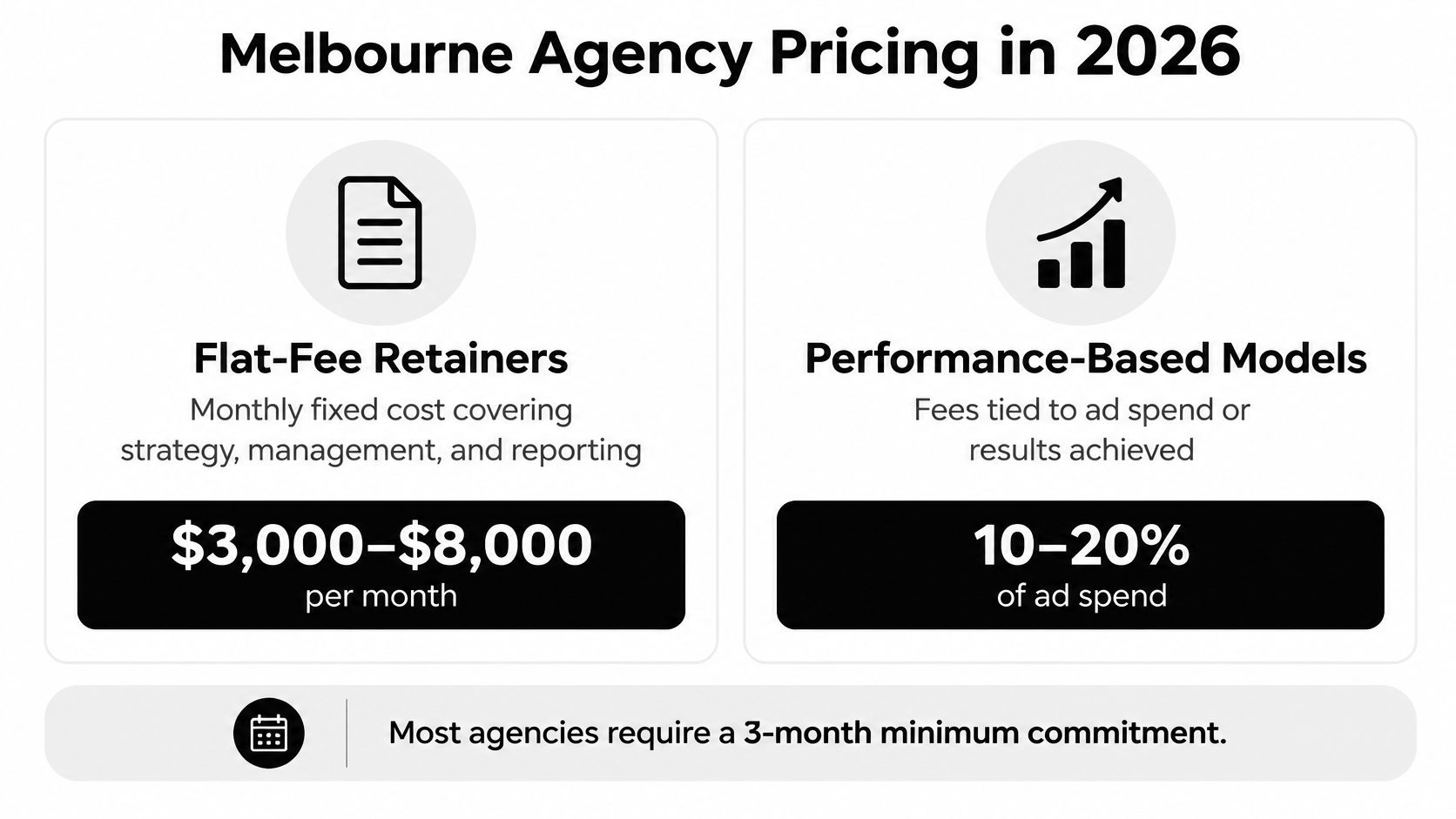
The three models you will be quoted
Flat fee retainers are the most common. Smaller accounts often start around $1,500 to $2,500 a month, and serious ecommerce or lead generation work usually sits around $3,000 to $6,000 a month. You get predictability. The risk is paying the same fee in a quiet month when little testing happens, so tie the fee to deliverables like creative volume and optimisation cadence.
Percentage of spend models usually fall between 12% and 20% of ad spend. They can work when spend is large and growing, but watch the incentive. The agency earns more when you spend more, even if your margins get worse. If you accept this model, cap it and review it against profit, not revenue alone.
Hybrid models combine a base fee with a performance bonus tied to qualified leads, sales, or gross profit. I like these when tracking is clean, because both sides win from the same number. They fall apart when the bonus metric is fuzzy. Define a qualified outcome in writing before anyone celebrates.
The costs hiding under the retainer
- Creative production: UGC creators, shoots, editing, and design often sit outside the retainer.
- Extra platforms: Adding TikTok or LinkedIn to a Meta retainer usually adds a fee.
- Landing pages: WordPress design, Shopify design, and CRO work are rarely free.
- Tools: Call tracking, reporting software, and CRM costs can be passed through.
That last point matters for service businesses running Google Ads for contact form submissions and call campaigns. Tools like CallRail and Go High Level are popular, and in my own work I also set up a custom number through Twilio for clients who miss calls after hours. It offers 24 hour call answering, never gets sick or tired, books appointments into your calendar or Calendly, and can save thousands in lost business for tradies, hairdressers, beauty therapists, dentists, restaurants, and doctors. Whatever you use, make sure the cost and the data sit in your name.
Budget rule I give every client: Work backwards from margin and allowable cost per acquisition, never forwards from what a competitor spends.
That's also the honest answer to what budget to spend on Google Ads and how much does it cost to start Google Ads. There's no magic number. Australian online retail sales were $4,492.1 million in May 2025, up 8.4% year on year, and reached $4,703.8 million in June 2025, up 13.0%, according to Australian Bureau of Statistics retail trade data for May 2025. Demand is there. Your budget should be set by your average order value, gross margin, conversion rate, and repeat purchase behaviour. A $40K a month Shopify store does not need an enterprise retainer, and a cheap retainer on a serious spend is usually a junior learning on your card.
Interview Questions That Reveal How the Agency Thinks
Sales calls reward polish. These questions reward operators. Ask them word for word if you like, and write the answers down.

Questions about creative and testing
Ask, how do you decide what creative to test first, and how many concepts do we launch each month. A strong answer names hooks, proof formats, and audience signals, plus a kill rule based on spend or conversions. A weak answer talks about brand guidelines for ten minutes.
Ask, when do you use creator style video versus polished brand assets. Social video growth makes this a real operating question now. Australian social advertising spend reached US$4.73 billion in 2025, up 11% year on year, and influencer marketing reached US$590 million, up 13.5%, in figures covered by Campaign Brief reporting on We Are Social and Meltwater findings. That same coverage notes 6 in 10 Australians use social media to research brands each month. Your captions, comments, and reviews are part of the sale, not decoration.
Questions about trouble and ownership
Ask, what do you do when a campaign is losing money in week two. I want to hear a sequence. Check tracking, check landing page conversion, isolate the variable, pause losers, protect the budget. If they say they'll let the algorithm learn for a month on your money, that's your answer about them.
Ask, who builds our landing pages and what happens to our accounts if we leave. If they rely on Shopify development or WordPress work they don't control, timelines will slip. On exit, you should keep ad accounts, pixels, audiences, creative files, and tracking setups. Everything.
Ask, where does reporting come from and how often do we review strategy. Platform numbers alone aren't reporting. You want ad data matched to Shopify revenue, CRM lead quality, or booked appointments, reviewed on a set cadence.
The question most founders skip
Ask, can I speak to two current clients directly. Not testimonials. Not a case study PDF. Two owners, on the phone, who'll tell you what communication is like when results dip.
Refusing client references is a reference in itself.
Listen for red flags while they answer. Vague timelines. No named contacts. Guarantees about ROAS before they've seen your data. And my least favourite sentence in this industry, we'll figure that out in onboarding. Figure it out now, while your money is still in your account. I'd also test their wider knowledge. If you sell products, ask them to explain Campaign priority in Google Ads or PMAX vs Google Shopping ads. A real performance team can explain that Shopping priority decides which campaign bids first when products overlap, per Google Ads Help on Shopping campaign priority, and that Shopping relies on your Merchant Center product feed rather than keyword lists, as set out in Google Ads Help on Shopping ads and product data. You don't need them to run Google for you. You need to know they understand the full journey your customer takes.
KPIs, Reporting and What Good Looks Like in Month One
Most agency reports are designed to make the agency look busy. Reach up. Impressions up. Clicks cheap. Meanwhile your bank account hasn't moved. I'll show you the framework I use with Melbourne ecommerce and lead generation clients.
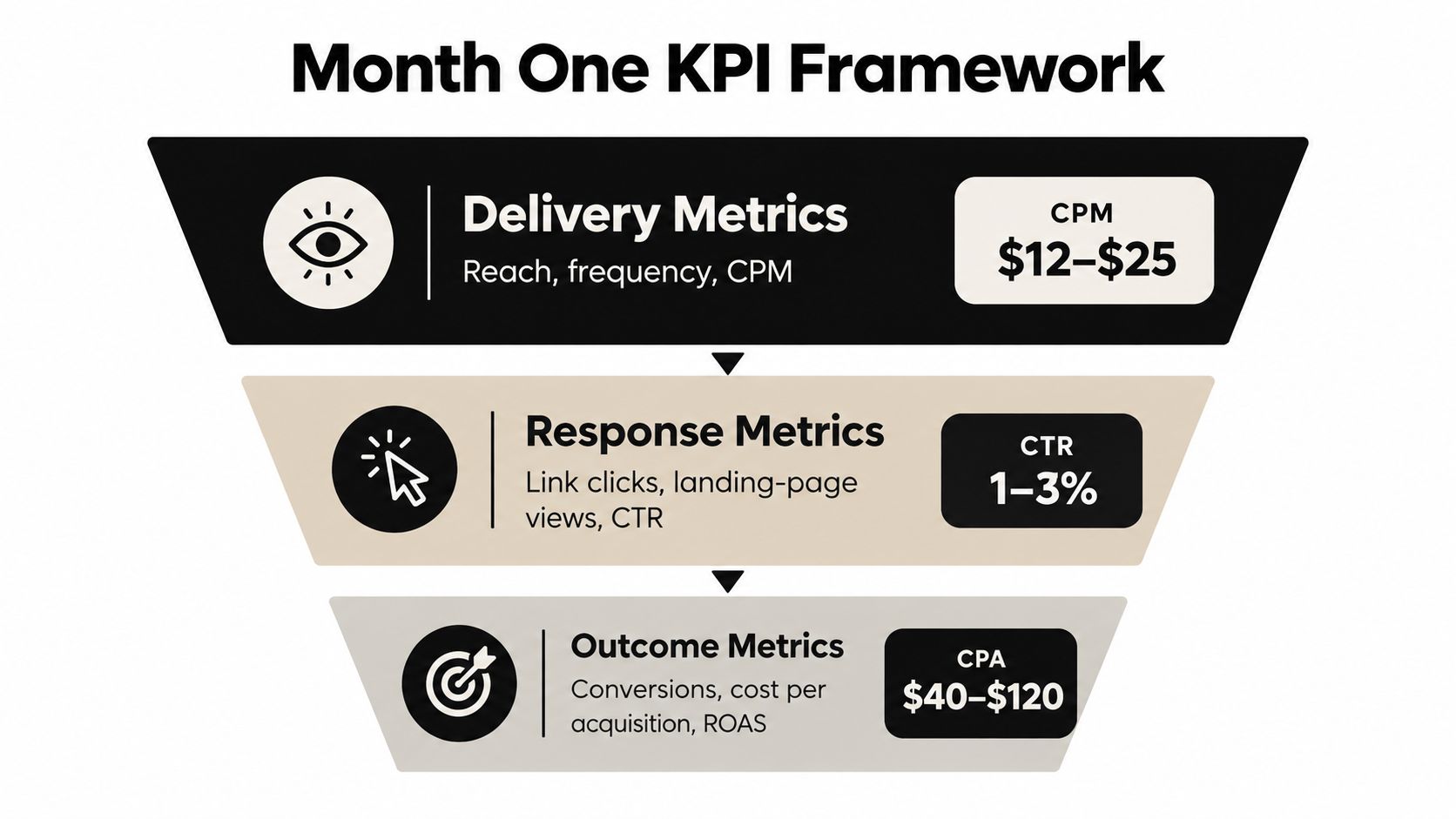
Report in three layers and never blend them
Delivery metrics tell you the ads ran. Reach, frequency, CPM. Useful for spotting audience fatigue, useless as proof of profit. Response metrics tell you people reacted. Link clicks, landing page views, add to cart, form starts. Business metrics tell you if it worked. Qualified leads, customer acquisition cost, gross profit ROAS, payback period.
Judge your agency mainly on layer three, and use layers one and two to diagnose why layer three moved.
The four stage workflow I insist on
- Define one commercial event: A qualified lead, booked consultation, or completed purchase, with a value attached.
- Track it properly: Meta and TikTok pixels plus server side or CRM capture, UTMs, and timestamps in Australian Eastern Time.
- Split your audiences: Prospecting, retargeting, and existing customers stay separate so retargeting can't flatter the whole account.
- Optimise weekly: Decisions based on cost per qualified outcome and contribution margin, not cheap clicks.
This approach fits how Australians behave. Figures showing 78% of Australians use social media, 58% use it for brand research, and 43% actively seek brand content before purchasing were reported in ACS Information Age coverage of Australians spending two hours a day on social media. Social creates and shapes demand. It doesn't always close it on the last click.
That point deserves honesty. In Australia, 31.3% of internet users discover brands through social media ads, while search sits higher at 37.7%, according to Meltwater's Australia Digital Report for the APAC region. So judge social as part of a system with Google Ads for service based businesses, strong landing pages, Local SEO, and a maintained Google Business Profile. For product advertisers deciding between campaign types, Performance Max can run across Search, Shopping, YouTube, Display, Discover, Gmail, and Maps, while Standard Shopping stays narrower, a distinction explained in Google Ads Help on Performance Max and Standard Shopping overlap.
What to expect at 30, 60, and 90 days
Month one is infrastructure and first signals. Tracking verified, Conversions API installation for Meta tested, first creative winners and losers identified. Month two is refinement. Better hooks, cleaner audiences, landing page fixes, lead quality feedback from your CRM. Month three is where scale decisions get made, based on cost per sales qualified lead or profitable ROAS, not platform applause.
Bring three questions to your first quarterly review. Which creative angle produced profitable customers, what did we stop doing and why, and what would you test next with more budget. If your agency can't answer those cleanly, your report is theatre. And please, on how to measure success Facebook ads work, don't quit too early on a test with no conversion volume, but don't fund a loser out of hope either. Set the spend limit before launch.
Common Hiring Mistakes and the Low-Risk Way to Start
I'll finish with the mistakes that have cost Melbourne businesses the most money in rooms I've been in. None of them are exotic. All of them are avoidable.
The four habits that drain budgets
Chasing the cheapest quote is the big one. Cheap management usually means few creative tests, slow optimisation, and no senior thinking. You save on the retainer and pay triple in wasted spend.
Signing a 12 month lock in before proof is next. I've never understood why a founder who negotiates hard with suppliers will hand an unproven agency a year. Don't.
Treating the agency like a vendor also hurts you. If you hide your margins, your stock problems, and your lead quality issues, they can't optimise to your real business. Share the numbers that matter. A good seo agency Melbourne partner or paid media team works the same way. They need commercial context, not just a brief and a deadline.
Pulling the plug after two quiet weeks is the mirror mistake. On Facebook Ads, don't quit too early before a test has enough volume to judge. Marketing your business is consistency over months of testing, not a fortnight of hope followed by a new agency.
Start with a pilot you control
Here's the structure I recommend. Run a 30 or 60 day pilot with success criteria agreed before launch. One commercial event, one target cost range, a set number of creative tests, and a review date. Your business owns every account, pixel, audience, and file from day one. The handover process gets documented at the start, not negotiated at the end.
During the pilot, watch behaviour more than promises. Do they flag problems before you spot them. Do their reports match your Shopify or CRM numbers. Do they tell you to fix a landing page built through proper Shopify developers Melbourne or WordPress developers Melbourne work when the page, not the ad, is the bottleneck. That honesty is worth more than a good first week.
My rule for any pilot: If the agency will not be judged on qualified outcomes, they have already told you how they plan to be judged.
For context on how I work, Alpha Omega Digital is a Melbourne based team that builds WordPress and Shopify sites and runs Google Ads and paid social for ecommerce and service businesses, including tracking setups like GTM, Analytics, and Meta Conversions API. We also service clients in Sydney, Brisbane, Newcastle, Perth, Adelaide, Darwin, and Hobart.
If you're a business with a paid ads budget of at least 3k a month, I'd love to offer you a low risk deal, get a month of paid ads management FREE. Apply now through the contact page. No 12 month hostage contract, no account you don't own. We earn the second month by proving the first.
If you're spending at least 3k a month on paid ads and you want proof before a long contract, we offer a month of paid ads management free so you can judge our creative testing, tracking, and reporting on real qualified outcomes. Visit Alpha Omega Digital to apply through the contact page and start with accounts, pixels, and data that stay in your name from day one.
Alpha Omega Digital
Read more insights from our team on web design, paid ads, and growth strategy.