A Melbourne business owner checks Google Ads on Monday morning, sees conversions coming through, and feels some relief. The numbers look active. Spend is producing clicks, enquiries, maybe even sales. But the underlying question usually sits underneath all of that. Are those ads creating profit, or just creating activity?
I see this all the time with ecommerce brands and service businesses. A Shopify store can show solid revenue in the dashboard while a low-margin product range eats up the return. A local service business can generate plenty of leads, but half of them might be poor fits, price shoppers, or suburbs you do not want to service.
That is where business owners get stuck. Google Ads reports what happened in the account. It does not automatically tell you whether the result was commercially worthwhile.
A healthy click-through rate does not answer that. Cheap clicks do not answer it either. Even a strong-looking conversion count can hide a weak outcome if fulfilment costs, discounts, labour, or lead quality are pulling the numbers down.
ROAS is the metric that starts to clear this up. It shows how much revenue you are getting back for what you spend on ads. It is not the whole story, but it is one of the fastest ways to tell whether a campaign is helping the business or just keeping the dashboard busy.
The reason this is important is simple. A good ROAS is not a generic benchmark you copy from a blog post and hope fits. It depends on your margins, your overheads, your sales process, and how accurately you track revenue or lead value.
For a Melbourne ecommerce business, that might mean working out whether a 3:1 return is profitable after shipping and product costs. For a plumber, clinic, or law firm, it might mean figuring out how many booked jobs or retained clients need to come from those leads before the ad spend makes sense.
That is the practical angle here. The goal is to calculate your actual break-even ROAS, then improve from there with numbers that fit your business.
Introduction Are Your Google Ads Actually Making You Money
A lot of business owners open Google Ads and go straight to spend. They see money going out every day, then try to calm themselves down by looking for a few sales or leads in the account. That's usually where the confusion starts.
I've seen this with both ecommerce and service businesses. A Shopify store owner sees revenue in the platform and assumes the campaign is healthy. A tradie sees calls coming in and thinks the ads must be doing the job. Then we dig a little deeper and find that one product line has almost no margin, or the leads are weak, or the campaign is only converting branded searches while the broader account struggles.
What the dashboard often hides
Google Ads can show activity without showing commercial reality. That matters because a campaign can look busy and still be a poor business decision.
Common examples include:
- Cheap clicks with weak buyers that inflate traffic but don't create profitable sales
- Lead campaigns with no value model where every form fill gets treated the same, even though some enquiries are worth far more than others
- Strong-looking revenue numbers that ignore shipping, discounts, fulfilment pressure, or management costs
- Automated bidding set too aggressively so volume drops while the account still appears efficient on paper
When owners ask me whether the ads are working, they usually don't need more dashboard data. They need a better way to judge whether the money coming back is enough.
That's where ROAS becomes useful. It cuts through a lot of noise and gives you a more grounded view of paid search performance. Not the whole story, but the part most businesses should be watching far earlier than they do.
Why this matters more in Melbourne
Melbourne businesses often operate in crowded markets. Search demand can be strong, but so is competition. That means you can't afford to judge campaigns by vanity metrics. If you're running Google Shopping for an ecommerce brand, or lead generation for a service business, the gap between “ads are active” and “ads are profitable” can be wider than people expect.
A practical ROAS target gives you control. It helps you decide whether to scale, hold, or fix the account before more budget gets wasted.
ROAS 101 The Metric That Actually Matters
A business owner might tell me, “We spent $2,000 last month and brought in $8,000 from Google Ads. Is that good?” My first step is to calculate ROAS.
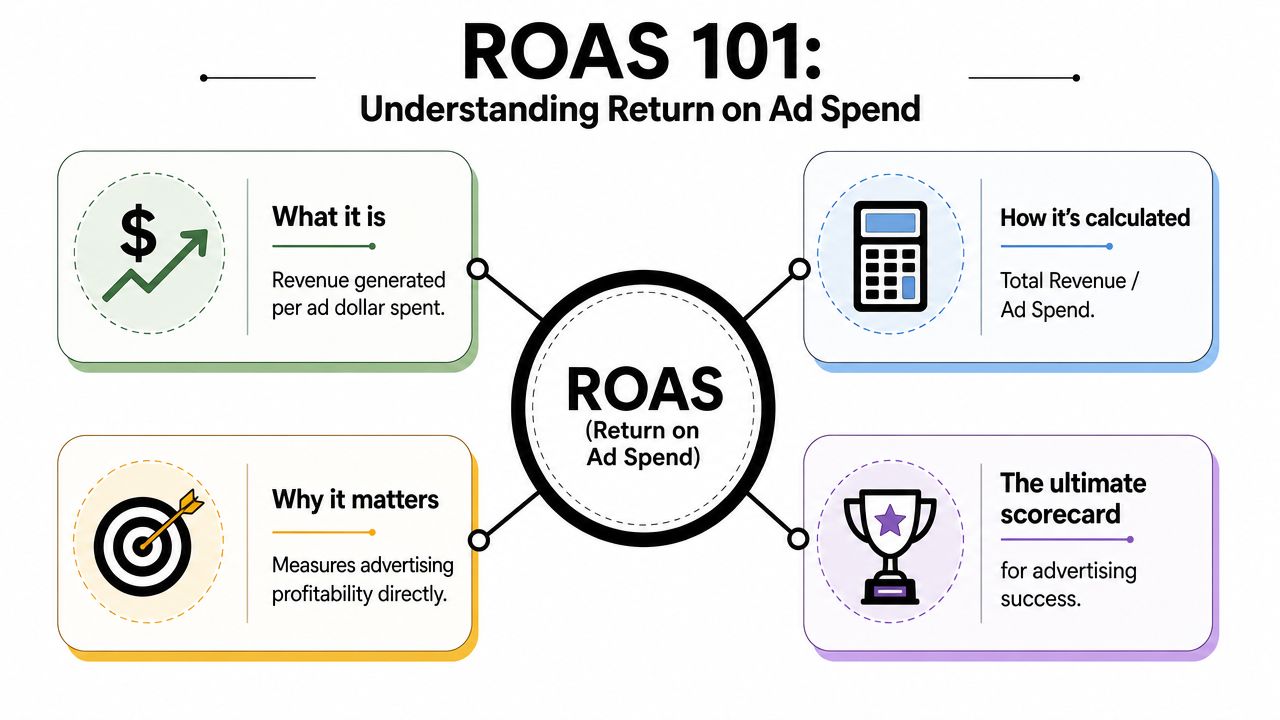
ROAS stands for Return On Ad Spend. It measures how much revenue you generate for each dollar spent on ads. The formula is simple: conversion value / cost.
If you spent $1,000 and tracked $4,000 in revenue, your ROAS is 4.0, or 400%. That means your ads returned $4 for every $1 spent.
What ROAS tells you
ROAS is a measure of advertising efficiency. It helps you judge whether your campaigns are producing enough revenue relative to spend.
It does not tell you whether the business made a healthy profit after product costs, wages, fulfilment, software, and overheads. That's why small business owners often get tripped up by the difference between ROAS, CPA, and ROI.
| Metric | What it focuses on | Best use |
|---|---|---|
| ROAS | Revenue returned from ad spend | Judging campaign efficiency |
| CPA | Cost to acquire a conversion | Controlling lead or sale costs |
| ROI | Overall return after broader business costs | Assessing total profitability |
For ecommerce brands, ROAS is usually one of the quickest ways to judge whether a campaign deserves more budget. For service businesses, it only becomes useful if lead values reflect real sales quality. A plumbing company in Melbourne's southeast, for example, should not value every form fill the same if emergency call-outs and small quote requests lead to very different revenue.
Why ROAS often beats CPA as a decision metric
Cheap conversions can hide expensive problems.
I see this a lot in lead generation. A campaign can produce low-cost enquiries, but if those leads rarely answer the phone, live outside your service area, or never become booked jobs, the low CPA is giving you false comfort. The same problem shows up in ecommerce when a campaign drives sales for heavily discounted products with thin margins.
ROAS gives a better commercial read because it ties spend back to revenue, not just activity.
Practical rule: If a campaign looks strong because the cost per conversion is low, check the revenue quality before increasing budget.
What ROAS misses
ROAS only works as well as the tracking underneath it. If conversion values are inflated, missing, or assigned to the wrong actions, the number becomes less useful.
For service businesses, this is often where reporting falls apart. Calls need tracking. Offline sales need to be fed back into Google Ads or your CRM. If the account only records contact forms, the reported ROAS can still point you in the right direction, but it will not reflect the full commercial picture.
I also tell clients not to judge ROAS too quickly. Some conversions come through after a delay, especially for considered purchases and quote-based services. If you review performance too early, you can end up tightening bids or cutting spend before the stronger conversions have landed.
That's why ROAS matters. But a good ROAS number depends on your margins, your sales process, and what your business needs to keep from each sale.
So What Is a Good ROAS Benchmark
A Brunswick retailer and a Bayside plumber can both report a 4:1 ROAS and get very different business outcomes. One may be making healthy profit and ready to scale. The other may be covering ad costs while losing margin to fulfilment, staff time, or weak lead quality.
That is why benchmark numbers help, but only up to a point.
The figure many advertisers quote is 4:1, or $4 back for every $1 spent. It is a useful reference because it gives a small business owner a quick way to judge whether performance looks broadly healthy. It is not a universal target, and it is definitely not a guarantee of profit.
I use benchmark ROAS the same way I use suburb-level averages for rent or wages. Good for orientation. Not enough to make a decision.
The benchmark many advertisers start with
A 4:1 ROAS is a reasonable starting benchmark for Google Ads conversations because it sits high enough to suggest decent efficiency without being unrealistic for every campaign type.
Still, context matters more than the headline number.
A branded Search campaign, a Shopping campaign for repeat-purchase products, and a lead gen campaign for a high-ticket service should not all be judged the same way. Some campaigns are built to capture demand that already exists. Others are there to introduce the business, fill the pipeline, or bring in first-time customers who buy again later.
Google's automated bidding options also work better once an account has enough recent conversion data. If volume is thin, broad benchmark talk becomes even less useful because the account may not yet have enough signal for stable optimisation.
Google Ads ROAS Benchmarks by Business Model
| Business Model | Average ROAS (Starting Point) | Good ROAS (Target) | Notes |
|---|---|---|---|
| Ecommerce with tighter margins | Around the broader Google Ads average | Often needs to push beyond 4:1 | Margin pressure usually leaves less room for error |
| Ecommerce with healthier repeat purchase behaviour | Around the broader Google Ads average | A lower front-end ROAS can still be workable | Repeat buying can justify a softer initial target |
| High-intent Search or Shopping campaigns | Start from your own historical data | Often justifies a tighter target than broader reach campaigns | These campaigns usually capture stronger purchase intent |
| Lead generation for service businesses | Start from assigned lead values and close rates | Depends on job value and margin structure | Reported ROAS is only as good as the conversion values behind it |
Why ecommerce and lead gen benchmarks behave differently
For ecommerce, ROAS is usually easier to read because revenue is tied directly to the transaction. If Shopify or WooCommerce tracking is set up properly, the number is often close to commercial reality.
For service businesses, ROAS is more interpretive. A form fill is not revenue. It is a potential sale with a close rate, an average job value, and a real cost to deliver. I see this a lot with Melbourne trades and professional services. Two campaigns can generate the same number of leads, but the campaign that attracts better suburbs, better-fit jobs, and higher close rates will be worth far more.
So yes, use the benchmark. Just use it as a rough reference.
Once a campaign has enough history, your own numbers should carry more weight than any generic industry average. That is the point where the question shifts from “Is this ROAS good in general?” to “Is this ROAS good for our margins, our sales process, and our growth goals?”
Why Your Good ROAS Is Unique
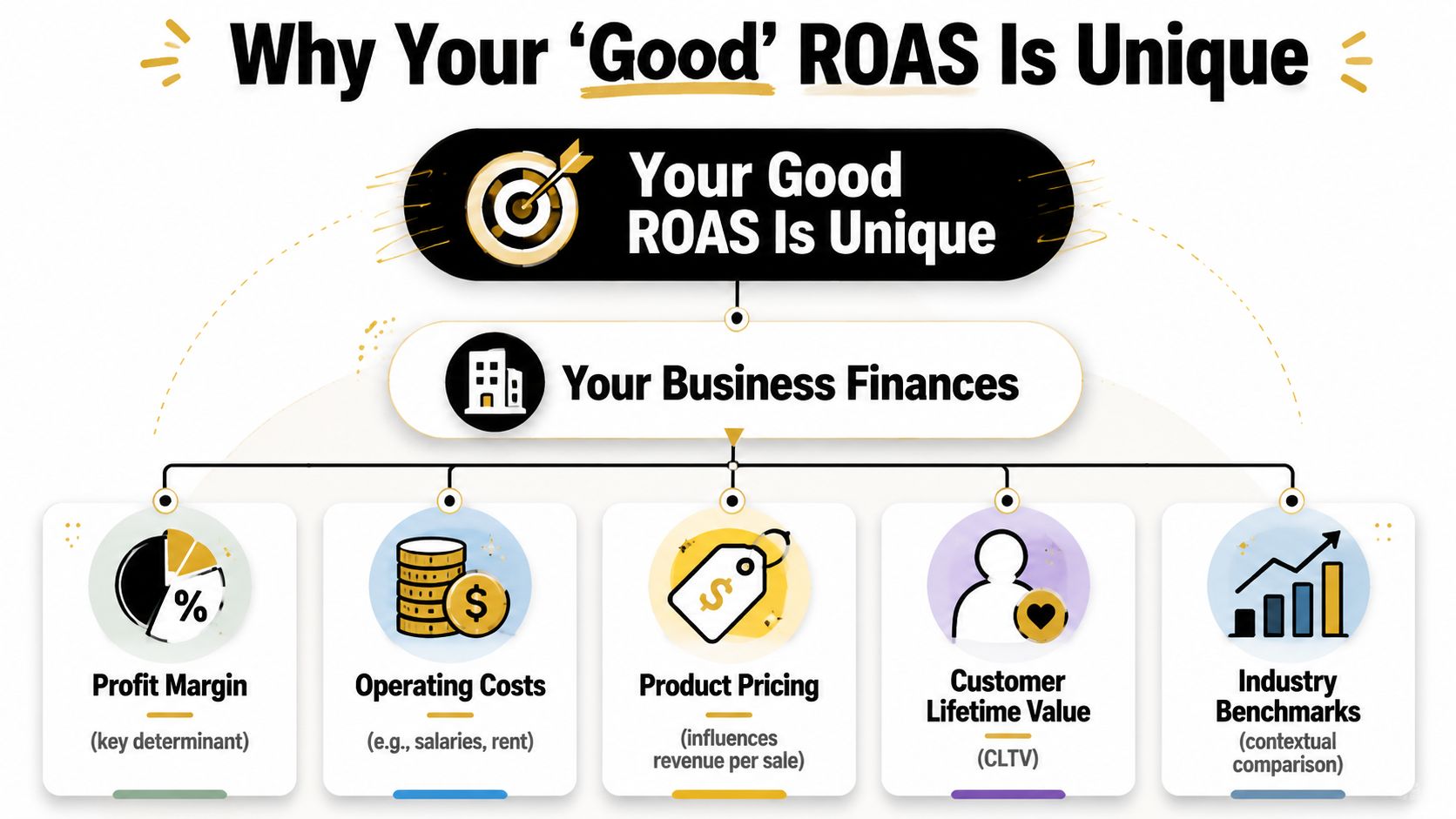
This is the part most articles skip. The answer to what is a good ROAS for Google Ads is personal to the business.
A campaign can hit the commonly quoted benchmark and still be mediocre. Another campaign can sit below that benchmark and still be a smart investment. The difference usually comes down to finances, customer value, and campaign intent.
Profit margin changes everything
Profit margins determine whether 4:1 is strong or merely acceptable, and high-intent Search and Shopping campaigns generally justify higher ROAS targets than broader reach campaigns because they capture users closer to purchase and convert at a higher value-per-click efficiency (Improvado's ROAS guidance).
That one point changes how you should read almost every ROAS report.
If you sell a product with healthy margin and a customer often buys again, you may have room to acquire that customer at a lower first-purchase return. If you sell a low-margin item and fulfilment costs are already tight, you'll need much stronger front-end efficiency.
Customer lifetime value can justify a lower initial ROAS
Not every campaign should be judged only on the first transaction. Many ecommerce brands make poor calls by doing so.
If a customer buys once and disappears, front-end ROAS matters a lot. If a customer buys repeatedly, subscribes, or comes back through email and remarketing, then first-purchase ROAS may understate the full value of the campaign.
A few examples where this matters:
- Consumable products where buyers reorder naturally
- Beauty and wellness brands with repeat purchase behaviour
- Service businesses with ongoing maintenance work
- Businesses with strong back-end sales processes that lift the value of an initial lead
That doesn't mean you should excuse poor acquisition economics. It means you should read them properly.
A lower ROAS can be a strategic win when the customer is worth much more after the first sale.
Campaign intent changes the target
Not every campaign exists to squeeze out the highest possible immediate return. Some campaigns are built to capture high-intent demand. Others support product discovery, remarketing, or market expansion.
That's why I rarely use one fixed ROAS target across an entire account. Campaigns close to purchase intent usually deserve stricter targets. Broader activity often needs more room.
A practical approach:
| Campaign type | Typical expectation |
|---|---|
| Branded search | Usually strong efficiency, but limited scale |
| High-intent non-brand search | Should be held to a tougher ROAS target |
| Shopping for proven products | Needs disciplined margin-aware targets |
| Broader reach campaigns | Can justify lower immediate ROAS if they support future demand |
The mistake is forcing every campaign to look identical in the dashboard. That usually causes underinvestment in growth areas or overinvestment in easy, low-scale wins.
Local businesses need local maths
For Melbourne businesses, this becomes even more practical. Your cost structure, lead quality, delivery area, and service capacity all shape what “good” looks like. A campaign that works for a national ecommerce brand might not work for a local operator managing jobs suburb by suburb.
That's why the best ROAS target isn't copied from a blog. It's built from your numbers.
Setting Your Target ROAS A Practical Walkthrough
Once you stop chasing generic benchmarks, the next question is simple. What target should you use?
The cleanest place to start is your break-even ROAS. That's the level where your ads are covering what they need to cover before you can call the campaign commercially healthy.
Start with your margin
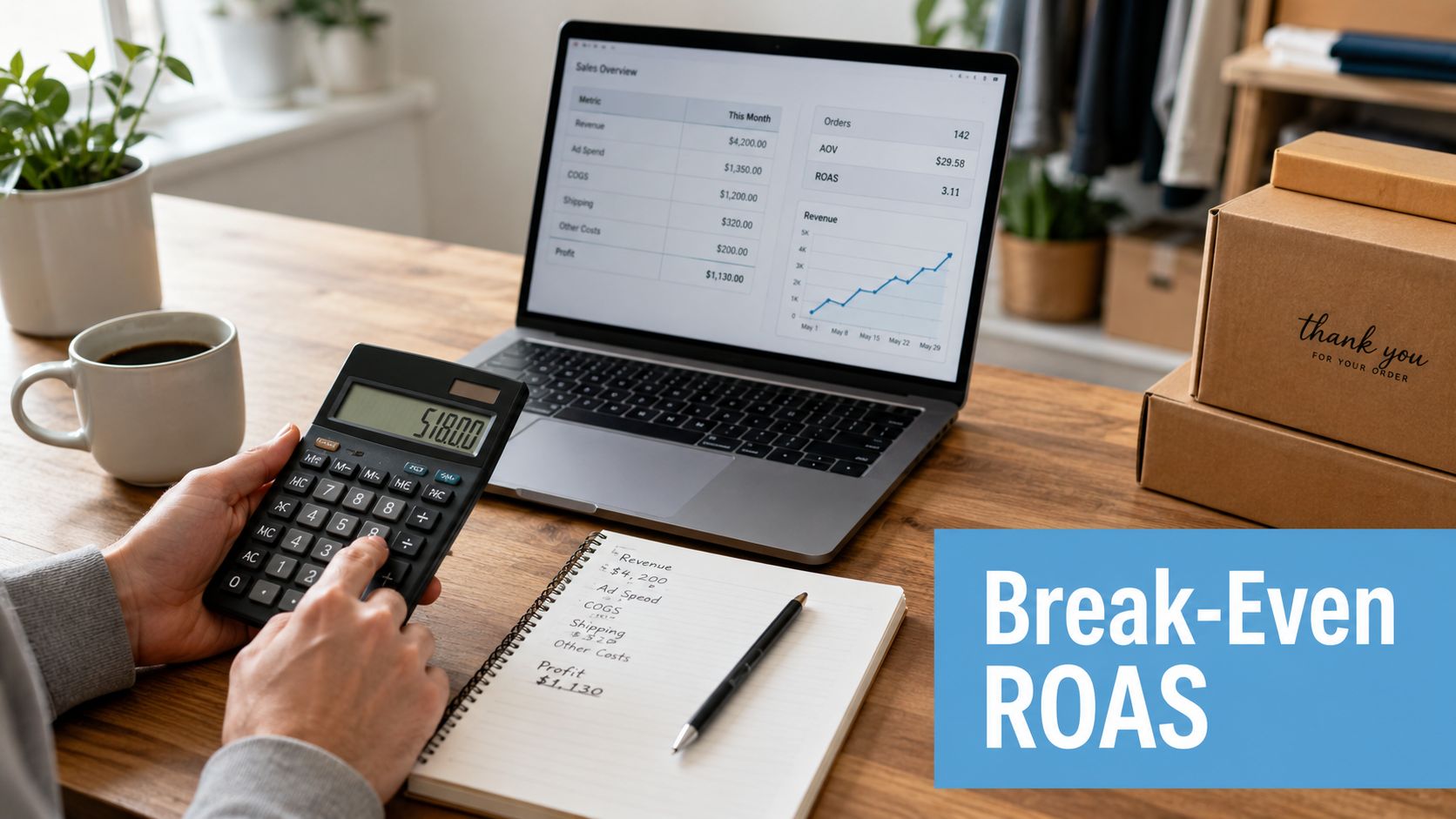
The practical formula many advertisers use for break-even ROAS is:
Break-even ROAS = 1 ÷ profit margin
If your margin is stronger, you can survive with a lower ROAS. If your margin is tight, the target rises quickly.
Here are two examples drawn from the planning logic many small businesses use:
- A business with a 25% margin has a break-even ROAS of 4:1
- A Melbourne ecommerce store selling a product with a 30% margin has a break-even ROAS of 3.33x
Those examples make the point better than any generic benchmark can. The target comes from your margin first, then from everything else layered around it.
Ecommerce example
Let's say you run a Shopify store and one of your key products sells steadily through Google Shopping.
If the margin on that item is healthy enough to support paid acquisition, then a ROAS result can be interpreted quite clearly. If the margin is weak, the same campaign result can be misleading. This is why a lot of ecommerce accounts look promising at the top line while struggling underneath.
What I normally want to know is:
- Which product categories carry the account
- Whether repeat purchase changes the front-end target
- Whether promotions are inflating revenue but reducing real return
- Whether the feed and landing pages support intent properly
If your site experience is holding back conversion rate, ad performance suffers with it. That's often where development work matters. Sometimes the fix is on the campaign side. Sometimes it's the page, the theme, or the checkout journey.
Lead generation example
For service businesses, you need a lead value model before ROAS means much.
One planning example often used looks like this: an average job worth $2,000, a 40% profit margin, and a lead-to-customer close rate of 1 in 5. In that setup, the target value per lead works out to $160.
The point isn't the arithmetic alone. The point is that ROAS for lead gen depends on assigning realistic values to actions.
That's why proper tracking matters so much. For call-driven businesses, we often build the setup around call attribution and offline lead handling rather than relying only on web forms. In some cases that includes custom call tracking flows and custom numbers through Twilio, especially where missed calls mean lost revenue. For tradies, clinics, restaurants, and other busy operators, a tracked number with round-the-clock answering can help route calls, capture intent, and book into a calendar or Calendly without depending on someone being free at the front desk.
If your business relies heavily on calls, this kind of setup gives you a much clearer path to valuing Google Ads properly. It's the difference between “we got some enquiries” and knowing which campaign generated work that matters. If you want a service-business example, our work on Google Ads for plumbers shows the kind of campaign structure that usually matters more than surface-level metrics.
Don't set a target ROAS first and hope your business fits it. Build the target from margin, lead value, and sales reality.
Actionable Strategies to Improve Your Google Ads ROAS
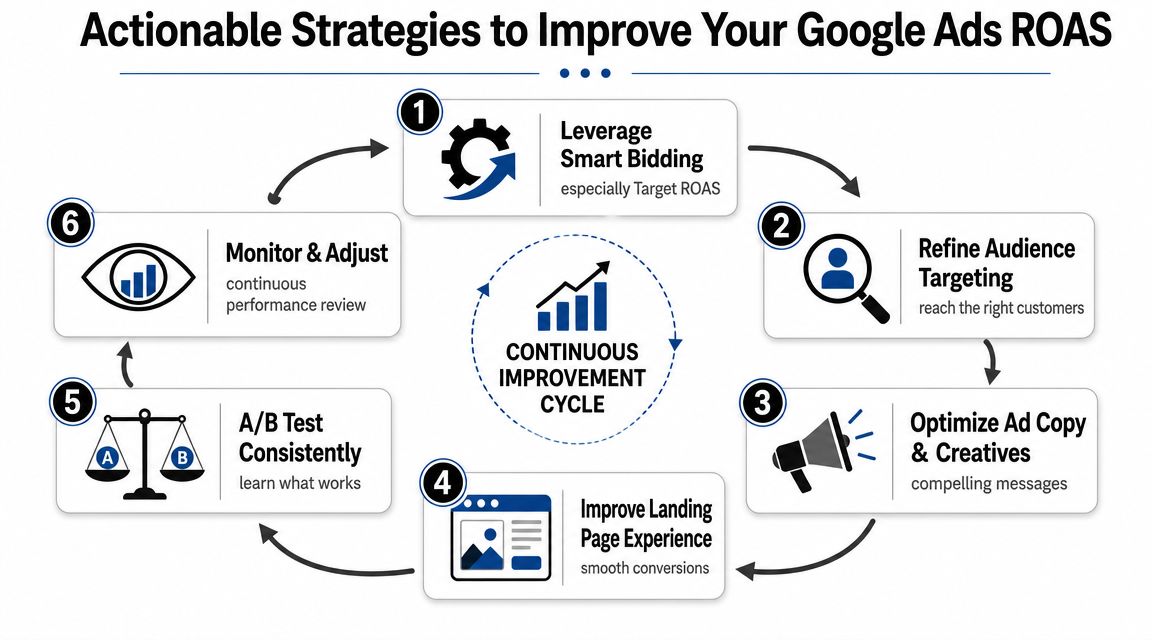
A lot of Melbourne business owners get to this point with a clear target ROAS, then wonder why results still feel inconsistent. The reason is simple. ROAS improves through better account decisions and fewer leaks after the click.
Use Target ROAS properly
Target ROAS bidding can work well once conversion values are clean and stable. It uses predicted conversion value to shape bids toward your return goal. In practice, I only trust it when the account has enough reliable value data coming through and the campaign is not mixing very different types of intent.
The common mistake is setting the target too high because the number looks good on paper. Google will usually respond by bidding more cautiously, which can shrink reach and sales volume. A campaign can end up showing a prettier ROAS while bringing in less revenue and fewer qualified leads.
Review it with a bit of patience, too. Recent performance can look worse or better than it is if your sales cycle has any delay.
Fix the parts outside the ads
Many ROAS problems are not bidding problems.
If the keyword targets broad research traffic, the ad promises too much, or the landing page makes people work to find the next step, your cost per conversion rises fast. I see this often with local service businesses around Melbourne. The clicks are there, but the page is slow, the offer is vague, or the form asks for too much.
Areas I'd check first:
- Search intent alignment so campaigns focus on buyers and high-intent enquiries
- Negative keyword control to cut irrelevant searches before they drain budget
- Ad copy quality that filters out poor-fit clicks instead of inviting everyone in
- Landing page speed and message match so the offer feels consistent from search to page
- Tracking quality across Google Ads, Google Tag Manager, and analytics
If the page is weak, bid strategy changes only go so far. Depending on the stack, that may mean support from a Shopify developer in Melbourne or someone handling WordPress development. For businesses that want campaign management alongside tracking and site-side conversion work, Alpha Omega Digital's Google Ads service is one local option.
Build a tighter optimisation loop
The best ROAS gains usually come from faster feedback and cleaner decisions. We want the account learning from the right signals, and we want the business responding before wasted spend piles up for another month.
A practical loop looks like this:
Audit conversion tracking first
Check that sales values, lead values, and primary conversions match what the business is trying to grow.Segment by intent
Split high-intent searches from broader discovery traffic so you can judge performance on the right standard.Review search terms hard
Wasted spend often hides in search term reports, especially in service accounts using broad match without enough control.Test message and offer
Sometimes the bid is fine. The issue is weak positioning, unclear pricing, or an offer that does not give people a reason to act now.Improve the product feed or landing page experience
For ecommerce brands, feed quality, pricing clarity, shipping information, and product page trust signals all shape ROAS.
If you sell physical products and need a practical merchant-side resource, this guidance for makers selling on Google is a helpful overview of the store-to-Google connection process.
A short explainer on the mechanics can help here:
The best ROAS improvements usually come from removing friction across the full path, from search term to sale, not from chasing one clever setting inside Google Ads.
Conclusion From Data to Decisions
So, what is a good ROAS for Google Ads?
It's the ROAS that leaves your business with enough margin after ad costs and supports the way you want to grow. The widely quoted benchmark is useful as a reference, but it isn't your answer. Your answer comes from your numbers.
That's the shift that makes Google Ads easier to manage. Once you stop judging performance by generic averages alone, you can make sharper decisions. You know when to scale. You know when to pull back. You know whether a campaign is profitable or just producing activity.
For Melbourne ecommerce brands, that usually means being strict about margin, feed quality, and the landing page experience. For service businesses, it means assigning proper value to leads, tracking calls properly, and understanding which campaigns generate work that closes.
A lot of wasted ad spend comes from treating ROAS like a vanity metric instead of a decision-making tool. Used properly, it becomes one of the clearest numbers in the account.
If you're looking for a digital marketing agency Melbourne businesses can work with on the paid media side, the goal shouldn't be to chase prettier reporting. It should be to build a Google Ads setup that reflects how your business makes money.
If you're a business with a paid ads budget of at least 3k a month, I'd love to offer you a low risk deal. Get a month of paid ads management FREE. Apply through the Alpha Omega Digital contact page or learn more about Alpha Omega Digital.
Alpha Omega Digital
Read more insights from our team on web design, paid ads, and growth strategy.