As the owner of Alpha Omega Digital, a marketing agency based in Melbourne, I've spent years deep in the trenches of digital advertising. I've seen firsthand what separates businesses that thrive online from those that just burn cash. Let me tell you, if you're a tradie in Melbourne, Sydney, or anywhere else in Australia, your next customer isn't looking in the Yellow Pages. They're on their phone, right now, typing something like "emergency plumber near me" or "electrician eastern suburbs." If your business isn't at the top of that page, I guarantee your competitor's is.
This isn't some abstract theory. This is the reality I've navigated for countless clients, from launching powerful Facebook ads for electricians to architecting high-converting Shopify sites for e-commerce giants. But the core principle remains the same, especially for service-based businesses: you need to be visible at the exact moment your customer has a problem.
This guide isn't just another blog post. It's a 10,000-word deep dive into everything I've learned about making Google Ads work for tradies. We're going to cover everything from the absolute basics to advanced strategies that my team and I use every day. We'll touch on everything from keyword research and ad creation to call tracking and measuring your return on investment. This is the playbook you need to turn Google Ads from a confusing expense into a predictable, job-generating machine.
Table of Contents
Part 1: The Undeniable Case for Google Ads for Tradies
- Why Google Ads is a Non-Negotiable Tool
- The Power of High-Intent Searches
- Moving Beyond "Hope" Marketing to Predictable Leads
- Real-World Results for Service-Based Businesses
Part 2: Building a Bulletproof Google Ads Foundation
- The Critical Importance of Account Structure
- Nailing the Core Setup: Location, Billing, and Linking
- Understanding the Customer Journey: From Search to Call
- The Role of a Strong Digital Presence
Part 3: The Art and Science of Keyword Research
- Thinking Like Your Customer: The Power of Pain Points
- Long-Tail Keywords: Your Secret Weapon for High-Quality Leads
- High-Intent vs. Low-Intent: Focusing Your Budget Where It Counts
- Negative Keywords: Your Campaign's Best Defence
Part 4: Crafting Ads and Landing Pages That Convert
- Writing Ad Copy That Demands a Click
- The Anatomy of a High-Converting Ad for Tradies
- Ad Extensions: Your Free Upgrade for Maximum Visibility
- The Landing Page: Your Most Important Conversion Tool
Part 5: Advanced Strategies for Maximum ROI
- The Power of PPC for Tradies: Beyond the Basics
- Call Tracking: Never Miss a Lead Again
- Leveraging Twilio for a 24/7 Automated Answering Service
- Integrating Google Ads with Your Local SEO Strategy
- PMAX vs. Standard Shopping: What's Right for You? (Even for Services)
Part 6: Tracking, Measuring, and Optimising for Success
- Setting Up Conversion Tracking: The Non-Negotiable First Step
- Google Tag Manager (GTM) and Google Analytics Explained
- The Metrics That Actually Matter: Cost Per Lead & ROAS
- A Simple Routine for Ongoing Campaign Optimisation
Part 7: Beyond Google Ads: Building a Complete Digital Ecosystem
- The Synergy of Google Ads and Facebook Ads
- Why Your Website Matters: WordPress and Shopify Development
- Measuring Success Across All Channels
- The Importance of Consistency in All Your Marketing
Part 8: Frequently Asked Questions (The Stuff Everyone Asks)
- How Much Should I Really Spend on Google Ads?
- How Long Until I See Real, Consistent Results?
- Can I Just Do This Myself? A Frank Answer.
- What's the Best Way to Handle My Budget?
Part 1: The Undeniable Case for Google Ads for Tradies
Let's get straight to it. I've spent years as a digital marketer, deep in the weeds of everything from complex WordPress development to managing six-figure monthly ad spends for e-commerce stores. But some of the most dramatic and satisfying results I've ever seen have come from running Google Ads for tradies. Why? Because it’s the most direct line you can draw between a person with an urgent, real-world problem and you, the person who can solve it.
Why Google Ads is a Non-Negotiable Tool
I talk to tradies all the time who see marketing as a "nice to have" or a confusing money pit. They're relying on word-of-mouth, maybe a local paper ad, and just hoping the phone rings. That's "hope" marketing. Google Ads is the polar opposite. It's a predictable, measurable, and scalable system for generating jobs.
Forget all the confusing tech jargon for a second; this is about connecting your skills directly with homeowners and businesses who have a problem and are ready to pay you to fix it, right now. The last time you needed a service, you didn't grab the Yellow Pages. You pulled out your phone. Your customers are doing the exact same thing. This isn't just a trend; it's a fundamental shift in consumer behaviour.
The Power of High-Intent Searches
Unlike flyers, radio spots, or even Facebook ads that interrupt people, Google Search Ads put your business in front of customers at the precise moment they are actively looking for a solution. This is what we in the industry call high buyer intent.
Someone searching for "24/7 hot water repair Kew" isn't just browsing. They have a serious, urgent problem that needs an immediate fix. Your ad appearing at the top of Google for that search isn't just marketing; it's a lifeline for the customer and a high-value job for you. It’s the digital equivalent of being the first number they see in an emergency.
At my agency, we live and breathe this stuff. We're a Google Ads agency that has seen the direct impact of this intent. A well-targeted ad for a plumber can be the most valuable piece of marketing they ever do, far surpassing the ROI of any other channel. We've even applied these principles when running Google Ads for plumbers, and the results are consistently powerful.
Moving Beyond "Hope" Marketing to Predictable Leads
Too many tradies I talk to are stuck on "hope" marketing. They hope for referrals, hope that local paper ad works, or hope their old website somehow gets some traffic. Google Ads for tradies is the complete opposite. It’s a predictable, measurable system for generating leads you can actually count on.
As a digital marketing agency in Melbourne, we engineer campaigns to deliver a return. We focus on what actually matters: the number of phone calls, the number of booked jobs, and the cost per lead. It's not about getting a million clicks; it's about making your phone ring with customers who need your specific skills. By targeting profitable services in your local service area, we can turn your advertising budget into a reliable job-generating machine.
Real-World Results for Service-Based Businesses
I've worked with countless tradies, from plumbers to electricians, and the results are consistently strong when the campaigns are set up properly. Here's what my real-world experience has shown is possible for service-based businesses:
- Home Improvement Trades: We often see conversion rates hitting around 8-9%. That means for every 100 people who click your ad, you're getting 8 or 9 direct phone calls or form fills.
- Personal & Emergency Services: For those urgent, "pipe has burst" type jobs, this number can be even higher. When someone’s basement is flooding, they aren't shopping around—they're calling the first qualified professional they can find.
The potential is huge. To see just how effective this can be for specific trades when everything is dialled in, a great resource is this guide on mastering Google Ads for cleaning businesses, which breaks down the tangible benefits. This guide will walk you through exactly how my team and I build campaigns that achieve these results.
Part 2: Building a Bulletproof Google Ads Foundation
Alright, let's talk about setting up Google Ads. The first time you open that dashboard, it can feel like you’re trying to navigate a maze blindfolded. But I'm going to walk you through the parts that actually matter for a service business like yours. The goal here isn't just to "have ads" running—it's to build a rock-solid foundation that gets your phone ringing with real, paying jobs.
One of the biggest mistakes I see tradies make right out of the gate is lumping all their different services into one messy campaign. That's a certified recipe for disaster and wasted cash. You need to get granular.
Think about it this way:
- A campaign for ‘Hot Water System Repair’ needs completely different keywords, ads, and even a different landing page than one for ‘Blocked Drain Clearing’.
- An electrician would be mad to use the same ads for ‘Switchboard Upgrades’ as they would for ‘Emergency Electrical Repairs’.
Structuring your account like this gives you total control over how much you spend and what you say for each specific service you want to push.
Nailing the Core Setup: Location, Billing, and Linking
Before you even start dreaming about keywords, we need to get the basic account settings dialled in. These are the absolute non-negotiables I go through with every single tradie I work with, whether they're in Melbourne or Sydney.
Location Targeting is Everything: A classic, costly mistake is getting the location targeting wrong. You have to lock it down to your exact service area. Don't just target "Melbourne." Use a radius around your home base or, even better, target the specific postcodes and suburbs where you know your ideal customers are. This one move alone will stop you from haemorrhaging money on clicks from people you can't even get to.
Billing and Linking: Next, get your billing details sorted and make sure you understand the payment threshold. Then, and this is critical, link your Google Analytics and Google Business Profile to your Ads account from day one.
Linking these accounts isn't an optional extra. It’s how Google shares data between platforms, giving you a crystal-clear picture of what’s working and letting you track phone calls that come straight from your Business Profile. This is step one in creating a data-driven campaign.
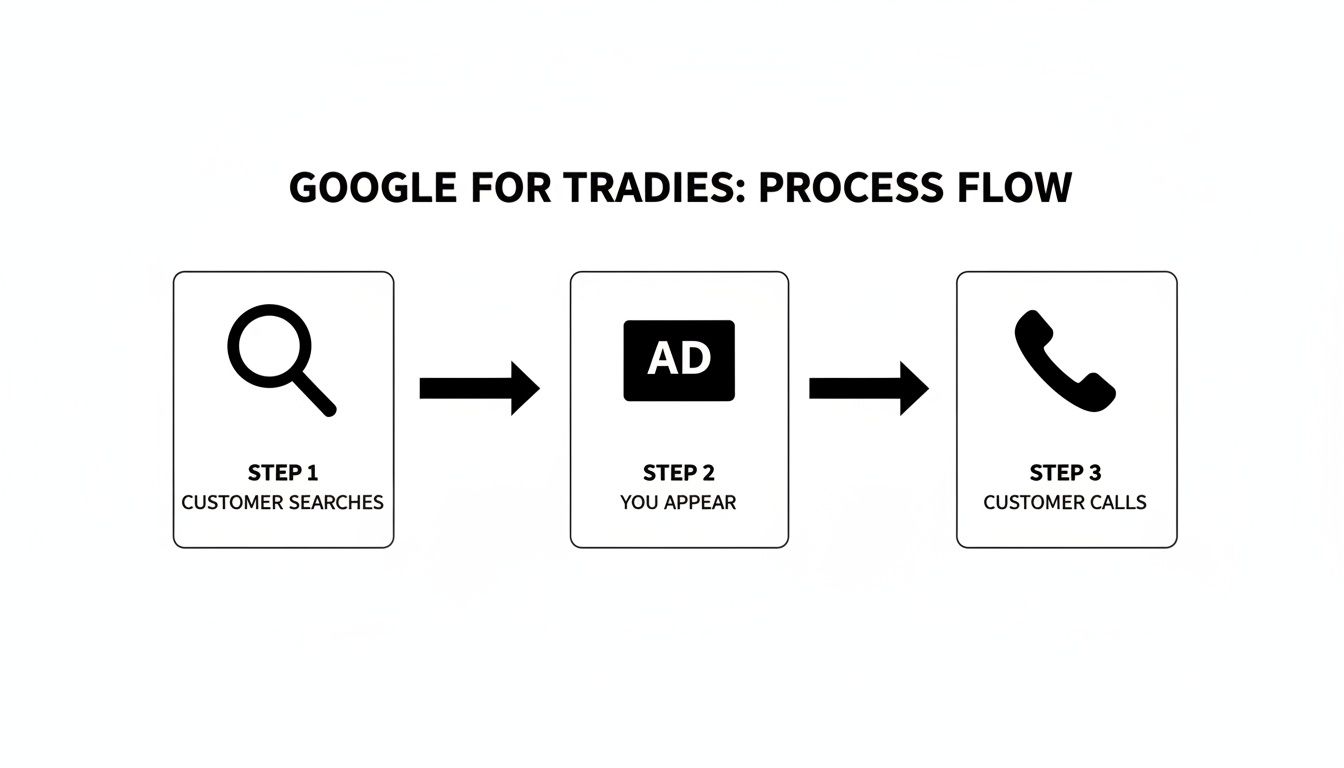
Understanding the Customer Journey: From Search to Call
When you set it up properly, the process is incredibly straightforward. It’s a direct line between a customer with a problem and you being the one to solve it. The ad is the crucial bridge between someone frantically searching for help and them picking up the phone to book a job with you. Simple as that.
And the data doesn't lie. Tradies in Australia are genuinely crushing it with Google Ads. We’re seeing conversion rates in high-demand sectors like home improvement hitting 8.62%, which smashes the national average. Real Aussie benchmarks show personal services like electricians and handymen are leading the pack at 8.83%. Getting this foundation right from the start is what primes your campaigns to hit these kinds of numbers from the moment you go live.
The Role of a Strong Digital Presence
Your ads don't exist in a vacuum. A customer who clicks your ad will likely do a quick check on your business. This is where your overall online presence comes into play. A professional-looking website and a well-maintained Google Business Profile are crucial trust signals.
To really get the most out of your ads, you need a strong digital presence to back them up. That starts with optimising your Google My Business profile, which works hand-in-hand with your ads to build trust before they even click. A strong local SEO presence makes your Google Ads more effective, and your ads, in turn, can boost your local visibility. It's a virtuous cycle.
As a web design Melbourne agency, we've seen the difference a professional site makes. A user who lands on a slick, fast, mobile-friendly page is far more likely to convert than one who lands on a clunky, outdated site.
Part 3: The Art and Science of Keyword Research
Right, this is where the real work begins. Your choice of keywords is what separates a profitable Google Ads campaign from a leaky bucket that just drains your budget. Get this right, and you’ll get calls from genuine, paying customers. Get it wrong, and you'll be flooded with clicks from tyre-kickers and DIY dreamers. The goal is to get inside your customer's head at the exact moment they have a problem and are ready to pay someone to fix it.
Thinking Like Your Customer: The Power of Pain Points
Before you even think about opening a keyword tool, grab a pen and paper. Seriously. Start brainstorming every possible way a customer might describe their problem—not just the services you offer. You need to think in terms of their pain points.
- A plumber doesn't just "fix pipes." They solve real-world problems like "burst water pipe under sink" or "no hot water in shower."
- An electrician isn’t just "doing wiring." They handle urgent situations like "power keeps tripping in house" or "install new downlights."
- A carpenter gets called for things like "deck repair rotten boards" or to get a "build new pergola cost."
This mindset shift is crucial. You're not selling a service; you're selling a solution to a problem.
Long-Tail Keywords: Your Secret Weapon for High-Quality Leads
Those long, super-specific phrases we just brainstormed are what we call long-tail keywords. They don't get a huge amount of searches, but the person typing them is way further down the buying journey. They know what they want, and they’re ready to hire. This is exactly who you want to target.
Think about it. There’s a world of difference between someone searching for "electrician" versus "24 hour emergency electrician Hawthorn." The first search is vague. It could be a student doing research or someone just browsing. The second one? That’s a person with a specific, urgent problem in a clear location. That’s a high-intent keyword, and it’s where you’ll find your best jobs.
Going for these long-tail keywords with high buyer intent is a core strategy we use. They are less competitive, meaning they cost less per click, and they often convert at a much higher rate. They are the easiest way to start ranking number one for searches that actually matter.
High-Intent vs. Low-Intent: Focusing Your Budget Where It Counts
To run Google Ads for tradies successfully, you have to understand the difference between keywords that scream "I'm ready to buy" and those that whisper "I'm just looking." Your budget should be focused almost entirely on high-intent, transactional keywords. Anything else is just a waste of money.
This table breaks down the difference between the general research terms and the specific, action-focused keywords that lead to actual work.
High Intent vs Low Intent Keyword Examples for Tradies
| Low-Intent Keyword (Informational) | High-Intent Keyword (Transactional) |
|---|---|
| How to fix a leaking tap | emergency plumber near me |
| Electrician hourly rate | get a quote for switchboard upgrade |
| Gutter cleaning tips | gutter cleaning service Richmond |
| Painting a room | local painter for interior walls |
| What is local SEO | seo agency melbourne |
| Beginners guide to google shopping ads | google shopping ads for dropshipping help |
| What budget to spend on google ads | how much does it cost to start google ads |
| PMAX vs google shopping ads | google ads for service based businesses |
See the pattern? The high-intent keywords are the money makers. They often include buying signal words like "emergency," "near me," "quote," "service," or a specific suburb. These terms show the searcher is ready to take action, and they are worth paying for. Our expert Google Ads agency team specialises in identifying and targeting these high-value terms to make sure your ad spend is working as hard as you do.
Negative Keywords: Your Campaign's Best Defence
Choosing what to target is only half the battle. Deciding what not to target is just as important, and that's where negative keywords come in. They are your campaign's best friend for protecting your budget. A negative keyword simply tells Google, "Do not show my ad for any search that includes this word."
Think of negative keywords as your campaign's bouncer. They keep the wrong crowd out, making sure your ads are only shown to people who are likely to become paying customers.
I always start every single tradie campaign with a solid list of negative keywords. It's your first line of defence against wasted ad spend, and it’s a step that so many people running their own ads completely forget.
Here’s a starter list to get you thinking:
- DIY Terms: 'DIY', 'how to', 'tutorial', 'guide', 'video', 'learn', 'course'
- Job-Seeking Terms: 'free', 'cheap', 'jobs', 'salary', 'apprentice', 'career'
- Brand Names: The names of your competitors or specific tool brands you don't use.
- Locations You Don't Serve: Suburbs, towns, or cities outside your service area.
- Informational Terms: 'what is', 'definition', 'example', 'template'
By adding these terms, you stop your ad for "emergency plumber" from showing up when someone searches for "emergency plumber course" or "how to fix a leaking pipe for free." It's a simple, but incredibly powerful, way to make your budget go further.
Part 4: Crafting Ads and Landing Pages That Convert

Alright, so you’ve got the click. Great start. But that’s all it is—a start. You now have just a few seconds to convince a stressed-out customer that you're the right person to call. This is the moment where your ad copy and landing page need to work together seamlessly to turn that initial interest into a genuine job lead.
Think about it from their perspective. When someone’s searching for "emergency hot water repair," they couldn't care less about your company's backstory. They have a problem, and they need a fast, reliable solution. Now.
Writing Ad Copy That Demands a Click
Your ad headline is your digital billboard. It has one job: to grab attention and instantly reassure the searcher that you can solve their problem. A simple, proven approach is to put your service and location front and centre.
Instead of a generic headline like "Expert Plumbing Services," get specific:
- Emergency Plumber in Richmond
- Hot Water System Repair Today
- Get a Quote for Decking Now
In your description, you need to build trust and give them a compelling reason to choose you over the other three ads on the page. Focus on the outcome, not just the service.
People don't buy "plumbing services"; they buy a "fixed leaking pipe" and peace of mind. Your ad needs to sell the solution, not just the service itself.
My experience as a Facebook ads agency has taught me the immense power of creative testing. The same applies here. We constantly test different headlines and descriptions to see what resonates. This creative testing process is crucial for squeezing every last drop of performance out of a campaign.
The Anatomy of a High-Converting Ad for Tradies
Make sure your ad description hits these key points:
- Urgency: "24/7 Service" or "Same-Day Quotes."
- Trust Signals: "Licensed & Insured," "10+ Years Experience," or "Google Guaranteed."
- A Clear Call to Action (CTA): "Call Now for a Free Quote" or "Book Your Service Online."
A single, clear CTA is just as crucial on Google as it is on social media. Don't confuse people with options; just tell them exactly what to do next.
Ad Extensions: Your Free Upgrade for Maximum Visibility
Ad extensions are a non-negotiable for tradies. Seriously. They make your ad physically larger on the results page and give customers shortcuts to get in touch. Think of them as free upgrades for your ads—you'd be crazy not to use them.
For any tradie, these are the absolute must-haves:
- Call Extensions: This puts your phone number right in the ad. On mobile, it becomes a click-to-call button, which is pure gold for generating immediate, high-intent leads.
- Location Extensions: This displays your business address or service area and links to your Google Business Profile. It’s a powerful local trust signal.
- Sitelink Extensions: These are extra links to specific pages on your site, like "Our Services," "Project Gallery," or "Contact Us." I often use these to link directly to pages for high-value services.
The Landing Page: Your Most Important Conversion Tool
This is where so many tradies get it wrong. Do not send ad traffic to your website's homepage. A homepage is designed for browsing; it’s full of distractions. You need to send every click to a dedicated, conversion-focused landing page.
A great landing page has one job: get the visitor to call you or fill out your form. As an ecommerce marketing agency that obsesses over conversion rates for Shopify and WordPress sites, we apply the same principle here. It's all about removing friction.
Your landing page absolutely must include:
- A Clear, Matching Headline: The headline must mirror your ad copy (e.g., "Emergency Plumbing in Richmond"). This tells visitors they’re in the right place.
- A Prominent Phone Number: Put it right at the top, make it massive, and ensure it’s clickable on mobile.
- A Simple Contact Form: Only ask for what you need. Name, phone number, and a brief message is usually plenty. This is crucial for running Google Ads for contact form submissions.
- Social Proof: Add customer testimonials, recent reviews, or logos of industry associations you belong to.
- A Strong Call to Action: Repeat the exact same CTA from your ad to maintain consistency.
This laser-focused approach pays off. Data consistently shows that Google Ads for tradies delivers real, measurable results. Home improvement sectors see impressive 8.62% conversion rates, and personal services hit 8.83%. In a competitive market like Melbourne, where searches for plumbers and sparkies are constant, a high-converting landing page is what turns those clicks into paying jobs.
Part 5: Advanced Strategies for Maximum ROI
Once you have the fundamentals locked down, it's time to layer in the advanced tactics that can take your campaigns from good to great. This is where you can really start to build a competitive moat around your business and maximize your return on ad spend.
The Power of PPC for Tradies: Beyond the Basics
PPC for tradies is more than just search ads. Consider leveraging Display ads for remarketing—showing visual ads to people who have previously visited your website. It’s a powerful way to stay top-of-mind. Also, don't underestimate the power of campaign priority in Google Ads. By setting different priorities for different campaigns (e.g., giving a higher priority to an emergency service campaign over a general quote campaign), you can steer your budget towards the most profitable jobs.
Call Tracking: Never Miss a Lead Again
While Google's own call tracking is a decent starting point, I always push my clients towards a more powerful solution. This is where specialised call tracking software becomes a complete game-changer for any service business.
Tools like CallRail or GoHighLevel are among the best call tracking softwares for PPC call campaigns. They let us assign a unique phone number to each of your marketing channels. This means we know with 100% certainty whether a call came from your Google Ad, your Facebook campaign, or your Google Business Profile. That data is pure gold when you're deciding where to put your budget.
Leveraging Twilio for a 24/7 Automated Answering Service
At our digital marketing agency in Melbourne, we often take this a step further for our clients. We set up a custom number through a service like Twilio. This isn't just a phone number; it's a programmable communications tool. We can build a system that includes:
- 24-Hour Call Answering: An automated, professional voice that greets every caller, day or night. It never gets sick, never gets tired, and never misses a call.
- Automated Appointment Booking: The system can interact with the caller to book an appointment directly into your calendar or Calendly.
- Lead Capture: It captures the caller's details and query, ensuring you never lose a lead, even if you're up a ladder or on another job.
This system can save thousands in lost business for tradies, hairdressers, beauty therapists, dentists, restaurants, and doctors. It's a high-tech receptionist that pays for itself almost immediately.
Integrating Google Ads with Your Local SEO Strategy
Your Google Ads and your Local SEO efforts should not be separate. They should work together. A strong ranking on the Google Map pack (driven by your Google Business Profile) combined with a paid ad at the top of the search results creates what we call "SERP domination." You own the most valuable real estate on the page.
Running ads can also provide valuable keyword data that you can feed back into your SEO strategy. If a keyword is converting well in your ads, it's a strong signal that you should try to rank organically for it too. As a leading seo agency melbourne businesses trust, we always integrate PPC and SEO for maximum impact.
PMAX vs. Standard Shopping: What's Right for You? (Even for Services)
While "Google Shopping Ads" might sound like it's only for e-commerce, the principles can be adapted. Performance Max (PMAX) campaigns are Google's AI-driven campaign type that can run across all of Google's inventory (Search, Display, YouTube, Gmail, etc.). For a service business, you can use PMAX to promote your different services as "products."
This is an advanced strategy, but comparing PMAX vs Google Shopping Ads (or their service-based equivalents) can unlock new sources of leads. We've seen success by creating campaigns that target users across the entire Google ecosystem, driving both brand awareness and direct response. It's a powerful tool, but it requires careful setup and monitoring to ensure it doesn't just burn budget on non-converting traffic, a common issue similar to when Google Shopping ads are not spending budget.
Part 6: Tracking, Measuring, and Optimising for Success
Right, let's get into the part that really matters: turning your ad spend into actual profit. You can't improve what you don't measure. It’s a classic saying, but it's the absolute truth when it comes to Google Ads for tradies. This is where we stop guessing and start making decisions based on hard data. Forget vanity metrics like clicks and impressions. We’re here to focus on what actually rings the till: phone calls and job enquiries.
Setting Up Conversion Tracking: The Non-Negotiable First Step
If you do nothing else, do this. Setting up conversion tracking is the most critical step, because without it, you're flying blind. You need to know which keywords, ads, and campaigns are making your phone ring or filling up your inbox.
For any tradie, there are really only two conversions that matter:
- Phone Calls: These are the lifeblood of most trade businesses. We need to track calls that come directly from your ads (using call extensions) and the calls made after someone lands on your website.
- Contact Form Submissions: For the customers who prefer to type out their job details or get a quote after hours, tracking every single form fill is just as crucial.
Google Tag Manager (GTM) and Google Analytics Explained
Setting this up properly involves adding a bit of code to your website, something we always manage for our clients using Google Tag Manager (GTM). GTM is a container that holds all your tracking scripts. Instead of getting a developer to add ten different pieces of code to your site, we just add the GTM container once, and then we can manage everything from there.
We use GTM for setting up Google Tag Manager containers that fire tags for Google Analytics, Google Ads conversions, and even Meta (Facebook) pixels. This includes setting up the Meta Conversion API for more robust tracking on social media. When paired with Google Analytics, it ensures every single lead gets counted and properly attributed to the right marketing channel. It's a bit of a technical job, but it’s the non-negotiable foundation for measuring what’s actually working.
The Metrics That Actually Matter: Cost Per Lead & ROAS
Once your tracking is humming along, you can finally stop worrying about clicks and start focusing on the numbers that translate directly to your bottom line.
Here are the key performance indicators (KPIs) I watch like a hawk for my tradie clients:
- Cost Per Conversion (or Cost Per Lead): This is your total ad spend divided by the number of calls and form fills. Knowing exactly what it costs you to get a lead is the first step to understanding profitability.
- Conversion Rate: This is the percentage of people who click your ad and then actually take action (call you or fill out a form). A high conversion rate is a great sign that your ads and landing page are working together perfectly.
- Return on Ad Spend (ROAS): This is the holy grail. It calculates the total revenue you've generated from your ads divided by your ad spend. A 4:1 ROAS means you made $4 for every $1 you spent. It doesn't get clearer than that.
The market is definitely competitive. But with an expert in your corner, your budget goes a lot further. In a market where Aussie businesses are adapting their ad strategies, professional management can make a massive difference.
A Simple Routine for Ongoing Optimisation
Optimisation isn't a "set and forget" task. It’s an ongoing process of making small, consistent improvements that add up over time. I follow a simple weekly and monthly routine to keep campaigns running at their peak.
This involves things like digging into the search terms report to find and add new negative keywords, tweaking ad copy to get more clicks, and adjusting bids to spend more on the keywords that are actually making you money. It's all about making your marketing dollars work as hard as you do. This consistent effort is what separates a profitable campaign that grows your business from one that just limps along and burns cash.
Part 7: Beyond Google Ads: Building a Complete Digital Ecosystem
While Google Ads is an incredibly powerful tool for getting in front of high-intent customers, it's even more powerful when it's part of a larger, cohesive digital marketing strategy. The most successful businesses I work with don't just rely on one channel; they build an ecosystem where each part supports the others.
The Synergy of Google Ads and Facebook Ads
Many people see Google Ads and Facebook Ads as an either/or choice, but they work best together.
- Google Ads is for capturing demand. You're reaching people who are actively searching for your service right now.
- Facebook Ads is for creating demand. You're reaching potential customers based on their interests, demographics, and online behaviour, even if they aren't actively looking for a tradie today.
As a leading Facebook Meta ads agency, we often use Facebook to build brand awareness and run remarketing campaigns. Someone who clicked your Google Ad but didn't call might see a compelling video testimonial from you on their Facebook feed a day later. This multi-touchpoint approach dramatically increases conversion rates. Mastering Facebook ads and knowing how to measure success on Facebook ads is a skill in itself. A key lesson is: don't quit too early. It takes time to find winning creatives and audiences.
Why Your Website Matters: WordPress and Shopify Development
Your website is the central hub of your digital presence. All roads lead back to it. Whether a customer comes from a Google Ad, a Facebook post, or a Google Maps listing, they'll likely end up on your site. It needs to be professional, fast, and easy to navigate on a mobile phone.
For most service businesses, WordPress is the gold standard. It's incredibly flexible and powerful. As an experienced WordPress developer, I can attest to its capabilities. We can build anything from a simple but effective brochure site to a complex platform with custom functionality, like building custom blocks in Gutenberg for unique content layouts. For our clients in Melbourne, we are the go-to WordPress developers Melbourne businesses rely on.
For businesses that also sell products, Shopify is a fantastic platform. My experience as a Shopify developer has shown me how powerful it can be. We've done everything from custom Shopify design to advanced Shopify development, including building custom Shopify apps using Shopify CLI and working with the Shopify API.
Measuring Success Across All Channels
With leads coming from multiple sources, having a unified measurement plan is crucial. This goes back to setting up GTM and Google Analytics correctly. We need to be able to see the full customer journey. Did they first find you on Facebook, then search for your brand name on Google, and finally call you from your Google Business Profile? A proper analytics setup can answer these questions, giving you a true understanding of your marketing ROI.
The Importance of Consistency in All Your Marketing
The single biggest factor for success I've seen over the years is consistency. Marketing your business = consistency. It's not about running one big campaign and then stopping. It's about consistently showing up where your customers are, consistently refining your message, and consistently measuring your results.
Whether it's your Google Ads, your Facebook presence, your website, or your Local SEO, a steady, persistent effort will always beat sporadic, all-out bursts. It builds brand recognition, trust, and a predictable pipeline of work.
Part 8: Frequently Asked Questions (The Stuff Everyone Asks)
Over the years, I've had countless chats with tradies who are keen to get Google Ads running but have a few questions that keep them up at night. I've heard them all. Let's clear the air and tackle the most common ones head-on so you get a realistic picture of what to expect.
How Much Should I Really Spend on Google Ads? / How much does it cost to start google ads?
This is usually the first question out of everyone's mouth, but the answer is more straightforward than you might think. I always tell my clients to start with a budget they're comfortable with, but realistically, you need at least $1,000 to $1,500 a month to get meaningful traction.
Think of it as fuel for the machine. This level of spend gives us enough data to properly target your key services in your main service area. It allows us to see which keywords are actually driving phone calls and which ones are just wasting your money.
A tiny budget means we get a trickle of data, which makes it incredibly difficult and slow to optimise. It's far better to start smart, prove the model works, and then scale things up once you see the jobs rolling in.
Starting with a decent budget from day one means we can figure out what’s working much faster. From there, we can confidently pour more fuel on the fire.
How Long Until I See Real, Consistent Results?
You’ll see activity almost immediately. Traffic will hit your site and you might even get a few leads in the first week. But when I talk about ‘results,’ I mean a consistent, predictable flow of profitable work.
Getting to that point typically takes around 30-90 days. This initial period is all about gathering data and optimising. We're not just setting and forgetting the ads; we are actively testing and refining everything:
- Keywords: Figuring out which search terms bring in genuine job inquiries versus calls from time-wasters.
- Ad Copy: Testing different headlines and descriptions to see what gets people to actually click.
- Bidding Strategies: Finding the most cost-effective way to bid for those top spots without breaking the bank.
So yes, the phone can start ringing right away. But that steady stream of quality leads you're after? That comes from a patient, data-driven approach over the first couple of months. Consistency is always the key to winning with Google Ads for tradies.
Can I Just Do This Myself? A Frank Answer.
Of course you can, and plenty of tradies give it a crack. But I'll be blunt: Google Ads has a brutally steep learning curve. It’s incredibly easy to burn through a lot of cash, fast, if you don't know the ins and outs of the platform.
Things like keyword match types, building a solid negative keyword list, and setting up conversion tracking that actually works are not intuitive. As a digital marketing agency in Melbourne, my entire job is to handle that complexity for you.
My team and I live inside these platforms every single day. We know how to set up campaigns correctly from the get-go, how to sidestep the common and costly mistakes, and how to use the advanced strategies that get you a much better return on your ad spend. My team consists of expert WordPress developers, savvy social media managers from our Facebook ads agency division, and dedicated PPC specialists.
It’s just like any skilled trade—you could try to DIY the plumbing, but hiring a pro is almost always going to be faster, safer, and give you a better result in the end.
What's the Best Way to Handle My Budget?
Be strategic. Don't spread your budget too thin across too many services at once. Start by focusing on your one or two most profitable services in a tight geographic area. Prove that the model works. Once you're consistently getting a positive return on investment from that core campaign, you can then start to scale. This might mean expanding your service area, adding more services to your campaigns, or increasing your daily budget. Scaling systematically based on data is how you grow your business without taking on unnecessary risk.
Alpha Omega Digital is a marketing agency based in Melbourne, Australia but also services clients from Sydney, Brisbane, Newcastle, Perth, Adelaide, Darwin and Hobart. Have a project in mind? Contact us.
If you're a business with a paid ads budget of at least $3k a month, I'd love to offer you a low-risk deal – get a month of paid ads management FREE. Apply now through our contact page.
[email protected]
Read more insights from our team on web design, paid ads, and growth strategy.