You're probably in one of two spots right now. Either the phone is too quiet and you're tired of waiting for referrals to trickle in, or the phone is ringing but half the leads are rubbish and you've got no clear idea which part of your marketing is working.
That's where most tradies get stuck. They know how to quote, schedule, manage staff, order materials, keep jobs moving, and keep customers happy. Then an agency calls, throws around terms like SEO, PPC, retargeting, GTM, landing pages, attribution, and conversion APIs, and suddenly it feels like you need a second trade ticket just to judge whether you're being sold something useful.
I run a digital marketing agency in Melbourne, and I've had this conversation with tradies more times than I can count. Plumbers, electricians, builders, roofers, painters. Same pattern. They've paid for a website that looks decent but doesn't convert. They've boosted a few Facebook posts. They've tried Google Ads with little visibility into what happened after the click. Or they've relied on word-of-mouth for years and now realise it doesn't give them enough control over pipeline.
A good tradie marketing agency doesn't just “do marketing”. It builds a lead system you can understand, measure, and trust. That means local SEO that helps you get found, landing pages that match the service and suburb being searched, paid ads that bring in intent-driven enquiries, and tracking that shows which leads turn into booked jobs.
If you're looking for a marketing agency Melbourne businesses can talk to without getting jargon dumped on them, keep reading. I'm going to lay this out the way I'd explain it across a desk, not in a boardroom slide deck.
Your Guide to Finding the Right Marketing Partner in Melbourne
Most tradies don't need more marketing options. They need fewer bad ones.
This is the core issue. You're not short on people willing to sell you a website, run some ads, or promise page one rankings. You're short on people willing to explain what they're doing, why it matters for your trade, what the trade-offs are, and how success gets measured after the lead comes in.
What tradies usually tell me first
The first conversation is rarely about “growth strategy”. It's usually much simpler than that.
It sounds like this:
- “We've spent money before and got nothing from it.”
- “The leads looked cheap, but they never turned into real jobs.”
- “Our website looks fine, but nobody fills in the form.”
- “We rank for our business name, but not for the services we want.”
- “I don't care about clicks. I care about calls and booked work.”
That's exactly the right mindset.
A tradie marketing agency should start with your commercial reality. What jobs do you want more of? Which suburbs matter most? What's a good lead worth to you? What kind of jobs waste your time? If an agency jumps straight to “let's post on Instagram three times a week” before asking those questions, they're already working backwards.
The difference between a supplier and a partner
A supplier completes tasks. A partner solves business problems.
That distinction matters more than most business owners realise. A supplier might build a site, launch some campaigns, and send a monthly PDF. A partner asks why your emergency jobs convert differently from your larger quoted works, why one suburb produces better customers than another, and whether your office answers the phone fast enough when leads come in.
Practical rule: If the agency can't explain your marketing in plain English, they probably can't manage it clearly either.
The right marketing agency Melbourne tradies need will often challenge your assumptions. Not to be difficult. To protect your budget. Sometimes the issue isn't that you need more traffic. Sometimes your offer is vague, your service pages are too broad, your forms ask too much, or your ad traffic is landing on a generic homepage that says everything and nothing.
What a serious agency looks at first
Before anyone talks scale, they should look at the foundations.
Here's the short version of what I'd want reviewed before serious spend goes live:
| Area | What should be checked | Why it matters |
|---|---|---|
| Website structure | Service pages, suburb pages, mobile speed, calls to action | Traffic won't convert if the site is confusing |
| Tracking | Form submissions, phone calls, ad platform events, analytics setup | You can't optimise what you can't verify |
| Lead handling | Missed calls, response time, quoting process | Good leads still get lost after the click |
| Channel fit | Google Ads, Local SEO, Meta ads, remarketing | Not every channel suits every trade equally |
| Commercial focus | Best services, best margins, best service areas | More leads means nothing if they're the wrong jobs |
A significant weakness for many agencies becomes clear. They're comfortable buying media. They're less comfortable fixing the plumbing underneath the campaigns.
Why local understanding matters
A Melbourne tradie doesn't market the same way as a national eCommerce brand.
You care about service areas, travel time, suburb relevance, urgency, review signals, and whether the phone rings when someone needs help now. Your customer may search in a rush. They may not compare ten providers. They may call the first business that looks trustworthy, local, and available.
That changes everything about how a digital marketing agency Melbourne businesses choose should approach the work. Your campaigns need geographic intent. Your pages need local specificity. Your ad copy needs to sound like a business that services the area, not a template pretending to.
Red flags worth taking seriously
Some warning signs are obvious. Others are subtle.
Watch for these:
Homepage-only strategy
If all traffic gets sent to one generic page, relevance drops. That hurts both conversions and lead quality.No discussion about calls
Tradies win a lot of work by phone. If the agency only talks about web forms, they're ignoring a major part of your sales process.Reporting built around vanity metrics
Impressions and clicks can be useful diagnostic signals, but they're not business outcomes.No technical ownership
If nobody can confidently handle tag setup, event tracking, call attribution, or CRM connections, performance work gets shaky fast.One-size-fits-all retainers
A plumber chasing emergency work and a builder quoting larger projects need very different account structures and expectations.
Questions worth asking before you sign
A decent agency shouldn't be rattled by direct questions. In fact, I think tradies should ask more of them.
Try these:
- How do you track phone calls from ads and the website?
- Where will paid traffic land, and why?
- How do you decide which services and suburbs get separate pages?
- What happens if leads come in but don't turn into booked jobs?
- Who builds or edits the website if conversion issues are found?
- How often do you review search terms, lead quality, and missed opportunities?
- Can you explain your reporting without hiding behind jargon?
You're not being difficult by asking. You're acting like a business owner who understands that marketing spend needs accountability.
A better way to think about agency value
A tradie marketing agency earns its keep when it reduces wasted spend, improves lead quality, and gives you confidence in the numbers.
That doesn't mean every month is perfect. It means there's a process. Tracking is set up properly. Decisions are made on evidence. The website improves over time. Campaigns get tighter. Poor-fit leads get filtered out. Service-area strategy gets sharper. The business becomes less dependent on guesswork.
That's what most owners want. Not hype. Not mystery. Just a system that helps them buy leads more intelligently and grow with less chaos.
If you're comparing providers right now, keep one standard in mind. You don't need an agency that sounds impressive. You need one that understands how a trade business turns clicks into quotes, quotes into jobs, and jobs into repeatable growth.
Why Word-of-Mouth Is No Longer Enough
Referrals still matter. They always will.
But relying on referrals alone puts your pipeline in someone else's hands. You get work when past clients remember you, when builders send something through, when neighbours talk, or when a supplier mentions your name. That can keep a business alive. It rarely gives you much control.
Your customers already changed their behaviour
This isn't a theory. In Australia, 87% of people are online and 93% use the internet every day, which is why tradies can reliably reach homeowners and decision-makers through channels like Google and social media rather than relying only on offline referrals, as noted in Megaphone's guide to marketing for tradies.
That one fact changes the conversation.
If the people who need your services are online every day, digital lead generation isn't some optional extra for larger companies. It's part of basic market access. When a hot water system fails, a switchboard needs upgrading, or a roof leak appears after heavy rain, plenty of customers don't start with a friend's recommendation. They start with a search.
Referrals are strong, but inconsistent
There's a reason tradies love referrals. They tend to convert well. The customer already has some trust. The sales process can be shorter. Price resistance can be lower.
The downside is obvious once you look at your calendar.
Referrals don't arrive on command. They don't fill quiet weeks just because payroll is due. They don't help much when you want to push one specific service, expand into a new suburb, or smooth out the peaks and troughs that make staffing hard to manage.
A business built only on referrals usually grows in bursts. A business with a strong digital lead system grows with more control.
That's the shift a lot of trade businesses need to make. Not replacing word-of-mouth. Supporting it with channels you can influence.
What digital does that referrals can't
Digital gives you levers.
When setup is right, you can:
- Target urgent demand by showing up when someone is searching for help now
- Prioritise profitable services instead of taking whatever happens to come in
- Focus on specific locations where travel time and margins make sense
- Retarget visitors who looked at your site but didn't call the first time
- Track lead sources so you know what deserves more budget
That last point matters a lot. Referrals often feel “free”, but they're also hard to scale on purpose. A proper digital setup doesn't just create opportunities. It creates feedback. You can see what's working and adjust.
Why the old playbook is weaker now
A lot of tradies built solid businesses in an era where a decent signwritten van, local reputation, and a simple website were enough. That was workable for a long time.
Now the buying journey is more compressed. People compare businesses faster. They check reviews faster. They jump between map listings, websites, and ad results in minutes. If your digital presence is weak, the market doesn't wait for you to catch up. It gives the lead to someone else.
Here's the practical comparison:
| Approach | Strength | Limitation |
|---|---|---|
| Word-of-mouth | High trust and often strong close rate | Unpredictable volume |
| Google search presence | Captures active intent | Requires setup and maintenance |
| Paid ads | Faster lead flow and control | Can waste money without tracking |
| Social and remarketing | Builds familiarity and follow-up touchpoints | Works best with solid foundations underneath |
The point isn't that every tradie needs every channel. The point is that depending on one channel, especially one you can't control, leaves money on the table and exposes the business to dry spells.
The risk of staying “good enough” online
Many tradies aren't invisible online. They're just weak where it counts.
They've got a basic site. A half-complete Google Business Profile. Maybe a few reviews. Maybe an old Facebook page. It creates the feeling of having a digital presence without establishing a reliable lead engine.
That middle ground is dangerous because it looks acceptable from the inside. From the customer's side, it often looks generic, outdated, or less trustworthy than the competitor who has clearer service pages, better reviews, suburb relevance, and stronger calls to action.
What this means for a trade business owner
If you want steady growth, digital needs to stop being treated like a side project.
Not because offline reputation has stopped working. Because online behaviour now sits right beside it. The customer who hears your name from a friend still searches for you. The builder who gets referred still checks your site. The homeowner who sees your van still looks you up later. Your digital presence supports referral traffic as much as it creates fresh demand.
That's why a serious tradie marketing agency doesn't frame digital as replacing trust. It helps you convert the trust you've already built and capture the intent you're currently missing.
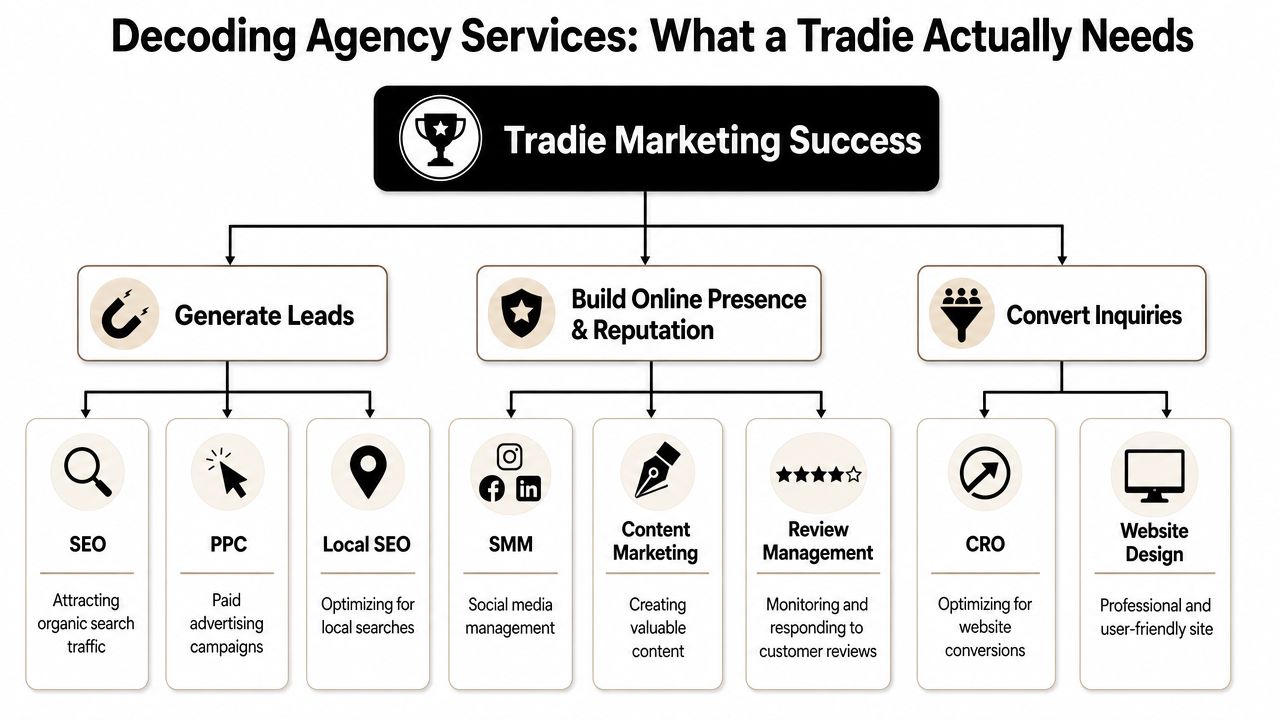
Decoding Agency Services What a Tradie Actually Needs
Most agencies make this part sound more complicated than it is.
For a tradie, the stack is pretty simple. You need to get found by the right people, give them confidence quickly, and make it easy for them to contact you. Everything else sits under those three jobs.
Local SEO that matches how tradies actually get searched
A lot of agencies talk about SEO like it's one big thing. For tradies, local SEO is usually the sharper conversation.
You don't need traffic from people three states away. You need visibility when someone searches for the service you do in the suburb or region you service. That's why local SEO isn't just “ranking higher”. It's aligning your business with local intent.
That usually means:
- Google Business Profile work so you have a stronger chance of appearing in map results
- Service-specific pages so you're not trying to rank one page for everything
- Suburb relevance so Google and the customer both see where you work
- Review signals because reviews affect trust long before someone fills out a form
A tradie who does blocked drains, hot water systems, and emergency plumbing shouldn't bury all of that on one broad page called “Services”. Each high-value service deserves its own page and message.
Website design that sells, not just decorates
In this context, many businesses get burned.
They hire a web designer, end up with a clean-looking site, and then wonder why it doesn't produce work. The problem isn't always design quality. It's design priorities. A tradie website should be built like a salesperson, not a brochure.
That means the page needs to answer practical questions fast:
- What do you do?
- Where do you do it?
- Why should I trust you?
- How do I contact you right now?
If a visitor has to hunt for your phone number, scroll past generic slogans, or click through a maze of pages to work out whether you service their suburb, the site is getting in the way.
For businesses that want flexible service sites, custom forms, suburb landing pages, and ongoing control, I generally prefer WordPress because it's adaptable and easy to shape around lead generation needs. If you want to see the type of development support that sits behind that, our WordPress developers work on builds that prioritise usability, speed, and conversion flow.
Paid ads when you need leads now
SEO builds an asset over time. Google Ads and Meta ads let you create demand flow much faster.
For most tradies, Google Ads is the first channel I'd assess because search intent is direct. Someone searching for “electrician South Yarra”, “emergency plumber near me”, or “roof repair Brunswick” is already telling you what they need. That's very different from trying to interrupt someone on social media.
Meta ads still have a place, especially for awareness, retargeting, offer-based lead generation, and keeping your business visible in local areas. But the role is different. Google usually captures need. Meta often supports discovery and follow-up.
Here's the simple breakdown:
| Service | What it does for a tradie | Common mistake |
|---|---|---|
| Local SEO | Helps you appear in local search and map results | Trying to rank one page for every service |
| Website design and development | Converts visitors into calls and form leads | Prioritising visuals over enquiry flow |
| Google Ads | Captures high-intent demand quickly | Sending traffic to the homepage |
| Meta ads | Builds familiarity and can generate leads with the right offer | Judging success by likes instead of enquiries |
| Tracking and analytics | Shows what leads came from where | Installing tools but not validating them |
WordPress development matters more than most agencies admit
A lot of conversion problems are development problems wearing a marketing costume.
If a site is slow, hard to edit, badly structured, or impossible to track properly, campaign performance suffers. This is why a business looking for a digital marketing agency Melbourne owners can rely on should care about development capability, not just ad management.
With WordPress, practical development work for tradies often includes:
- Building custom Gutenberg blocks so pages can be edited cleanly without breaking layouts
- Creating landing page templates for different services and service areas
- Improving mobile layouts because a huge share of tradie traffic comes through phones
- Cleaning up forms and event triggers so leads can be tracked properly
If a site needs deeper support, a specialist WordPress developer can reshape page templates, forms, and content blocks so the site becomes easier to scale without rebuilding it from scratch.
Don't ignore Shopify and eCommerce crossover
This article is about tradies, but there's a useful crossover here.
Some trade businesses also sell products online. Think plumbing supplies, electrical accessories, hardware kits, maintenance products, or branded stock. In those cases, the agency needs to understand both lead generation and eCommerce systems.
That's where Shopify comes in. A team that can handle Shopify development in Melbourne or work as Shopify development partners can bridge the gap between service marketing and online sales. The same goes for more technical builds involving a Shopify developer, broader Shopify developers, or work tied to the Shopify developer API.
Not every tradie needs that. But if your business has a retail angle, stock catalogue, or future eCommerce plan, it matters.
The agencies that struggle with tradies usually think in channels. The agencies that do well think in jobs, service areas, lead handling, and conversion paths.
What a tradie actually needs from the stack
If I strip the jargon away, the core setup looks like this:
A website built for enquiries
Fast, mobile-friendly, easy to contact, and structured by service and location.A search presence that reflects local intent
Google Business Profile, service pages, suburb pages, and review support.Paid campaigns with purpose
Search for demand capture. Meta for support, visibility, retargeting, or specific lead offers.Tracking that isn't guessed
Calls, forms, booked jobs, and campaign attribution need a clean path.Ongoing refinement
Good marketing gets better when real lead quality feeds back into the system.
A lot of owners think they need “SEO or ads”. In practice, most solid trade businesses eventually need both, plus a website that deserves the traffic.
That's what a tradie marketing agency should be solving. Not a branding exercise detached from revenue. Not random posts for the sake of looking active. A system that gets you found, helps you win trust fast, and turns attention into jobs.
The Tech That Turns Clicks into Booked Jobs
This is the part many agencies avoid because it's where excuses disappear.
Anyone can launch ads. Anyone can install a plugin. Anyone can say they set up analytics. The harder part is building the technical backbone that tells you which click turned into which call, which call became a quote, and which quote became real revenue.
The website has to act like a system
A high-performing tradie marketing agency should treat the website as a conversion system, not just a brochure. That means service-area keyword mapping, separate landing pages for each core service and suburb cluster, connecting Google Business Profile and review signals, and routing calls and form fills into tracked events before scaling paid media, as outlined in Marketing Movement's tradie marketing agency guidance.
That's the standard I'd expect.
The failure mode I see all the time is simple. Businesses launch paid traffic too early. They drive clicks to a broad homepage. The form thank-you event isn't configured properly. Phone clicks aren't tracked cleanly. Nobody knows whether the enquiry came from branded search, non-branded search, maps, retargeting, or direct traffic. Then the agency says they need “more data”.
The problem wasn't a lack of data. It was bad plumbing.
Why GTM and Google Analytics matter
A lot of owners hear Google Tag Manager and Google Analytics and switch off because it sounds technical. Fair enough. Here's the plain-English version.
Think of GTM like the switchboard that tells your website what actions need to be noticed. A button click, a form submission, a phone tap on mobile, a booking action. Google Analytics is where those actions get organised into useful behaviour data.
If those tools are set up badly, you get fuzzy reporting. If they're set up well, you can answer practical questions:
- Which landing page generates actual enquiries?
- Which campaign attracts visitors who stay and engage?
- Which suburb page gets traffic but not leads?
- Which mobile buttons are being used most?
- Which ads are driving form submissions versus phone calls?
For tradies, that matters because the sales cycle is rarely neat. Someone may visit the site, leave, come back later, call from mobile, and book after speaking with your office. Tracking needs to respect how people behave.
Meta Conversions API without the nonsense
Meta ads have become harder to measure cleanly if you rely only on browser-side tracking. That's why Meta Conversions API matters.
Simple analogy. The browser pixel is like hearing part of a conversation through a wall. Conversions API is more like getting the message delivered through a more direct channel. It helps send event data from your systems back to Meta in a more reliable way.
For a service business, that can support:
- lead form submissions
- qualified lead events
- booked consultation events
- call-related outcomes, if your systems are connected properly
A proper Conversions API installation for Meta should be tied to meaningful business events, not random vanity actions. If every low-intent form fill gets treated as a top-tier lead, your campaign learns the wrong lesson.
APIs are just bridges
The word API scares people for no reason.
An API is just a bridge that lets two systems talk. That's it. If your call tracking software needs to pass data into your CRM, that's a bridge. If your booking system needs to notify an ad platform that a lead became an appointment, that's a bridge. If a Shopify store needs custom functions, that's a bridge too.
Most tradie businesses are no longer using one tool. They've got a website, ad accounts, forms, calendars, call tracking, maybe a CRM, maybe quoting software. If those tools don't talk, the reporting breaks down and the follow-up gets messy.
Call tracking is where performance becomes believable
For tradies, phone calls are often the most valuable conversion point.
That's why I take call tracking seriously. If your campaigns drive phone leads and nobody can tell you which ad, keyword, landing page, or source drove the call, your optimisation is partly blind. You're making decisions on incomplete information.
There are several tools in this space. CallRail is commonly used. GoHighLevel is another platform some businesses use when they want broader lead workflow management. We've also built custom setups around Twilio for businesses that want more control over how inbound calls are handled.
A custom number through Twilio can do more than log calls. It can support always-on answering logic, route leads based on rules, collect basic information, and push bookings into a calendar or Calendly flow. For a tradie business, that matters because missed calls often equal lost work. If the phone rings while you're on-site, in the ute, or after hours, a system that keeps responding helps recover opportunities that would otherwise vanish.
Field lesson: missed-call problems often look like lead-generation problems. They're not the same thing.
Development matters because templates only get you so far
Being hands-on with development gives an agency an edge.
A trade site often needs more than theme settings and page builder tweaks. It may need custom landing page templates, lightweight form handling, cleaner event triggers, or custom blocks in Gutenberg so your team can update pages without breaking layout logic.
For service businesses, I still like WordPress because it's flexible enough to build exactly what the lead flow needs. That can mean a custom-built quote form, suburb page structures, or conversion-focused service templates. If the brief gets more technical, stronger WordPress development capability makes a difference.
The same principle applies on the eCommerce side. If a trade-related business sells online and needs custom store functions, app logic, or data connections, a team with Shopify technical experience can solve problems a media-only agency can't.
What good technical setup looks like in practice
A clean setup usually includes these moving parts working together:
| Layer | What it should do |
|---|---|
| Landing pages | Match the keyword, service, and suburb intent |
| Tagging setup | Track forms, calls, clicks, and key on-site actions |
| Analytics | Show user paths and campaign behaviour clearly |
| Call tracking | Attribute phone leads to source and campaign |
| CRM or lead handling | Record what happened after the enquiry |
| Ad platform integrations | Feed back better-quality conversion data |
One relevant provider, Alpha Omega Digital, works across both web development and paid media, which is useful when a business needs the site, tracking, and campaigns adjusted together instead of splitting those jobs across separate vendors.
The broader point is bigger than any one agency. The tradie businesses that get the best results usually don't separate marketing from implementation. Their ads, site structure, tracking, and follow-up all connect.
That's what turns clicks into booked jobs. Not luck. Not reports. The system underneath.
Your Masterclass on Google and Facebook Ads
Paid ads can be brilliant for tradies. They can also empty a budget fast if the account structure is sloppy or the strategy doesn't match how trade leads work.
I'll keep this practical. Google and Facebook are not interchangeable. They solve different problems.
Google Ads for service-based businesses
If someone searches for a service you offer in an area you service, that's the cleanest form of intent most tradies can buy.
That's why Google Ads for service based businesses is usually the first paid channel worth serious attention. You're not trying to convince someone they might need a plumber eventually. You're showing up when they're already looking.
For tradies, the basics matter more than hacks:
- tight keyword targeting
- location settings that reflect actual service areas
- ad copy that matches the service
- landing pages built for the exact job type
- proper tracking for calls and contact form submissions
The mistake I see often is over-grouping. One campaign, broad keywords, one homepage. That setup might spend money, but it doesn't give you useful control.
Contact form submissions are fine, but calls usually close faster
Some agencies optimise around any conversion they can get because it makes the dashboard look active. That's not enough.
A campaign should be aligned with how your business wins work. If calls produce better outcomes than forms, then call tracking and call-focused ad paths deserve more attention. If bigger project work comes through detailed form leads, then those forms need to be structured properly and tracked accurately.
For Google Ads for contact form submissions, the big issue is friction. Long forms can reduce volume. Short forms can reduce quality. The answer depends on your trade, your capacity, and whether you want more urgent jobs or more considered quote requests.
Budget questions tradies ask all the time
The budget question always comes up early. It should.
There isn't one universal number that suits every trade, location, or service mix, so I won't pretend there is. What matters is whether the budget gives the campaign enough room to gather signal and whether the business is clear on what kind of lead flow it wants.
A better budgeting conversation looks like this:
| Budget question | Better way to frame it |
|---|---|
| How much does it cost to start Google Ads? | What services, suburbs, and lead types are we prioritising first? |
| What budget should we spend? | What level of enquiry volume can the team handle without quality slipping? |
| Why isn't my campaign spending? | Is targeting too narrow, are bids too cautious, or is conversion setup broken? |
I'd rather see a focused campaign around priority services and high-value areas than a thin budget sprayed across every service you offer.
PMAX versus standard campaigns
A lot of businesses ask about PMAX vs Google Shopping ads, or campaign priority in Google Ads, because they've heard the terms from eCommerce discussions or generic PPC content.
For most tradies, classic service-led search campaigns are still the centre of gravity because they match direct intent. PMAX can have a place, especially when supported by strong assets, tracking, and account structure, but it's not a magic replacement for thoughtful search campaigns. It's also less transparent, which can frustrate owners who want tighter control over search terms and message alignment.
Google Shopping is a different conversation again. It matters more when the business sells physical products online. For a pure service business, Shopping usually isn't the primary path.
If you do have a trade-retail crossover business, then a beginners guide to Google Shopping ads, Google Shopping ads for dropshipping, or troubleshooting issues like Google Shopping ads not spending budget become relevant. For pure lead-gen tradies, they're secondary.
Facebook and Instagram for tradies
Meta ads can work well, but only when their role is clear.
Google catches intent that already exists. Facebook and Instagram help create familiarity, support remarketing, and generate leads from audiences who may not have searched yet. That can work well for renovation services, seasonal offers, maintenance reminders, visual trades, and local brand reinforcement.
A decent Facebook ads agency shouldn't judge success by engagement alone. Likes don't pay wages.
What matters is whether the creative, offer, and follow-up flow fit the business. For example:
- a roof restoration business may do well with strong before-and-after visuals
- an electrician may benefit from local trust-building creative and a clear service offer
- a builder may need longer-form trust content and retargeting before a lead is ready
If you want examples of how we think about trade-specific campaign structure, our pages on Google Ads for plumbers and Facebook Ads for electricians show the difference between generic ad tactics and service-specific messaging.
Meta ads creative testing that isn't random
A proper Meta ads creative testing process should be methodical.
Not “let's throw up a few graphics and see what happens”. More like this:
Test angles first
Emergency response, trust, speed, workmanship, financing, local presence, guarantees if applicable.Test formats next
Static image, short video, before-and-after, testimonial-style creative, direct-to-camera explainer.Keep landing page intent aligned
If the ad talks about switchboard upgrades, don't send people to a generic electrical services page.Judge lead quality, not just lead count
Cheap leads that never book are expensive.
That's also why businesses shouldn't quit too early. Some campaigns need enough time to collect signal, especially when follow-up cycles are longer or the audience needs repeat exposure before acting.
Good paid social doesn't just target audiences. It tests messages against real buying motives.
A note on local trust signals
Even in paid ads, local trust matters.
Your website, Google Business Profile, reviews, suburb references, and offer clarity all influence campaign performance. The ad gets the click. The rest of your digital presence gets the enquiry.
If I'm assessing whether a tradie should lean harder into Google, Meta, or both, I'm looking at three things first:
- how urgent the customer need usually is
- how visual or demonstrable the service is
- how strong the existing website and trust assets are
That gives a better answer than platform hype ever will.
What works versus what doesn't
A blunt summary helps here.
What tends to work
- tightly themed search campaigns
- suburb and service-specific landing pages
- phone-first conversion tracking
- clear offers and service descriptions
- creative testing tied to actual lead quality
What tends not to work
- broad keywords with vague intent
- sending everyone to the homepage
- judging Facebook by likes and reach
- running ads before the tracking is verified
- changing strategy every few days because results aren't instant
Paid ads can absolutely produce steady work for tradies. But they work best when they sit on top of a site that converts and a tracking setup that tells the truth.
Your Vetting Checklist How to Choose the Right Agency
You sit down with two agencies. Both promise more leads. Both show polished reports. Both say they know tradies.
The difference shows up the moment you ask how they will turn ad spend into booked work for your business, in your suburbs, with your mix of urgent jobs and quote jobs.
That is the filter I would use.
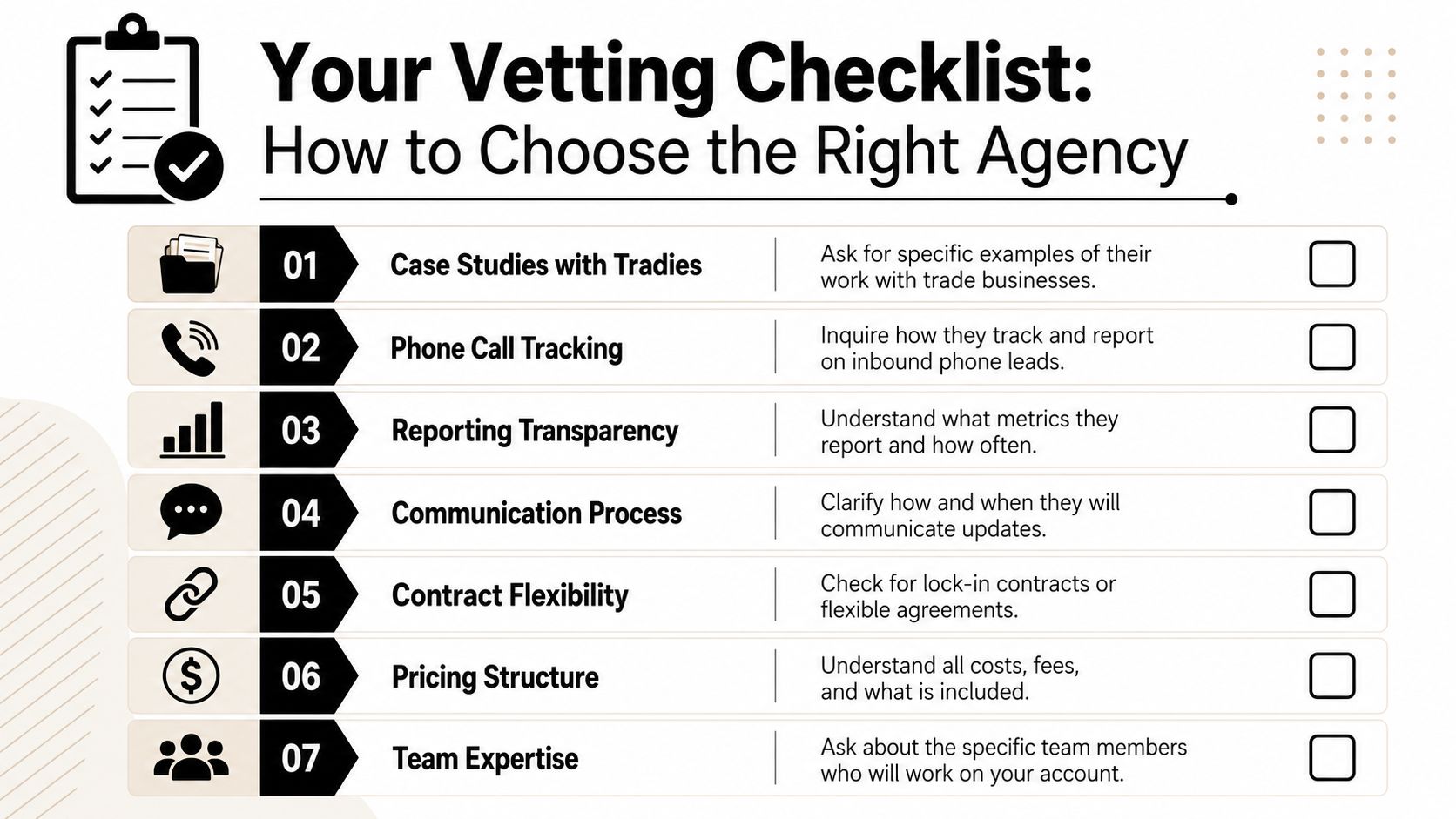
A good agency should be able to explain, in plain English, how they structure campaigns by service, where traffic lands, how calls and forms are tracked, and what happens before budget is increased. If they stay vague, hide behind jargon, or keep returning to clicks, keep looking.
Ask about trade experience, but test depth
Trade experience matters. Real trade understanding matters more.
I would not be impressed by “we work with tradies” on its own. A plumber handling emergency callouts, an electrician doing switchboard upgrades, and a builder quoting larger projects do not need the same campaign structure, follow-up process, or reporting.
Ask them:
- Which trades have you worked with, and for how long?
- How do you treat urgent call-driven work versus quote-based jobs?
- How do you split campaigns by service and suburb?
- How do you measure lead quality after the enquiry?
Good answers sound specific. You should hear how they handle missed calls, low-intent keywords, booking delays, and suburb-level demand differences. That tells you whether they understand the job pipeline, not just ad platforms.
The landing page question exposes weak setups fast
Ask one direct question. Where does paid traffic go?
If the answer is the homepage, there is usually a mismatch somewhere. The ad promises one thing. The page says five things. The visitor has to work out whether you service their area, whether you do that exact job, and how to contact you.
A better answer is service-specific and location-specific pages where needed, with call-first or form-first layouts based on the type of enquiry.
Here's the quick version:
| Agency answer | What it usually means |
|---|---|
| “We send most traffic to the homepage.” | Generic setup, lower relevance, weaker conversion path |
| “We build pages per service and area where needed.” | Better match between search intent and page experience |
| “We test call-first and form-first paths.” | Focus on lead capture and buyer behaviour |
That does not mean every campaign needs dozens of pages. It means the agency should know when tighter relevance will improve conversion and when a simpler structure is enough.
Reporting should answer business questions
A report should help you make decisions.
If you need a 30-minute translation session to understand what happened, the reporting is built for the agency, not for you. I want a tradie owner to be able to open a report and see what came in, where it came from, what improved, and what needs fixing.
You should be able to answer these questions quickly:
- How many leads came in?
- Which channel drove them?
- Were they calls, forms, or both?
- Which campaigns improved?
- Which campaigns wasted spend?
- How many leads turned into quoted or booked work?
That last point matters. Clicks and impressions do not pay wages. Booked jobs do.
If an agency cannot connect marketing activity to enquiries and job value, you are being asked to trust the story instead of the numbers.
Ask who does the work
This question saves a lot of pain.
Some agencies sell with senior staff, then hand the account to a junior team, a freelancer, or an offshore provider you never meet. That setup can work, but only if responsibilities are clear and quality control is tight.
You should know:
- Who manages the ad account
- Who handles tracking
- Who edits the website or landing pages
- Who you speak to when something breaks
- How quickly changes can be made
That matters even more if you later need support beyond ads, such as landing page changes, WordPress updates, or Shopify development. A team with real build capability is different from a team that only buys media. If that matters to you, ask whether they can support broader build work like web design in Melbourne or more technical ecommerce setups.
Ask how they track phone calls
For tradies, phone tracking is not a side feature. It is part of the job.
If a campaign drives calls but the agency cannot tell you which campaign, keyword, or page triggered them, you are missing the clearest proof of performance. We use call tracking because it closes that gap. It works like a job sheet for your marketing. You can see what came in, where it came from, and whether it turned into real work.
Ask this:
“If I get ten calls from this campaign, how do you prove which campaign and keyword produced them?”
A capable agency should be able to explain dynamic number insertion, source attribution, call reporting, and how that data is tied back to leads or booked jobs. If they shift the conversation back to web forms, that is a warning sign.
To help you compare what good vetting sounds like against generic sales talk, this short video is worth a look:
Contract terms show how the relationship is set up
Contract terms tell you a lot about risk.
A long lock-in before the agency has proved fit usually favours the agency. A shorter agreement can be healthier, provided the setup work, ownership terms, and notice period are clear. I would rather see a fair agreement with defined responsibilities than a cheap offer with unclear control over your accounts and assets.
Check these points carefully:
- notice periods
- setup fees
- who owns the ad accounts if you leave
- who owns the landing pages and creative
- whether tracking assets stay with you
Do not treat this as paperwork. Treat it as business protection.
The shortlist questions I'd use
If I were helping a tradie shortlist agencies in Melbourne, these are the seven questions I would use:
- How do you structure campaigns for separate services and suburbs?
- What happens before any paid traffic is launched?
- How do you track phone calls and form submissions?
- What does your reporting show beyond clicks?
- Who handles landing page changes and technical tracking?
- How do you assess lead quality after the enquiry?
- What are the contract and account ownership terms?
The right agency will answer clearly, without fluff, and without getting defensive. That is usually a good sign you are talking to a team that understands the work, the numbers, and the reality of how tradie businesses grow.
The First 90 Days What a Professional Onboarding Looks Like
Signing with an agency shouldn't feel like tossing your keys to a stranger and hoping for the best.
A professional onboarding process gives you clarity early. You should know what's being audited, what's being built, what gets launched first, and what signals matter before any scaling decision is made.
A properly built and marketed tradie website should generate 15 to 60 qualified enquiries per month, depending on the trade, and some performance-focused agencies report launching 200+ campaigns for trade businesses, which points to a mature, results-driven niche rather than generic marketing activity, according to The Tradie Marketing Agency's discussion of tradie website lead expectations.
That doesn't mean every business hits the same outcome. It means the benchmark for serious work is measurable enquiry flow, not vague activity.
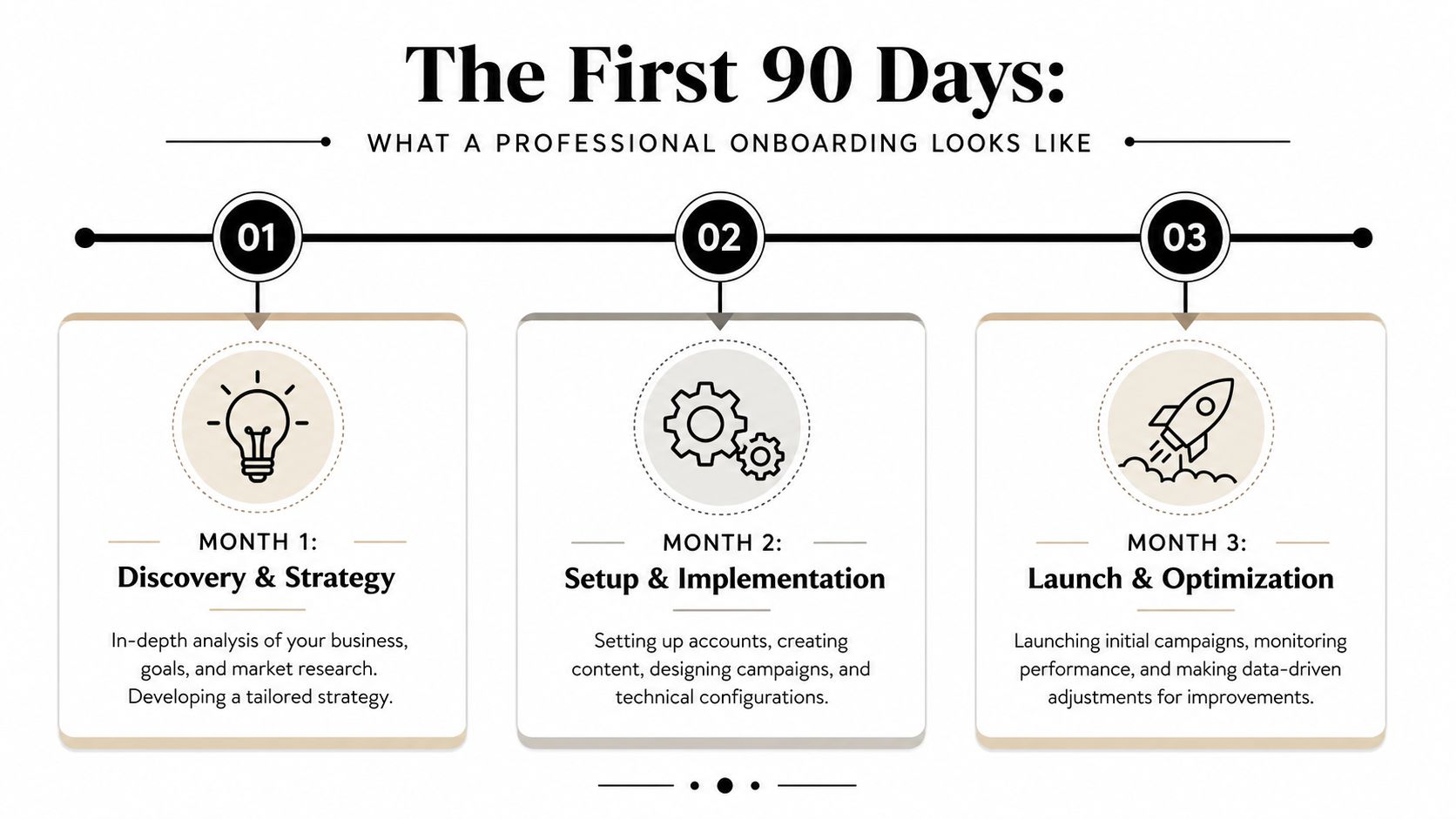
Month one is about diagnosis, not heroics
The first month should be quieter than most clients expect.
That doesn't mean nothing is happening. It means the serious work starts under the bonnet. If an agency wants to launch everything in the first few days without auditing the site, tracking, service mix, and lead handling process, they're moving too fast.
In a proper first month, the focus is usually:
- access to ad accounts, website, analytics, and business listings
- review of existing campaigns, if any
- call flow review and enquiry handling review
- keyword and service-area mapping
- tracking setup or repair
- landing page planning
For a tradie, this stage matters because your marketing often breaks in the handoff points. The ad might be fine. The page might be weak. The form may not trigger properly. Calls may go unanswered. Discovery should expose those issues before budget gets pushed harder.
What a useful discovery session sounds like
A serious agency won't just ask what services you offer. They'll ask which jobs you really want.
That conversation should get into things like:
| Discovery topic | Why it matters |
|---|---|
| Best-margin services | Not all leads are equally valuable |
| Service areas | Travel time affects profitability |
| Team capacity | There's no point flooding the business with leads you can't handle |
| Sales process | Some jobs are booked on the call, others need follow-up |
| Existing reviews and trust assets | These influence conversion rates later |
| Missed-call patterns | Lead loss often happens here, not in the ad account |
This is also where website work often gets scoped. If your existing site can't support landing page expansion, call tracking, better forms, or service-specific content, the agency should say so plainly.
Month two should produce signal, not miracles
Once the foundation is stable, month two is where launch and early optimisation usually begin.
This is not the phase where I'd expect polished certainty. It's the phase where patterns start to emerge. Which services are pulling stronger response. Which suburbs engage better. Which ads get clicked but don't convert. Which landing pages need a sharper message or faster contact path.
In practical terms, month two often includes:
- launching Google Ads campaigns for priority services
- activating or refining local landing pages
- validating form and call tracking
- checking search term quality
- refining ad copy based on actual enquiry behaviour
- reviewing mobile user experience repeatedly
Early performance should be judged by signal quality. Not ego. Not panic.
That's especially important for tradies who've had bad agency experiences before. If you've been burned, you may expect instant proof. Fair enough. But useful optimisation needs clean inputs first. A rushed launch on bad tracking creates false confidence or false disappointment.
Month three is where the account starts to tell the truth
By the third month, you should have enough evidence to make sharper decisions.
A professional tradie marketing agency starts separating what looked promising from what performs. You'll often find that one service category deserves more budget, one location underperforms, one landing page converts far better than another, or one type of lead closes at a much stronger rate.
At this point, good agencies start making decisions like:
- shifting spend toward better-fit services
- pausing weak search themes
- improving ad copy for stronger qualification
- adjusting landing pages to reduce low-quality enquiries
- tightening location focus
- integrating more post-lead feedback from your team
What you should expect to receive by this stage
The owner experience matters here.
By the end of the first 90 days, you shouldn't just have “campaigns running”. You should have a clearer operating picture. You should know what's been built, what's improving, where the weak spots are, and what deserves further investment.
A healthy 90-day outcome usually includes:
- Stable tracking so forms and calls are visible
- A working campaign structure built around actual service priorities
- Landing page direction based on real performance, not guesses
- Lead quality feedback loops between your team and the agency
- A clearer growth path for SEO, ads, site improvements, and follow-up automation
Some businesses need heavier technical work in that first quarter. Others need more work on messaging and call handling. The exact mix changes. The pattern doesn't. Good onboarding reduces confusion, protects budget, and gets the business to a place where scaling decisions are made on evidence.
Measuring What Really Matters From Clicks to Cash
The conversation now gets serious.
A lot of agencies can show you activity. Fewer can show you outcomes in a way that holds up once you compare reports against your job calendar and bank account. For a tradie, that gap matters more than anything else.
Many agencies fail because they don't measure what happens after the enquiry, even though real performance marketing should connect ad spend to booked jobs and revenue through transparent, first-party-data-driven attribution, as highlighted in this Australian industry commentary on attribution and measurable performance.
That's the whole game.
Vanity metrics have their place, but not in the driver's seat
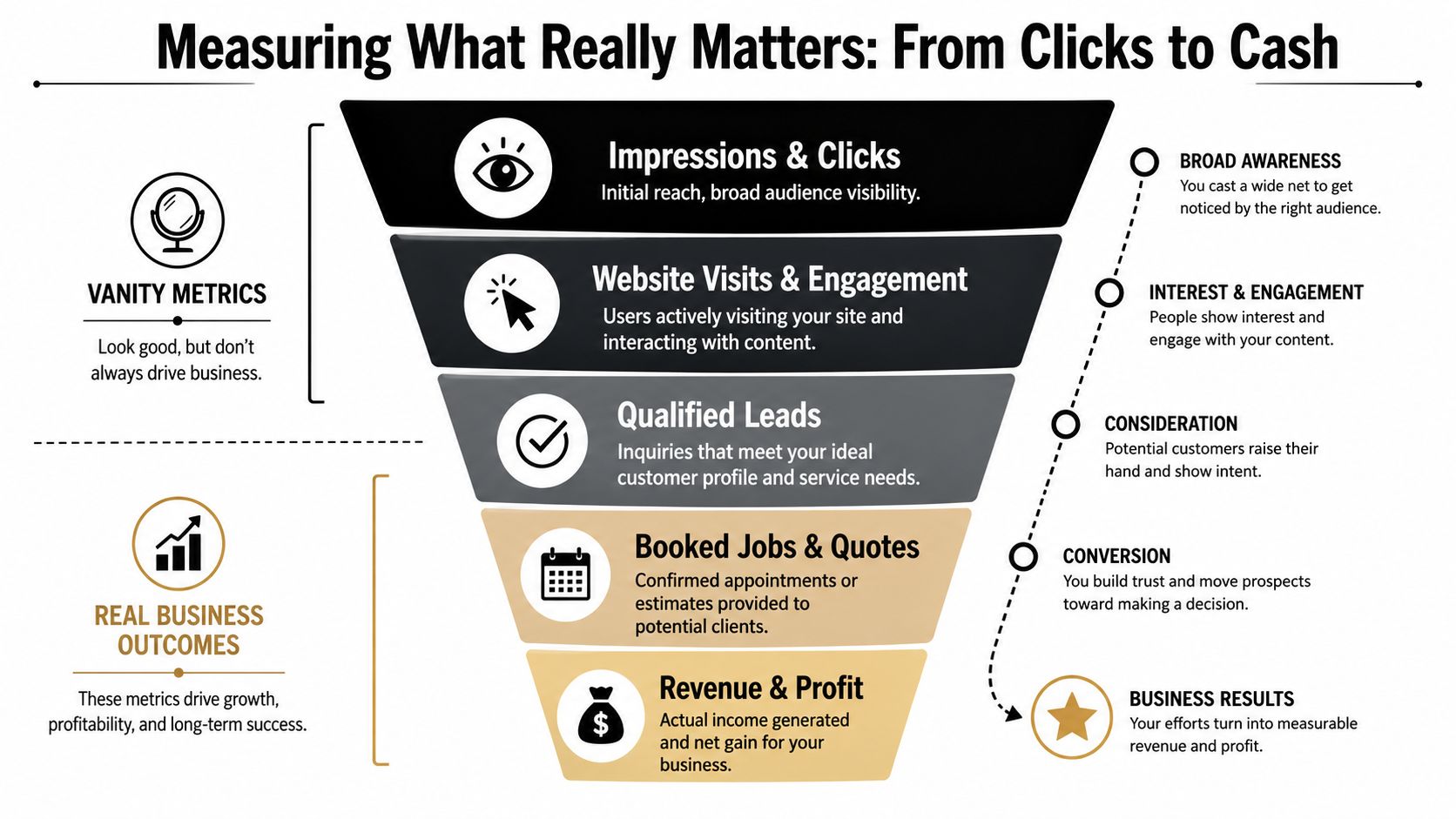
Impressions, clicks, click-through rate, reach. These metrics are not useless. They can help diagnose what's happening at the top of the funnel.
But for a tradie business, they should never be the headline.
If an agency tells you clicks are up, your next question should be, “Did that turn into qualified leads?” If they tell you leads are up, ask, “How many booked?” If they tell you bookings are up, ask, “Which jobs and which campaigns drove them?”
That progression matters because every stage filters quality.
| Stage | What it tells you | What it doesn't tell you |
|---|---|---|
| Clicks | Your ads are attracting attention | Whether the lead was any good |
| Leads | People made contact | Whether the job booked |
| Booked jobs | Sales process worked | Whether the work was profitable |
| Revenue outcome | Campaign influenced income | Whether the customer will repeat or refer |
Call tracking changes weak reporting into usable reporting
For tradies, call tracking is often the turning point between guesswork and management.
When call tracking is set up properly, you can identify which channel drove the call, which landing page supported it, and often which keyword or campaign triggered the enquiry. If call recording is enabled, your team can also review whether the lead was relevant, whether the phone was answered well, and whether office handling needs improvement.
That matters because a lot of “bad lead” complaints are often mixed problems:
- some leads are poor-fit
- some leads are mishandled
- some calls go unanswered
- some forms get ignored too long
- some campaigns over-attract price shoppers because the message is too broad
Without tracking, all of that gets lumped together as “marketing didn't work”.
The after-the-enquiry gap
This is still the weakest area in a lot of agency setups.
They'll track the click. They may track the form. They may track the phone call. But once the lead enters your business, visibility drops off. Nobody records whether the job was quoted, whether it was won, whether it was profitable, or whether that customer came back later for more work.
A better system ties those stages together, even if it starts modestly.
For example:
- The campaign generates the enquiry
- The enquiry enters a call log, CRM, or booking workflow
- Your team marks whether it was qualified
- The result gets tied back to the source
- Budget shifts toward what creates booked work
That's why first-party data matters. The more your own systems capture lead quality and job outcomes, the less you rely on shallow platform-level metrics.
Revenue thinking changes agency conversations
Once booked jobs and revenue become the focus, a lot of the usual marketing chatter falls away.
You stop asking:
- how many impressions did we get?
- what was the reach?
- how many people watched the video?
And you start asking:
- which services are producing the best jobs?
- which suburbs produce the strongest close rate?
- which campaigns bring in tyre-kickers?
- where are we losing good leads after they enquire?
- how should budget be reallocated next month?
That's a much more useful relationship with a tradie marketing agency. It turns reporting into decision-making.
A campaign isn't successful because it generated noise. It's successful because it produced work worth doing.
Don't separate marketing from business operations
This is another place owners get tripped up. They expect marketing reports to tell the full story without feeding real sales outcomes back into the system.
But your agency can't magically know which enquiries became jobs unless someone tracks that. Even a simple process is better than none. Marking leads as booked, unqualified, lost, or quoted gives the account a feedback loop. Over time, that's what improves targeting and message quality.
The same thinking applies beyond marketing. Once the jobs are coming in, you also need clean operational visibility around margins, compliance, and deductions. If you want a practical resource on that side, this guide to local tax advice for tradies is worth bookmarking.
What a good monthly review should actually answer
By the time reporting is mature, your monthly review should answer questions like these:
- Which campaigns generated the most qualified enquiries?
- Which lead sources turned into booked jobs?
- Were missed calls affecting performance?
- Did any service pages attract traffic without converting?
- Did one suburb cluster outperform another?
- What should be paused, improved, or expanded next?
That's how clicks become cash. Not by staring harder at ad dashboards. By connecting lead generation, lead handling, and business outcomes into one clear picture.
If you're after a straight-talking Alpha Omega Digital approach and your business has a paid ads budget of at least 3k a month, I'd be happy to offer a low-risk deal. Get a month of paid ads management free and apply through the contact page. We're a Melbourne-based marketing agency and work with businesses across Melbourne, Sydney, Brisbane, Newcastle, Perth, Adelaide, Darwin and Hobart.
Alpha Omega Digital
Read more insights from our team on web design, paid ads, and growth strategy.