If you're reading this, there's a fair chance you're stuck in the same spot I see all the time with ecommerce owners. The store is live. Orders are coming through. But growth feels messy, expensive, and harder than it should be. You're not looking for someone to just tweak a theme. You're looking for a Shopify partner in Australia who can sort out the build, the tracking, and the marketing without turning the whole thing into a drawn-out agency circus.
That distinction matters. A lot of businesses start by searching for a Shopify developer. What they often need is broader than that. They need a team that understands Shopify development, Shopify design, Google Ads, Meta ads, GTM, Google Analytics, Meta Conversions API, local SEO, and conversion tracking as one connected system. That's the gap I want to address here.
I run a Melbourne-based agency, so I see this from both sides. Business owners want a site that looks sharp and converts. Agencies often pitch design first and leave the hard commercial questions for later. That approach usually costs more in rework. If you're hiring a Shopify agency Australia wide, you need to know how to spot a real growth partner from a freelancer, a theme installer, or a generalist studio that happens to list Shopify on its services page.
Recognising the Signs You Need a Shopify Agency
Most business owners don't wake up one morning and decide, out of nowhere, to hire a Shopify agency. It usually happens after a stretch of friction. The store looks fine, but conversion stays weak. Apps start conflicting. Tracking breaks. Meta ads are sending traffic, but nobody's confident the purchases are being attributed properly. Product pages get patched together with workarounds, and every small change takes far too long.
I spoke with a founder not long ago who'd built her own store after hours. She'd done a solid job. The brand looked polished, the catalogue was organised, and the early traction gave her confidence. Then growth stalled. She was spending more time dealing with theme issues, mobile layout problems, and checkout complaints than working on stock, margins, and product development.
That's the point where DIY stops being efficient.
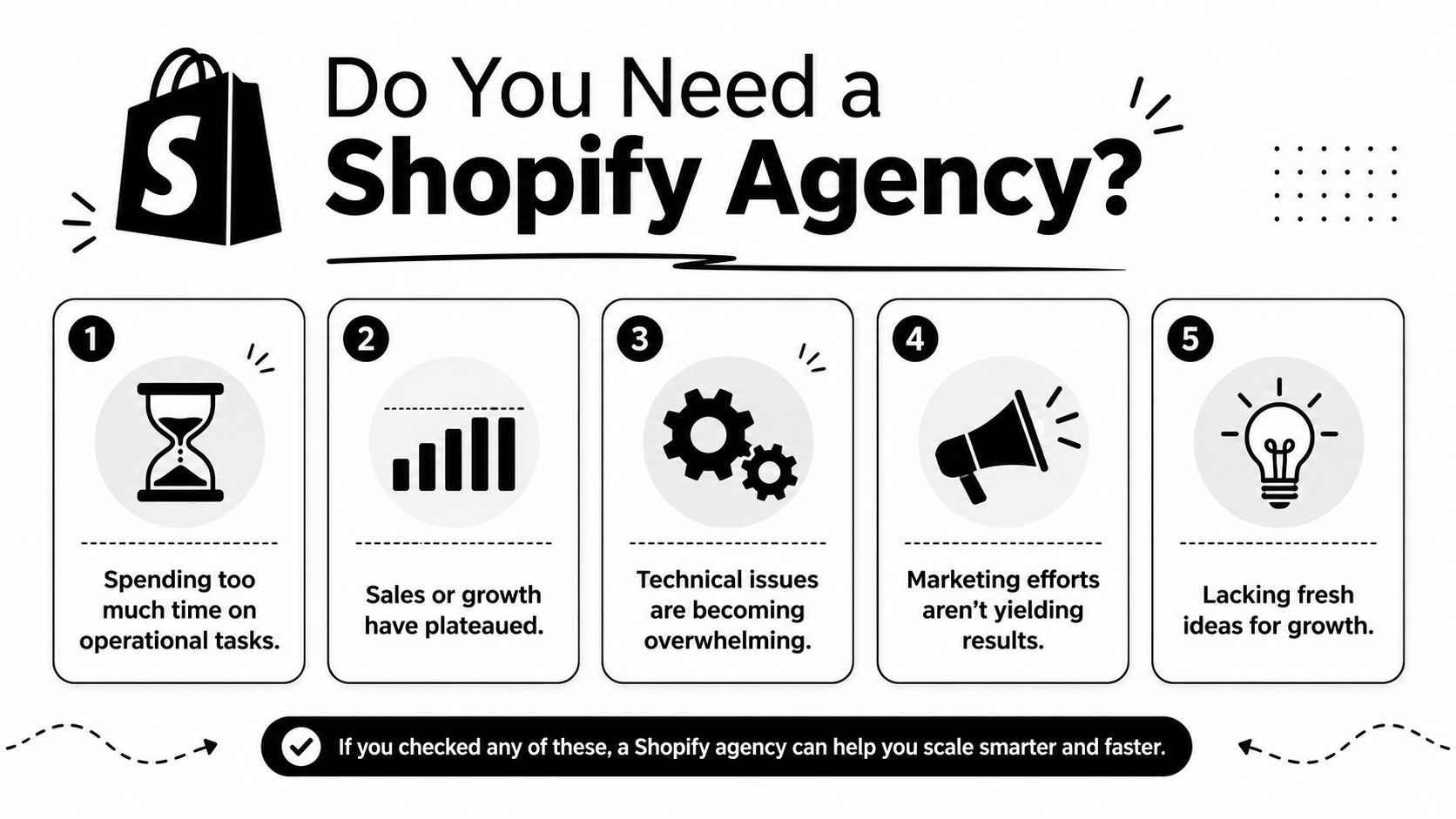
You're spending your best hours on the wrong work
If you're the owner, your highest-value tasks usually aren't theme edits, feed troubleshooting, app conflicts, or fixing event tracking in Google Tag Manager. Yet that's where a lot of founders end up. They become the accidental developer, the accidental media buyer, and the accidental analytics manager.
A proper agency takes those jobs off your plate and gives them structure.
Practical rule: If your store keeps pulling you into technical jobs that delay product, stock, service, or sales decisions, you've probably outgrown the DIY setup.
Sales are flat and nobody knows why
Flat revenue doesn't always mean weak demand. Sometimes the issue is poor mobile UX, broken reporting, slow collection pages, unclear shipping communication, or a mismatch between traffic source and landing page. When no one owns diagnosis, businesses start guessing.
That guesswork gets expensive fast. One week it's a new app. Next week it's a redesign. Then it's a different ad angle. None of it fixes the root problem.
One reason agency support matters is that structure improves the odds of building something that lasts. While only about 3% of all Shopify store signups globally achieve long-term success, that rate jumps to over 12% for stores that partner with specialized Shopify agencies in Australia who follow a structured methodology for growth, according to this discussion referencing Shopify success rates.
Your marketing feels disconnected from the website
This is one of the biggest signs. A lot of stores run ads as if the site and the media account are separate things. They're not. If your Facebook ads agency, Google Ads agency, or freelancer can't talk comfortably about landing page structure, collection page UX, GTM, GA4, and product feed quality, performance usually tops out early.
Here are the common signs I watch for:
- Reporting is unreliable: Purchases in Shopify, Meta, and GA4 don't line up closely enough to support good decisions.
- Creative testing has no landing page strategy: New ads go live, but product pages and collection filters stay unchanged.
- Mobile behaviour looks poor: Sessions arrive, people browse, then drop out before cart or checkout.
- Your team keeps adding apps to solve structural problems: That often slows the store and creates more maintenance.
You need more than a single specialist
A freelancer can be excellent for a defined technical task. But many growing brands don't just need a theme tweak. They need Shopify development, Shopify design, paid traffic management, event tracking, feed optimisation, and sometimes supporting content work on WordPress as well. That's where a broader team starts making sense.
If your business needs custom data layer work, Conversions API installation for Meta, setting up Google Tag Manager containers, Google Shopping ads, and support with Instagram Shop and Facebook Shop, you don't want to coordinate five vendors who all blame each other when results slip.
Defining Your Project From a Vague Idea to a Clear Brief
A typical first call goes like this. The owner says they want a better Shopify site. Ten minutes later, they also want cleaner tracking, lower acquisition costs, easier merchandising, and a team that can keep growing revenue after launch. If that never makes it into the brief, the proposal will miss the actual job.
A clear brief protects both sides. It gives the agency enough context to scope the work properly, and it forces you to decide whether you need a developer, a marketing team, or an Australian partner that can handle both.
Start with the commercial problem
I usually tell clients to write the brief as if they are explaining the business to a new senior hire. Skip the mood board for now. Start with what is broken, what is underperforming, and what the business needs from Shopify over the next 12 to 24 months.
Shopify's Australian small business statistics point to recurring pressure points for local businesses selling online, including security, marketing costs, website development, and fulfilment. Those are useful categories because they stop the brief drifting into subjective feedback like "make it look more premium."
Write the business problems in plain language:
- Security and platform control: Too many staff logins, risky app usage, weak process around access, or concerns about tracking and checkout trust.
- Marketing efficiency: Rising customer acquisition costs, poor attribution, weak conversion rate, low quality traffic, or inconsistent feed performance.
- Site build and maintenance: Theme limits, too many apps, slow updates, poor mobile UX, or custom features the current setup cannot support.
- Operations and fulfilment: Shipping rules, inventory sync issues, dispatch communication gaps, or manual work your team repeats every day.
That gives an agency something useful to respond to.
Separate the work into clear streams
One of the biggest mistakes I see is treating everything as a website project. For a growing ecommerce brand, the build is only one part of the commercial system. The brief should separate design, development, and growth requirements so the agency can show how those pieces connect.
Design requirements
Define how the store needs to present products and help customers buy. Good design direction is less about taste and more about clarity.
Include points like:
- Brand position: Premium, value-focused, technical, editorial, gift-led, or catalogue-heavy
- Priority templates: Homepage, collection pages, product pages, landing pages, cart, bundle pages
- Mobile UX needs: Sticky add to cart, variant selectors, filters, product media behaviour, comparison blocks
- Content placement: Reviews, FAQs, UGC, buying guides, shipping info, trust signals
If content plays a major role in acquisition, mention that. Some brands sell on Shopify but still need separate content infrastructure outside the store. That affects platform decisions, template planning, and who should be on the agency team.
Development requirements
This part needs more detail than many business owners expect. If you know certain functions are required, list them early so you do not get a cheap proposal that turns expensive later.
Examples include:
- Platform integrations: ERP, CRM, subscriptions, loyalty tools, stock systems, shipping software
- Theme and feature work: Custom sections, bundles, advanced filtering, account features, upsell logic
- Custom functionality: Shopify API work, private workflows, or custom app development
- Tracking and measurement: GTM, GA4, enhanced ecommerce events, Meta Pixel, Meta Conversions API, feed diagnostics
I have seen plenty of briefs ask for "a Shopify redesign" when the hard part was data layer work, feed cleanup, and fixing broken attribution. If paid media matters to the business, that belongs in the brief from day one.
Marketing requirements
The difference between a freelance developer and a growth partner becomes apparent. If the agency is expected to help after launch, the brief should spell that out clearly.
List the channels and responsibilities:
- Google Ads: Search, Shopping, Performance Max, remarketing, branded search
- Meta ads: Prospecting, retargeting, creative testing, offer testing, catalogue ads
- Feed management: Product titles, category mapping, exclusions, diagnostics, merchant centre issues
- SEO and local visibility: Technical SEO, collection page structure, content support, local search presence
- Reporting: GA4, Shopify reporting alignment, lead or purchase attribution, channel-level performance reviews
A store can look good and still fail commercially if no one has planned how traffic, landing pages, product feeds, and conversion tracking will work together.
Define constraints before agencies price the job
Good briefs also explain the limits around the project. Agencies need to know what they are working with, not just what you want.
Include practical details such as:
- target launch window
- internal approval process
- who writes content
- who supplies product data and imagery
- whether the store is a rebuild, migration, or optimisation project
- budget range, if you have one
- whether you need post-launch media buying and CRO support
Two agencies can read the same vague brief and price completely different jobs. One assumes a theme refinement. Another assumes a rebuild with tracking, feeds, and campaign setup. Both can sound reasonable on the call.
Define success in language your team can measure
A strong brief ends with outcome statements. I prefer simple ones that tie back to operations, sales, or marketing performance.
For example:
- We need a store our team can update without relying on app workarounds.
- We need better alignment between Shopify, Meta, and GA4 so reporting is usable.
- We need stronger mobile product pages and collection merchandising.
- We need one partner who can build the store, manage paid media, and support growth after launch.
That last point matters more than many founders realise. If you want a full-service Australian partner, say so directly. It will filter out agencies that only build sites, and it will surface teams that can connect custom Shopify development with Google Ads, Meta ads, tracking, and local market strategy. That is a different engagement from hiring someone to edit a theme.
How to Find and Vet a Top Australian Shopify Agency
You shortlist three agencies. One shows polished mockups. One talks pure development. One says it can handle the build, Google Ads, Meta, tracking, and post-launch growth. On paper, all three sound credible. In practice, they are very different hires.
That difference matters because a Shopify project rarely fails on design alone. It usually breaks at the handoff points. The store launches, feeds are messy, tracking is unreliable, campaigns underperform, and nobody owns the commercial result. If you want one Australian partner who can build and grow the channel, vet for that from the start.

Start with agencies that understand the Australian buying context
A team can be technically capable and still miss the practicalities of selling here. Australian ecommerce has its own operating details. Shipping expectations differ by state. Promotions shift around local retail periods. Mobile behaviour is strong. Payment preferences, tax handling, returns friction, and stock messaging all shape conversion.
I put real weight on local context because it shows up in decisions that look small at first. Should the cart highlight shipping thresholds early? How should delivery messaging change for metro versus regional customers? What does a sensible feed structure look like for Google Shopping in this market? Agencies that work with Australian brands every week usually answer those questions clearly and fast.
Check whether they can connect build work to growth
A lot of agencies can get a Shopify store live. Fewer can explain how the build supports paid media, reporting, and conversion work after launch.
That is the gap I look for when vetting. If your plan includes Google Ads, Meta ads, email capture, GA4, GTM, Meta CAPI, product feeds, landing page testing, or CRO, the agency should talk about those things as part of one system. If development and acquisition are split across separate suppliers, someone has to own the joins. Often that someone becomes the client.
Here are a few signs the team understands the full picture:
- They discuss traffic quality, not just page design: They ask where revenue will come from and how landing pages need to support paid traffic.
- They care about measurement: They mention GA4 structure, GTM, CAPI, event quality, attribution issues, and feed hygiene in practical terms.
- They understand operational limits: They ask about inventory sync, merchandising workload, approvals, and how your internal team updates the store.
- They can support after launch: They have a credible view on testing offers, improving product pages, managing campaigns, and reading performance data.
A developer can build a good store. A growth partner should also help you get profitable traffic into it and fix what happens once real users arrive.
Review their own site with a stricter lens
An agency website does not need to win design awards. It should show competence and commercial judgement.
I check four things first. Does the site work properly on mobile? Can I understand what they do, without fuzzy service sprawl? Is the content specific enough to suggest hands-on experience? Do they talk about conversion, analytics, feeds, and channel performance, or only brand and visuals?
If an agency claims it handles SEO, paid search, paid social, and Shopify development, its own site should reflect that range in a believable way. Not with buzzwords. With clear service lines, sensible UX, and content that sounds like it came from real client work.
Vet the operating model, not just the portfolio
Nice screenshots are easy to sell. Delivery quality is harder to fake.
I would rather see a slightly less glamorous portfolio from a team that can explain scope control, QA, deployment, tracking setup, and post-launch support than a beautiful gallery with no detail behind it. Good agencies talk openly about trade-offs. They tell you where a theme is enough and where custom development is worth the spend. They explain what they do in-house and what they outsource. They can describe what happens when campaign data does not match Shopify revenue, or when an app choice creates speed and maintenance problems later.
That is usually where weak agencies get exposed.
Green flags and red flags
A stronger shortlist comes from watching how an agency explains its work.
Green flags
- Clear service boundaries: They say what is included, what needs a specialist, and where scope can expand.
- Technical fluency: They can explain theme changes, app trade-offs, Shopify API work, tracking plans, and QA steps in plain English.
- Channel capability: They speak comfortably about Google Shopping, PMAX, Meta campaigns, feeds, GA4, GTM, and creative or landing page testing.
- Commercial awareness: They ask about margin, AOV, repeat purchase behaviour, merchandising, and operational bottlenecks.
- Useful adjacent support: If your stack includes content hubs or non-Shopify landing pages, agencies with WordPress developer services can be easier to coordinate than separate web and ecommerce suppliers.
Red flags
- Everything sounds simple: Experienced teams know where Shopify projects get messy.
- Case studies stay vague: If every result is "strong growth" with no explanation of what changed, keep digging.
- No process detail: Discovery, build, QA, launch, and optimisation should be explained clearly.
- Tracking gets brushed aside: That usually becomes a problem the moment ads start spending.
- Portfolio mismatch: A sleek fashion brand portfolio does not prove capability with large catalogues, bundles, subscriptions, B2B logic, or migration complexity.
The agency's real value shows up when data is messy, launch dates move, app conflicts appear, or paid traffic exposes weaknesses in the store.
Read beyond the homepage
Do not hire from one landing page, one directory profile, or one sales call. Read several service pages and at least one article. You are looking for signs of lived experience. The writing should reflect actual delivery work, not generic ecommerce advice recycled from elsewhere.
I also look for consistency across services. If an agency says it handles Shopify design, development, Google Ads, Facebook ads, analytics, and broader ecommerce strategy, that story should hold together across the site. One factual example is Alpha Omega Digital's Shopify developers in Melbourne, presented alongside paid media and ecommerce support. That integrated model suits brands that want one partner across build and growth. Other businesses will still prefer a narrower technical specialist. The right choice depends on how much coordination you want to carry internally.
The Critical Questions to Ask Before You Sign Anything
Most agency calls are too polite. The owner asks a few general questions, the agency gives polished answers, and everyone leaves feeling positive without learning much. That's not enough. Before you sign anything, you need questions that reveal how the team thinks, how it works, and whether it can handle both the build and the growth layer.
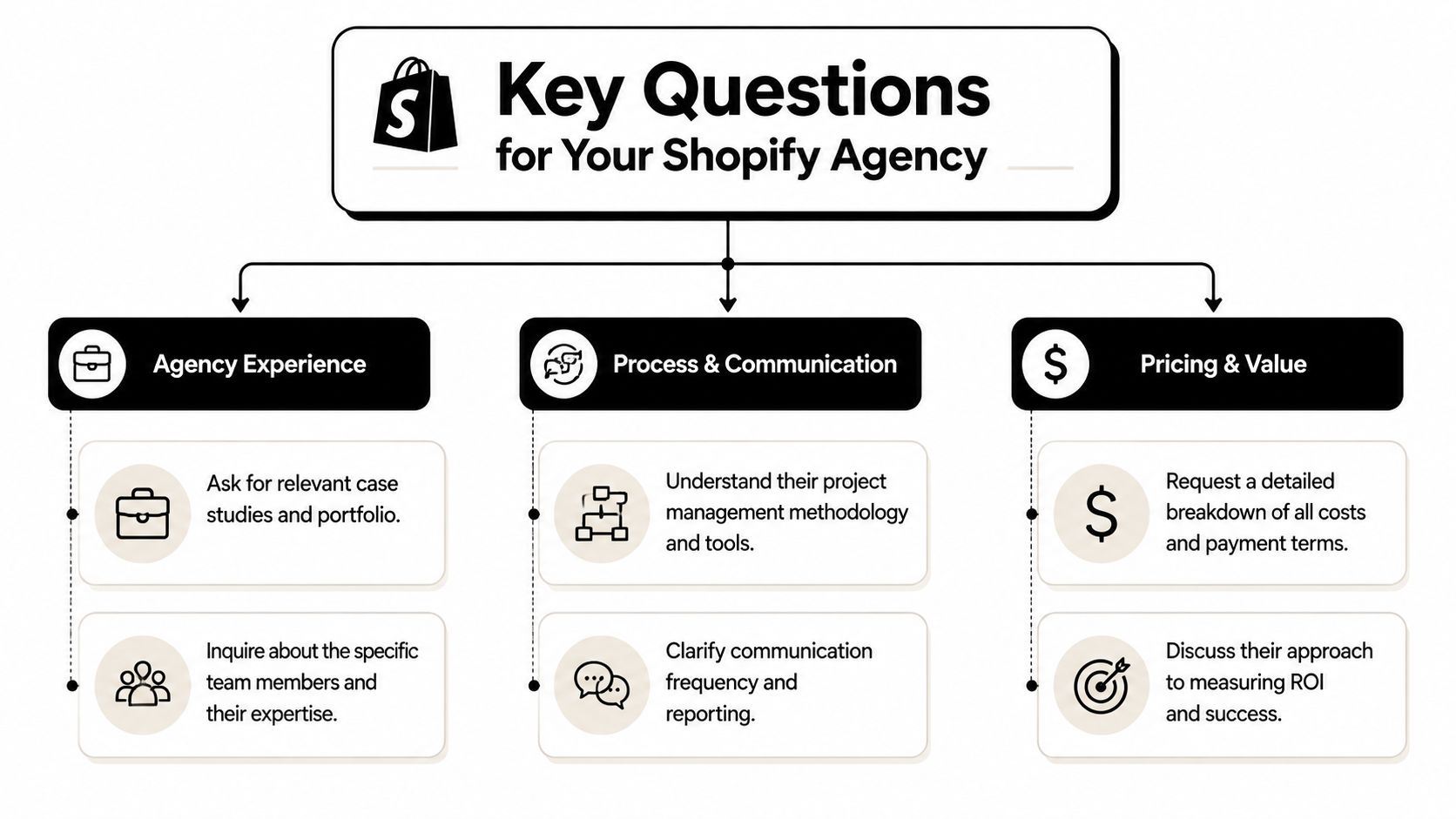
One reason these questions matter so much is performance variance. The average Shopify store conversion rate in Australia is 1.4%, but top agencies can push this to over 3.5% by optimising for the 70% of local shoppers who browse on mobile and integrating region-specific payment gateways, according to Marketix's Australian Shopify statistics roundup. If an agency can't explain how it approaches mobile UX and local checkout friction, that's a warning sign.
Ask about build depth, not just Shopify familiarity
A lot of providers say they do Shopify when what they really mean is they customise existing themes and install apps. That can be fine for some projects. It isn't the same as proper technical capability.
Ask direct questions like these:
- Can you handle Shopify API integrations if we need custom data flow?
- Do you build custom functionality inside the theme, or rely mostly on third-party apps?
- Have you done building custom Shopify apps using Shopify CLI?
- How do you approach QA before launch?
- Who does the actual development work, and where are they based?
If your site also needs content depth, ask whether they have genuine WordPress web developer, WordPress development company, or WordPress website developer capability. Plenty of ecommerce brands still need WordPress for content hubs, landing pages, or non-store sections.
Ask how they handle tracking and attribution
Weak agencies often get exposed. If they dodge specifics, expect reporting problems later.
Questions worth asking:
- How do you set up Google Tag Manager and GA4 for Shopify?
- What events do you treat as critical for ecommerce reporting?
- How do you approach Conversions API installation for Meta?
- Do you use native app setups only, or can you support custom GTM-based implementations where needed?
- How do you test event accuracy after launch?
A serious team should be comfortable discussing setting up Google Tag Manager containers, data layers, purchase event validation, and the difference between platform reporting and site-side tracking.
If an agency says tracking can be "sorted later", treat that as a commercial risk, not a minor admin task.
Ask how they manage paid acquisition
This matters even if you're hiring them mainly for development. Website decisions shape ad performance. Product page layout, landing page intent, collection filtering, speed, social proof, and checkout friction all affect media efficiency.
Good questions here include:
- What's your Meta ads creative testing process?
- How do you decide between PMAX vs Google Shopping ads?
- What's your approach to campaign priority in Google Ads for Shopping structures?
- How do you handle Google Shopping ads for dropshipping if product feed quality is inconsistent?
- What do you look for when Google Shopping ads are not spending budget?
- How do you measure success on Google Ads for contact form submissions versus direct ecommerce sales?
- What's your view on Google Ads for service based businesses compared with product-based stores?
For social, ask whether they support Instagram Shop and Facebook Shop, how they test hooks and offers, and how they evaluate performance before making major budget calls.
Ask how they think about creative and patience
A lot of businesses quit channels too early because nobody set proper expectations. That's especially common with Meta. Creative testing takes volume, iteration, and enough runway to gather signals. If an agency's answer is just "we test creatives every week," keep digging.
Ask them:
- What variables do you test first in Meta ads?
- How do you separate offer fatigue from creative fatigue?
- How do you decide when Facebook ads, don't quit too early applies and when it doesn't?
- How do you define success beyond platform ROAS?
A strong Facebook Meta ads agency should be able to talk about messaging angles, landing page alignment, and how to measure success in Facebook ads without reducing everything to one dashboard metric.
Ask how they support broader ecommerce operations
Not every ecommerce brand is pure DTC with a simple catalogue. Some also need local search visibility, service-side campaigns, and inbound call handling.
If that applies to you, ask about:
- Local SEO and Google My Business
- PPC for tradies or service-style campaigns alongside ecommerce
- Call tracking and lead routing
- Whether they can implement AI-assisted phone workflows
For service-led businesses or hybrid operators, we've set up custom numbers through Twilio with practical features such as 24 hour call answering, routing conversations without a human receptionist, booking appointments into a business calendar or Calendly, and catching after-hours leads that would otherwise go cold. That kind of setup can save missed revenue for tradies, hairdressers, beauty therapists, dentists, restaurants, and doctors. The point isn't that every Shopify store needs it. The point is that the right agency should understand the wider lead system when your business model isn't purely transactional.
Agency Capability Checklist
| Area of Expertise | What to Ask For | Good Answer Example |
|---|---|---|
| Shopify development | Ask for examples of custom builds, API work, and app decisions | They explain when they use theme customisation, when they use apps, and when custom development is justified |
| Shopify design | Ask how they improve mobile UX and product page clarity | They discuss merchandising, trust elements, mobile interaction, and checkout friction |
| Analytics and tracking | Ask how they set up GTM, GA4, and Meta CAPI | They describe implementation, testing, and validation instead of saying "the plugin handles it" |
| Google Ads | Ask their view on Shopping, PMAX, search intent, and feed quality | They talk about structure, exclusions, query control, and commercial goals |
| Meta ads | Ask how they run creative testing and evaluate winners | They explain testing variables, landing page alignment, and decision thresholds |
| WordPress capability | Ask whether they can support content hubs or custom Gutenberg blocks | They can explain building custom blocks in Gutenberg and when WordPress is better for content-heavy sections |
| Communication | Ask who you'll deal with weekly and how reporting works | They name the roles, meeting cadence, and the tools they use |
| Post-launch support | Ask what happens after go-live | They outline optimisation, bug triage, reporting, and prioritisation |
Decoding Proposals Pricing Timelines and Contracts
Once proposals arrive, most business owners compare the total figure first. That's understandable, but it's rarely the smartest place to start. Cheap proposals often hide scope gaps. Expensive proposals sometimes bundle strategy language without enough delivery detail. The useful comparison is value, clarity, and fit.
One of the biggest reasons owners hesitate at this stage is lack of clarity. A 2025 survey found that 68% of Australian SMBs delay ecommerce projects due to unclear agency pricing and a lack of contractual service-level agreements, as noted in The Hope Factory's discussion of transparent agency pricing in Australia. I see that hesitation all the time, and it's justified.
Understand the pricing model before the number
Most Shopify proposals fall into one of three structures.
Project fee
This suits a defined build, migration, redesign, or tracking implementation. It works well when the deliverables are clear and both sides agree on what counts as in scope.
Watch for these details:
- What's included: templates, revisions, integrations, migration, QA, launch support
- What's excluded: copywriting, product uploads, photography, feed work, post-launch changes
- Change request handling: how they price extra work once the build starts
Monthly retainer
This makes more sense when the agency is doing ongoing optimisation, media buying, CRO, SEO, or support. It's often the right setup when the business needs continuous growth work, not a one-off launch.
A retainer should explain:
- meeting cadence
- reporting rhythm
- who is on the account
- whether development hours are included
- how priorities are set month to month
Hybrid model
This is common and often sensible. A one-off build fee covers design and development, then a retainer covers paid ads, CRO, support, analytics, or SEO after launch.
Read for missing scope, not just included scope
The biggest cost blowouts usually come from what wasn't written down. If a proposal says "tracking setup included," that can mean anything from a basic app install to a proper GTM and GA4 implementation with tested ecommerce events.
Look carefully at these areas:
- Feeds and merchant centre work
- Meta Conversions API setup
- Migration complexity
- Email platform integration
- Custom sections and custom app logic
- Post-launch bug fixing period
- Training for your internal team
A proposal that feels slightly boring is often a good sign. Clarity beats agency theatre every time.
Timelines need assumptions attached
I don't trust a timeline unless it's tied to dependencies. Fast projects can work, but only if someone has named the bottlenecks. Product data, approvals, imagery, copy, app credentials, and stakeholder feedback all affect delivery.
When reviewing a timeline, ask:
- What needs to come from our side, and by when?
- What pauses the timeline?
- What counts as acceptance at each stage?
- How many revision rounds are built in?
- What happens if third-party apps or platforms cause delays?
That matters whether you're hiring for Shopify development partners, a broader ecommerce marketing agency, or a team handling both website and media buying.
Contract terms that actually matter
A lot of owners skim the contract because they're tired by this point. Don't. The contract is where vague promises either become real obligations or disappear.
Pay attention to:
- IP ownership: Who owns the design files, code, accounts, creatives, and ad data?
- Access control: Will you have admin ownership of Shopify, Meta, GA4, GTM, Merchant Centre, and any apps?
- Service levels: What support response times apply after launch?
- Termination terms: How much notice is needed, and what happens to work in progress?
- Handover obligations: If you leave, what documentation or asset transfer must they provide?
If the agency also runs paid traffic, check whether campaign assets remain portable. That matters for Google Ads agency work, Facebook ads agency management, and any call tracking setup.
Value-adds that are worth noticing
Some agencies include things that improve ROI without making a huge song and dance about it. That can be a stronger sign than flashy proposal language.
Examples include:
- call tracking implementation
- landing page testing support
- merchant feed troubleshooting
- GTM event validation
- calendar booking integrations
- lead handling workflows for service-heavy businesses
If you're also running service campaigns, practical additions such as Google Ads for plumbers style lead-gen structures or Facebook ads for electricians can matter when the business has both ecommerce and booked-service revenue.
Onboarding and Kicking Off a Successful Partnership
A signed proposal doesn't create momentum on its own. Good onboarding does. With good onboarding, a lot of projects either become organised quickly or drift into confusion. The best agency relationships start with structure, access, and shared definitions of success.
The kickoff should answer operational questions fast
The first meeting shouldn't be a vague chat about goals. It should lock down who is doing what, how communication works, and where decisions get made.
A clean kickoff usually covers:
- project owner on your side
- project lead on the agency side
- channels being used, such as Slack, email, Asana, ClickUp, or Monday
- approval process for design, development, and ads
- timeline dependencies and internal deadlines
If an agency skips over process because it wants to seem flexible, that often creates unnecessary friction later.
Access needs to be handled properly
This sounds basic, but it's where plenty of partnerships wobble in week one. The agency can't do good work without the right access, and the business shouldn't hand over everything blindly either.
Typical access areas include:
- Shopify admin: themes, apps, settings, products, shipping
- Meta Business Manager: ad account, pixel, catalogue, domain
- Google stack: GA4, GTM, Merchant Centre, Google Ads, Search Console
- Email or CRM tools: Klaviyo, Mailchimp, HubSpot, or similar
- Creative systems: Canva, Figma, Drive, asset libraries
Where needed, businesses should also clarify whether the agency handles setting up Meta Conversion API, catalogue sync for Instagram Shop and Facebook Shop, and event checks across ad platforms.
Define success before launch pressure starts
A lot of teams leave KPI discussions too late. Then launch day arrives and everyone starts arguing about what matters. That isn't a reporting issue. It's a planning issue.
Agree early on whether success is measured by:
- revenue
- blended return from paid media
- contact form submissions
- booked calls
- average order value
- product page engagement
- landing page conversion quality
This matters even more if the brief crosses channels. Some stores need ecommerce purchases tracked tightly. Others also care about lead quality from Google Ads for contact form submissions or booked consultations.
Early alignment saves awkward conversations later. If success hasn't been defined in operational terms, every report becomes a debate.
The first month should produce clarity
I don't think onboarding needs to feel dramatic. It needs to do one thing well. It should reduce ambiguity. By the end of the first month, you should know the active priorities, the reporting setup, the gaps in the existing stack, and the order in which issues will be fixed.
That applies whether your partner is handling Shopify design, local SEO, Google Shopping, or a broader mix that includes WordPress development, Google My Business, and paid social.
A smooth onboarding phase isn't glamorous, but it often predicts the health of the whole engagement better than the sales process does.
Your Next Step to Shopify Growth
A lot of Shopify projects stall after launch for a simple reason. The store gets built, but no one owns the full path from traffic to conversion to repeat purchase. I've seen Melbourne businesses spend months choosing a theme and almost no time choosing the partner who will manage feed quality, landing pages, offer testing, and paid acquisition after the site goes live.
That decision shapes growth more than the build itself.
A strong Shopify partner should be able to connect custom development with commercial execution. That means handling platform work such as Shopify API and front end changes, while also understanding Google Shopping, Meta creative testing, GTM and Google Analytics, and the local context your business sells into. A store can be technically finished and still be a poor sales asset if the tracking is off, the merchandising is weak, or the paid media setup sends the wrong traffic.
This matters even more for businesses with a mixed model. If you sell products, generate leads, run content, or support Shopify with other sites, the handoff points multiply quickly. In that setup, broader capability across WordPress development, WordPress design, building custom blocks in Gutenberg, and Google Ads for service based businesses can save a lot of coordination time and prevent the usual channel silos.
If you're comparing agencies, look at whether they cover both build and performance work in practice, not just in a sales deck. Reviewing Google Ads agency services, Facebook Meta ads agency support, and advanced Facebook ads strategies will tell you more about how they think than a generic "full service" claim ever will. The right choice is the team structure that fits your growth model, budget, and internal capability.
Alpha Omega Digital is a marketing agency based in Melbourne, Australia, and also services clients in Sydney, Brisbane, Newcastle, Perth, Adelaide, Darwin and Hobart. Have a project in mind? Contact us
If you're considering Alpha Omega Digital and your business has a paid ads budget of at least 3k a month, I'd love to offer you a low risk deal. Get a month of paid ads management free. Apply through the contact page.
[email protected]
Read more insights from our team on web design, paid ads, and growth strategy.