You're probably staring at a plateau that feels unfair. The traffic is there, the ads have been running, the site looks decent enough, and yet the pipeline still depends on slow weeks, referral bursts, or whoever remembered to follow up first. That's the moment most Melbourne owners start looking for a lead generation agency Melbourne businesses can trust, and it's also where the wrong hire can steadily drain cash for months.
The problem usually isn't “more marketing”. It's the mismatch between traffic, tracking, conversion, and follow-up. A good digital marketing agency Melbourne companies hire should understand the whole chain, from landing page speed and call tracking to Google Ads structure, Meta creative testing, CRM handoff, and the compliance details that decide whether a lead is actually usable.
Defining Your Growth Goals and Agency Fit
A Melbourne ecommerce owner can have steady traffic, strong product interest, and a checkout that works well on desktop, yet still struggle to grow. The problem may be a clumsy mobile experience, weak trust signals, or no reliable process for turning visitors into enquiries and repeat buyers. Before comparing agencies, identify the point where growth is being lost.
Start with the bottleneck, not the service menu
A marketing agency Melbourne businesses choose should match that bottleneck. If the site is slow, campaign budget leaks before users understand the offer. If form submissions are weak, changing ad copy alone will not solve the problem. If sales calls are missed, the failure sits after the click, in routing, response time, or CRM ownership.
Australian website data shows why these basics matter. Only 62% of SMEs had a website, 7% planned to get one within 12 months, and 72% of SMEs with websites said the site improved business effectiveness in the cited Australian business analysis. The same analysis found that only 13% included testimonials and only 30% passed a speed test (small business website design Melbourne analysis). The opportunity is often less about adding another channel and more about improving trust, speed, and conversion paths on the assets already receiving traffic.
Practical rule: if an agency only discusses impressions, clicks, and reach, ask how it will improve lead quality, response time, and close rate.
Match the agency to the kind of growth you need
A media buyer, a full-funnel ecommerce partner, and a technical conversion team solve different problems. Product businesses may need Shopify development, Shopify design, product-feed management, and remarketing. Service businesses may need Google Ads for service based businesses, Google Ads for contact form submissions, call tracking, and local SEO. A partner covering both areas must be able to explain how technical changes affect acquisition performance.
Write the brief around the constraint. Ask for WordPress development because the current site cannot support custom blocks or fast landing pages. Ask for WordPress Design when the page structure and trust signals are making offers difficult to understand. Specify WordPress development Melbourne support when local availability, maintenance, and rapid campaign changes matter. If attribution is unclear, request a Facebook ads agency, Google ads, and GTM and Google Analytics setup that can connect campaigns to qualified outcomes rather than just traffic.
First-party tracking deserves equal attention. Confirm who owns consent settings, event definitions, CRM fields, and the data passed through forms or APIs. For an Australian business, ask how the proposed setup handles privacy obligations and whether the agency documents what data is collected, where it goes, and who can access it. If the agency is layering in chat or conversational capture, compare the feature set against conversational platform features before committing to a stack.
For ecommerce, test the agency's technical depth. Ask whether it can manage product feeds, Shopify API work, and Building custom Shopify apps using Shopify CLI when standard apps create limitations. For content-led lead capture, ask how it approaches Building custom blocks in Gutenberg and WordPress development workflows without making routine edits dependent on a developer. A capable partner should be comfortable with WordPress website developer work as well as campaign management.
Use Australian benchmarks to sanity-check your expectations
Benchmarks help expose weak funnel planning. In Australia, B2B lead-generation landing pages convert at 8.8%–18.2%, while general B2B sites average 2%–5%, according to the linked Australian marketing analysis (Australian marketing statistics). A separate funnel benchmark lists 5–10% visitor-to-MQL, 20–30% MQL-to-SAL, 10–20% SAL-to-SQL, 25–30% SQL-to-opportunity, and 20–40% opportunity-to-close (lead generation Australia funnel benchmark).
Use those figures as planning references, not promises. A large audience can still produce few customers when qualification, follow-up, or sales handoff fails. A credible seo agency Melbourne brands should consider, or a paid media agency with operational depth, will explain where the funnel leaks and which system owns each stage.
Auditing the Technical Stack and Development Capabilities
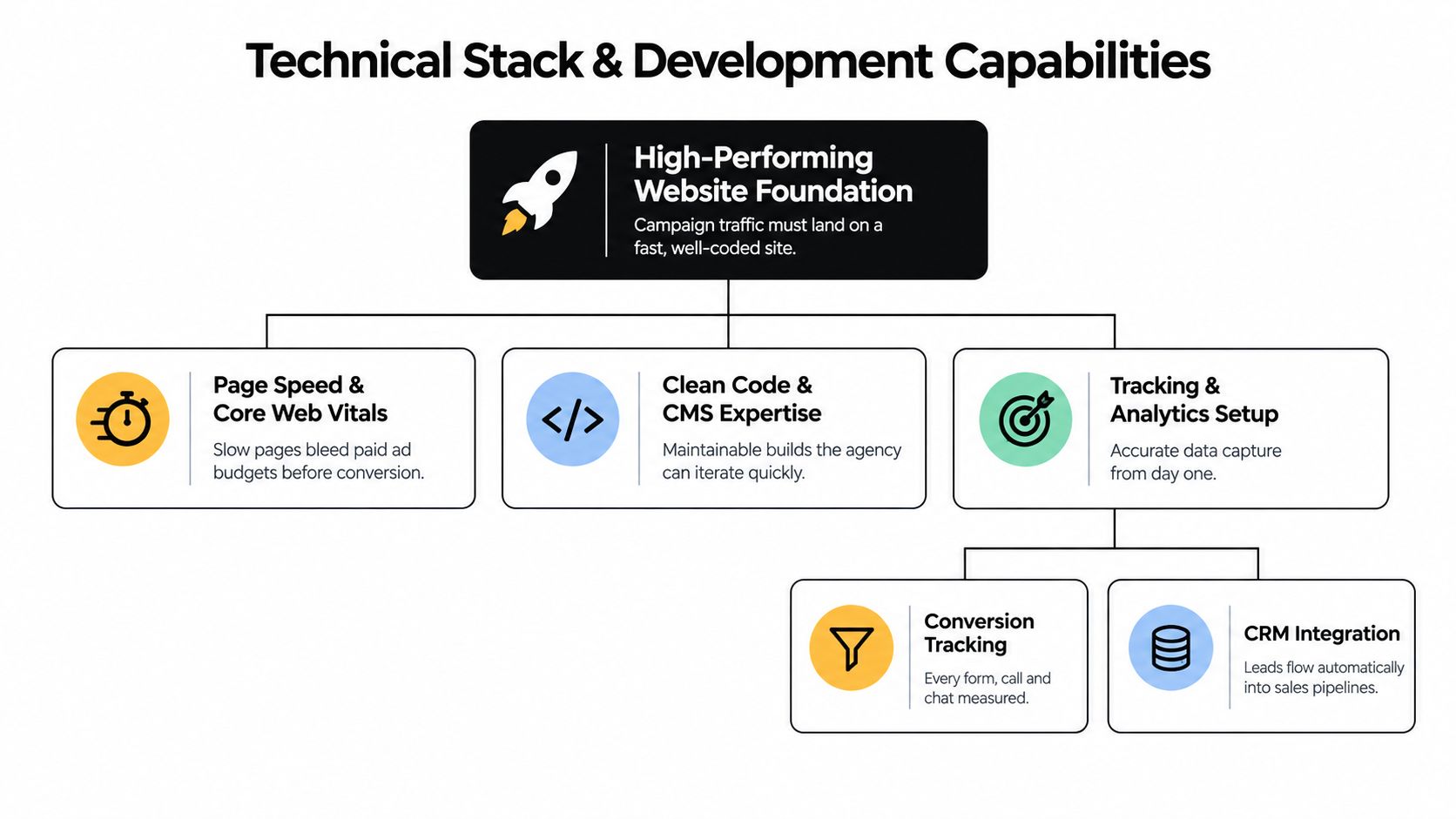
A lot of campaigns fail for a boring reason, the landing page can't carry the weight of the traffic. I've seen well-targeted ads sent to slow themes, bloated plugins, broken forms, and tracking setups that make every report feel like guesswork. When that happens, the agency can't tell whether they have an ad problem, a page problem, or a data problem, because the stack itself is muddy.
What a serious build should include
A strong WordPress development or Shopify development setup starts with maintainability. Out-of-the-box themes can be fine for simple sites, but once you need custom landing pages, conversion blocks, product logic, or tighter lead routing, the limits show fast. That's where a team that knows WordPress web developer work, WordPress website developer work, and WordPress development company standards makes a difference.
On the Shopify side, I want a team that can handle Shopify developers, Shopify developer, and Shopify development partners conversations without leaning on third-party apps for everything. If they can build with Shopify API and use Building custom Shopify apps using Shopify CLI, they're more likely to create a store that scales cleanly. The same principle applies to WordPress development Melbourne and WordPress developers work, where custom blocks and lean templates often outperform patchwork page builders.
Tracking has to be installed properly, not guessed at
If the agency can't explain setting up Google Tag Manager containers and Conversions API installation for Meta, I'd be cautious. GTM should be the control layer for tags, triggers, and events. Meta CAPI should help preserve signal quality when browser-side tracking gets unreliable. Those aren't “nice to have” extras, they're the baseline for trustworthy reporting.
For lead gen, I'd also ask how they handle form submissions, calls, chat, and booked appointments. A clean system should capture events, push them into the CRM, and preserve source data all the way through the sales process. That matters if you're running Google ads for service based businesses, PPC for tradies, or Google ads for contact form submissions, because one missing event can make a good campaign look weak.
Practical rule: if the agency says “the platform will optimise it out”, ask them what they're doing to improve the landing page, the tracking, and the handoff. The platform can't repair a bad stack for you.
Why the right development partner changes paid media outcomes
For ecommerce, I'd expect the team to understand Shopify design, feed health, collection page structure, and the difference between standard templates and conversion-led builds. If the store needs Instagram shop and Facebook shop support, the product architecture has to be clean before Meta can do much with it. If the catalogue is messy, paid social ends up amplifying confusion instead of demand.
For WordPress-led lead gen, I'd want the agency to know how to build custom sections in Building custom blocks in Gutenberg, how to keep pages light, and how to avoid plugin sprawl. For stores and service brands, that technical discipline is often the difference between a landing page that converts and one that just looks polished. I've also found that teams comfortable with WordPress development, WordPress developers Melbourne, and WordPress-development style projects tend to think more like problem-solvers than button-pushers.
If you're comparing a digital marketing agency Melbourne owners might recommend, ask to see the stack, not just the ad account. You want to know what happens after the click, who owns the code, and how fast they can iterate when the data says something's off.
Evaluating Paid Media Strategy and Platform Expertise
I don't care how slick the pitch deck looks if the paid media logic is weak. Australia's auction environment is expensive enough that sloppy targeting, weak landing pages, and lazy testing can chew through budget with very little to show for it. The agencies worth hiring can explain how Google and Meta work together, where each channel is useful, and where each one usually falls over.
Google Ads has to be structured around intent
For service businesses, Google ads should be built around search intent, call tracking, and conversion quality. For ecommerce, it's usually a mix of search, feed-led Shopping, remarketing, and audience layering. If the agency is talking about beginner's guide to google shopping ads content or Google shopping ads for dropshipping, fine, but I'd still want them to explain how they manage product data, margin pressure, and feed segmentation.
Google's own guidance says campaign priority in Google Ads only matters when the same product is advertised in multiple Shopping campaigns for the same country, and that the highest-priority campaign bids first with priority levels set to Low, Medium, or High (Google Ads campaign priority help). Google also says campaign priority determines which campaign budget is used when products overlap across campaigns (Shopping campaign setup guidance). If an agency can't explain that cleanly, they probably don't have a strong Shopping account structure.
Meta needs creative discipline, not random testing
A Facebook ads agency or Meta ads partner should have a real creative testing process. I want to hear how they angle hooks, format variations, proof points, and offers. I also want to know how they decide when to keep testing, when to cut, and when to scale. Throwing a handful of assets into Ads Manager isn't strategy, it's gambling with prettier thumbnails.
This matters even more if the team says they can handle Mastering facebook ads or wants to present themselves as a broad facebook meta ads agency. The funnel has to be clean enough to measure, and the creative has to be tied to the buying stage. If they're doing lead gen, they need to know how to measure success in Facebook ads without overvaluing cheap leads that never answer the phone.
Paid media questions that separate operators from talkers
When I'm auditing a team, I ask simple questions and listen for specifics.
- Budget logic: how do you decide what budget to spend on Google Ads for a new account, and what happens when the first week is noisy?
- Search structure: how do you separate Google Ads for plumbers, PPC for tradies, and other service niches from broader lead gen campaigns?
- Shopping structure: when do you use PMax vs Google Shopping ads, and why?
- Conversion hygiene: how do you fix Google shopping ads not spending budget when the feed looks fine but delivery stalls?
- Attribution: how are GTM and Google Analytics configured so the reports reflect reality?
- Automation: how do you connect the ad account to CRM and follow-up flows so leads don't go cold?
A good team will answer with process, not theatre. They'll talk about feed quality, conversion volume, form quality, page experience, and follow-up speed. They won't pretend every campaign can scale forever.
For agencies that build on both paid search and paid social, I'd also ask how they handle Meta ads creative testing process, and whether they know when to shift from lead volume to lead quality. That's where a lot of otherwise capable media buyers struggle. They can launch, but they can't diagnose the point where the funnel is leaking qualified demand.
Navigating Pricing Models and Contract Structures
Agency pricing becomes difficult to judge when the scope is vague. I've seen retainers that looked expensive but were straightforward, alongside “cheap” deals that concealed media margins, restricted access, or minimal setup work. Judge the fee against the outcome, the work required, and the assets you will still control when the agreement ends.
Compare the common models carefully
A flat retainer offers predictable costs and can suit ongoing optimisation across several channels. A percentage-of-spend model may work for some ecommerce accounts, but it can reward higher spending rather than better efficiency. Performance-based fees can appear attractive, yet they usually depend on clean measurement and may leave the agency unwilling to complete the technical work needed before results can be judged.
For context, Australian Google Ads lead-generation accounts commonly see CPCs around A$4.20–A$14.20, with average cost per lead of A$95–A$310 in B2B and A$48–A$135 in home services and trades, and landing-page conversion rates of 3.9%–14% for lead gen (Google Ads benchmarks). If the landing page converts below 2%, that usually indicates a page or tracking problem rather than a bidding issue, according to the same benchmark set.
Practical rule: ask the agency to work backwards from your target close rate, then show the expected lead volume, management effort, and testing schedule. If the proposal cannot connect those inputs to the fee, the pricing model lacks a useful commercial basis.
What to watch for in contract language
Read lock-in clauses before comparing monthly fees. Check ownership and exit terms for ad accounts, landing pages, creative files, pixels, first-party data, API connections, and tracking assets. Confirm that your team can retrieve raw data and retain access to the systems that capture consent, leads, and customer events. An agency that owns every important asset leaves you renting access to your own growth system, with little influence when the contract ends.
Australian privacy requirements should also appear in the scope, especially where forms, CRM synchronisation, remarketing audiences, or chatbot conversations collect personal information. Ask who configures consent records, where data is stored, and what happens to those integrations after termination. A low fee is less appealing if your team must rebuild tracking or fix an undocumented API connection.
If the agency is adding chatbot or conversational technology, compare its operating cost with a resource such as pricing for AI chatbots. This helps separate the agency's management fee from the cost of automation itself, and clarifies which manual tasks the system should replace. It does not determine the right agency, but it gives the proposal a practical cost frame.
A simple comparison of pricing models
| Pricing Model | Best For | Key Risk |
|---|---|---|
| Flat retainer | Ongoing optimisation, mixed-channel accounts, ecommerce growth | Paying for idle time if scope is vague |
| Percentage of ad spend | Large spend accounts with stable structures | Incentive to raise spend rather than efficiency |
| Performance-based fee | Narrow offers with clean tracking and short sales cycles | Hidden exclusions, weak support before results appear |
For a seo agency Melbourne comparison, ask whether SEO work sits inside the same engagement or remains a separate discipline. Cross-channel insight can be useful, but vague bundling often leaves one service neglected. The proposal should define deliverables, ownership, reporting, privacy responsibilities, and exit terms in plain language.
Integrating Local SEO and Automated Lead Follow-Up
Paid media gets the first click, but it doesn't always win the sale. For local service brands and ecommerce stores with high-consideration offers, the conversion often depends on whether the business shows up well in local search, answers quickly, and keeps the conversation alive after the first visit. That's where local SEO and follow-up systems become part of lead generation, not separate nice-to-haves.
Local visibility still matters
A complete, active Google Business Profile earns 7× more clicks than an empty profile, and Australian brands with active profiles logged the highest monthly actions among the four countries studied in one Australia-focused local SEO study (local SEO statistics Australia). That doesn't mean profile optimisation solves everything, but it does mean local buyers are more likely to interact when the profile is complete and current.
For a lead generation agency Melbourne companies hire, I'd expect local SEO to sit beside paid media, not beneath it. If someone searches a service near them and sees a weak profile, poor review handling, or thin business information, the ad budget has to do more work than it should. For ecommerce brands with local showrooms, that can affect both online and offline conversion paths.
Follow-up speed is part of the product
Lead follow-up is where many systems break. If someone fills out a form, calls, or sends a message and nobody responds quickly, the lead is cold before sales has a chance to work it. That's why I like setups that combine CRM routing, alerts, and phone coverage with a real after-hours fallback.
We often use a custom number through Twilio with 24 hour call answering, appointment booking into a calendar or Calendly, and lead capture for businesses that can't afford to miss the first interaction. It's especially useful for tradies, hairdressers, beauty therapists, dentists, restaurants, and doctors, because the missed-call cost is often immediate and visible. The value isn't the novelty of the system, it's that the business gets a consistent answer path when the owner is on a job, in transit, or already with a customer.
Compliance isn't optional in Australia
Australian email and SMS outreach has to respect the Spam Act, while phone outreach is constrained by Do Not Call and telemarketing rules. That matters because a lot of agencies still treat outreach like a pure volume game. It isn't. First-party data, consent-led communication, and sensible record-keeping are becoming the baseline for any business that wants to stay contactable and avoid ugly surprises.
Practical rule: if an agency can't explain how it captures consent, stores source data, and routes leads into a compliant follow-up flow, the rest of the pitch is too early to trust.
A useful resource for mapping those steps is the step-by-step local lead gen guide, especially if you want to connect local visibility, lead capture, and automation without guessing. The point is not to chase more channels. It's to make every enquiry easier to answer, easier to qualify, and harder to lose.
Your Onboarding Checklist and Interview Script
Once you've chosen a partner, the first month matters more than the sales pitch. I've seen good agencies underperform because onboarding was sloppy, access was partial, and nobody agreed on what a qualified lead was. I've also seen average agencies look better than they were because the business handed over clean assets, clear goals, and fast feedback.
The handover checklist
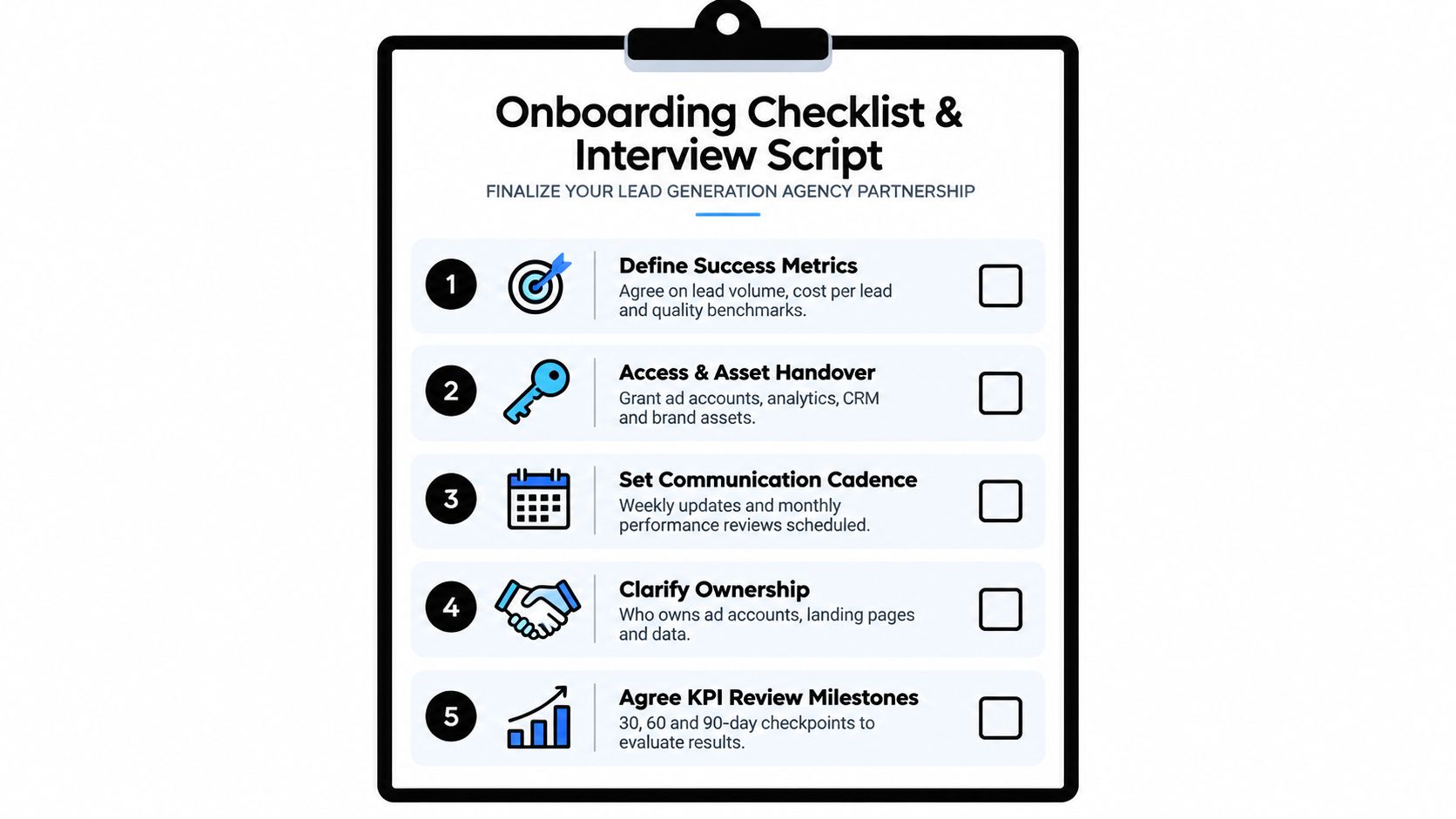
Use this list before the first campaign goes live.
- Define success metrics: agree on lead volume, cost per lead, and lead quality benchmarks.
- Access and asset handover: grant the correct access to ad accounts, analytics, CRM, Shopify, WordPress, and brand files.
- Set communication cadence: schedule weekly updates and monthly performance reviews.
- Clarify ownership: decide who owns the ad accounts, landing pages, tracking, and data.
- Agree KPI review milestones: lock in 30, 60, and 90-day checkpoints.
If the agency is handling Google ads, Meta ads, setting up Meta conversion API, or setting up Google Tag Manager containers, ask them to show the tracking map before launch. That map should identify every source of truth, not just the ad platform. For ecommerce, the same applies to feed setup, product data, and any Shopify API connections that push behaviour into the CRM or automation stack.
Questions I'd ask in the final interview
A confident founder or account director should answer these without dodging.
- What does a qualified lead mean in your reporting?
- Who builds the tracking, and who checks it after launch?
- How do you handle a campaign that gets clicks but weak form fills or calls?
- What happens if the landing page converts but sales says the leads are poor?
- Which assets stay with us if the contract ends?
- How often do you review creative, audience, and search term quality?
- What's your process for Google shopping ads not spending budget?
- How do you approach PMax vs Google Shopping ads for a product catalogue?
- What do you do differently for Google Ads for contact form submissions versus call-heavy campaigns?
- How do you manage compliance for outreach and remarketing in Australia?
If the answers are vague, the working relationship will be vague too. If the answers are specific, operational, and tied to actual workflows, you're probably speaking to a team that can handle more than a pretty dashboard.
A simple call script that cuts through the sales pitch
Use this near the end of the interview:
- State the problem: “Our current issue is not traffic alone, it's conversion and follow-up.”
- State the asset reality: “We need a partner who can handle tracking, landing pages, and campaign management together.”
- State the risk tolerance: “We're willing to move fast, but we need clear reporting and ownership.”
- Ask for the roadmap: “What would the first 90 days look like, week by week?”
- Ask for the warning signs: “What would tell you this account isn't ready to scale?”
A digital marketing agency Melbourne businesses keep long term should answer those questions with calm specifics. If they rush past them and go back to vanity metrics, that's your sign to keep looking.
If you're a business with a paid ads budget of at least 3k a month, I'd love to offer you a low risk deal, get a month of paid ads management FREE. Alpha Omega Digital handles WordPress development, Shopify development, Google Ads, Meta Ads, and lead tracking for Melbourne businesses that want a cleaner system, not just more clicks. Visit Alpha Omega Digital and apply through the contact page if you want a practical review of your current setup.
[email protected]
Read more insights from our team on web design, paid ads, and growth strategy.