You're probably here because you've already had a crack at Google Ads.
Maybe you set up a Search campaign yourself, followed Google's prompts, added a few broad keywords, let smart recommendations do their thing, and watched spend roll out faster than leads came in. Maybe your Shopify store got traffic but not enough sales. Maybe your phone barely rang, or worse, it rang with the wrong kind of enquiries.
That pattern is common across Melbourne ecommerce brands and service businesses. The problem usually isn't that Google Ads “doesn't work”. It's that the platform is easy to start and hard to run well. Good results rarely come from ads alone. They come from the full stack around them: tracking, landing pages, offer clarity, call handling, feed quality, CRM feedback, and disciplined optimisation.
A solid agency Google Ads partner doesn't just touch bids and keywords. It should understand your website build, whether that's WordPress development with custom Gutenberg blocks or a Shopify setup with theme edits, app conflicts, feed issues, and checkout friction. If you're speaking to a so-called digital marketing agency Melbourne business owners can rely on, that technical depth matters more than polished sales language.
Why Your DIY Google Ads Aren't Working
Most DIY accounts fail in boring ways, not dramatic ones.
The business owner does what seems sensible. They create one campaign, target a big area, send traffic to the homepage, leave default settings on, and judge success by clicks. A few weeks later they're frustrated because the clicks didn't turn into booked jobs, quality leads, or repeatable online sales.
That frustration is fair. Google Ads can look simple from the outside, but in Australia it sits in the middle of a huge demand channel. With Google holding roughly 94% of the search engine market in an Australia where 98.1% of the population is online, getting Google Ads right isn't just an option; it's the primary way to connect with customers who are actively searching for your solution according to this Google Ads statistics summary.
The setup is usually wrong before the first click
I've looked at a lot of small business accounts where the issue wasn't effort. It was structure.
Common examples include:
- Loose targeting: One campaign tries to cover every service, suburb, and intent level at once.
- Weak conversion setup: Form submissions might be tracked, but calls, qualified leads, and sales outcomes aren't.
- Homepage traffic: Those with a specific service in mind land on a generic page with too many choices.
- Blind automation: Smart bidding and broad match get turned on before the account has clean inputs.
- No negative keyword discipline: Search terms drift quickly, especially for service businesses.
A plumber in Melbourne searching “emergency blocked drain Brunswick” is not the same as someone casually reading about plumbing costs. Google knows the difference if you feed it the right signals. If you don't, it will still spend.
DIY campaigns often fail long before bidding becomes the issue. Tracking, page relevance, and offer clarity break first.
Google Ads is part marketing and part operations
That's why I don't treat paid search as a stand-alone media buy. For ecommerce, it touches feed health, product pages, shipping clarity, and review trust. For tradies and clinics, it touches call routing, quote speed, suburb coverage, and whether missed calls get recovered.
A capable marketing agency Melbourne businesses hire for Google Ads should be thinking beyond ad copy. It should ask what happens after the click. Who answers the phone. Where the lead goes. Whether the enquiry reaches a CRM. Whether your WordPress site loads cleanly on mobile. Whether your Shopify product pages match search intent.
When those pieces are missing, DIY Google Ads doesn't just underperform. It teaches the wrong lesson. Business owners conclude the channel is bad, when the underlying issue is the system around it.
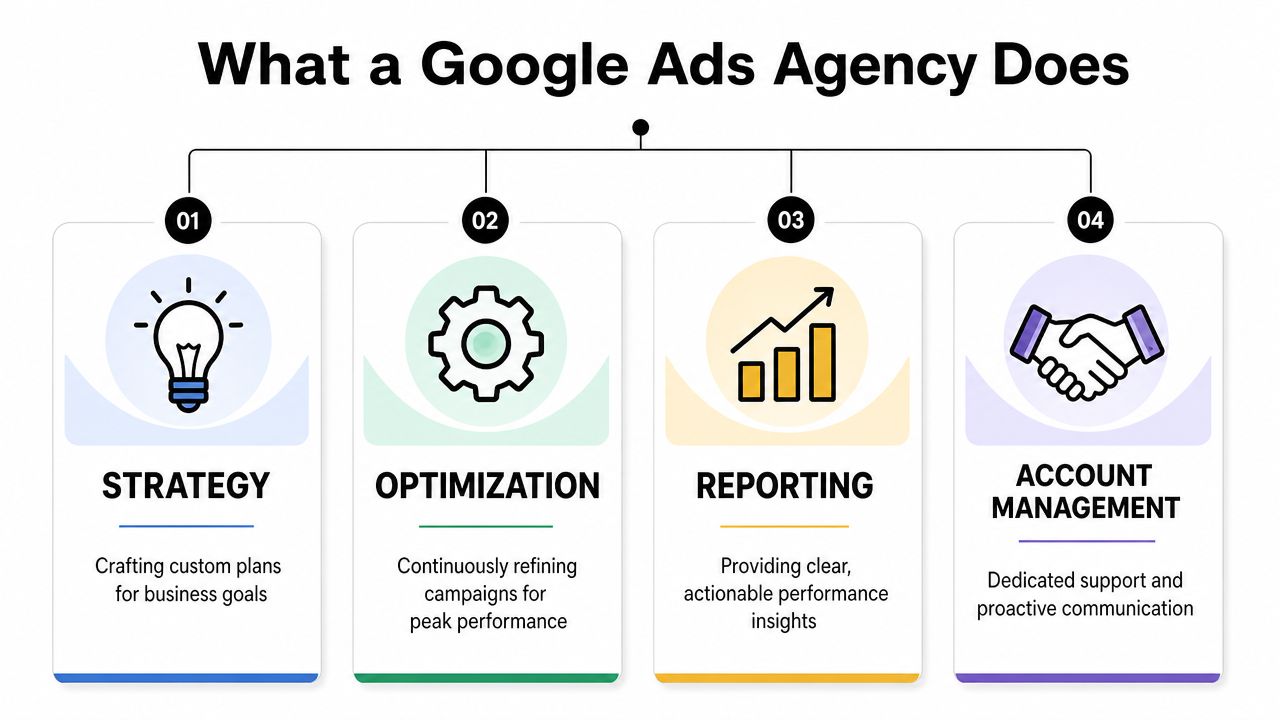
What a Google Ads Agency Actually Does All Day
A Melbourne business owner usually sees the surface. Leads are up or down. Cost per lead looks fine or ugly. Calls feel quiet. Underneath that, a good Google Ads agency is dealing with dozens of small decisions that shape whether the account can scale or keeps wasting money.
Strategy starts before campaign build
We start by defining the commercial target, not the media target.
For a tradie, that often means profitable callouts in the right suburbs, during the right hours, with call tracking set up so booked jobs can be separated from tyre-kickers. For an ecommerce brand, it can mean protecting margin, clearing stock, or pushing higher-value categories instead of chasing revenue that looks good in-platform but falls apart after shipping, returns, and discounts.
The questions that matter are operational:
- Which services or products produce the best customers?
- Which postcodes are worth bidding harder on?
- What counts as a qualified lead?
- Who answers the phone, and what happens if nobody picks up?
- Does the landing page match the search, or are we sending people to a generic page?
That is the difference between media buying and actual account management. A capable agency is not just adjusting bids. It is helping shape the system around the click.
Technical setup determines whether the account can learn properly
A lot of agency time goes into plumbing the data properly.
In real client work, that means setting up Google Tag Manager cleanly, checking GA4 events, fixing duplicate conversions, and making sure form submissions, calls, purchases, and micro-conversions are recorded in a way Google can use. For service businesses, I usually want call tracking tied back to campaign and keyword data, plus some way to distinguish a genuine booking enquiry from a wrong number or spam lead. For ecommerce, we check feed quality, enhanced conversions, Merchant Center issues, and whether the checkout and thank-you flow are passing back usable data.
This is also where the agency needs technical range. If a WordPress form fires the wrong event, or a Shopify theme update breaks purchase tracking, the ad account suffers immediately. Bid strategy cannot fix broken inputs. Agencies that only live inside Google Ads tend to miss that.
Good teams also look beyond Google when the stack calls for it. Meta Conversion API, CRM syncing, offline conversion imports, and basic attribution hygiene all affect decision-making. Some of the best actionable advice for small businesses is still ignored because the hard part is not knowing what to do. It is implementing it across tags, platforms, call flows, and websites without breaking reporting.
Creative and landing pages shape conversion quality
Ad copy still matters. So do images, video cuts, offers, trust elements, and page layout.
Google has clear requirements for video assets. Its video asset guidance covers formats, aspect ratios, and file limits. In practice, we build for placement. A YouTube asset, a vertical cut for mobile inventory, and a square variant for other surfaces do different jobs. If the first three seconds are weak or the framing breaks on mobile, spend disappears fast.
The same applies to display. Image dimensions and file constraints affect what can realistically be shown, as outlined in this reference on Google display ad sizes. That sounds minor until a retailer tries to cram pricing, product detail, and branding into a tiny unit and wonders why click-through rate and conversion rate both stay flat.
Landing page work is often where agency value becomes obvious. We rewrite headings, change page order, shorten forms, fix mobile spacing, add suburb relevance, improve CTA visibility, and test trust signals. On WordPress, that can mean template edits or section rebuilds. On Shopify, it can mean product page changes, collection logic, app cleanup, and tighter merchandising. Paid search works better when the agency can handle the page and the tracking, not just the ads account.
Optimisation is mostly diagnosis and prioritisation
After launch, the job becomes a steady cycle of checking what is breaking, what is improving, and what deserves attention first.
Some days we are reviewing search terms, negatives, location performance, auction overlap, ad strength, and conversion lag. Other days we are fixing Merchant Center disapprovals, adjusting device modifiers, importing offline sales data, or listening to recorded calls to check lead quality. For tradies, I often care more about whether the phone rang with the right kind of work than whether CTR improved by a small margin. For ecommerce, I care whether campaign structure matches stock, seasonality, and margin reality.
That is what a useful agency does all day. It manages the ad account, the tracking layer, the website experience, and the feedback loop between them. In Melbourne, that full-stack approach is usually what separates accounts that plateau from accounts that become reliable growth channels.
Real-World Benefits of Outsourcing to an Agency
Monday morning in Melbourne. A plumber has spent part of the weekend replying to quote requests, two of the calls from Google Ads were for work outside the service area, and the campaign is still spending on search terms that have no chance of turning into booked jobs. By midday, the ads are still live, nobody has checked whether the form submissions are genuine, and the owner is back on the tools.
That is where outsourcing starts to make commercial sense. A good agency does not just adjust bids. It removes the operational mess around the account so spend can be judged against booked work, revenue, and margin.

Service businesses stop paying for the wrong enquiries
For tradies and other service businesses, the biggest win is usually lead quality.
We regularly take over accounts that are targeting broad service terms across half of Victoria, with no proper call tracking, weak suburb relevance, and one generic landing page trying to do every job. The account may be generating activity, but activity is not the point. If the phone rings for the wrong suburb, a low-value job, or someone price shopping with no intent to book, the campaign is still underperforming.
The fix usually involves account structure, tracking, and page work together. We split urgent terms from research terms, tighten geo targeting, use suburb-specific landing pages, and set up call tracking through GTM so calls can be tied back to campaigns and keywords. In trades, that kind of setup matters more than shaving a few cents off CPC.
That same logic sits behind our work in niches like Google Ads for plumbers, where the goal is to get better jobs into the pipeline, not just more form fills.
Ecommerce brands get stronger results when ads, tracking, and site changes are handled together
For ecommerce, outsourcing pays off when the agency can work across the full stack.
A lot of Melbourne stores do not have an ads problem in isolation. They have a feed problem, a tracking problem, a merchandising problem, or a page-speed problem that shows up inside ad performance. We see this constantly on Shopify and WordPress builds. Product titles are messy, variant data is inconsistent, conversion events are duplicated, mobile layouts bury the add-to-cart button, or promo messaging is out of step with what is in the feed.
An agency that only manages campaigns can spot some of that, but it cannot fix much of it. A technical marketing partner can. That means cleaning up GTM, checking merchant feed health, refining landing pages, coordinating with developers, and testing offers against margin reality. For Australian ecommerce brands, that joined-up execution is often what turns paid search from an expensive traffic source into a channel that can scale.
The main upside is focus
Business owners should be making decisions about stock, staffing, service delivery, and cash flow. They should not be spending late nights inside search term reports or trying to work out why conversions dropped after a theme update.
I have seen the best results when the agency relationship feels like an extension of the business. We handle the account, the tracking layer, the landing page issues, and the reporting logic. The client keeps context on sales, fulfilment, and capacity. Both sides can then make faster decisions with fewer blind spots.
If you want broader context on disciplined execution, this round-up of actionable advice for small businesses is worth reading.
A capable agency gives you more than campaign management. It gives you a technical operator who can move from ad copy to GTM, from call attribution to landing page fixes, and from lead volume to lead quality without losing the commercial goal. That is usually the difference between an account that stays busy and an account that becomes reliably profitable.
Decoding Agency Pricing Models and Your Budget
Agency pricing confuses a lot of business owners because the fee model can hide how the relationship will work.
Some structures reward careful management. Others reward spend inflation. You want to know which one you're being sold.
The common models
| Model | How It Works | Best For |
|---|---|---|
| Monthly retainer | Fixed management fee each month for agreed scope | Businesses that want predictable costs and clear deliverables |
| Percentage of ad spend | Agency fee rises or falls with media spend | Brands with large spend and stable trust in the agency relationship |
| Performance-based | Fee is tied to agreed outcomes or commercial targets | Businesses with strong tracking and shared definitions of success |
Each can work. Each can also go wrong.
A flat retainer is usually the cleanest model for small to medium businesses because it encourages strategy, tracking work, landing page input, and reporting rather than rewarding the agency for pushing more budget through the platform.
A percentage-of-spend model can fit larger accounts, but it has an obvious tension. If the agency earns more when spend rises, you need confidence that scaling is justified. Otherwise you can end up paying more for more activity, not necessarily better outcomes.
Performance models sound attractive, but they're messy when attribution is weak. If leads close offline, if sales cycle length varies, or if multiple channels assist conversion, then “pay for performance” gets complicated quickly.
Your budget needs room to learn
Business owners often ask how much it costs to start Google Ads. The honest answer depends on what you're selling, how competitive your market is, and how solid your tracking is.
What matters is having enough budget to produce usable data and enough management attention to act on that data. Tiny budgets can make every decision look random. That's especially true for ecommerce accounts with many products, or service accounts where only a portion of leads are worth pursuing.
A few practical budgeting rules help:
- Separate ad spend from management fees: Don't blend them together or you won't know what media is doing.
- Keep testing funds available: New landing pages, fresh creative, and feed improvements often matter as much as media cost.
- Budget for tracking work: GTM, Analytics, call tracking, and CRM integration are not optional extras.
- Match budget to business model: A local service campaign behaves differently from a Shopify catalogue campaign.
Cheap management usually costs more
When a business hires the lowest-cost provider, I often find one of two things. Either the account is barely managed, or it's almost fully handed over to automation without enough oversight.
That's why I'd rather see a business run a smaller, focused account well than fund a bloated setup badly. A serious agency Google Ads engagement should include thinking time, implementation time, reporting time, and technical problem-solving. If the fee can't support that, something will be missing.
Measuring Success Beyond Clicks and Impressions
Clicks are not the result. They're just one step on the path.
Impressions aren't the result either. Neither is platform ROAS on its own. Those metrics can tell you something, but they can't tell you enough. A campaign can look strong inside Google Ads and still be poor for the business.
Platform metrics are only the surface
This is the gap many agencies never close.
An agency's true value lies in connecting Google Ads to business-level metrics. Many agencies fail to bridge the gap between a click and a final sale, especially for Australian businesses with mixed online/offline customer journeys. The best agencies prove their worth by tracking revenue and lead quality in your CRM, not just vanity metrics in the Google Ads dashboard as argued in this piece on where agencies really add value in Google Ads.
That matters a lot in Australia because plenty of businesses don't close the sale online. A customer clicks an ad, calls the office, asks a few questions, books later, or visits in person. If your reporting stops at “form submitted” or “call clicked”, the account is being judged on incomplete information.
What we actually try to measure
For service businesses, I care about whether leads are contactable, relevant, and commercially useful.
For ecommerce, I care about order quality, margin logic, returning customer patterns, and whether paid traffic is helping profitable products move. If your team wants a refresher on the mechanics behind click costs, this short resource to learn CPC with SmashPops is worth a look. It's useful background, but CPC by itself still won't tell you if the campaign is healthy.
A stronger measurement stack usually includes:
- Qualified lead tracking: Not every form fill deserves equal value.
- Call attribution: Especially for trades, clinics, and appointment-led businesses.
- CRM feedback loops: Sales outcome data should come back into the ad decision process.
- Offline conversion imports: Closed deals matter more than front-end enquiry counts.
- LTV and margin thinking: Revenue without context can fool you.
A campaign that produces fewer enquiries can still be the better campaign if the sales team closes them at a higher rate.
Call tracking is where a lot of service businesses leak money
This is one of the biggest gaps I see with tradies, salons, dentists, clinics, and local operators. They pay for calls, miss calls, and then wonder why Google Ads “didn't work”.
We often set up a custom number through Twilio so calls can be routed, tracked, and handled properly. In some cases that setup also supports round-the-clock answering logic, appointment booking into a calendar or Calendly, and cleaner reporting on which campaigns are driving calls that turn into booked work. For businesses that rely on fast response, that kind of system can save a huge amount of lost opportunity.
That's where a broader technical partner matters. An ecommerce marketing agency or performance team worth hiring should be comfortable discussing GTM, call tracking, CRM stages, form quality, and follow-up process. If all they report on is clicks and cost, they're not close enough to the core business.
Better measurement changes account decisions
Once you can see what happens after the click, you start making better choices.
You pause campaigns that generate low-quality leads even if they look cheap. You invest harder in search themes that produce better jobs. You build landing pages around the enquiries that close. You stop celebrating vanity metrics and start managing towards actual commercial outcomes.
That's usually the point where Google Ads becomes far more stable.
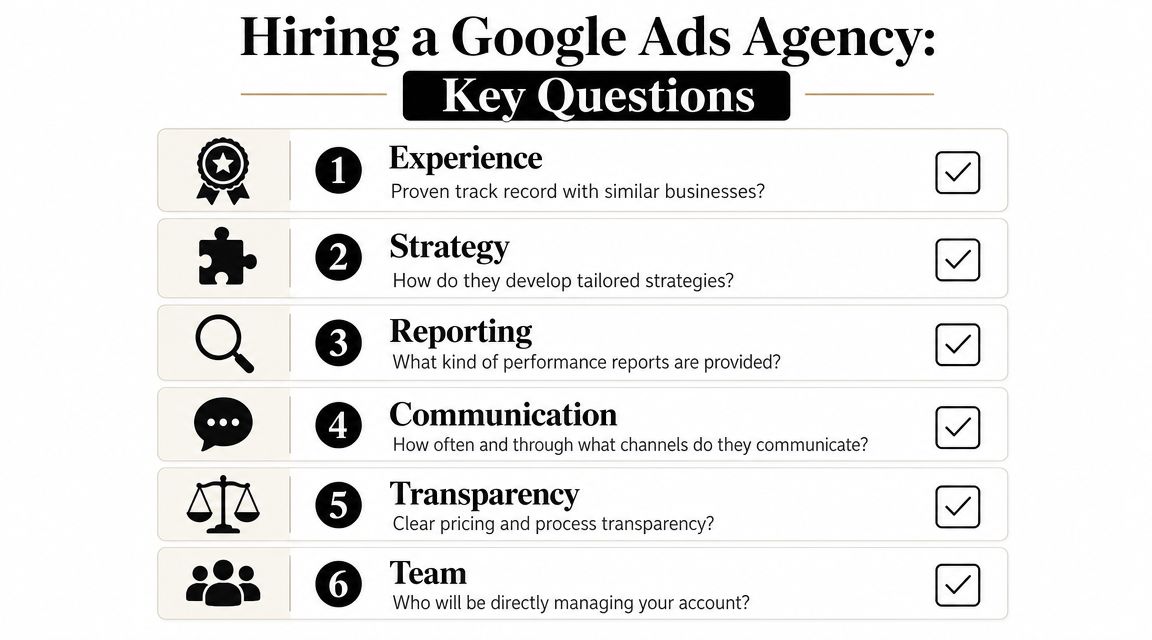
Critical Questions to Ask Before Hiring Any Agency
A Melbourne business owner signs with an agency, gets a clean pitch, sees a polished report a month later, and still has no idea why sales are flat. I've seen that pattern enough times to know the problem usually starts before the contract is signed. The wrong questions let weak operators hide behind jargon, screenshots, and platform metrics.
Ask how they control automation
Google Ads now automates a lot of the buying. That does not remove the need for judgement. It raises it.
A good agency should be able to explain, in plain English, how it checks Performance Max, broad match, smart bidding, and other automated campaign types without relying on Google's summary view alone. If they cannot explain what they look at outside default reports, they probably are not controlling much.
Ask these questions:
- How do you verify Performance Max results beyond the platform summary?
- Which inputs do you actively manage, such as feeds, creative, audience signals, location settings, and conversion actions?
- How do you prevent the system from chasing weak leads, repeat customers, or branded searches that would have happened anyway?
Those answers tell you whether the agency is steering the account or just watching it spend.
Ask whether they handle the full technical stack
For Melbourne ecommerce brands and tradie businesses, Google Ads performance often depends on work outside Google Ads. That includes GTM setup, form tracking, phone lead attribution, landing page speed, Shopify theme issues, WordPress template edits, and CRM handoff points.
This is one of the clearest separators between a media buyer and a technical marketing partner.
If you run a service business, ask who sets up call tracking, how form submissions are validated, and what happens when a lead moves from enquiry to quote to booked job. If you run ecommerce, ask who handles feed fixes, product page friction, checkout tracking errors, and landing page tests. For founders running online stores, this guide for Shopify founders is a useful reference because it treats growth as a mix of media, site performance, and measurement, not ad buying in isolation.
Ask what you will actually see each month
“Monthly reporting” is too vague. I'd want to know what decisions the report helps you make and what systems you can access yourself.
Ask:
- Will I have direct access to the ad account, GA4, GTM, and conversion tracking setup?
- How do you separate qualified leads from low-intent enquiries?
- Can you report on sales, booked jobs, or revenue, not just form fills and calls?
- What do you change if performance drops? Ads, search terms, landing pages, offer, tracking, or all of the above?
- Who is doing the day-to-day work on the account?
- How often do we review results and agree on next actions?
If the agency avoids direct answers here, that usually shows up later as vague reporting and slow problem solving.
Ask how they think across the whole buying journey
Google Ads rarely works in a vacuum. Search demand is shaped by brand awareness, repeat traffic, local visibility, reviews, seasonality, and how quickly someone follows up a lead.
The agency does not need to run every channel. They do need to understand how paid search fits with the rest of your marketing and operations. We regularly look at sales process issues, landing page friction, and channel overlap because those factors change bidding decisions, budget allocation, and what counts as a good lead.
A good hiring conversation should leave you with a clear picture of how the agency thinks, what it owns, what it needs from your team, and where results are likely to break if the setup is weak. That level of clarity is usually a better sign than a polished sales deck.
Our Transparent Onboarding and Reporting Workflow
A bad handover can waste the first month.
We often see the same pattern with Melbourne ecommerce brands and tradie businesses. The account looks active, the ads are getting clicks, but no one can say with confidence which calls turned into booked jobs, which enquiries were tyre-kickers, or whether Shopify and WordPress pages are helping or hurting conversion. That is why our onboarding starts with setup and verification, not rushed campaign edits.
The six-step workflow
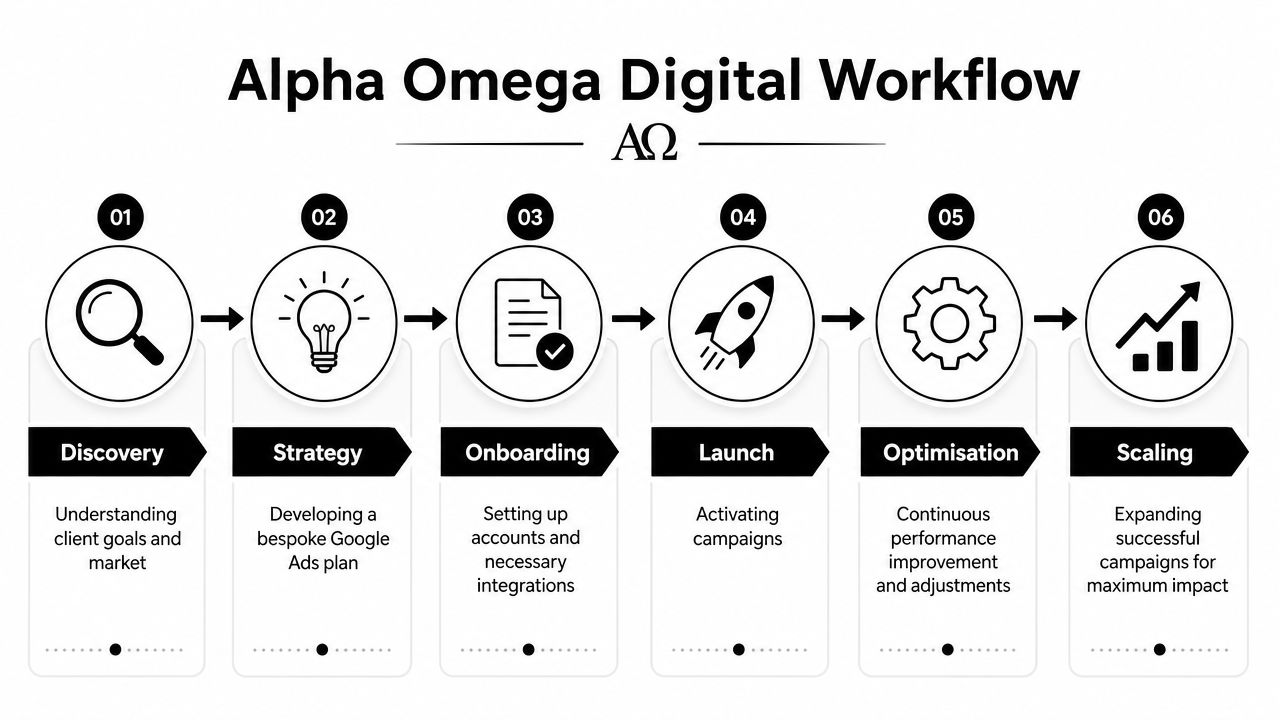
Here's the operating rhythm we use at Alpha Omega Digital.
Discovery
We review the business model, margins, service areas, product priorities, seasonality, and what counts as a real lead or sale. For tradies, that usually means sorting urgent jobs from low-value quote requests. For ecommerce, it means understanding product economics, repeat purchase behaviour, and where merchandising affects paid traffic performance.Strategy
We map campaign structure, budget priorities, landing page requirements, and measurement rules before changing bids. This is also where we decide what the account needs from the wider stack, including call tracking, CRM feedback, GTM events, feed work, and page changes on WordPress or Shopify.Onboarding
Access gets sorted properly. We check Google Ads, GA4, GTM, Merchant Center, CRM pathways, phone tracking, forms, and consent settings. If call tracking is missing, we set it up so phone leads can be tied back to campaign intent instead of being lumped into a generic conversion bucket.Launch
Campaigns go live once the basics are verified. That includes conversion actions, audience signals, feed health, ad assets, location settings, and whether the landing page matches the search intent we are paying for.Optimisation
We review search terms, lead quality, booked job rates, location performance, product-level results, and on-page behaviour. Some fixes happen inside Google Ads. Others sit in GTM, the website template, the offer, or the sales follow-up process.Scaling
We expand once the account is producing reliable signals. That can mean broader coverage across suburbs, stronger Shopping segmentation, new landing pages, more aggressive remarketing, or CRO work to improve the traffic you already paid for.
What clients should expect during onboarding
Good onboarding is collaborative and technical.
We need access, but we also need the operating context your account history will not show us. Which jobs are profitable. Which products go out of stock. Which suburbs waste time. Which enquiries never close. Which team members answer calls properly. Those details change campaign structure, bidding decisions, and reporting priorities.
This stage often reaches beyond ads management because the ad account is only one part of the system:
- WordPress or Shopify updates: landing page edits, template fixes, page speed issues, product page improvements, form changes
- Tracking setup: GTM triggers, GA4 events, thank-you page logic, call tracking, enhanced conversions
- Attribution cleanup: checking that forms, calls, purchases, and imported CRM outcomes are counted accurately
- Sales feedback loops: confirming whether leads became quotes, booked work, revenue, or repeat customers
That full-stack work matters. A lot of agencies stay inside Google Ads and call that management. In practice, performance usually improves faster when the same team can handle the tracking stack, the landing page issues, and the reporting logic as one job.
Reporting should help you make decisions
I have no interest in monthly reports that just list clicks, CPC, and a few coloured arrows.
A useful report should show what changed, why it changed, and what we are doing next. Which search themes are producing qualified calls. Which campaigns are driving weak form fills. Whether a Shopify collection page is leaking purchase intent. Whether a WordPress service page needs a stronger offer or a shorter form. Whether booked jobs are rising even if raw lead volume is flat.
Clients should be able to see the same logic we use internally. If we recommend a budget shift, a landing page rebuild, or tighter lead qualification, the report should make that decision obvious. That is the standard I would expect from any digital marketing agency Melbourne business owners trust with serious ad spend.
Your Google Ads Questions Answered and Your Next Step
A few recurring questions come up right before a business decides whether to hire help.
PMax or standard Shopping for ecommerce
Neither is automatically “better”.
Performance Max can work well when your feed is strong, conversion tracking is trustworthy, and you already know which products and offers tend to close. Standard Shopping still has value when you want cleaner query control, clearer segmentation, or a more deliberate testing environment. For many stores, the answer isn't picking one forever. It's knowing what job each campaign type is doing and whether your measurement can support that choice.
Why Shopping campaigns sometimes don't spend
Usually the issue sits in one of a few places.
- Feed problems: Missing or weak product data can limit visibility.
- Overly narrow targeting or structure: The campaign can strangle itself.
- Low-confidence inputs: Weak tracking makes automation less assertive.
- Poor product-market fit in the ad setup: Sometimes the products being pushed just aren't the right entry point.
For Shopify stores, I also check template quality, image consistency, variant setup, and whether the product page matches the intent the ad is trying to capture.
Google Ads for contact form submissions
This can work well, but only when the form isn't the whole strategy.
If the page is vague, the form is too long, the offer is weak, or nobody follows up quickly, the campaign gets blamed for an operational issue. For service businesses, I usually prefer a setup that supports both forms and phone calls, then compares quality across both paths.
What budget should you spend
Enough to generate learning and act on it.
If the budget is too thin, every click feels expensive and every week looks different. That doesn't help anyone. A healthier setup is one where the business can afford to test, improve pages, tighten tracking, and stay consistent long enough to learn what the market is telling them.
Do you need more than just ad management
Often, yes.
The strongest results usually come when one team can connect paid search with landing pages, analytics, call flows, WordPress or Shopify implementation, and broader channel feedback. That's especially true for ecommerce brands with feed and site issues, and for local service businesses where missed calls and weak follow-up undermine performance.
If you're looking for a marketing agency Melbourne businesses use for Google Ads, WordPress, Shopify, GTM, analytics, call tracking, and conversion-focused landing page work, a key test is simple. Can they improve the system around the ad account, or only the ad account itself?
If you're a business with a paid ads budget of at least 3k a month, I'd love to offer you a low risk deal. Get a month of paid ads management FREE. Apply now through the contact page.
Alpha Omega Digital is a Melbourne-based agency working with businesses across Australia, including Sydney, Brisbane, Newcastle, Perth, Adelaide, Darwin and Hobart. If you need help with Google Ads, Shopify, WordPress, tracking, or conversion-focused web work, you can learn more through Alpha Omega Digital.
Alpha Omega Digital
Read more insights from our team on web design, paid ads, and growth strategy.