A few years ago, I sat across from a Christian business owner in Melbourne who hesitantly asked, “Can I grow this properly without turning into someone I'm not?” I knew exactly what he meant, because I'd wrestled with the same tension myself while running a digital marketing agency Melbourne clients trust with real budgets, real livelihoods, and real reputations.
Marketing That Aligns With Your Faith
When people hear Christian marketing, they often picture one of two extremes. Either it's soft, vague, and ineffective, or it's pushy and awkward. In practice, it should be neither.
I've found the healthiest approach is much simpler. Marketing is just communication with intent. The question isn't whether you market. Every business does. The question is how you market, what motivates it, and whether your methods line up with the values you claim to live by.
Faith doesn't remove strategy
Early on, I felt friction between my faith and my work. Marketing had a reputation for hype, pressure tactics, and polished half-truths. But the longer I worked with eCommerce brands, local service businesses, and faith-led organisations, the clearer it became that the problem wasn't marketing itself. The problem was poor character inside the marketing.
A Christian business owner doesn't need to avoid Google Ads, Shopify, WordPress development, or email automation. You need to use them with integrity, with restraint, and with genuine care for the people on the other side of the screen.
That matters even more in Australia now. The 2021 Australian Census recorded 43.9% of Australians identifying as Christian, down from 52.1% in 2016, which means broad, assumption-based outreach is less effective in a more mixed and secular environment, as noted in this analysis referencing the Australian Christian affiliation shift. If you assume shared language, shared beliefs, or shared priorities, you'll miss people.
What this looks like in practice
For a Christian café owner, it might mean building a brand around hospitality, quality, and service rather than forcing religious language into every ad.
For a ministry, it might mean removing insider jargon from the homepage so a visitor who has never stepped inside a church still feels welcome.
For an online store, it might mean product pages that are clear, mobile-friendly, and helpful instead of padded with urgency tricks.
Christian marketing works best when values show up in the experience, not just the slogan.
That's why I often tell clients to stop thinking of Christian marketing as a category and start seeing it as a decision filter. It affects the words you choose, the offers you make, the data you collect, and the way you follow up.
A better way to think about audience reach
In Melbourne, I've seen faith-based organisations and Christian-led businesses get far better traction when they lead with relevance. Answer the actual question. Solve the actual problem. Make the next step obvious.
If you're serving churches or ministries, this practical guide to digital marketing for churches is worth reading because it stays grounded in the day-to-day realities of digital outreach instead of staying abstract.
This is the trade-off. If you chase attention at any cost, you may grow faster in the short term and weaken trust. If you market with clarity and integrity, growth can feel slower at first, but the leads are usually better aligned and the brand lasts longer.
The Core Principles of Ethical Marketing
I like frameworks because they help business owners make consistent decisions under pressure. When an ad account is underperforming, stock is sitting, or leads are slowing down, ethics gets tested quickly. So I use a simple framework: SERVANT.
Service and excellence
Service means your marketing helps people make good decisions. It doesn't confuse them into taking action. A clean landing page, an honest product description, and a clear returns policy are service.
Excellence means you don't hide behind “good intentions” while delivering sloppy execution. If your WordPress site is slow, your Shopify checkout is clunky, or your mobile layout breaks on product pages, visitors feel that immediately. Excellence isn't vanity. It's respect.
A lot of Christian business owners are sincere but underbuilt. They have heart, but the site looks dated, the tracking is broken, and the enquiry forms fail. That gap costs trust.
Responsibility and value
Responsibility applies to budget, messaging, and audience targeting. If you're spending on Google Ads or Meta, you're stewarding money that could have gone elsewhere in the business. That means no lazy campaign setup, no vague reporting, and no chasing vanity metrics.
Value means your content, ads, and emails should leave the audience better informed than before. Even if they don't buy today, they should come away with clarity.
Here's a simple way to check whether your marketing is serving people:
| Question | Healthy answer |
|---|---|
| Is the offer clear? | A visitor knows what you do within seconds |
| Is the claim honest? | No inflated promises or misleading framing |
| Is the next step simple? | One primary action, not five competing choices |
| Is the follow-up respectful? | Relevant, permission-based, easy to opt out |
Authenticity and nurture
Authenticity doesn't mean broadcasting every belief statement in every channel. It means your business sounds like a real person, not a template. The best-performing ad creative I've seen for service businesses is often the owner speaking plainly on camera about a problem they solve every week.
Nurture means understanding that many individuals aren't ready on the first click. They might need a remarketing ad, a useful email, a testimonial, or a clearer product explanation before they act.
That's especially true for eCommerce. A cold visitor rarely buys because your product title is clever. They buy because your store answers the objections they already had.
Truth and trust
Truth is the one I come back to most. No fake scarcity. No inflated before-and-after claims. No padded social proof. No pretending a broad offer is highly personalised when it isn't.
Practical rule: If a campaign needs manipulation to convert, the offer or message probably needs work.
This also applies to data. A major gap in most Christian marketing advice is that it talks a lot about tone and not enough about privacy, consent, and trust. That gap matters in Australia, especially because guidance around privacy, consent, and Christian digital marketing in Australia highlights the need to market without violating community expectations or Anti-Spam rules.
For me, compliance isn't just legal housekeeping. It's neighbour-love in operational form.
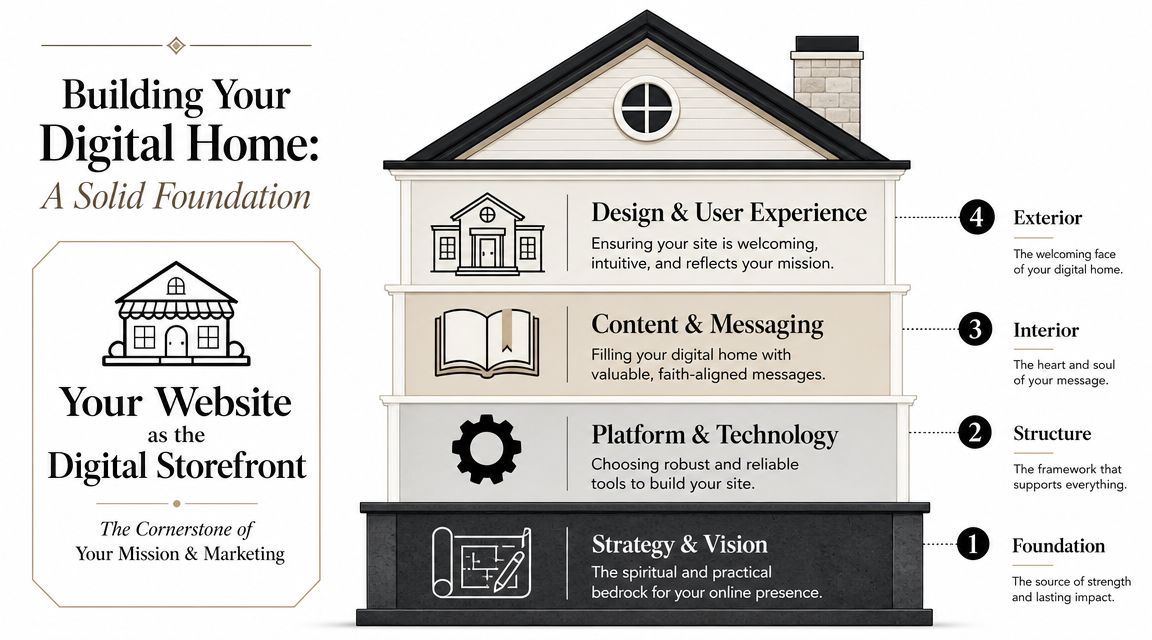
Building Your Digital Home on a Solid Foundation
Your website is where curiosity either grows or dies. I've seen businesses spend heavily on ads only to send traffic to a site that leaks trust at every step. Slow pages, cluttered menus, weak copy, broken forms, and no measurement. That isn't a traffic problem. It's a foundation problem.
WordPress or Shopify
For most Christian businesses I work with, the platform decision comes down to business model.
WordPress suits organisations that need flexibility. If you're publishing lots of content, need custom page structures, want a custom brochure site, or require bespoke Gutenberg blocks, WordPress is often the better fit. It's also strong for service businesses that need lead generation, SEO landing pages, and custom design control.
Shopify is usually the cleaner path for eCommerce. If the main goal is selling products efficiently, Shopify gives you a more structured commerce environment with cleaner catalogue management, checkout flow, app integrations, and easier day-to-day operations for non-technical teams.
Here's the quick version:
| Platform | Best fit | Watch-out |
|---|---|---|
| WordPress | Content-heavy sites, service businesses, custom layouts | Plugin bloat and weak builds can create maintenance issues |
| Shopify | Product-led stores, simpler operations, integrated selling | Over-reliance on apps can create clutter and cost creep |
Good design is not decoration
I've had clients come in wanting “something that looks premium,” but what they really needed was a site that made decisions easy. Strong WordPress design or Shopify design isn't mainly about style. It's about reducing hesitation.
That means:
- Clear navigation so people don't get lost
- Focused page structure with one primary action per page
- Readable product or service copy that answers real objections
- Fast mobile experience because that's where many first visits happen
- Trust elements like testimonials, policies, FAQs, and contact clarity
If you run a service business, your site should answer three things quickly: what you do, who you help, and what to do next.
If you run an eCommerce store, your site should reduce friction from homepage to checkout.
When custom development makes sense
In this aspect, many businesses either overspend or underspend.
You do not need custom development for everything. But you do need it when the site has to support a workflow that templates can't handle properly. That might mean custom quote forms, account areas, filtered catalogues, advanced product logic, or unique content blocks for ongoing publishing.
For businesses needing custom builds, working with a WordPress developer in Melbourne can make sense when off-the-shelf themes create more constraints than speed.
For stores, experienced Shopify developers are useful when you need theme customisation, app integration, or custom storefront features tied to the Shopify developer API.
A strong website doesn't just look trustworthy. It removes the small doubts that stop people from acting.
I've also found that Christian entrepreneurs often underinvest in build quality because they're trying to be prudent. Prudence matters. But if your site undermines your message, frugality becomes expensive.
Being a Good Steward of Search With SEO and Content
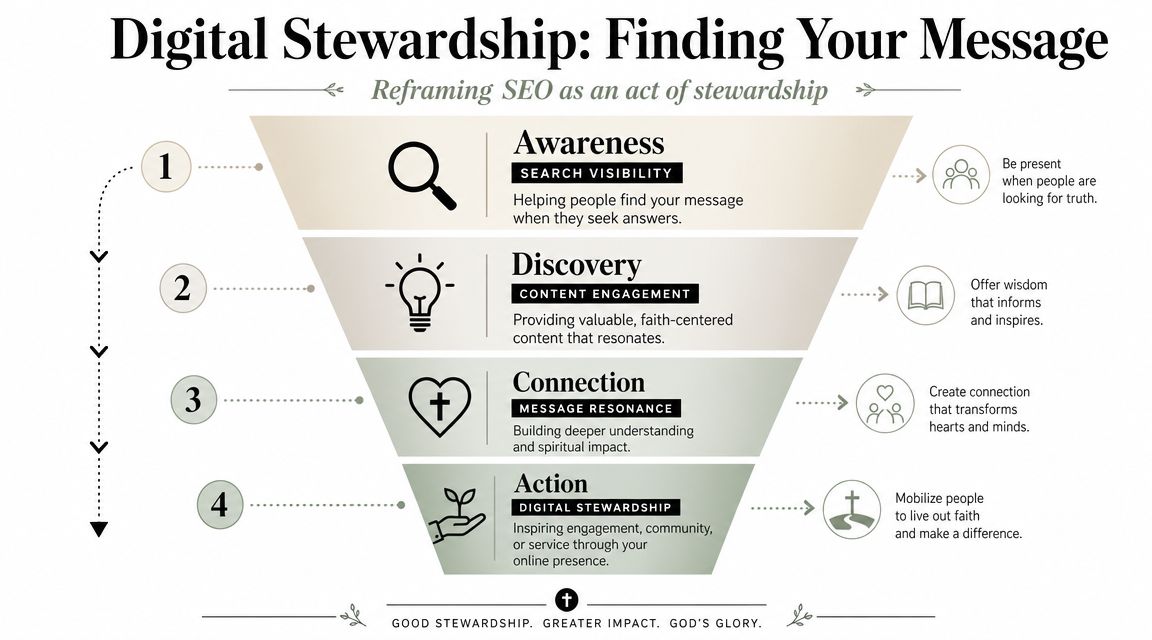
SEO is often explained like a technical game. I don't see it that way. I see it as digital stewardship. If you have something useful to offer, being hard to find isn't humble. It's inconvenient for the people already looking for help.
Local intent matters more than many realise
For Australian businesses, local search is one of the clearest practical opportunities. Guidance built on recent Australian digital behaviour notes that Google Search and Maps are vital for local intent, which is why practical local SEO, Google Business Profile optimisation, and testimonial-led content often outperform broader brand messaging for discovery.
That lines up with what I see on the ground. A plumber, Christian bookstore, café, counsellor, or local church doesn't win search by sounding lofty. They win by being relevant, nearby, and easy to trust.
Local SEO is modern hospitality
If someone searches for your service in Melbourne, and your Google Business Profile is half-complete, your reviews are stale, and your service pages are thin, you're making them work too hard.
That's why local SEO should include:
- A complete Google Business Profile with accurate categories, hours, and service details
- Location-aware landing pages that speak to actual suburbs or service areas
- Review generation systems that ask happy customers at the right time
- Content that answers buying questions rather than just describing your business
- Technical basics like page speed, clean metadata, internal linking, and mobile usability
For churches and ministries, this is just as important. People often search for practical things first. Service times, childcare, location, denomination, beliefs, parking, accessibility. If that information is buried, they leave.
Here's a useful overview of insights on AI search visibility if you're also thinking about how content gets surfaced beyond traditional blue-link search.
Long-tail keywords with buyer intent
Many businesses waste time. They chase broad vanity phrases instead of the longer, more specific searches that signal intent.
A few examples from real commercial categories:
- WordPress developer Melbourne
- Shopify developers Melbourne
- Google Ads for plumbers
- Facebook ads for electricians
- Google Shopping ads for dropshipping
- Conversations API installation for Meta
- Google Ads for contact form submissions
Those aren't glamorous terms. They're useful terms. They attract people who already know roughly what they need.
Helpful content earns attention longer than clever content.
I've watched businesses transform search visibility by publishing pages and articles that answer the exact questions buyers ask before they enquire. Not abstract thought leadership. Clear, practical content. Setup guides. Platform comparisons. Pricing expectations. Common mistakes. Troubleshooting.
That's how SEO becomes an act of service.
Using Paid Ads for Growth and Outreach
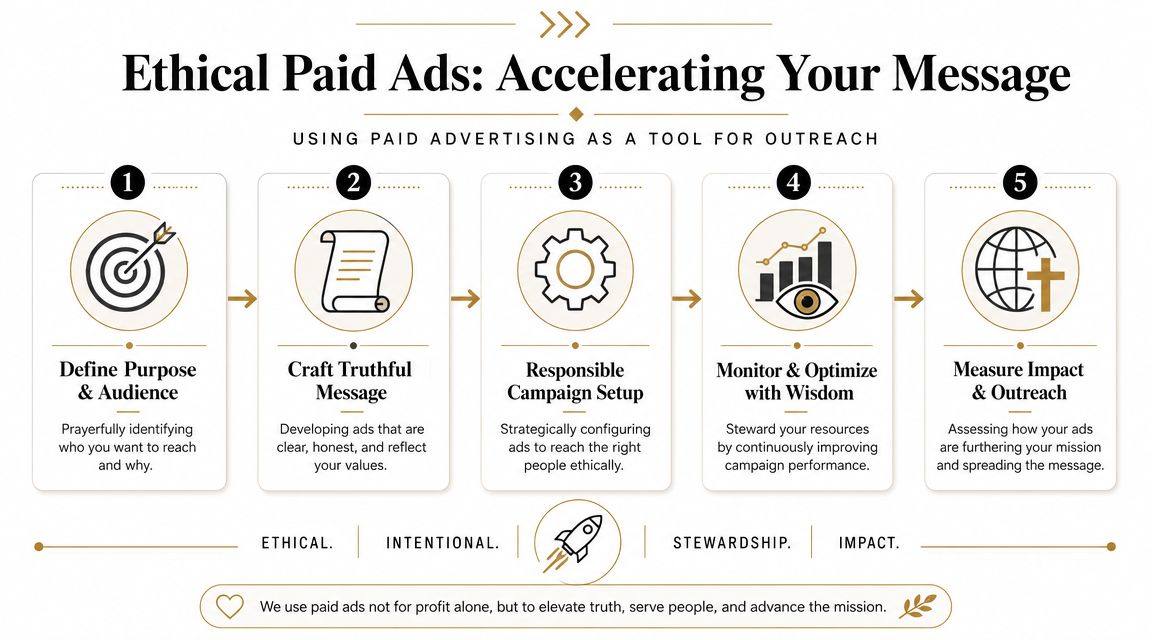
Paid ads can feel uncomfortable for Christian business owners because money amplifies everything. If the strategy is weak, you lose money faster. If the message is off, more people see it. But if the offer is sound and the campaign is structured well, paid traffic can accelerate the right kind of growth.
Google Ads for intent and Meta Ads for demand
I usually explain it this way.
Google Ads captures existing intent. Someone is already searching. That's why it works well for service businesses, local operators, and bottom-of-funnel eCommerce terms.
Meta Ads creates and shapes demand. People aren't usually searching for your offer in that moment. You have to stop the scroll, earn attention, and move them toward interest.
That means the job of creative is different.
On Google, campaign structure matters more than flashy copy. On Meta, creative testing matters far more than many businesses realise. The image, hook, opening line, first few seconds of video, and landing page alignment all matter.
What strong campaign setup looks like
For faith-based brands in Australia, one of the most useful technical principles is that intent-first keyword structures and first-party data capture with conversion API tracking tend to produce more usable acquisition systems than broad demographic targeting.
That has real implications.
For Google Ads, I prefer tighter ad groups built around clear buyer intent. If someone searches for church software, Christian education resources, or a local service, the landing page should match that intent exactly.
For Meta, I'd rather run fewer, cleaner tests than flood an account with random creative. A simple process often works best:
Test the angle first
Compare different hooks or problem statements before changing everything else.Then test the format
Static image, UGC-style video, founder talking head, product demo.Only then optimise the offer and landing page
If the click quality is poor, the issue may be the ad. If click quality is good but conversions are weak, the landing page is usually the suspect.
Practical examples for service businesses and eCommerce
For tradies, I've seen Google Ads outperform almost every other channel when the campaign is local, tightly themed, and paired with proper call tracking. That's why pages like Google Ads for plumbers resonate. They speak directly to the service model instead of pretending all lead gen is the same.
For electricians and other trades, a dedicated service-page-to-ad flow often works better than sending traffic to a broad homepage. The same principle sits behind focused campaign work such as Facebook ads for electricians.
For eCommerce, the common question is PMAX vs Google Shopping ads. My practical answer is that standard Shopping often gives cleaner control, while PMAX can help when feed quality, creative assets, and tracking are in order. If your feed is messy, PMAX won't fix that. It just automates confusion faster.
I'd also encourage businesses to review the benefits of brand keyword search ads because branded search is often misunderstood, especially once competitors start appearing around your name.
Where agencies help and where they don't
A good agency saves you from expensive ambiguity. A bad one gives you dashboards full of activity and no commercial clarity.
If you need specialist help, a focused Google Ads agency or a dedicated Facebook Ads agency can handle structure, testing, reporting, and attribution. But the business still needs to know its offer, margins, and sales process.
Paid ads don't fix weak positioning. They expose it.
That's the core trade-off. Ads create speed, not substance.
Mastering the Technical Side of Marketing
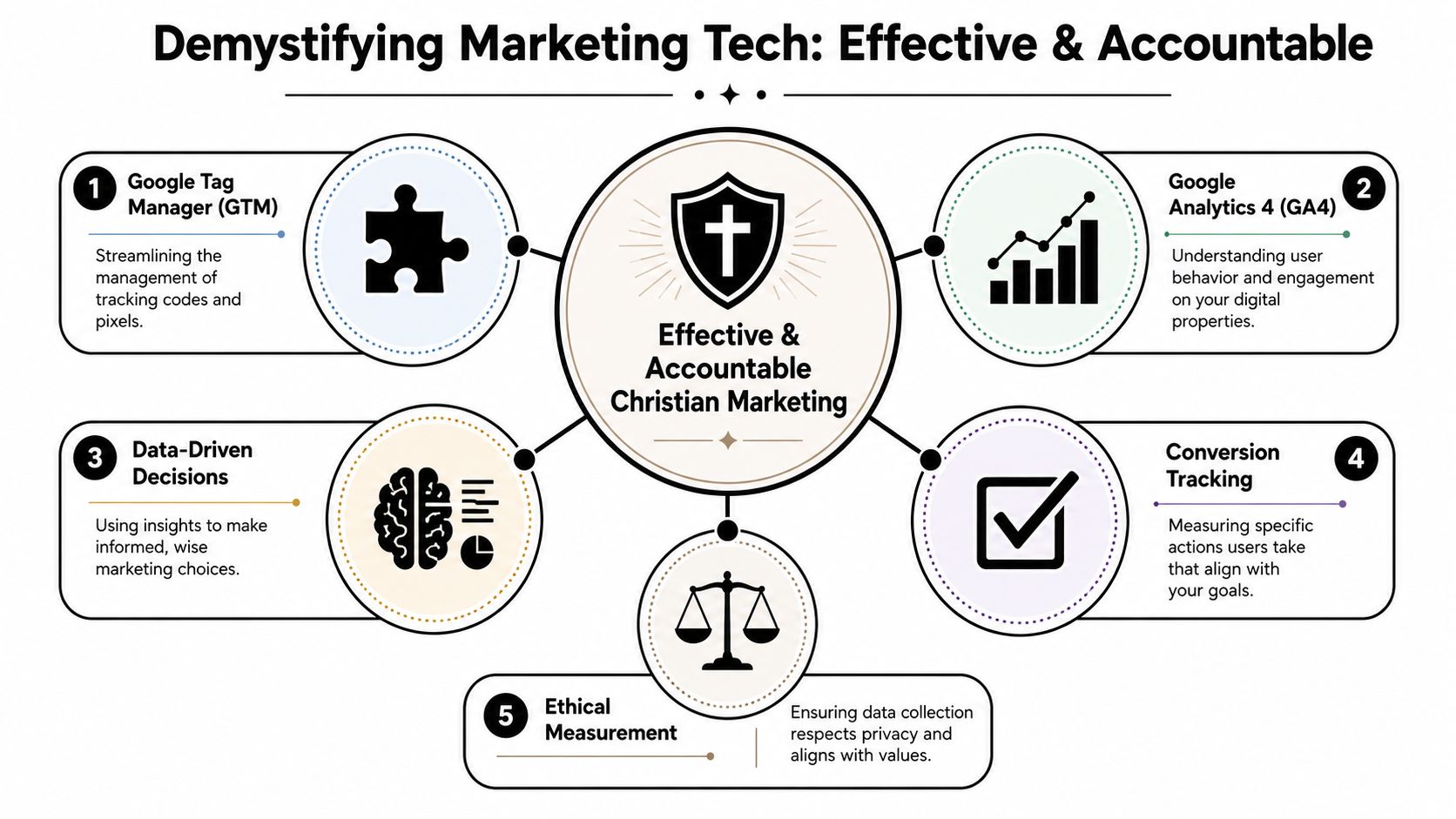
Some business owners switch off when they hear GTM, GA4, server-side tracking, or Conversion API. I get it. The names sound technical because they are. But the purpose is simple. You need a reliable way to understand what's working.
What each tool actually does
Here's the plain-English version:
| Tool | What it does | Why it matters |
|---|---|---|
| GTM | Manages tracking tags and event scripts | Cleaner implementation and easier maintenance |
| GA4 | Shows user behaviour and conversion paths | Helps you see where traffic comes from and what it does |
| Meta Conversion API | Sends conversion data more reliably | Improves attribution when browser tracking is limited |
If you're running paid ads without these basics in place, you're often making decisions from incomplete data.
Tracking is stewardship, not surveillance
Used properly, measurement is a form of stewardship. You're not collecting data to become invasive. You're trying to answer practical questions.
Which campaign drove the enquiry?
Which product category gets attention but not purchases?
Which landing page creates friction?
Did the ad generate actual business, or just cheap clicks?
That's why I set up event tracking around meaningful actions. Product views. Add to carts. Form submissions. Phone clicks. Booking starts. Purchase completions.
For WordPress sites, that often means careful Google Tag Manager container setup, form tracking, GA4 event mapping, and testing across devices.
For Shopify stores, it often means checking native events, custom events, checkout attribution, and whether the Meta Conversion API installation is passing useful signals.
Where custom work starts to matter
Some stores outgrow app-stacking quickly. They need custom experiences, data flows, or back-end logic that standard themes and plugins don't handle well.
That's where Shopify API work, private integrations, and even lightweight custom apps can make life easier. I've seen this help with product logic, fulfilment workflows, and customized customer experiences.
On the WordPress side, building custom blocks in Gutenberg is often a better long-term choice than handing a content team a rigid page builder they'll eventually fight with.
One practical option businesses look at for this mix of site build, tracking, and growth support is an e-commerce marketing agency that works across both development and performance channels. That matters because fragmented setups create blind spots fast.
If your reporting can't show which channels produce meaningful actions, optimisation becomes guesswork.
The businesses that scale more calmly usually aren't the loudest. They're the ones with clean measurement, disciplined testing, and fewer assumptions.
Nurturing Your Community Through Communication
Clicks are easy to overvalue. Relationship is where true business gets built.
I've seen this repeatedly with both Christian organisations and ordinary local businesses. They spend time getting attention, but the follow-up is slow, generic, or non-existent. Then they assume the channel failed, when the actual failure happened after the lead arrived.
Consent is part of trust
In Australia, email and SMS can't be treated casually. Under Australia's Spam Act 2003 requirements for consent, sender identification, and unsubscribe, permission-based segmentation isn't just smart operations. It's part of protecting trust.
That means your nurture system should be built around consent from the start.
A healthy setup usually includes:
- Clear opt-ins that explain what someone is signing up for
- Segmented follow-up based on what they asked for or viewed
- Simple unsubscribe options that function
- Useful email sequences rather than constant blasts
- CRM hygiene so inactive or irrelevant contacts aren't pushed forever
For Christian marketing, that matters even more because community trust is often fragile and highly relational. If you burn trust in the inbox, it's harder to recover than on a social post.
Automation should feel helpful
The best automation doesn't feel robotic. It feels timely.
For an eCommerce store, that might be browse abandonment emails, post-purchase education, and replenishment reminders.
For a service business, it might be lead acknowledgement, booking reminders, quote follow-up, and review requests.
For ministries or churches, it might be a welcome email flow, event reminders, and segmented content based on interest.
The principle is the same. Use systems to support real communication, not replace it.
The call-handling problem most service businesses ignore
One of the most practical systems we've implemented for service clients is custom call tracking tied to a dedicated number through Twilio. This is especially useful for tradies, dentists, restaurants, doctors, hairdressers, and beauty therapists where missed calls often mean lost revenue.
A setup like this can do a few important things:
- Route calls intelligently so the right team gets them
- Support round-the-clock answering without relying on one staff member
- Book appointments into a calendar or Calendly
- Track which campaigns generated phone leads
- Reduce missed opportunities when the owner is on the tools or with a client
That's a real service win. The phone doesn't get tired, doesn't call in sick, and doesn't forget to capture details. But the point isn't replacing people. It's making sure people who are ready to buy don't fall through the cracks because no one answered.
I've watched businesses obsess over ad creative while their phone handling lost the leads the ads generated. Good communication systems close that gap.
Take the Next Step in Your Marketing Journey
The tension many Christian business owners feel is real, but it doesn't have to stay unresolved. You don't have to choose between growth and integrity. You do have to build carefully.
That means a website that serves people well. SEO that makes you findable when someone is already looking. Paid ads that are structured around intent and honest messaging. Tracking that tells the truth. Follow-up systems that respect consent and treat people like neighbours, not records in a database.
As a marketing agency Melbourne businesses work with for WordPress development, Shopify development, paid ads, local SEO, and measurement, I've seen that the businesses with the strongest long-term outcomes usually share the same habits. They stay clear. They stay consistent. They don't panic and rebuild everything every month. They improve what matters.
If you're in eCommerce, this often means getting the basics right before adding complexity. Product feed quality before aggressive scaling. Conversion tracking before creative expansion. Landing page clarity before blaming traffic.
If you're a service business, it usually means matching ad intent to page intent, tightening your enquiry flow, improving call handling, and measuring success by qualified leads rather than raw volume.
Businesses across Melbourne and wider Australia often need help across several moving parts at once. Website design, development, Google Ads, Meta ads, local SEO, analytics, and automation work best when they support the same commercial goal instead of living in separate silos.
Alpha Omega Digital is based in Melbourne and also works with businesses in Sydney, Brisbane, Newcastle, Perth, Adelaide, Darwin, and Hobart. If you've got a serious growth target and want practical execution without the usual fluff, the next step is straightforward.
If you're a business with a paid ads budget of at least 3k a month, I'd love to offer you a low risk deal. Get a month of paid ads management FREE. Apply now through the contact page.
If you want a practical partner for Christian marketing, eCommerce growth, WordPress or Shopify development, and paid media strategy, take a look at Alpha Omega Digital. If you have a project in mind, you can apply through the contact page.
[email protected]
Read more insights from our team on web design, paid ads, and growth strategy.