You're finishing a pool installation in Melbourne's south-east, your next job came through a referral, and your phone has gone quiet again. Meanwhile, competitors keep appearing in local homeowners' Facebook and Instagram feeds, showing finished backyards that look a lot like the projects you build.
I'd approach that problem as a sales-pipeline issue, not a posting-frequency issue. Facebook ads for pool companies should produce qualified site assessments, with enough information to decide whether a project deserves your estimator's time. Cheap enquiries aren't much use if they're outside your service area, nowhere near your budget requirements or impossible to build.
Why Facebook Ads Work for Pool Companies
A referral-led builder already has something valuable: completed work that homeowners can inspect, discuss and recommend. Facebook gives that work a distribution channel beyond the people who happen to know your previous customers.
Meta's advertising-planning tools estimated 16.65 million Facebook users in Australia in January 2024, according to DataReportal's Digital 2024 Australia report. That's potential advertising reach, not a verified count of active users or homeowners ready to buy a pool.
The useful distinction is discovery versus immediate demand. A homeowner might save a backyard transformation while they're still discussing landscaping, finance or whether their block has enough room. An ad can start that conversation without pretending they're ready to sign a construction contract.

Make the project understandable
Show the original backyard, access constraints, construction and finished result. A polished pool photograph attracts attention; an explanation helps someone recognise their own project.
For an overseas design comparison, homeowners can compare pool types for Northern Arizona through R.E. and Sons Landscaping. Treat it as design reading, not Australian advice about approvals, construction or pricing.
As a Melbourne digital marketing agency, we combine website development with paid advertising. My recommendation for pool builders is a connected system: a clear offer, realistic AUD budget, seasonal messaging, disciplined creative testing, and tracking for both form enquiries and phone calls.
Your Pool Facebook Ads Campaign at a Glance
This is the operating system I'd use as a starting checklist, with recommended settings rather than guaranteed performance outcomes.
| Step | What to do | Key setting or number |
|---|---|---|
| 1. Pick one offer | Free site assessment or 3D design consult matched to the season | One primary offer per campaign |
| 2. Install tracking first | Meta Pixel plus Conversions API, using Google Tag Manager where appropriate | Server-side Lead event tested before day 1 |
| 3. Create the campaign | Objective: Leads with an instant form | 4 qualifying form fields |
| 4. Set targeting | Start with a 15-30 km radius around the service area and broad local targeting | Exclude past customers and old quotes where appropriate |
| 5. Set the budget | Proposed starting spend of AUD $50-$100 per day | Model lead costs against the planning range in the budget section |
| 6. Build creative | 3-5 variants covering a pool reveal, before-and-after carousel and owner-to-camera ad | Put the hook inside the first 3 seconds |
| 7. Follow up fast | Automated SMS or email acknowledgement, then a phone call | Set an internal response target of 5 minutes |
| 8. Review and optimise | Judge cost per qualified site visit, not cheapest lead | Schedule an initial review at the 2-4 week mark |
Save the table as a pre-launch checklist, but don't confuse completing the technical tasks with building a profitable campaign. Someone still needs to answer enquiries, check feasibility and record what happened after the first conversation.
Assign ownership before launch
Give each handoff a named owner. The person publishing ads doesn't automatically own sales follow-up, and the person answering the phone doesn't necessarily know which projects the construction team wants.
- Campaign owner: Checks delivery, creative and enquiry costs.
- Sales owner: Contacts prospects and records qualification.
- Estimator: Confirms whether a site assessment is commercially worthwhile.
- Tracking owner: Tests forms, calls and CRM records.
Practical rule: If nobody owns the next action after a lead arrives, fix that before increasing spend.
Exclusions also need judgment. A recently quoted homeowner may benefit from a targeted follow-up campaign rather than permanent exclusion, while an existing customer could still be relevant for heating, equipment or maintenance offers.
The checklist is deliberately simple. Adding campaigns, audiences and automation won't compensate for an unclear offer or an unattended inbox.
How Meta Finds Your Future Pool Customers
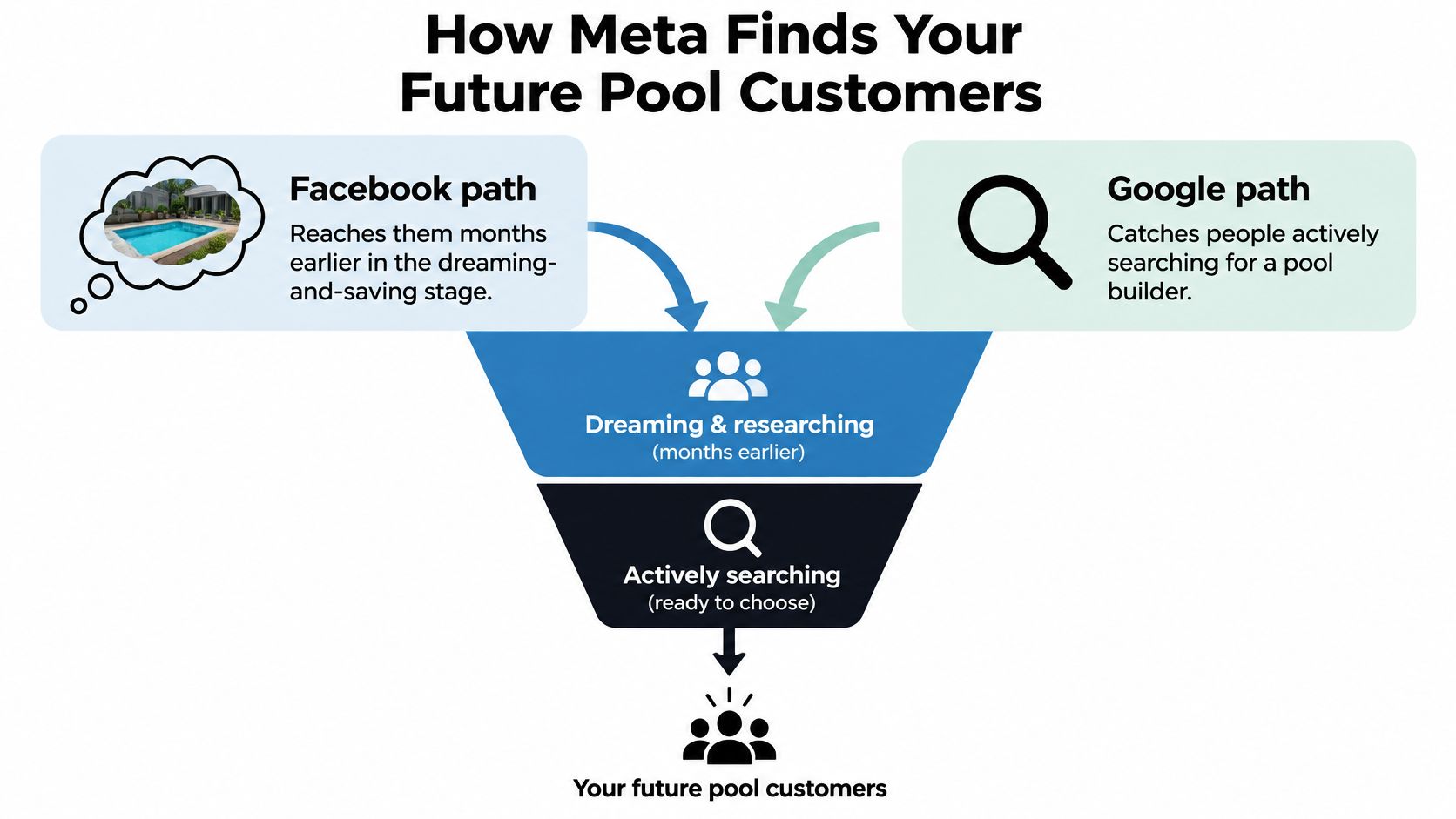
Google and Facebook meet different versions of the same buyer. Someone searching for a pool builder is expressing demand; someone watching a backyard transformation may still be deciding whether a pool belongs in their plans.
That's why I'd avoid judging both channels by identical buying timelines. Google Ads for service-based businesses can capture an active search, while Facebook can introduce the builder, explain the process and give a homeowner a reason to enquire.
Meta's tools estimated a potential Australian Facebook advertising audience of 17.2 million people in early 2025, according to DataReportal's Digital 2025 Australia report. That national estimate supports considering the channel, but it doesn't tell you how many suitable projects exist around your depot.
The buyer paths look different before they converge on an enquiry.
Give the delivery system useful boundaries
Think of automated delivery as briefing a capable sales representative. You give them the service territory, the right project photographs and a clear explanation of what you're selling, rather than a rigid list of assumed hobbies.
Meta's advertising systems, including retrieval technology such as Andromeda, help select eligible ads for people. The practical advertiser controls are still familiar: location, offer, creative, conversion signals and exclusions.
I would start with broad local targeting, then separate audiences only when the commercial proposition changes. A new installation in an outer-suburban estate needs different messaging from resurfacing an older pool in an established suburb.
Let the creative qualify the customer
A useful funnel is straightforward:
- Attention: Show a recognisable backyard problem or finished transformation.
- Enquiry: Offer an assessment or consultation with a specific purpose.
- Qualification: Confirm suburb, project type, timing and budget fit.
- Sales progression: Book the assessment, prepare the quote and record the outcome.
Don't assume Meta can reliably identify property ownership or site suitability from your targeting choices. Ask those questions through the enquiry process.
For homeowners exploring layouts, OutdoorBrite's ai generated backyard design is an example of a visual planning resource. Any generated concept still needs a builder's assessment of access, dimensions, engineering and compliance.
Show completed pools, name the suburbs you service and distinguish new builds from renovations. The right person understanding your offer matters more than everyone liking the image.
Plan Seasonal Offers and Messages That Sell Pools
I'd plan the annual campaign calendar around construction capacity first and weather second. More enquiries aren't useful if the offer promises a completion date your team can't deliver.
The allocation below is an illustrative annual budget plan, not a measured Australian demand distribution. Use it to organise testing, then adjust it against your own qualified enquiries, available build slots and margins.
| Season | Customer mindset | Best lead offer | Creative focus | Budget share |
|---|---|---|---|---|
| Spring (Sep-Nov) | Backyards returning to attention and homeowners exploring projects | Free site assessment and genuinely available swim-next-summer build slots | Finished pools and family lifestyle video | Proposed 40% |
| Summer (Dec-Feb) | Comparing pool use, upkeep and upgrades | Resurfacing, pool heating and equipment upgrade offers | Cool-water lifestyle reels and before-and-after examples | Proposed 30% |
| Autumn (Mar-May) | Reviewing summer and planning the next project | Autumn-build offer or available finance option | Construction timelapse and finance explainer | Proposed 20% |
| Winter (Jun-Aug) | Planning designs and comparing complete backyard options | Free 3D design consult and pool, fencing and landscaping package | Clearly labelled renders and pricing-guide download | Proposed 10% |
Match the offer to the decision
In spring, a site assessment can help homeowners move from inspiration to feasibility. Explain what the appointment covers: access, proposed placement, intended use and the next step towards a quote.
Summer messaging can distinguish installation enquiries from owners who already have a pool. Heating, resurfacing and equipment upgrades deserve their own campaigns because the scope, sales process and job economics differ.
Autumn offers should reflect actual operational advantages. If your team has suitable availability, promote it; don't manufacture a discount that leaves the job unprofitable.
Winter is useful for testing design-led messaging, but don't assume winter clicks will automatically be cheaper. A low click price isn't valuable if those visitors never progress beyond collecting ideas.
Build an offer bank without mixing everything together
Keep several offers ready, but give each campaign a single primary action.
- Free site assessment: Best when the sales team can explain the appointment's value.
- Free 3D design consultation: Useful when design is included and its limits are clear.
- Pricing guide: Explain inclusions, exclusions and the factors that change the final quote.
- Finance option: Advertise only an available product with accurate eligibility and terms.
- Backyard bundle: Define who supplies the pool, fencing and landscaping, and what's excluded.
A secondary retargeting offer can serve people who engaged without enquiring. Someone who isn't ready for a site visit might prefer a guide explaining access requirements and the quoting process.
Promise the build schedule you can deliver, not the summer deadline that makes the ad sound exciting.
A November enquiry isn't a reason to promise a Christmas swim. Salespeople need the same availability information that appears in the advertising.
Set Up Targeting, Budget and Lead Forms
Set the system up in the order enquiries will travel through it. That makes testing easier and exposes broken handoffs before they cost you money.
Build the technical and sales connection
Install and test tracking. Configure Meta Pixel for browser events and Conversions API for an appropriate server-side event path. Google Tag Manager can manage browser tags, but server-side delivery requires a supported integration or server-side infrastructure, not just a standard web container.
Connect the form to the CRM. Use a Leads campaign with an instant form as the initial test. Native forms and website forms need different testing: an instant-form submission should reach the CRM even though the prospect never loads your website.
Ask commercially useful questions. Include property suburb, project type, intended timeframe and indicative budget. Use new installation, renovation and resurfacing options so the sales team can route the enquiry correctly.
Longer forms create friction. I'd accept that trade-off when the extra information prevents unsuitable site visits, but I'd remove questions that nobody uses to make a decision.
Alpha Omega Digital uses Google Analytics, Google Ads, Google Tag Manager, Meta Pixel, LinkedIn Insight Tag, Microsoft Clarity, HubSpot and other marketing technologies. A pool campaign doesn't need every tool installed; it needs the relevant tools configured correctly.
Choose geography and budget deliberately
Map the actual service area. Start around the operating base, then check the suburbs against travel time and project economics. A circular radius can include locations you don't want to service, so review the map rather than accepting the default.
Choose a funded test. The Australian home-improvement planning benchmark is AUD $25-$60 per Facebook lead, according to Made4Tradies' Australian Facebook ads guide. That's not a pool-specific forecast or a guaranteed acquisition cost.
The following arithmetic uses that planning band and an approximate monthly daily-spend conversion.
| Monthly budget | Daily spend | Modelled leads at AUD $25-$60 CPL | What this buys |
|---|---|---|---|
| AUD $1,500 | About AUD $50/day | 25-60 | Testing one offer and 3-5 creatives in a single ad set |
| AUD $3,000 | About AUD $100/day | 50-120 | A proposed structure with two ad sets and retargeting, provided audiences justify it |
| AUD $5,000 | About AUD $167/day | About 83-200 | More room to test and scale suitable campaigns |
These are media budgets, not an allowance that automatically includes development, call-tracking subscriptions, creative production or management. More budget also doesn't require more ad sets; concentrated delivery can be preferable to dividing a small local audience.
- Activate follow-up before launch. Send an immediate acknowledgement that identifies your business and explains the next step. Assign a person to call, with a backup owner when they're on site or unavailable.
As a worked planning example, AUD $40 leads with a 20% qualification rate produce an AUD $200 qualified-lead cost. That still isn't the cost of a site assessment or sale, and it shouldn't be called profitable until delivery costs and sales conversion are understood.
Measure What Matters and Feed Data Back to Meta
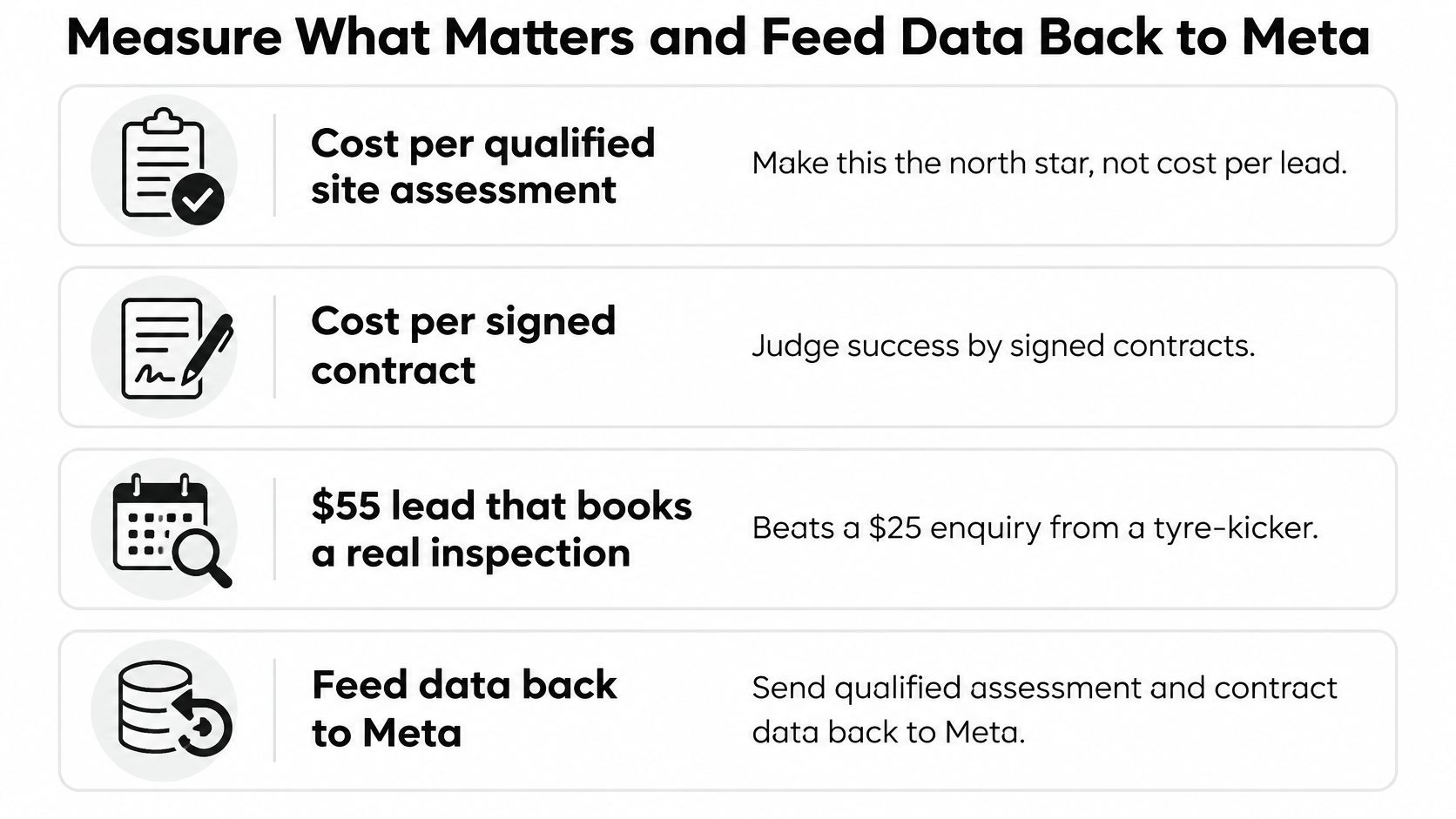
Cost per qualified site assessment is a better operating measure than cheapest form submission. A hypothetical AUD $55 enquiry that becomes a suitable inspection can be worth more than an AUD $25 contact who only wanted an unrealistic price.
Define qualified before reporting on it. For a pool builder, I'd require a serviceable address, relevant project scope, plausible budget fit and agreement to an assessment, rather than letting each salesperson apply a different definition.
Keep a commercial scorecard
Use the CRM to distinguish these outcomes:
- Cost per enquiry: Media spend divided by valid new enquiries.
- Qualified-lead rate: The share meeting your written qualification criteria.
- Cost per booked assessment: Spend divided by suitable appointments booked.
- Show-up rate: Whether the assessment happened.
- Quote-to-contract rate: How many issued quotes became signed work.
- Revenue per lead: Contract revenue associated with the enquiry cohort.
Track gross profit alongside revenue wherever possible. A large contract with difficult access and expensive delivery isn't automatically a better acquisition than a smaller, straightforward project.
The reporting priority is illustrated below.
Build a record beyond the browser
Odin Digital's Australian targeting guide reports that roughly 80% of Australian iPhone users opted out of tracking. Treat that as secondary reporting, not a measurement of your own customers, but take the operational problem seriously: platform attribution won't capture every customer journey.
Record campaign identifiers, landing-page parameters, the customer's stated source, call outcomes, quoted value and closed revenue. A homeowner might discover you through Facebook and later return directly or call after discussing the project with their partner.
Conversions API can provide another event path; it doesn't override consent choices or recover every missing conversion. Deduplicate matching browser and server events, and verify that any offline outcome sent to Meta reflects a real CRM status.
If you're evaluating waste, you can compare Meta ad spend audits through NotFair. Compare the findings with qualified appointments and contracts, rather than accepting a dashboard's waste classification without checking the underlying enquiries.
Use call tracking without losing the human handoff
For a custom phone workflow, I'd configure a Twilio number for campaign attribution and connect it to the CRM. CallRail and GoHighLevel are also options to evaluate, depending on whether call attribution or a broader CRM workflow is the priority.
A Twilio number alone isn't an AI receptionist. Round-the-clock answering requires an answering application, routing rules, a booking integration and testing.
An AI receptionist can be configured for 24-hour availability, without staff fatigue or sick leave, and to book into a calendar or Calendly. It still needs reliable infrastructure, clear disclosure, escalation rules and safeguards against inventing prices or availability.
That approach can be relevant to tradies, hairdressers, beauty therapists, dentists, restaurants and doctors, but healthcare enquiries need particularly careful privacy and escalation design. Preventing missed calls may protect valuable bookings; claims about saving thousands need the business's own evidence.
Forms should explain why details are collected, link to a privacy policy and separate enquiry handling from optional promotional SMS and email. Review Australian privacy and spam obligations before uploading customer lists or expanding automated messaging.
Launch Campaigns and Test Creative
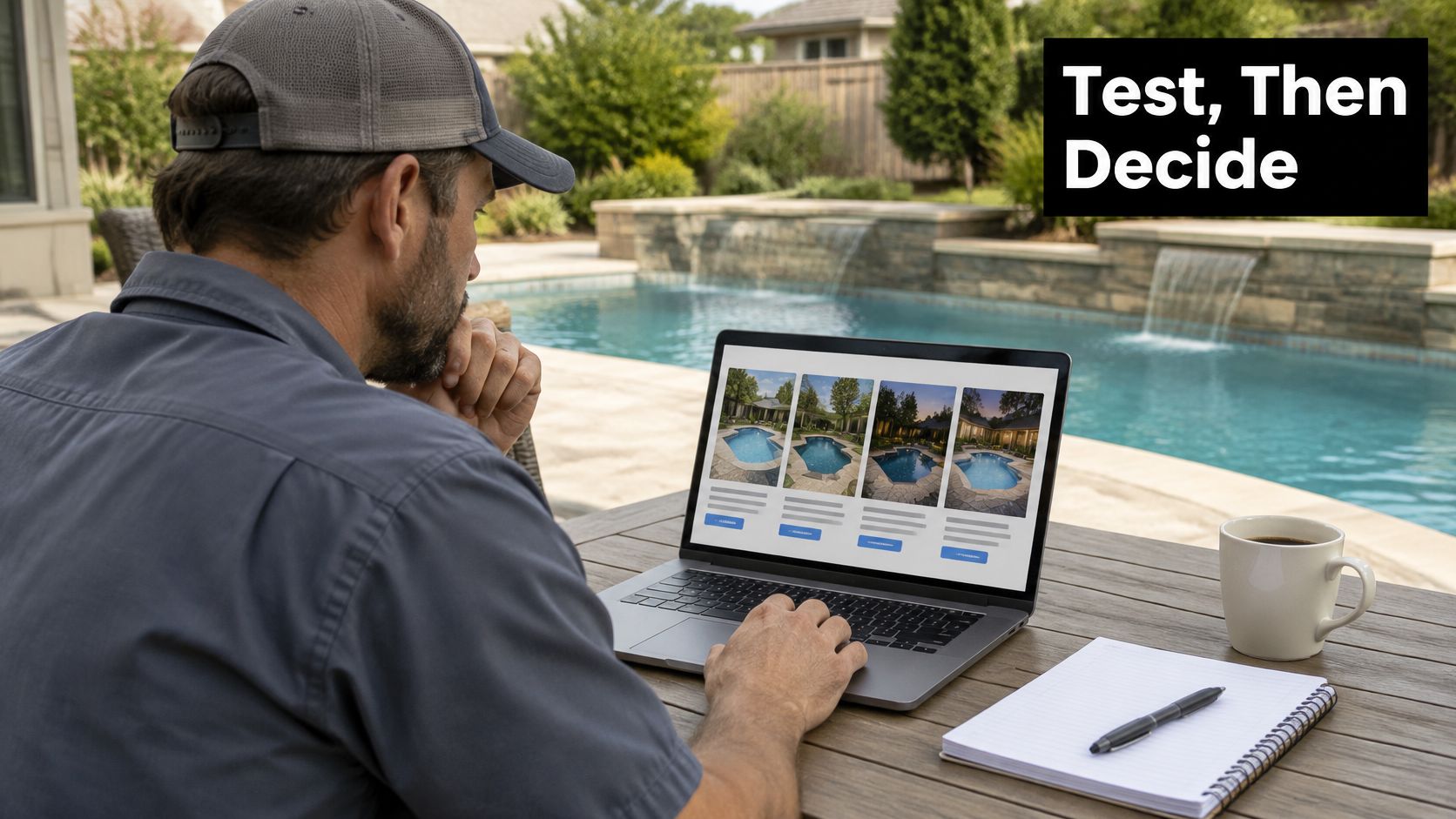
Launch with a test you can interpret, not a folder full of unrelated ads. I would begin with three to five creative variants built around a defined offer and a consistent qualification process.
A real project discussion is stronger material than a generic lifestyle image.
Test a proposition, not just a colour
Before publishing, confirm the offer, service suburbs, form destination, acknowledgement, phone routing and CRM owner. Submit a test lead from a real device and confirm the record arrives with the information your team needs.
Useful creative directions include:
- Pool reveal: Open with the completed backyard, then explain the original problem.
- Before-and-after carousel: Keep the viewpoint comparable so the change is understandable.
- Owner-to-camera explanation: Address access, project scope or what happens during an assessment.
- Package-price static: Use only an accurate price with visible inclusions and exclusions.
- Construction timelapse: Explain the process without implying every site follows the same schedule.
My starting production brief would use a hook in the opening three seconds and short, roughly 15-30-second videos. Those are testing recommendations, not rules that guarantee delivery or sales.
I'd schedule an initial creative review around day 14, rather than declaring failure after 48 hours. Pause obvious technical failures immediately, but don't automatically delete an ad with limited spend and no meaningful sample.
Keep a control when introducing a new variant. Change the opening, proposition or proof deliberately so the result tells you something useful.
The accompanying video can be viewed below.
Worked scenarios, not client results
Scenario A is a hypothetical fibreglass builder in Melbourne's south-east spending AUD $3,000 during a spring month. Suppose the campaign produces 62 leads, 18 qualified prospects, 11 site visits and four signed contracts.
That is approximately AUD $48.39 per lead, a 29% qualification rate, AUD $272.73 per site visit and AUD $750 in media spend per signed contract. At an assumed AUD $70,000 per contract, signed contract value totals AUD $280,000, not profit or necessarily collected revenue.
Scenario B is a hypothetical resurfacing crew offering a pre-summer pool health check. If it spends AUD $930 for 30 leads at AUD $31 each and books six suitable quotes, the cost per booked quote is AUD $155.
Neither scenario establishes a benchmark. They demonstrate why the estimator's diary and CRM outcomes matter more than an attractive lead-cost screenshot.
Royal Life Saving WA's aquatic infrastructure material concerns public aquatic facilities, not private-pool advertising conversion rates. Don't use broader swimming participation as evidence that a local construction campaign will sell.
Keep the ad that produces commercially suitable assessments, even when another ad wins the cheapest-lead contest.
Run It Yourself or Hire Help
I would consider outside help when monthly media spend reaches AUD $3,000 and nobody has clear responsibility for testing, measurement and follow-up. That's a decision rule, not an industry threshold, and hiring an agency won't repair an unattended sales process by itself.
With a smaller budget, a tightly controlled DIY campaign can be sensible. Keep the offer narrow, record every enquiry outcome and fund a test you can afford without depending on immediate contracts.
Buy accountability, not dashboard access
When comparing a Facebook ads agency, establish who manages the account, what gets tested and which commercial outcomes appear in reporting. Our guides to Facebook ads for electricians and Google Ads for plumbers cover related trade-advertising decisions.
We manage Meta and Google advertising alongside WordPress development, Shopify development and conversion-focused website work. For a pool business selling equipment online as well as installations, separate purchase campaigns from consultation campaigns so each has a relevant offer and measurement model.
- Management scope: Agree on strategy, creative responsibilities, tracking and optimisation.
- Media spend: Advertising budgets are paid separately unless otherwise agreed.
- Client responsibilities: Pricing, availability, sales handling and customer service remain with the business.
Use relevant proof without assuming identical results
Kheong Yap of Natural Comfort Bedding says:
"We've been using Alpha Omega Digital for years doing our Facebook and Google ads marketing, and our business has grown in revenue to numbers we used to see back when we had 3 locations. To do these numbers from one location is excellent. Highly recommend."
That's an ecommerce customer's testimonial, not a forecast for pool construction. We don't guarantee enquiries, contracts, revenue or advertising returns.
If you're a business with a paid ads budget of at least 3k a month, I'd love to offer you a low risk deal- get a month of paid ads management FREE. Apply now through the contact page.
For a pool campaign built around qualified site assessments, visit Alpha Omega Digital to discuss Meta advertising, landing pages and CRM integration. We're based in Melbourne and service businesses in Sydney, Brisbane, Newcastle, Perth, Adelaide, Darwin and Hobart. Send your service suburbs, current monthly advertising budget and the projects you want more of through our contact page so we can recommend clear next steps.
Alpha Omega Digital
Read more insights from our team on web design, paid ads, and growth strategy.